Nature and identity with 性
性 means nature , characteristic , or sex . It refers to what is innate to a person or thing.
Etymology
This kanji is an ideogram built from 忄 (heart ) and 生 (birth ), giving the sense of what is innate or born into a thing.
Compatibility 相性 (Compatibility)
相性(あいしょう) means compatibility between people or things, whether their qualities work well together.
It combines 相 (mutual ) with 性 (nature ) to show the nature between two things (their compatibility).
Kanji Explanation: Mutuality and appearance with 相 (Future entry)
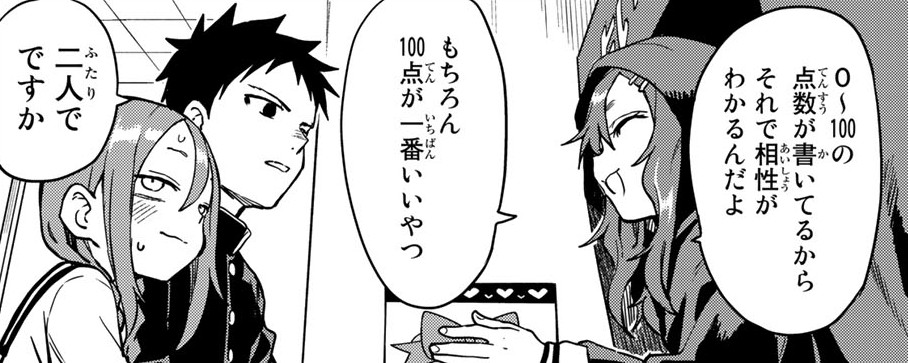
それでも歩は寄せてくる » Volume 15 » Page 17At the school festival, Ayumu and Urushi stop by the affinity fortune telling booth while Maki is on duty. Maki holds out a box with an opening on top, and says the need to pull out a single card together.
マキ: 「0〜100の点数(てんすう) が書(か) いてるからそれで相性(あいしょう) がわかるんだよ」“Your compatibility is determined by the score written from 0 to 100.”「もちろん100点(てん) が一番(いちばん) いいやつ」“” 歩(あゆむ) :「二人(ふたり) でですか?」“Together?” Challenge Yourself Show translation
Challenge
How does Maki's compatibility fortune work? Clues 0〜100の点数(てんすう) が書(か) いてるから a score from 0 to 100 is written on the card それで相性(あいしょう) がわかる "You can tell your compatibility from that score." もちろん100点(てん) が一番(いちばん) いい "Of course, 100 points is the best." What does the speaker mean? A card gives a score from 0 to 100, with 100 showing the best match. The written 点数(てんすう) measures their 相性(あいしょう) , and Maki states that 100 points is best. Each person draws a separate card, and the lower score wins. Ayumu checks that they draw together, and Maki says 100 is the best score, not the lowest. The card predicts how many years they will remain friends. The number measures 相性(あいしょう) , compatibility, not a number of years. They write their own score after answering questions. Maki says the score is already written on the card. Only a score of exactly zero reveals compatibility. The scale runs from 0 to 100, and Maki identifies 100 as the best result. The booth compares their individual shogi rankings. The score concerns how well the two people fit together, not their shogi ability.
Ayumu and Urushi draw a card together. Its number from 0 to 100 represents their 相性(あいしょう) , and a score of 100 is the best possible match.
View Full Example Gender 女性 (Woman)
女性(じょせい) means a woman or adult female.
It combines 女 (woman ) with 性 (sex ) to show the female sex .
Idiom Explanation: Having a bad experience with 〜目に遭う (Future entry)
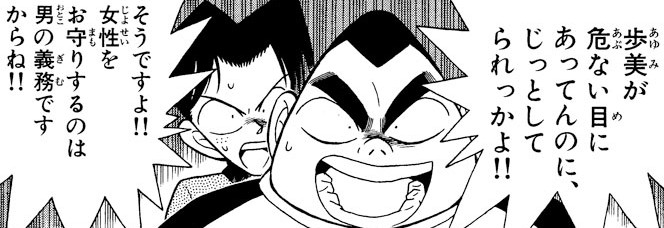
名探偵コナン » Volume 9 » Page 28During a hide-and-seek game at the park, Ayumi hides in a car trunk and falls asleep. She wakes to find the car moving and discovers a bag of money, a slimy saw, and what seems like a severed head. Conan, tracking her via their Detective Boys badges, prepares to pursue on his electric skateboard. Genta and Mitsuhiko join him on it, but Conan urges them to stay behind due to the danger.
元太(げんた) :「歩美(あゆみ) が危(あぶ) ない目(め) にあってんのに、じっとしてられっかよ!!」“Ayumi is in danger, so how can I just stand by and do nothing?” 光彦(みつひこ) :「そうですよ!! 女性(じょせい) をお守(まも) りするのは男(おとこ) の義務(ぎむ) ですからね!!」“That's right! It's a man's duty to protect women!” Challenge Yourself Show translation
Challenge
Why does Genta refuse to stay behind? Clues 歩美(あゆみ) が危(あぶ) ない目(め) にあってんのに even though Ayumi is going through something dangerous じっとしてられっかよ how could I stay still? What does the speaker mean? Ayumi is in danger, so he cannot sit still. The rhetorical じっとしてられっか rejects doing nothing while Ayumi is endangered. He thinks Ayumi has already returned safely. 危(あぶ) ない目(め) にあってんのに presents her danger as ongoing. He wants to continue the hide-and-seek game. His concern has shifted from the game to rescuing Ayumi. He believes Conan's skateboard is too slow. He does not criticize the skateboard. He insists on joining the pursuit. He has a duty to guard the park. Genta's reason is Ayumi's danger, not responsibility for the location. He wants Conan to wait while he calls the police. He rejects waiting and wants to take action immediately.
Genta says he cannot remain idle while Ayumi is in danger. 危(あぶ) ない目(め) にあう describes undergoing a dangerous experience.
View Full Example 男性 (Man)
男性(だんせい) means man or adult male.
It combines 男 (man ) with 性 (sex ) to show the male sex .
Kanji Explanation: Ability and capability with 能 (Future entry)
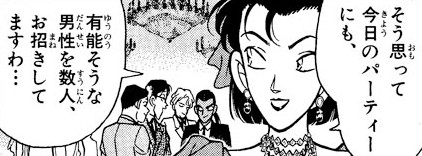
名探偵コナン » Volume 9 » Page 120Detective Mouri is invited as a special guest to the birthday party for Reika, daughter of the Yotsui Group’s chairman. At the event, Reika announces her intent to marry.
霊化(れいか) :「そう思(おも) って今日(きょう) のパーティーにも、有能(ゆうのう) そうな男性(だんせい) を数人(すうにん) 、お招(まね) きしてますわ…」“With that in mind, I've invited several promising gentlemen to today's party...” Challenge Yourself Show translation
Challenge
What kind of men has Reika invited to the party? Clues 有能(ゆうのう) そうな男性(だんせい) men who seem capable 数人(すうにん) 、お招(まね) きしてます I have invited several of them What does the speaker mean? Several men who appear capable and promising. 有能(ゆうのう) そうな describes men who give the impression of being capable. Several men she already knows are incompetent. 有能(ゆうのう) means capable, and そうな describes that appearance. Every male employee in the Yotsui Group. 数人(すうにん) means several people, not every employee. Only men who have refused to marry. The line evaluates their apparent ability, not a history of refusing marriage. Several musicians hired to perform. Reika presents the men as possible partners, not entertainers. Men who invited her to their own parties. Reika is the one who invited them to today's party.
Reika says she invited several men who look capable. 有能(ゆうのう) そうな describes her favorable impression rather than proven knowledge of their ability.
View Full Example 異性 (Opposite sex)
異性(いせい) means the opposite sex or a person of a different sex from oneself.
It combines 異 (other ) with 性 (sex ) to show the other sex .
Kanji Explanation: Difference and strangeness with 異 (Future entry)
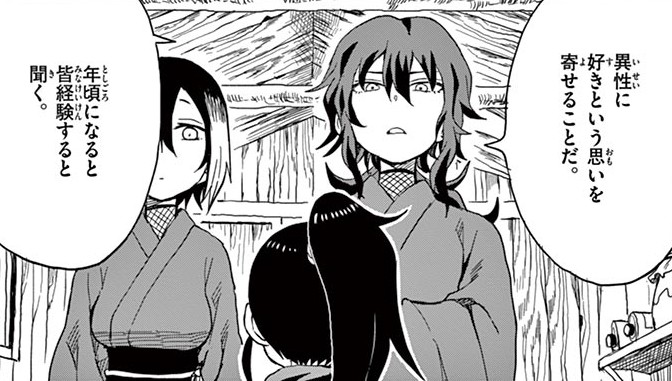
くノ一ツバキの胸の内 » Volume 2 » Page 41During a ninja training exercise, Tsubaki disguises herself as the teacher’s assistant in the hope of getting close enough to take the teacher’s mask. When the teacher unknowingly reveals that keeping boys and girls separate has been aided by lying to the female ninjas about men being scary, Tsubaki accidentally drops her disguise. The teacher has no choice but to take Tsubaki into her confidence and explain the reason for the separation, starting with the word “love”, of which Tsubaki is unfamiliar.
ハナ先生(せんせい) : 「異性(いせい) に好(す) きという思(おも) いを寄(よ) せることだ。」“It means harboring feelings of affection for someone of the opposite sex.”「年頃(としごろ) になると皆(みな) 経験(けいけん) すると聞(き) く。」“I hear that everyone goes through this when they reach a certain age.” Challenge Yourself Show translation
Challenge
How does Hana-sensei define love? Clues 異性(いせい) に marks people of the opposite sex as the target of the feelings 好(す) きという思(おも) いを寄(よ) せることだ "It is to harbor feelings called liking or affection." 年頃(としごろ) になると皆(みな) 経験(けいけん) すると聞(き) く she has heard that everyone experiences it when they reach a certain age What does the speaker mean? Harboring feelings of affection for someone of the opposite sex. 異性(いせい) に marks the target, and 好(す) きという思(おも) いを寄(よ) せる describes directing affectionate feelings toward that person. Being admired by someone of the opposite sex. The person with the feelings is the understood subject. 異性(いせい) に marks where those feelings are directed, not who sends them. Becoming friends with every person of the opposite sex. Hana-sensei defines an affectionate feeling, not friendship or a duty involving everyone. Feeling afraid whenever someone mentions men. Fear is part of the lie told to the students. The definition uses 好(す) き, feelings of liking. Reaching the age when ninja training becomes difficult. 年頃(としごろ) になると refers to an age when people experience love, not difficulty in training. Hearing stories about affection without experiencing it. Hana-sensei says she has heard that everyone experiences love. Hearsay is the source of her claim, not the definition itself.
Hana-sensei defines love as directing 好(す) きという思(おも) い toward the 異性(いせい) , someone of the opposite sex. She adds that she has heard people experience it when they reach a certain age.
View Full Example Qualities 性能 (Performance)
性能(せいのう) means the performance or capability of a machine or product.
It combines 性 (nature ) with 能 (ability ) to show inherent capability or performance characteristics.
Kanji Explanation: Ability and capability with 能 (Future entry)
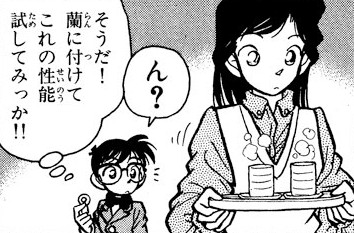
名探偵コナン » Volume 2 » Page 57Professor Agasa gives Conan a tracking device. He eagerly looks for an opportunity to see how it works.
コナン: 「そうだ!蘭(らん) に付(つ) けてこれの性能(せいのう) 試(ため) してみっか!!」“I know! I'll stick it on Ran and see how it performs!!” Challenge Yourself Show translation
Challenge
蘭(らん) に付(つ) けて attach it to Ran これの性能(せいのう) 試(ため) してみっか maybe I will try testing its performance What does the speaker mean? Attach it to Ran and see how well it works. 蘭(らん) に付(つ) けて states where he will put it before testing its 性能(せいのう) . Ask Ran to take the device apart. 付(つ) ける means attach it, not dismantle it. Hide it from Ran without turning it on. His goal is to test its performance, which requires using it. Give it back to Agasa for repairs. Conan eagerly wants to try the new device himself. Use it to measure Ran's physical strength. The device tracks location. 性能(せいのう) refers to how well that function works. Attach it to himself so Ran can find him. The person marked by に is Ran.
Conan decides to attach the tracker to Ran and try out its performance. 試(ため) してみっか is his rough, casual way of proposing the test to himself.
View Full Example