Negation and lack with 不
The kanji 不 functions as a marker of not , non- , and lack . In compounds it usually negates or reverses the meaning of the following element, creating words for absence, impossibility, defect, or insufficiency.
Limits and Inability
不可能 (Impossible)不可能( ふかのう ) means impossible or unable to be done.
It combines 不 (not ) with 可能 (possible ) to show the absence of possibility .
Example 1 of 2: Hidden behind the short hand with 短針 Example 1 of 2
怪盗セイント・テール »
Volume 1 » Page 54
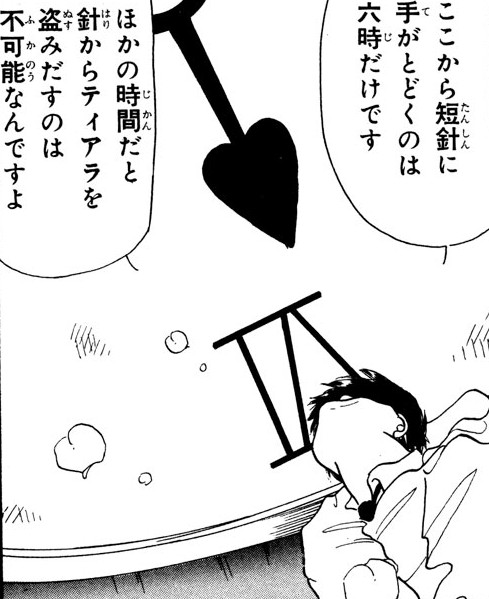
Asuka Jr. is tasked with guarding a jeweled tiara, which Saint Tail has stated her intention to steal. The owner tells Asuka Jr. it’s been hidden behind the short hand on a clock tower, so Asuka Jr. waits below the face of the clock for Saint Tail’s arrival. He tells the owner that Saint Tail will likely arrive precisely at 6 o’clock.
アスカ Jr.:
「ここから短針( たんしん ) に手( て ) がとどくのは六( ろく ) 時( じ ) だけです」
“The hour hand is only within reach from here at six o'clock.”
「ほかの時間( じかん ) と針( はり ) からティアラを盗( ぬす ) みだすのは不可能( ふかのう )
“At any other time, it would be impossible to steal the tiara from the hand, you see.”
Challenge Yourself
Show translation
Challenge
What does Asuka Jr. say about reaching the hour hand from here?
Clues
手( て ) がとどくto be within reach
六( ろく ) 時( じ ) だけonly at six o'clock
What does the speaker mean?
The hour hand is within reach only at six o'clock.
六( ろく ) 時( じ ) だけ identifies the only time when 手( て ) がとどく is true.
The hour hand stays within reach until six o'clock.
だけ means "only". The line would need まで to express "until six o'clock".
The hour hand is within reach for six hours.
六( ろく ) 時( じ ) means six o'clock. A duration of six hours would be 六時間( ろくじかん ) .
ここから sets the viewpoint to “from here”. The clause ending in のは introduces what Asuka Jr. is discussing, and 六( ろく ) 時( じ ) だけです identifies six o’clock as the only time the hour hand is within reach.
View Full Example
Example 2 of 2: Indiscriminate murder would be one thing if with 〜ならともかく Example 2 of 2
名探偵コナン »
Volume 5 » Page 110
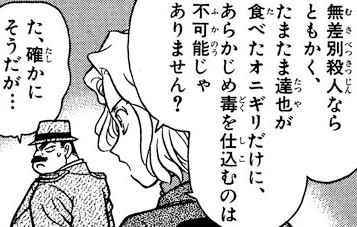
Sonoko is invited to a band’s after party. During the get-together, the band’s singer Tatsuya eats a rice ball only to collapse and die. The police are called in, and Inspector Megure discovers the victim was poisoned. He accuses the man who prepared the food, but Conan bites into a rice ball to show it’s safe. The victim’s manager, Mari, agrees.
麻理( まり ) :「無差別( むさべつ ) 殺人( さつじん ) ならともかく、たまたま達也( たつや ) が食( た ) べたオニギリだけに、あらかじめ毒( どく ) を仕込( しこ ) むのは不可能( ふかのう )
“If it were indiscriminate murder, that's one thing but since it was just the rice ball Tatsuya happened to eat, wouldn't it be impossible to poison it beforehand?”
目暮( めぐれ ) :「た、確( たし ) かにそうだが…」
“Th-that's true.”
Challenge Yourself
Show translation
Challenge
Why does Mari say the rice ball could not have been poisoned beforehand?
Clues
無差別( むさべつ ) 殺人( さつじん ) ならともかくindiscriminate murder would be one thing
たまたま達也( たつや ) が食( た ) べたオニギリだけ
only the rice ball Tatsuya happened to eat
What does the speaker mean?
Nobody could predict which rice ball Tatsuya would happen to choose.
たまたま and だけ make the targeted choice too specific to arrange blindly in advance.
Every rice ball had already been tested and found safe.
Mari argues from the unpredictability of Tatsuya's choice, not from laboratory testing.
Tatsuya prepared all of the rice balls himself.
The line does not say who prepared every rice ball. It focuses on which one he happened to eat.
The poison could only work in a drink.
Mari questions how poison could be placed in the chosen rice ball, not whether food can carry it.
The poison was added after Tatsuya ate.
She discusses whether it could have been planted beforehand.
An indiscriminate poisoning would also have been impossible.
〜ならともかく treats indiscriminate murder as the more imaginable case.
Mari contrasts an indiscriminate attack with the precise poisoning of the one rice ball Tatsuya happened to eat. Without knowing his choice, planting the poison beforehand seems impossible.
View Full Example
Negative States
不安 (Anxiety)不安( ふあん ) means anxiety or unease, often a vague fear that something may go wrong.
It combines 不 (not ) with 安 (peaceful ) to show a lack of ease .
ふらいんぐうぃっち »
Volume 5 » Page 49
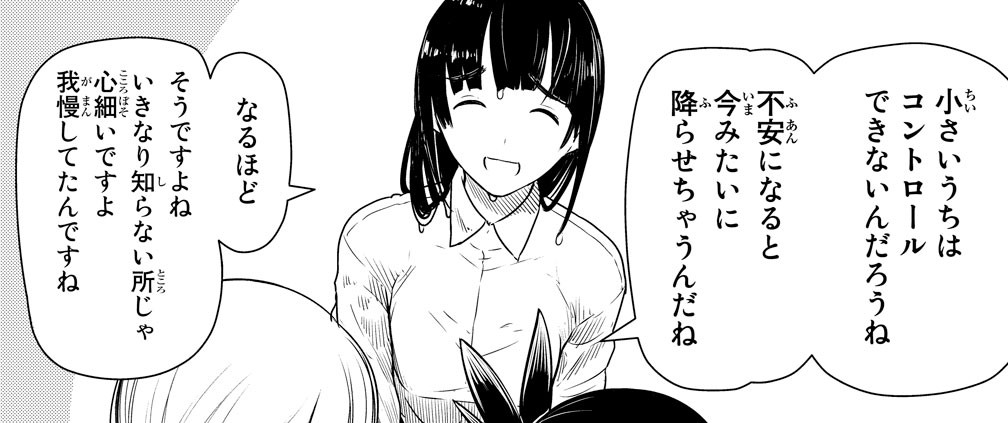
During a visit with Anzu’s family, Makoto receives a request to babysit for another witch. Things are fine at first, but after a while, rain begins to pour inside. Anzu’s mother realizes that the child they’re watching over has rain magic.
杏子( あんず ) の母( はは ) :「小( ちい ) さいうちはコントロールできないんだろうね。不安( ふあん ) 今( いま ) みたいに降( ふ ) らせちゃうんだね」
“You don't have control while you're small, right? When he's uneasy, it pours like just now.”
真琴( まこと ) :「なるほど。そうですよね。いきなり知( し ) らない所( ところ ) じゃ心細( こころぼそ ) いですよ。我慢( がまん ) してたんですね」
“I see. So that's it. It's a little scary suddenly being in a place you don't know. You've been patient, haven't you?”
Challenge Yourself
Show translation
Challenge
What does Anzu's mother infer about the child's rain magic?
Clues
小( ちい ) さいうちはコントロールできないthe child cannot control it while still young
不安( ふあん ) になると今( いま ) みたいに降( ふ ) らせちゃうwhen the child feels uneasy, the magic unintentionally makes it rain
What does the speaker mean?
The child cannot control it yet and causes rain when uneasy.
小( ちい ) さいうちは limits the lack of control to childhood, and 不安( ふあん ) になると gives the trigger for the rain.
The child deliberately makes it rain whenever visitors arrive.
降( ふ ) らせちゃう presents the rain as an unintended result, not a deliberate greeting.
The magic works only when the child feels calm.
The stated trigger is 不安( ふあん ) になる, becoming uneasy, not relaxing.
The child has already learned to stop the rain at will.
コントロールできない says the child cannot yet control the magic.
Rain magic disappears permanently after childhood.
The temporary stage concerns control while young. The line does not say the magic itself will disappear.
The rain comes from an unfamiliar place, not from the child.
The mother connects the child's unease directly to making it rain like it is now.
Anzu’s mother concludes that the child is still too young to control the rain magic. Anxiety triggers it, so the unfamiliar setting has caused the child to make rain fall indoors without meaning to.
View Full Example
不良 (Defect)不良( ふりょう ) means defective or in poor condition. As a noun, it can mean a delinquent.
It combines 不 (not ) with 良 (good ) to show what is not good .
ふだつきのキョーコちゃん »
Volume 3 » Page 167
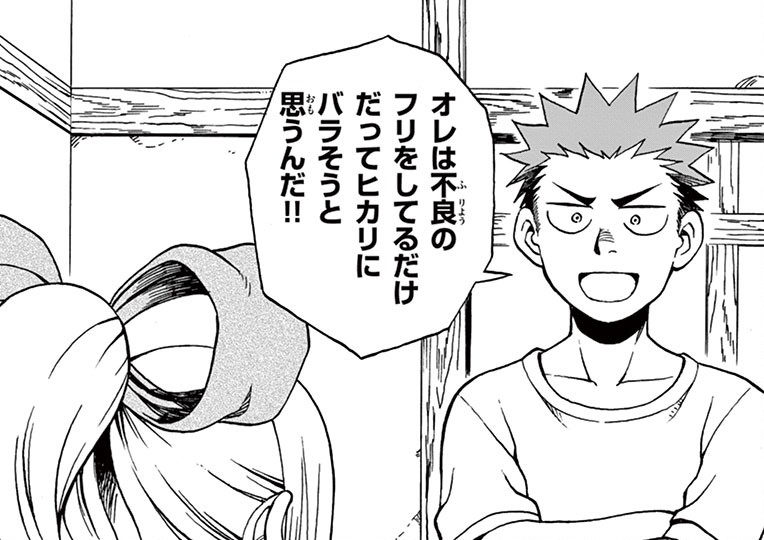
Kenji thinks Kyouko is upset because he and Hikari don’t get along well.
ケンジ:
「オレは不良( ふりょう ) 思( おも ) うんだ!!」
“I think I will reveal to Hikari that I'm just pretending to be a delinquent!”
Challenge Yourself
Show translation
Challenge
What does Kenji intend to tell Hikari?
Clues
オレは不良( ふりょう ) のフリをしてるだけだ
he is only pretending to be a delinquent
ヒカリにバラそうと思( おも ) う
he intends to reveal that secret to Hikari
What does the speaker mean?
He is only pretending to be a delinquent.
不良( ふりょう ) のフリをしてるだけ states the secret, and バラそうと思( おも ) う marks his intention to reveal it.
He plans to become a real delinquent.
フリ says his delinquent image is an act. Kenji plans to explain the pretense, not make it real.
Kyouko asked him to avoid Hikari.
The quoted content concerns Kenji's false delinquent persona. It does not report a request from Kyouko.
He has already told Hikari the whole truth.
バラそうと思( おも ) う expresses a current intention, so the revelation has not happened yet.
Hikari is pretending not to recognize him.
オレ is the topic of the pretense. Kenji says that he himself acts like a delinquent.
He wants Hikari to pretend to be a delinquent too.
ヒカリに marks the person he will tell. It does not make Hikari the person doing the pretending.
Kenji plans to tell Hikari that his delinquent behavior is only an act. バラそうと思( おも ) う expresses his intention to reveal the secret, while だけ limits the truth to mere pretense.
View Full Example
不幸 (Misfortune)不幸( ふこう ) means misfortune, unhappiness, or an unfortunate circumstance.
It combines 不 (not ) with 幸 (fortune ) to show the absence of good fortune .
ご注文はうさぎですか? »
Volume 1 » Page 100
Cocoa did fortune telling for her friends, only for all their fortunes to happen to her in a bad way.
チノ:
「ココアさんは人( ひと ) の不幸( ふこう ) 身代( みが ) わりになる才能( さいのう ) があるんですか?」
“Cocoa, do you have a talent for taking on other people's misfortune?”
リゼ:
「今後( こんご ) 占( うらな ) いやめた方( ほう ) がいいぞ自分( じぶん ) のために」
“For your own sake, you had better stop fortune telling from now on.”
ココア:
「なんで!?」
“Why!?”
Challenge Yourself
Show translation
Challenge
What does リゼ mean in the highlighted line?
Clues
占( うらな ) いやめた方( ほう ) がいい(占:うらな)いやめた(方:ほう)がいい advises Cocoa to stop
What does the speaker mean?
For your own sake, you had better stop fortune telling from now on.
Rize recommends giving up fortune telling after its predictions have caused Cocoa trouble.
Rize advises Cocoa to keep telling fortunes from now on.
The highlighted form is 占( うらな ) いやめた方( ほう ) がいい. Here 占( うらな ) いやめた方( ほう ) がいい advises Cocoa to stop, so this choice does not match the Japanese.
Rize says Cocoa has already stopped fortune-telling.
The highlighted form is 占( うらな ) いやめた方( ほう ) がいい. Here 占( うらな ) いやめた方( ほう ) がいい advises Cocoa to stop, so this choice does not match the Japanese.
Rize tells Chino to give up fortune-telling for Cocoa's sake.
The highlighted form is 占( うらな ) いやめた方( ほう ) がいい. Here 占( うらな ) いやめた方( ほう ) がいい advises Cocoa to stop, so this choice does not match the Japanese.
占( うらな ) いやめた方( ほう ) がいい advises Cocoa to stop. Rize recommends giving up fortune telling after its predictions have caused Cocoa trouble.
View Full Example
不自然 (Unnatural)不自然( ふしぜん ) means unnatural, awkward, or contrived.
It combines 不 (not ) with 自然 (natural ) to show what is not natural .
名探偵コナン »
Volume 12 » Page 20
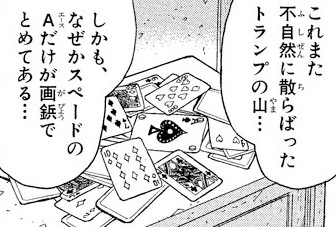
The Detective Boys group visits a cabin where Professor Agasa has secretly set out clues leading to a treasure. Conan draws the group’s attention to an arrow pointing to a table, on top of which there is…
コナン:
「これまた不自然( ふしぜん ) 散( ち ) らばったトランプの山( やま ) …」
“A pile of cards, rather unnaturally scattered about.”
「しかも、なぜかスペードのAだけが画鋲( がびょう ) でとめてある…」
“Further, for some reason, only the ace of spades is pinned down with thumbtacks...”
Challenge Yourself
Show translation
Challenge
What unusual detail does Conan notice about the cards?
Clues
スペードのAだけが
only the ace of spades
画鋲( がびょう ) でとめてあるhas been fastened with thumbtacks
What does the speaker mean?
Only the ace of spades is pinned down.
だけ singles out the ace of spades as the one card fastened with thumbtacks.
Every card is pinned to the table.
だけ limits the pinned card to the ace of spades.
The ace of spades is missing from the pile.
Conan can see it and notes that it has been pinned down.
Only the spade cards are arranged in order.
The line identifies one card, not the entire spade suit.
The cards have been scattered by the wind.
Conan calls the arrangement unnatural and focuses on the deliberately fixed card.
A thumbtack is hidden beneath every ace.
The thumbtacks are used to fasten only the ace of spades.
The pile is scattered unnaturally, and only the ace of spades has been fixed in place with thumbtacks. だけ marks that card as the exception.
View Full Example
States of Uncertainty
不思議 (Mystery)不思議( ふしぎ ) means mysterious, strange, or difficult to explain.
It combines 不 (not ) with 思議 (ordinary reasoning ) to show something beyond easy explanation .
名探偵コナン »
Volume 3 » Page 147
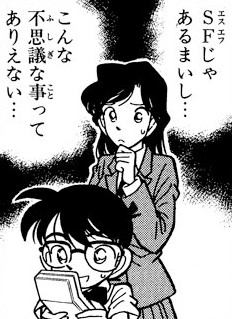
Evidence piles up for Ran that Conan, the smart young boy staying with her family, may actually be Shin’ichi, her missing childhood friend. She’s convinced that he’s Shin’ichi on the inside, but the sticking point is how he went from being a teenager to a child.
欄( らん ) :「SF( エスエフ ) じゃあるまいし…」
“It's not like this is sci-fi.”
「こんな不思議( ふしぎ ) 事( こと ) ってありえない…」
“Such an incredible thing is inconceivable...”
Challenge Yourself
Show translation
Challenge
Why does Ran reject the idea she is considering?
Clues
SF( エスエフ ) じゃあるまいしit is not as if this were science fiction
こんな不思議( ふしぎ ) な事( こと ) ってありえない
something this strange cannot happen
What does the speaker mean?
It would belong in science fiction, not ordinary reality.
Ran invokes science fiction as the sort of setting where the impossible change might make sense.
She thinks science fiction always explains real crimes.
じゃあるまいし rejects science fiction as an applicable comparison.
She has proof that Conan and Shin'ichi are unrelated.
Her objection is that the physical change seems impossible, not that she has contrary proof.
She believes the strange event happened in a movie.
She is comparing the idea to science fiction, not identifying a movie scene.
She cannot remember what Shin'ichi looks like.
The line questions whether such an impossible transformation could occur.
She thinks Conan invented the science-fiction story.
Conan is not presenting a story here. Ran is reasoning through her own suspicion.
Ran feels that the transformation she suspects is too impossible for real life. SF( エスエフ ) じゃあるまいし dismisses it as something fit for science fiction instead.
View Full Example