Oldness and antiquity with 古
The kanji 古 has the straightforward meaning of something old or from long ago.
Etymology
In its later written form, this kanji is shown as 十 over 口. Traditional explanations connect it with something passed down through many mouths across many generations, making it ancient and longstanding.
Antiquity
古代 (Ancient times)古代( こだい ) means ancient times or antiquity, especially in historical writing.
It combines 古 (old ) with 代 (generation ) to show an old age of history .
カードキャプターさくら »
Volume 3 » Page 21
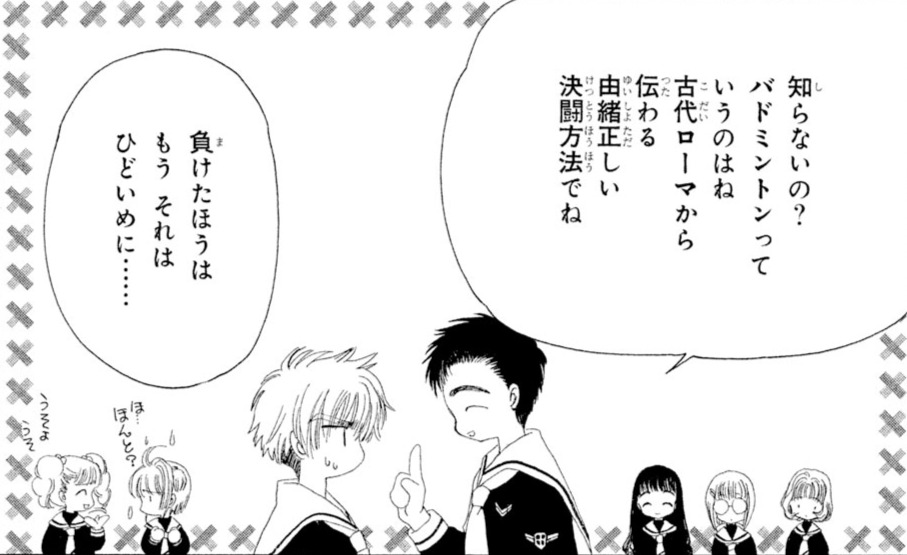
Li seems fired up over something with Sakura. Yamazaki suggests whatever the issue is be settled when they play badminton during that day’s physical education class. Li asks why things have to be settled via badminton.
山崎( やまざき ) :「知( し ) らないの?バドミントンっていうのはね 古代( こだい ) 伝( つた ) わる由緒( ゆいしょ ) 正( ただ ) しい決闘( けっとう ) 方法( ほうほう ) でね」
“You don't know? Badminton is a time-honored method of dueling that has been passed down since ancient Rome.”
「負( ま ) けたほうはもう それはひどいめに……」
“The loser suffers a truly terrible fate.”
Challenge Yourself
Show translation
Challenge
What claim does Yamazaki make about badminton?
Clues
古代( こだい ) ローマから伝( つた ) わるhanded down from Ancient Rome
由緒( ゆいしょ ) 正( ただ ) しい決闘( けっとう ) 方法( ほうほう ) a time-honored method of dueling
負( ま ) けたほうはas for the person who loses
What does the speaker mean?
It is an ancient Roman dueling method with a terrible fate for the loser.
Yamazaki links badminton to 古代( こだい ) ローマ and calls it a 由緒( ゆいしょ ) 正( ただ ) しい決闘( けっとう ) 方法( ほうほう ) , then hints at what happens to the loser.
It replaced dueling after the fall of Ancient Rome.
から伝( つた ) わる makes Ancient Rome the claimed origin. It does not place badminton after Roman dueling ended.
It was a game used to choose Roman teachers.
Yamazaki calls it a method of 決闘( けっとう ) , dueling. He says nothing about selecting teachers.
It is a modern sport that only resembles an ancient duel.
Yamazaki claims direct transmission from Ancient Rome, not a modern resemblance.
It is a safe way to avoid deciding who wins.
He explicitly mentions the person who loses and hints at a terrible consequence.
It began as a punishment for people who lost Roman duels.
Badminton itself is described as the dueling method. It is not presented as a later punishment.
Yamazaki spins badminton as a time-honored duel passed down from Ancient Rome, complete with an ominous fate for the loser. The line presents his tall tale as an explanation for settling the dispute through badminton.
View Full Example
Classical Texts
古文 (Classical Japanese)古文( こぶん ) means classical Japanese writing or literature, especially works from the Edo period or earlier. In school, it also names the study of such texts.
It combines 古 (old ) with 文 (writing ) to show old writing or a classical text.
あずまんが大王 »
Volume 1年生 » Page 34
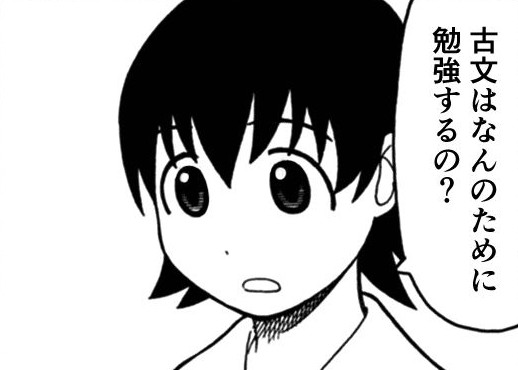
Following the a midterm exam, Yomi asks Tomo how it went.
とも:
「古文( こぶん ) 勉強( べんきょう ) するの?」
“What's the point of studying classical Japanese?”
Challenge Yourself
Show translation
Challenge
What is Tomo questioning about classical Japanese?
Clues
古文( こぶん ) はas for classical Japanese
何( なん ) のためにfor what purpose
勉強( べんきょう ) するの?why do we study it, asking for an explanation
What does the speaker mean?
She questions what purpose there is in studying it.
何( なん ) のために asks the purpose of 勉強( べんきょう ) する, with 古文( こぶん ) as the topic.
She asks when the classical Japanese exam begins.
The question uses 何( なん ) のために, not a time expression.
She asks which classical text they studied.
古文( こぶん ) names the subject as a whole. No particular text is requested.
She asks who teaches classical Japanese.
The unknown information is the purpose of studying, not the teacher's identity.
She says classical Japanese is easy to study.
Tomo asks a doubtful question about its point. She does not evaluate its difficulty.
She wonders whether her answer on the exam was correct.
The scene follows an exam, but her line asks why anyone studies the subject at all.
Tomo makes classical Japanese the topic and asks what purpose studying it serves. The final の gives the question an explanatory, doubtful tone.
View Full Example
Practice and Learning
稽古 (Practice)稽古( けいこ ) means practice or training, especially in martial arts, performing arts, and other traditional disciplines. It can also mean a lesson or training session in one of those arts.
It combines 稽 (examine ) with 古 (old ) to show practice rooted in studying established ways .
Example 1 of 2: Koto lessons with 稽古 Example 1 of 2
名探偵コナン »
Volume 6 » Page 27
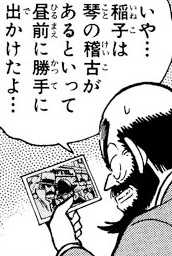
Hired to confirm whether a client’s wife is having an affair, Kogoro reveals a candid photo he took of the wife with another man.
The client mentions he let his staff take a break so they wouldn’t know about Kogoro’s visit. Kogoro asks if that includes the client’s wife.
伝次郎( でんじろう ) :「いや… 稲子( いねこ ) は琴( こと ) の稽古( けいこ ) 昼前( ひるまえ ) に勝手( かって ) に出( で ) かけたよ」
“No... Ineko said she had a koto lesson and went out on her own before noon.”
Challenge Yourself
Show translation
Challenge
What reason did Ineko give for leaving before noon?
Clues
琴( こと ) の稽古( けいこ ) があるといってsaying that she had a koto lesson
昼前( ひるまえ ) に勝手( かって ) に出( で ) かけたshe went out on her own before noon
What does the speaker mean?
She said that she had a koto lesson.
といって reports the koto lesson as the reason Ineko stated before leaving.
She said that she needed to buy a new koto.
The line names 稽古( けいこ ) , a lesson or training session, not shopping.
She left to dismiss the household staff.
Her stated destination concerns her own koto training.
She was invited to lunch by Kogoro.
She left before noon on her own, and Kogoro was visiting for the investigation.
She stayed home to practice alone.
出( で ) かけた says that she went out.
She refused to explain why she was leaving.
The speaker reports the reason she gave, whether or not it was truthful.
Ineko said she had a koto lesson and went out on her own before noon. 稽古( けいこ ) suits structured training in a traditional art.
View Full Example
Example 2 of 2: Training for a judo match with 稽古 Example 2 of 2
俺物語!! »
Volume 2 » Page 56
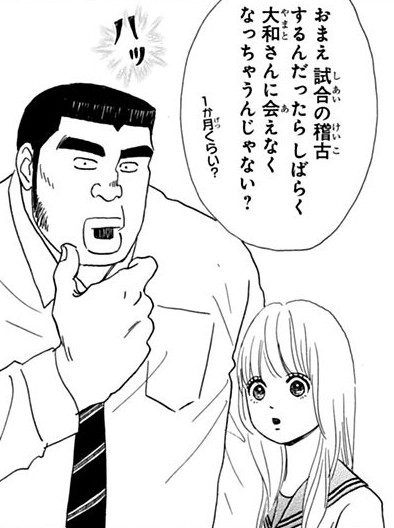
Members of the judo team plea for Takeo to help them in their upcoming match against a rival high school. Takeo quickly accepts their request, but Sunakawa considers how this will impact Takeo’s new relationship with Yamato.
砂川( すなかわ ) :「おまえ試合( しあい ) の稽古( けいこ ) 大和( やまと ) さんに会えなくなっちゃうんじゃない? 1( いっ ) か月( げつ ) くらい?」
“When you're training for the match, won't you be unable to see Yamato for a while? For about a month.”
Challenge Yourself
Show translation
Challenge
What consequence does Sunakawa warn Takeo about if he trains for the match?
Clues
試合( しあい ) の稽古( けいこ ) するんだったらif he is going to train for the match
しばらく大和( やまと ) さんに会( あ ) えなくなっちゃうんじゃない
he may end up unable to see Yamato for a while
What does the speaker mean?
He may be unable to see Yamato for about a month.
会( あ ) えなくなる means become unable to meet, and Sunakawa estimates the period as about one month.
He will have to stop seeing the judo team permanently.
The person he may not see for a while is Yamato, and the duration is temporary.
Yamato will join the judo training every day.
The line predicts less time with Yamato, not her participation in practice.
The match will be postponed for one month.
The month estimate concerns Takeo and Yamato not meeting, not the match date.
He will become unable to compete in the match.
The training creates a relationship cost. It does not remove his ability to compete.
Sunakawa will train in Takeo's place.
Sunakawa asks Takeo to consider the consequence of Takeo's own training.
Sunakawa warns that training for the judo match could leave Takeo unable to see Yamato for roughly a month. 会( あ ) えなくなっちゃう presents that as an unfortunate result.
View Full Example