Origins and main things with 本
The kanji 本 has the core meanings of root , origin , and main . Its readings are ホン and もと.
Etymology
This kanji is an ideogram built from 木 (tree) with an extra mark at the bottom to indicate the root .
Etymology Research
Kanjipedia’s account from Kadokawa’s Shinjigen classifies 本 as 指事( しじ ) , a graph that indicates a meaning by marking a location. The added line has a pointing function, so this analysis does not assign it a phonetic role. Kanjipedia
The Chinese University of Hong Kong agrees on the original meaning, the root of a plant. Its quoted Shuowen entry records 楍 as an old form. The database displays small-seal and bamboo or silk manuscript forms, but its 本 entry supplies no oracle-bone or bronze examples. This is a limit of the entry, not evidence that the character was absent from those periods. CUHK, Multi-function Chinese Character Database
CUHK cites plant roots in the Lüshi Chunqiu, a tree trunk in the Zhuangzi, and a root cause in the Guoyu. It also records a draft manuscript sense in the Nanshi. These textual examples show physical and abstract uses; they do not date every transition or prove a complete route to the modern Japanese word for a book. CUHK
Book
本屋 (Bookstore)本屋( ほんや ) means a bookstore or bookseller.
It combines 本 (book ) with 屋 (shop ) to show a shop for books .
この美術部には問題がある! »
Volume 8 » Page 94
Upon hearing Usami say she’s stopping by the school library, Uchimaki says he wants to go with, and Colette tags along.
内巻( うちまき ) :「本( ほん ) だらけだ!!」
“It's nothing but books!!”
コレット:
「本屋( ほんや )
“It's like a book store!!”
宇佐美( うさみ ) :「2人( ふたり ) とも静( しず ) かにしなさい」
“Quiet down, you two.”
Challenge Yourself
Show translation
Challenge
What surprises Uchimaki and Colette about the library?
Clues
本( ほん ) だらけだthe place is full of books or covered in books
本屋( ほんや ) さんみたいだ"It is like a bookstore," comparing the library to another book-filled place
What does the speaker mean?
The room is packed with books and looks like a bookstore.
本( ほん ) だらけ says books dominate the room, and 本屋( ほんや ) さんみたいだ reinforces that impression.
Books have been left scattered messily across the floor.
だらけ can describe a messy covering, but Colette's bookstore comparison shows that the surprise here is the sheer number of books.
The library has fewer books than a bookstore.
Their exclamations stress abundance. Nothing in either line makes a comparison about having fewer books.
They accidentally entered a bookstore instead of the library.
みたいだ marks resemblance. Colette says the library is like a bookstore, not that it actually is one.
Every book in the library is for sale.
The bookstore comparison describes how the room looks. It does not say the books can be purchased.
The library contains nothing except art books.
本( ほん ) だらけ identifies books generally. The dialogue does not limit them to art books.
Uchimaki reacts to the library as 本( ほん ) だらけ, overwhelmingly full of books. Colette makes the same point by saying it looks like a bookstore.
View Full Example
Genuine
本当 (Truth)本当( ほんとう ) means truth, real, or really.
It combines 本 (true origin ) with 当 (right / fitting ) to show what is truly right .
カードキャプターさくら »
Volume 3 » Page 158
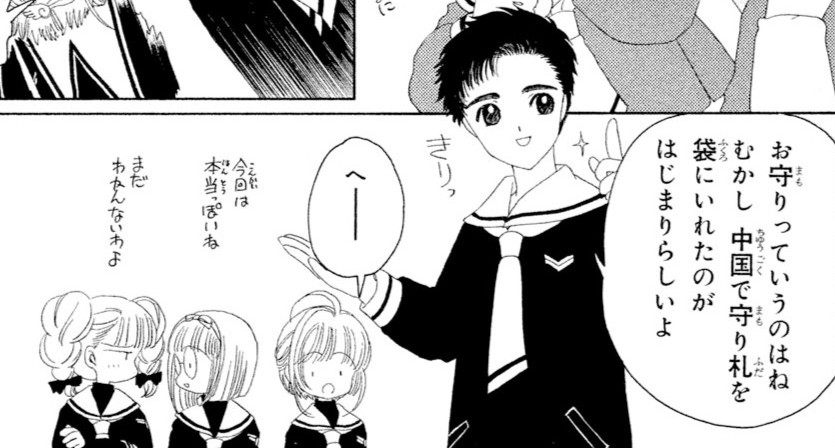
Sakura had to take a detour to get to class. She tells her friends at school about the shrine she saw along the way. Naoko says the talismans from there are popular, as they can grant wishes for things such as exams and romance.
山崎( やまざき ) :「お守( まも ) りっていうのはね むかし 中国( ちゅうごく ) で守( まも ) り札( ふだ ) を袋( ふくろ ) にいれたのがはじまりらしいよ」
“You know, apparently good-luck charms began long ago in China, when people put protective talismans into bags.”
奈緒子( なおこ ) :「今回( こんかい ) は本当( ほんとう )
“This time it sounds true, huh?”
千春( ちはる ) :「まだ わかんないわよ」
“We don't know that yet!”
Challenge Yourself
Show translation
Challenge
How does Chiharu respond to Naoko's reaction?
Clues
まだ
with a negative, something is not the case yet
わかんない
a casual contraction of わからない, meaning do not know
What does the speaker mean?
She says they still cannot tell whether the story is true.
まだわかんない leaves the truth of the story unsettled.
She says she knows the story is false.
わかんない means she does not know. She has not declared the story false.
She agrees that this story is true.
The negative わかんない challenges Naoko's reaction instead of agreeing with it.
Naoko says this story sounds true, but Chiharu replies that they do not know yet. She remains skeptical without calling it false.
View Full Example
本物 (Real thing)本物( ほんもの ) means the real thing or genuine article. It contrasts with copies, fakes, or imitations.
It combines 本 (real / original ) with 物 (thing ) to show the genuine thing .
ご注文はうさぎですか? »
Volume 1 » Page 70
Chiya and Syaro unexpectedly have to stay the night at Chino’s home.
シャロ:
「チノちゃんにパジャマ借( か ) りたのはいいけどちょっとかわいすぎない?」
“Borrowing pajamas from Chino-chan is fine, but aren't they a little too cute?”
「いつもはジャージなのに」
“Even though she usually wears a tracksuit.”
千夜( ちや ) :「本物( ほんもの ) 嬢様( じょうさま ) みたい♪」
“You look like a real young lady♪”
Challenge Yourself
Show translation
Challenge
What does シャロ mean in the highlighted line?
Clues
かわいすぎない
かわいすぎない? is a negative question about excess
What does the speaker mean?
Borrowing pajamas from Chino-chan is fine, but aren't they a little too cute?
Syaro asks whether the pajamas are too cute, inviting the others to agree with her discomfort.
Syaro complains that Chino's pajamas are not cute enough.
The highlighted form is かわいすぎない. Here かわいすぎない? is a negative question about excess, so this choice does not match the Japanese.
Syaro says she usually wears Chino's cute pajamas.
The highlighted form is かわいすぎない. Here かわいすぎない? is a negative question about excess, so this choice does not match the Japanese.
Syaro refuses the pajamas because they are the wrong size.
The highlighted form is かわいすぎない. Here かわいすぎない? is a negative question about excess, so this choice does not match the Japanese.
かわいすぎない? is a negative question about excess. Syaro asks whether the pajamas are too cute, inviting the others to agree with her discomfort.
View Full Example
本日 (Today)本日( ほんじつ ) is a formal word for today, common in announcements and customer service.
It combines 本 (this / present / main ) with 日 (day ) to show the present day .
名探偵コナン »
Volume 9 » Page 115
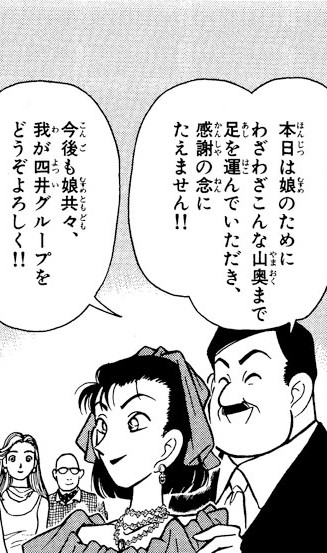
A large gathering takes place in a mansion deep in the mountains, in celebration of Reika, daughter of the head of Yotsui Group. After Reika blows out the candles on her birthday cake, her father congratulates her on turning 24, then he turns and addresses their guests.
四( よつ ) 井( い ) :「本日( ほんじつ ) 娘( むすめ ) のためにわざわざこんな山奥( やまおく ) まで足( あし ) を運( はこ ) んでいただき、感謝( かんしゃ ) の念( ねん ) にたえません!!」
“I can't thank you enough for coming all the way up here in the mountains today for my daughter!”
「今後( こんご ) も娘( むすめ ) 共々( ともども ) 、我( わ ) が四( よつ ) 井( い ) グループをどうぞよろしく!!」
“Please continue to be favorable to both my daughter and my Yotsui Group in the future!”
Challenge Yourself
Show translation
Challenge
What effort does Yotsui thank the guests for making?
Clues
わざわざこんな山奥( やまおく ) まで
going out of their way to come this deep into the mountains
足( あし ) を運( はこ ) んでいただきhonorifically, for making the trip
What does the speaker mean?
Traveling all the way to the mountain estate for his daughter.
わざわざ and 足( あし ) を運( はこ ) ぶ emphasize the trouble the guests took to come in person.
Carrying his daughter up the mountain.
足( あし ) を運( はこ ) ぶ is an idiom for visiting, not physically carrying another person.
Delivering the birthday cake themselves.
He thanks them for making the journey, not for transporting the cake.
Working for the Yotsui Group without pay.
The second line asks for their future goodwill, but the thanks concerns today's visit.
Organizing the party at their own homes.
The guests came to the estate in the mountains.
Walking instead of driving to the mansion.
The idiom does not specify the means of transportation. It means making the trip.
Yotsui thanks the guests for going out of their way to travel deep into the mountains for his daughter’s celebration. 足( あし ) を運( はこ ) ぶ means to visit in person.
View Full Example
Foundation
基本 (Basics)基本( きほん ) means the basics, fundamentals, or foundation of something.
It combines 基 (foundation ) with 本 (main / origin ) to show the main foundation .
くノ一ツバキの胸の内 »
Volume 5 » Page 120
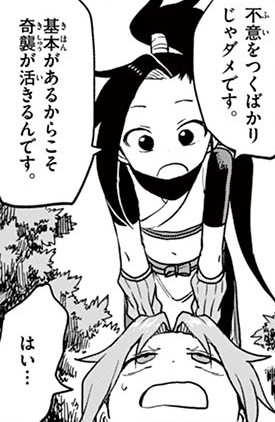
During a training session, Tsubaki quickly subdues Asagao. Sazanka uses this opportunity to launch a surprise attack, only for Tsubaki to anticipate it and take her down as well.
ツバキ:
「不意( ふい ) をつくばかりじゃダメです。」
“You can't rely just on surprise attacks.”
「基本( きほん ) 奇襲( きしゅう ) が活( い ) きるんです。」
“It's precisely from having fundamentals that surprise attacks become effective.”
サザンカ:
「はい…」
“Yeah...”
Challenge Yourself
Show translation
Challenge
According to Tsubaki, what makes surprise attacks effective?
Clues
不意( ふい ) をつくばかりじゃダメです"Relying only on surprise attacks is no good."
基本( きほん ) があるからこそ"precisely because the fundamentals are there"
奇襲( きしゅう ) が活( い ) きる"surprise attacks become effective"
What does the speaker mean?
A solid command of the fundamentals.
基本( きほん ) があるからこそ presents the fundamentals as the exact reason a surprise attack works.
Using surprise attacks as often as possible.
Tsubaki says 不意( ふい ) をつくばかりじゃダメ, relying only on surprise is no good.
Ignoring basic techniques so the attack stays unpredictable.
Her point is the opposite. Surprise tactics become useful when solid basics support them.
Waiting until an opponent stops training.
The line does not set a timing condition based on the opponent's training.
Taking an opponent down before they see any technique.
That describes a possible surprise attack, but Tsubaki asks what makes such attacks effective. Her answer is the fundamentals.
Learning a greater number of unusual techniques.
Tsubaki contrasts tricks with 基本( きほん ) , the basics. She does not call for more unusual techniques.
Tsubaki rejects reliance on surprise alone. With 基本( きほん ) があるからこそ, she says surprise attacks work precisely because the ninja has mastered the fundamentals.
View Full Example
本能 (Instinct)本能( ほんのう ) means instinct, an inborn impulse that drives behavior without conscious thought or learning.
It combines 本 (origin ) with 能 (ability ) to show innate capability .
三ツ星カラーズ »
Volume 7 » Page 20
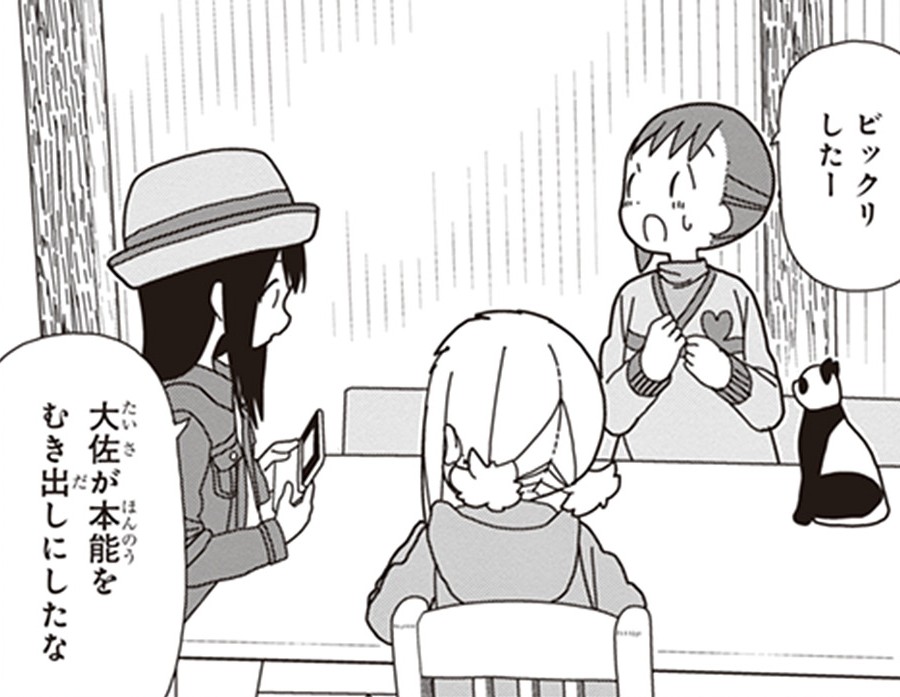
Yui and her friends are in their secret base when a pigeon flies in and lands on the table between them. The group’s cat, Colonel Monochrome, leaps after it, but the pigeon escapes.
結衣( ゆい ) :「ビックリしたー」
“That surprised me!”
琴葉( ことは ) :「大佐( たいさ ) が本能( ほんのう ) 出( だ ) しにしたな」
“The Colonel laid bare his instincts.”
Challenge Yourself
Show translation
Challenge
What does Kotoha say the Colonel's leap after the pigeon revealed?
Clues
大佐( たいさ ) が本能( ほんのう ) をむき出( だ ) しにしたthe Colonel laid his instincts bare
What does the speaker mean?
His natural hunting instincts.
本能( ほんのう ) is the instinct that the Colonel exposed when he leapt after the bird.
His fear of birds.
The Colonel pursues the pigeon, and Kotoha calls the reaction instinct rather than fear.
His ability to obey Yui's commands.
No command causes the leap. The phrase describes an inborn drive coming out.
His wish to leave the clubhouse.
The object marked by を is 本能( ほんのう ) , not a desire to leave.
His surprise at seeing the girls.
Yui is the one who says she was surprised. Kotoha comments on the cat's instinct.
His habit of sleeping on the table.
The comment follows his leap after the pigeon, not an act of sleeping.
Kotoha says the Colonel laid bare his natural instincts when he chased the pigeon. 本能( ほんのう ) is what he exposed, marked as the object by を.
View Full Example
本部 (Headquarters)本部( ほんぶ ) means the headquarters or central governing office of an organization.
It combines 本 (main ) with 部 (department ) to show the main department .
ARIA The MASTERPIECE »
Volume 3 » Page 286
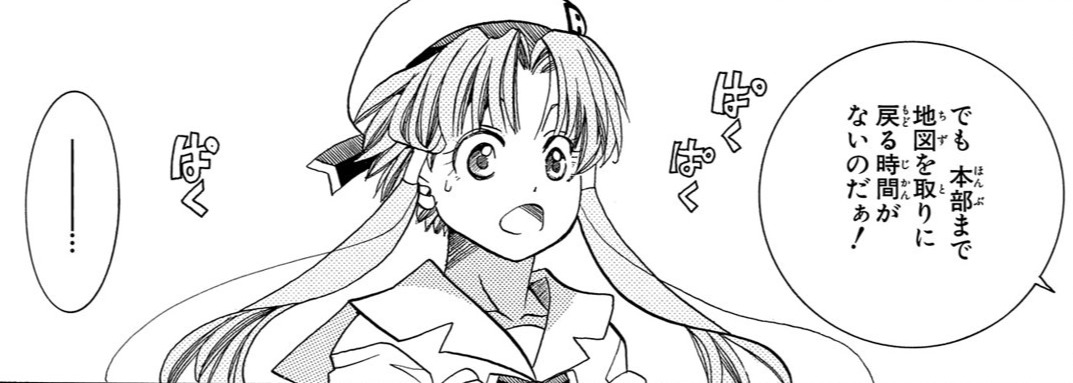
Akari encounters Woody while he’s out on a delivery run. He stopped to show off for some kids, but in the process, he seems to have lost his city map, and he has a terrible sense of direction. Akari asks if he has the delivery addresses, which he says he does.
ウッディー:
「でも 本部( ほんぶ ) 地図( ちず ) を取( と ) りに戻( もど ) る時間( じかん ) がないのだぁ!」
“But I don't have time to go back to headquarters to get a map!!”
View Full Example