Patterns and writing with 文
The kanji 文 has several connected senses: decorative patterning, characters and words, composed text, books and records, learning and the arts, and historical units of money or footwear size.
- Grade 1
- JLPT N4 (estimate)
- WaniKani level 2
- 4 strokes
Words with 文
- Texts and Letters
- 文句 もんく Complaint
- 文章 ぶんしょう Writing
- 論文 ろんぶん Paper
- 古文 こぶん Classical Japanese
- 恋文 こいぶみ Love letter
- 文法 ぶんぽう Grammar
- Culture and Learning
- 文化 ぶんか Culture
- 文明 ぶんめい Civilization
- 文学 ぶんがく Literature
- 天文台 てんもんだい Observatory
- 文学部 ぶんがくぶ Literature department
- Characters
- Books and Records
- 文庫 ぶんこ Paperback collection
- 文献 ぶんけん Literature
The bold kana are the part 文 contributes. Words in a dashed box have no manga example yet.
How to Read 文
ぶん in most compounds. もん turns up in a smaller set that includes 文句, 注文, and 呪文. The sense does not predict which one a word takes, so learn the reading with each word.
恋文 holds the native word ふみ, voiced to ぶみ. 文字 is read as a whole.
Etymology
Etymology Research
Oracle-bone and bronze forms show an upright human figure with a chest motif. CUHK records heart-shaped, crossed, and dotted markings. Some early forms omit the internal mark; Warring States bamboo forms and small-seal forms continue that simpler outline. These variants give better evidence for the older shape than a breakdown of the modern strokes. CUHK, 文
Kanjipedia classifies 文 as a pictogram. Under this account, the figure and marking belong to one image; the character has no separately identified phonetic component. Kanjipedia, 文
CUHK treats tattooing as the original meaning. Its cited oracle-bone inscriptions use 文 in personal names, place names, and the royal designation 文武丁. Bronze inscriptions also use it to praise ancestors and in the name of King Wen of Zhou. These attested uses already extend beyond literal body marking. CUHK, 文
Xu Shen’s Shuowen describes intersecting markings. CUHK proposes an extension through signs to writing and cites a Warring States bamboo text using 文 for composed text. This account connects the senses without dating every step. CUHK, 文
Japanese ふみ denotes written works or letters. The character’s Chinese formation explains the written symbol; it does not establish the origin of that Japanese word. Shogakukan’s Seisenban Nihon Kokugo Daijiten, 文
Texts and Letters
古文 (こぶん) (Classical Japanese)
古文 means classical Japanese writing or literature, especially works from the Edo period or earlier. In school, it also names the study of such texts.
It combines 古 (old) with 文 (writing) to show old writing or a classical text.
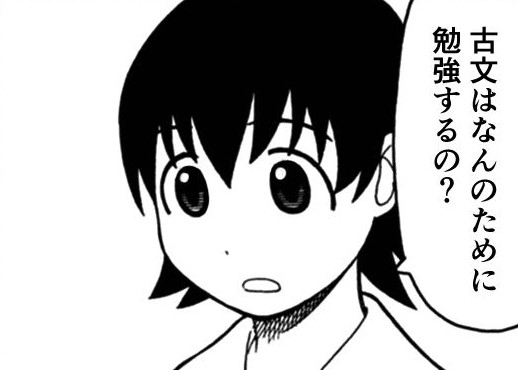
Following a midterm exam, Yomi asks Tomo how it went.
- とも:
- 「古文はなんのために勉強するの?」
- “What's the point of studying classical Japanese?”
文法 (ぶんぽう) (Grammar)
文法 is grammar, the rules for how words combine into sentences in a language.
It combines 文 (sentence) with 法 (rule) to show the rules of sentences.
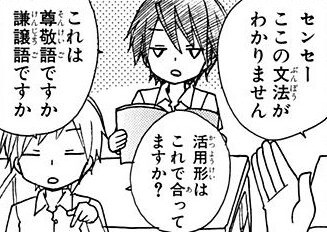
Students ask their teacher, Mittan, how long she has gone without a boyfriend. Mittan declares it top secret and tells them the only thing they may ask their teacher about is their studies.
- 生徒:
- 「センセー ここの文法がわかりません」
- “Miss, I don't understand the grammar here.”
- 淳平:
- 「活用形はこれで合ってますか?」
- “Is this the right conjugation?”
- 結心:
- 「これは尊敬語ですか謙譲語ですか」
- “Is this honorific language or humble language?”
Culture and Learning
天文台 (てんもんだい) (Observatory)
天文台 is a facility where celestial bodies (such as stars, the moon, and galaxies) and cosmic phenomena are observed and studied using instruments such as telescopes.
It combines 天文 (astronomy) with 台 (platform, stand) to show a platform for observing the heavens.
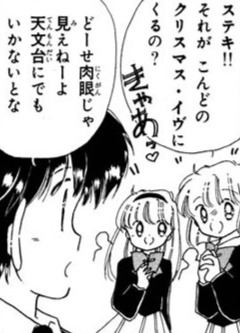
Before class, Asuka Jr. mentions a Graham Comet, which passes near the Earth once every fifty years.
- 涼子:
- 「ステキ!! それが こんどのクリスマス・イヴにくるの?」
- “Awesome!! Is it coming this Christmas Eve?”
- アスカ Jr.:
- 「どーせ肉眼じゃ見えねーよ。天文台にでもいかないとな」
- “You won't be able to see it with the naked eye anyway. You'd have to go to an observatory or something.”
文学部 (ぶんがくぶ) (Literature department)
文学部 is a university’s faculty or department of literature, which often covers the humanities in general.
It combines 文学 (literature) with 部 (department) to show the department of literature.
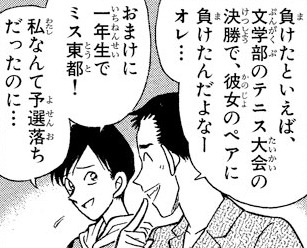
Kogoro, Ran, Sonoko, and Conan are guests at a villa where a university mystery club is celebrating member Asami’s birthday. The club’s vice president adds that the party also honors Asami’s novel, which just won a newcomer award. Morimoto, whose own story reached the final round of judging, says he can’t complain about losing to the club’s rising star.
- 野口:
- 「負けたといえば、文学部のテニス大会の決勝で、彼女のペアに負けたんだよなーオレ…」
- “Speaking of losing, I lost to her doubles team in the final of the literature department's tennis tournament...”
- 宮崎:
- 「おまけに一年生でミス東都!私なんて予選落ちだったのに…」
- “On top of that, she was Miss Toto as a freshman! I didn't even make it past the preliminaries...”
Characters
文字 (もじ) (Letters)
文字 means a letter, character, or piece of written text.
It combines 文 (writing / pattern) with 字 (character) to show written characters.
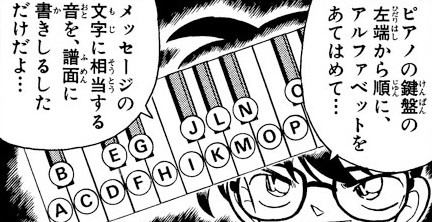
Following a series of murders, Conan discovers a message hidden in sheet music. He explains it to Ran.
- コナン:
- 「ピアノの鍵盤の左端から順に、アルファベットをあてはめて…」
- “Starting from the leftmost key on the piano keyboard, I assigned each key a letter...”
- 「メッセージの文字に相当する音を、譜面に書きしるしただけだよ…」
- “I simply wrote down the notes corresponding to the letters of the message on the sheet music...”
Building Bigger Words
These patterns come up again and again in manga. Learn the pattern and you can read words you've never seen.
文〜 ぶん (writing, letters)
- 文化祭 ぶんかさい school culture festival
- 文系 ぶんけい the humanities track
- 文通 ぶんつう exchanging letters
- 文面 ぶんめん the wording of a letter
〜文 ぶん (a piece of writing)
- 作文 さくぶん school composition
- 反省文 はんせいぶん written apology
〜文 もん
- 注文 ちゅうもん an order
- 呪文 じゅもん magic spell
Where 文 Breaks the Pattern
The meaning above carries you through most words. These are the ones where it won't, or where the reading is a surprise.
- 文字通り (もじどおり) literally
Built on 文字, so 文 has no reading of its own here.
Check Yourself
What does 文 mean?
Patterns and writing.
Read These Without Furigana
古文
文法
天文台
文学部
文字
Work Out a New Word
文化 is on this page, and 祭 is a festival. Read 文化祭 in this line. What does the speaker want to settle?
「文化祭で3組が何をするか決めたいです!」
Show the answer
文化祭, the school culture festival. “I’d like to decide what Class 3 is doing for the culture festival!”
文句 and 文化 both start with 文. Which one reads it もん?
Show the answer
文句, a complaint. 文化 takes ぶん.