People and persons with 人
人 refers to human beings, human nature, other people, and numbers of people.
Etymology
This kanji is a pictograph of a person standing with the body slightly bent. It’s an ancient human figure reduced to two simple strokes.
Crime
犯人 (Criminal)犯人( はんにん ) means the culprit or person who committed a crime.
It combines 犯 (offense ) with 人 (person ) to show the person who committed the crime .
ご注文はうさぎですか? »
Volume 1 » Page 72
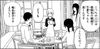
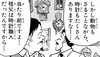
While telling ghost stories at night, Rize relays the tale from her childhood, of a frightened servant who felt she was being watched while walking home one night.
リゼ:
「犯人( はんにん ) 前進( ぜんしん ) の練習( れんしゅう ) をしていた私( わたし ) だ」
“I was the culprit. I was practicing crawling on my stomach.”
◯:
「バラしちゃだめじゃん!!」
“You shouldn't reveal it!”
Challenge Yourself
Show translation
Challenge
Which interpretation best matches the highlighted line?
Clues
バラしちゃだめじゃん
バラしちゃだめ means the culprit should not be revealed
What does the speaker mean?
You shouldn't reveal the culprit!
バラす means revealing a secret or giving something away. The others object because Rize has disclosed that she was the figure in the ghost story.
The others warn Rize not to be discovered while crawling.
The highlighted form is バラしちゃだめじゃん. Here バラしちゃだめ means the culprit should not be revealed, so this choice does not match the Japanese.
The others tell Rize to reveal more details about the culprit.
The highlighted form is バラしちゃだめじゃん. Here バラしちゃだめ means the culprit should not be revealed, so this choice does not match the Japanese.
The others say the culprit should remain hidden in the closet.
The highlighted form is バラしちゃだめじゃん. Here バラしちゃだめ means the culprit should not be revealed, so this choice does not match the Japanese.
バラしちゃだめ means the culprit should not be revealed. バラす means revealing a secret or giving something away. The others object because Rize has disclosed that she was the figure in the ghost story.
View Full Example
殺人 (Murder)殺人( さつじん ) means killing another person or murder.
It combines 殺 (kill ) with 人 (person ) to show the killing of a person .
名探偵コナン »
Volume 5 » Page 83
After discovering who the murderer is, Conan explains why the murderer went after Ran. He pinpoints when Ran unknowingly discovered a vital clue.
コナン:
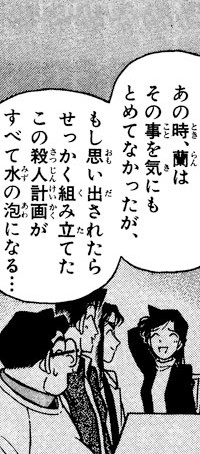
「あの時( とき ) 、蘭( らん ) の事( こと ) 気( き ) にもとめてなかったが、もし思( おも ) い出( だ ) されたらせっかく組( く ) み立( た ) てたこの殺人( さつじん ) 計画( けいかく ) がすべて水( みず ) の泡( あわ ) になる…」
“Ran didn't think anything of it at the time, but if she remembered it, all the murderous plans he worked so hard on putting together would go up in smoke.”
Challenge Yourself
Show translation
Challenge
What would happen if Ran remembered the clue?
Clues
もし思( おも ) い出( だ ) されたら
if she were to remember it
この殺人( さつじん ) 計画( けいかく ) がすべて水( みず ) の泡( あわ ) になる
the entire murder plan would come to nothing
What does the speaker mean?
The culprit's carefully prepared plan would be ruined.
水( みず ) の泡( あわ ) になる means that all the effort put into the plan would be wasted.
Ran would forget the clue permanently.
The condition is that Ran remembers it, not that she forgets it.
The culprit would have time to rebuild the plan.
The idiom describes the existing plan collapsing, not a chance to begin again.
The murder would be mistaken for an accident.
Remembering the clue would threaten the culprit's concealment rather than strengthen it.
Conan's investigation would have to stop.
The wasted effort belongs to the culprit's murder plan.
Ran would become part of the plan willingly.
Her memory would expose a clue and undermine the plan.
If Ran remembered what she had noticed, the culprit’s carefully assembled murder plan would fall apart. 水( みず ) の泡( あわ ) になる says that the invested effort would come to nothing.
View Full Example
Identity
人間 (Human being)人間( にんげん ) means a human being or humanity. It can also refer to someone’s character or personality.
It combines 人 (person ) with 間 (between ) to show human beings living among one another .
ARIA The MASTERPIECE »
Volume 2 » Page 129
Alicia and Akari visit an island that’s modeled after part of Japan back on Earth. There, an elderly local woman tells the two of the fox spirits that visit the human world there. Akari is excited at the prospect of meeting one, but the old woman gives her a warning: on rare occasion, a fox will take a person back home with them.
おばあさん:
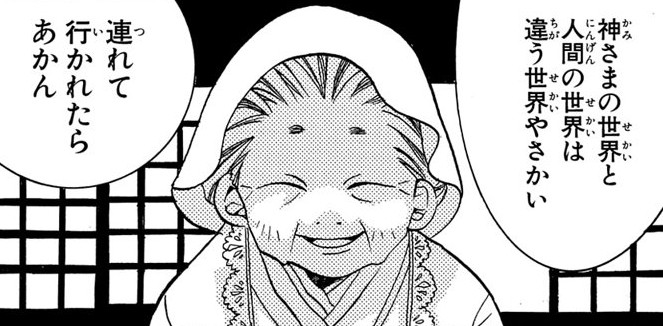
「神( かみ ) さまの世界( せかい ) と人間( にんげん ) 世界( せかい ) は違( ちが ) うやさかい」
“The god world and the human world are different.”
「連( つ ) れて行( い ) かれたらあかん」
“Therefore, it is bad to follow along.”
View Full Example
別人 (Different person)別人( べつじん ) means a different person. Figuratively, it can describe someone whose appearance or behavior has changed beyond recognition.
It combines 別 (different ) with 人 (person ) to show a different person .
三ツ星カラーズ »
Volume 8 » Page 107
Sacchan and Kotoha notice Yui walking with a couple of her friends from school. The two decide to sneak and follow after them. Sacchan notices Yui doesn’t act quite the same with these friends as she does with Sacchan and Kotoha.
さっちゃん:
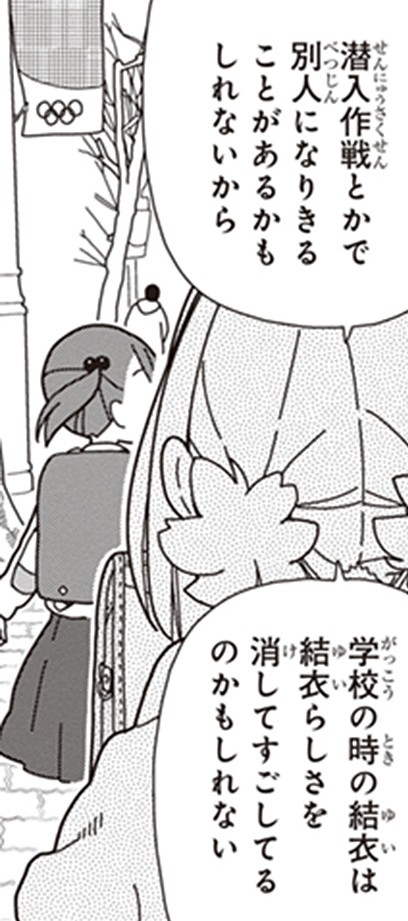
「潜入( せんにゅう ) 作戦( さくせん ) とかで別人( べつじん )
“Maybe it's because she's in an undercover operation or something that she sometimes pretends to be a different person....”
「学校( がっこう ) の時( とき ) の結衣( ゆい ) は結衣( ゆい ) らしさを消( け ) してすごしてるのかもしれない」
“...that Yui at school might be trying to hide her true self.”
Challenge Yourself
Show translation
Challenge
What explanation does Sacchan invent for Yui acting differently at school?
Clues
潜入( せんにゅう ) 作戦( さくせん ) とかで別人( べつじん ) になりきることがあるかもしれないperhaps she sometimes fully plays another person for an infiltration mission
結衣( ゆい ) らしさを消( け ) してすごしてるのかもしれないperhaps she spends school time hiding what makes her Yui
What does the speaker mean?
Yui may be playing a different person as part of an undercover mission.
潜入( せんにゅう ) 作戦( さくせん ) names an infiltration mission, and 別人( べつじん ) になりきる describes fully taking on another persona.
Yui has forgotten how she normally acts around Sacchan.
Sacchan speculates that Yui is deliberately hiding her usual self, not that she has forgotten it.
Yui's school friends are pretending to be different people.
Yui is the implied subject of 別人( べつじん ) になりきる and the named subject of the next line.
Yui is secretly investigating Sacchan and Kotoha.
The imagined mission explains Yui's behavior at school. The line does not name Sacchan and Kotoha as targets.
Yui behaves differently because school rules require it.
Sacchan mentions a possible mission, not a school rule.
Yui is preparing to leave school and become someone else.
〜ことがある describes something that may happen on some occasions, not a plan to leave permanently.
Sacchan imagines that Yui sometimes plays a different person for an undercover mission. In that theory, Yui hides her usual personality while she is at school.
View Full Example
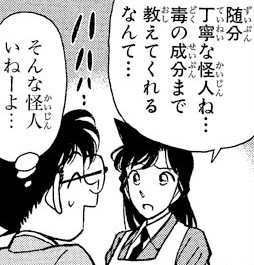
怪人 (Mysterious person)怪人( かいじん ) means a mysterious or suspicious person, often one with strange powers in fiction.
It combines 怪 (strange ) with 人 (person ) to show a person marked by eerie abnormality.
名探偵コナン »
Volume 14 » Page 15
A client tells Detective Mouri about the condition in which she found her deceased husband. Hearing the details, Conan identifies the likely poison, including the composition, the dosage required to kill, and the internal effects it has on a person. When Ran asks how he knows all this, Conan covers by saying the monster villain on the kid’s TV show he watched explained it.
蘭( らん ) :「随分( ずいぶん ) 丁寧( ていねい ) な怪人( かいじん ) 毒( どく ) の成分( せいぶん ) まで教( おし ) えてくれるなんて…」
“What a polite villain... Going so far as to tell the poison's composition...”
コナン:
「そんな怪人( かいじん )
“No such monster exists...”
Challenge Yourself
Show translation
Challenge
What makes Ran sarcastically call the television villain considerate?
Clues
毒( どく ) の成分( せいぶん ) までeven the poison's composition
教( おし ) えてくれるなんてto think that he would tell you
What does the speaker mean?
He supposedly explained even the poison's composition.
まで shows that the implausibly detailed explanation went as far as the chemical composition.
He warned viewers never to use poison.
Ran focuses on the technical information he supposedly provided, not a safety warning.
He gave Conan an antidote.
No antidote is mentioned. Conan claims the show supplied his knowledge.
He politely apologized to every victim.
丁寧( ていねい ) is sarcastic here because of the thorough explanation.
He concealed the poison's identity from Conan.
The supposed villain did the opposite by explaining its composition.
He taught Ran how to make a television program.
The information concerns the poison, not producing the show.
Ran mocks Conan’s excuse by imagining a villain helpful enough to explain even the poison’s chemical makeup. Conan’s reply admits that no such villain exists.
View Full Example
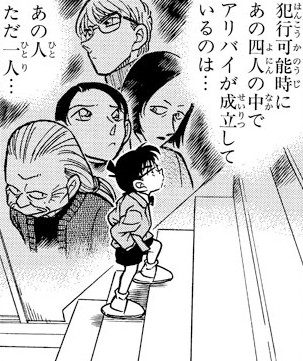
一人 (One person)一人( ひとり ) means one person or being alone. It can function as a counter expression or describe doing something by oneself.
It combines 一 (one ) with 人 (person ) to show one person .
名探偵コナン »
Volume 24 » Page 83
Following a murder made to look like an accidental death, Conan reviews the whereabouts of the four suspects at the time.
コナン:
「犯行( はんこう ) 可能( かのう ) 時( じ ) にあの四人( よにん ) の中( なか ) でアリバイが成立( せいりつ ) しているのは…」
“Among those four, the one with an established alibi during the time the crime could have been committed is...”
「あの人( ひと ) ただ一人( ひとり )
“...that person alone...”
Challenge Yourself
Show translation
Challenge
How many of the four suspects have an alibi that holds up?
Clues
あの四人( よにん ) の中( なか ) で
among those four people
アリバイが成立( せいりつ ) しているのは…あの人( ひと ) ただ一人( ひとり )
that person alone has an established alibi
What does the speaker mean?
Only one of them.
ただ一人( ひとり ) limits the valid alibi to a single person among the four.
All four of them.
Conan singles out one person rather than clearing the whole group.
Exactly two of them.
一人( ひとり ) gives the count as one.
Three of them.
The line identifies only one established alibi.
None of them.
Conan says one person's alibi does hold up.
The number is still completely unknown.
He has already narrowed the valid alibis to one person.
Among the four suspects, Conan says only one person has an alibi that is established as valid during the possible time of the crime.
View Full Example
四人 (Four people)四人( よにん ) means four people. It is the straightforward counting use of the kanji.
It combines 四 (four ) with 人 (person ) to show four people .
名探偵コナン »
Volume 24 » Page 83
Following a murder made to look like an accidental death, Conan reviews the whereabouts of the four suspects at the time.
コナン:
「犯行( はんこう ) 可能( かのう ) 時( じ ) にあの四人( よにん ) 中( なか ) でアリバイが成立( せいりつ ) しているのは…」
“Among those four, the one with an established alibi during the time the crime could have been committed is...”
「あの人( ひと ) ただ一人( ひとり ) …」
“...that person alone...”
Challenge Yourself
Show translation
Challenge
How many of the four suspects have an alibi that holds up?
Clues
あの四人( よにん ) の中( なか ) で
among those four people
アリバイが成立( せいりつ ) しているのは…あの人( ひと ) ただ一人( ひとり )
that person alone has an established alibi
What does the speaker mean?
Only one of them.
ただ一人( ひとり ) limits the valid alibi to a single person among the four.
All four of them.
Conan singles out one person rather than clearing the whole group.
Exactly two of them.
一人( ひとり ) gives the count as one.
Three of them.
The line identifies only one established alibi.
None of them.
Conan says one person's alibi does hold up.
The number is still completely unknown.
He has already narrowed the valid alibis to one person.
Among the four suspects, Conan says only one person has an alibi that is established as valid during the possible time of the crime.
View Full Example
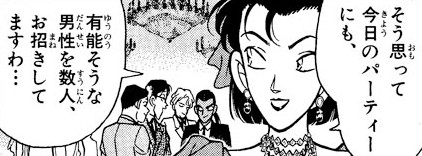
数人 (Several people)数人( すうにん ) means several people or a few people. It gives an approximate small number rather than an exact count.
It combines 数 (several ) with 人 (people ) to show an unspecified small number of people .
名探偵コナン »
Volume 9 » Page 120
Detective Mouri is invited as a special guest to the birthday party for Reika, daughter of the Yotsui Group’s chairman. At the event, Reika announces her intent to marry.
霊化( れいか ) :「そう思( おも ) って今日( きょう ) のパーティーにも、有能( ゆうのう ) そうな男性( だんせい ) を数人( すうにん ) 招( まね ) きしてますわ…」
“With that in mind, I've invited several promising gentlemen to today's party...”
Challenge Yourself
Show translation
Challenge
What kind of men has Reika invited to the party?
Clues
有能( ゆうのう ) そうな男性( だんせい ) men who seem capable
数人( すうにん ) 、お招( まね ) きしてますI have invited several of them
What does the speaker mean?
Several men who appear capable and promising.
有能( ゆうのう ) そうな describes men who give the impression of being capable.
Several men she already knows are incompetent.
有能( ゆうのう ) means capable, and そうな describes that appearance.
Every male employee in the Yotsui Group.
数人( すうにん ) means several people, not every employee.
Only men who have refused to marry.
The line evaluates their apparent ability, not a history of refusing marriage.
Several musicians hired to perform.
Reika presents the men as possible partners, not entertainers.
Men who invited her to their own parties.
Reika is the one who invited them to today's party.
Reika says she invited several men who look capable. 有能( ゆうのう ) そうな describes her favorable impression rather than proven knowledge of their ability.
View Full Example
Relationships
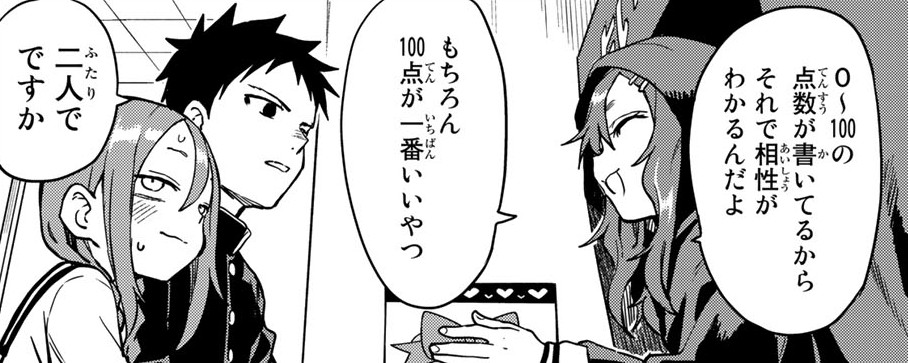
二人 (Two people)二人( ふたり ) means two people.
It combines 二 (two ) with 人 (person ) to show two persons .
それでも歩は寄せてくる »
Volume 15 » Page 17
At the school festival, Ayumu and Urushi stop by the affinity fortune telling booth while Maki is on duty. Maki holds out a box with an opening on top, and says the need to pull out a single card together.
マキ:
「0〜100の点数( てんすう ) が書( か ) いてるからそれで相性( あいしょう ) がわかるんだよ」
“Your compatibility is determined by the score written from 0 to 100.”
「もちろん100点( てん ) が一番( いちばん ) いいやつ」
“Of course, 100 points is the best score.”
歩( あゆむ ) :「二人( ふたり )
“Together?”
Challenge Yourself
Show translation
Challenge
How does Maki's compatibility fortune work?
Clues
0〜100の点数( てんすう ) が書( か ) いてるから
a score from 0 to 100 is written on the card
それで相性( あいしょう ) がわかる
"You can tell your compatibility from that score."
もちろん100点( てん ) が一番( いちばん ) いい
"Of course, 100 points is the best."
What does the speaker mean?
A card gives a score from 0 to 100, with 100 showing the best match.
The written 点数( てんすう ) measures their 相性( あいしょう ) , and Maki states that 100 points is best.
Each person draws a separate card, and the lower score wins.
Ayumu checks that they draw together, and Maki says 100 is the best score, not the lowest.
The card predicts how many years they will remain friends.
The number measures 相性( あいしょう ) , compatibility, not a number of years.
They write their own score after answering questions.
Maki says the score is already written on the card.
Only a score of exactly zero reveals compatibility.
The scale runs from 0 to 100, and Maki identifies 100 as the best result.
The booth compares their individual shogi rankings.
The score concerns how well the two people fit together, not their shogi ability.
Ayumu and Urushi draw a card together. Its number from 0 to 100 represents their 相性( あいしょう ) , and a score of 100 is the best possible match.
View Full Example
Society
人達 (People)人達( ひとたち ) means people or a group of people.
It combines 人 (person ) with 達 (plural group ) to show people as a group of persons .
名探偵コナン »
Volume 1 » Page 120
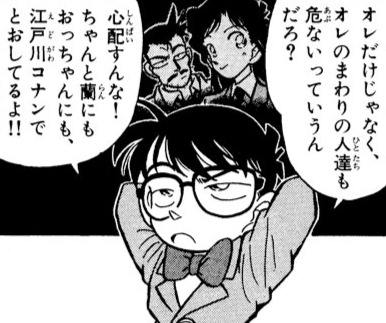
After Shin’ichi was forced to take a deadly drug that instead shrank him back to a child, he took on the undercover name Conan and went to stay with his childhood friend Ran and her detective father in the hope of a lead to the black-clad men who drugged him. He later discusses with Professor Agasa about how useless Detective Mouri is. The professor reminds Conan that the poison was supposed to have killed him, so he can’t rush and let others know his true identity.
コナン:
「オレだけじゃなく、オレのまわりの人達( ひとたち ) 危( あぶ ) ないっていうんだろ?」
“You're saying it won't be just me, but the people around me will be in danger too, right?”
「心配( しんぱい ) すんな!ちゃんと蘭( らん ) にもおっちゃんにも、江戸川( えどがわ ) コナンでとおしてるよ!!」
“Don't worry! I'm keeping up the Conan Edogawa act with Ran and the old man, too!!”
Challenge Yourself
Show translation
Challenge
Who does Conan say would be in danger if his situation became known?
Clues
オレだけじゃなく
not just me
オレのまわりの人達( ひとたち ) も危( あぶ ) ない
the people around me would be in danger too
What does the speaker mean?
Both Conan and the people around him.
だけじゃなく...も expands the danger from Conan to the people around him.
Only Conan himself.
だけじゃなく explicitly says the danger would not stop with Conan.
Only Ran and Kogoro.
Conan refers more broadly to the people around him, not only those two.
Only the men dressed in black.
The black-clad men are the threat. Conan is describing who could be harmed by them.
Nobody, because Conan has already revealed his identity.
Conan says he is still maintaining his cover identity with Ran and Kogoro.
Professor Agasa, but not Conan.
Conan includes himself first, then adds the people around him.
Conan understands Agasa’s warning to mean that exposing his identity would endanger more than Conan alone. The paired pattern だけじゃなく…も includes everyone around him as well.
View Full Example
職人 (Craftsperson)職人( しょくにん ) means a skilled craftsperson or artisan trained in a manual trade.
It combines 職 (profession ) with 人 (person ) to show a person of a trade .
ARIA The MASTERPIECE »
Volume 4 » Page 226
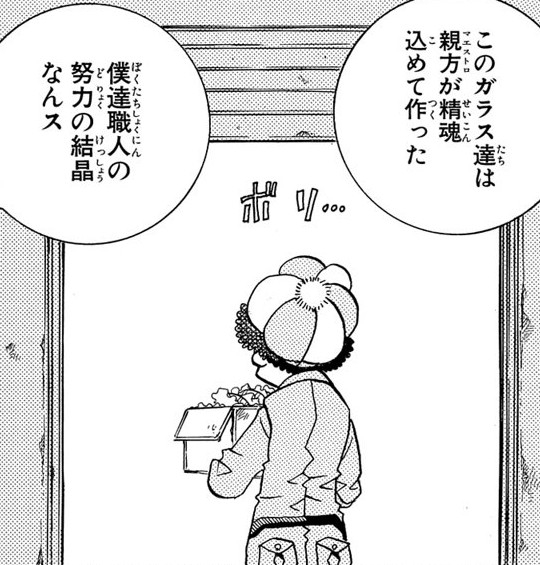
Akari picks up a box containing glassware items for her to transport. One of the employees from the shop making the glassware takes the box from her to place in her gondola. After he does this a second time, Akari says she can help carry the boxes, but he refuses.
職人( しょくにん ) :「このガラス達( たち ) は親方( マエストロ ) が精魂( せいこん ) 込( こ ) めて作( つく ) った」
“These pieces of glass were made with the maestro's heart and soul poured into them.”
「僕達( ぼくたち ) 職人( しょくにん ) 努力( どりょく ) の結晶( けっしょう ) なんス」
“They're the crystallization of our craftsmen's efforts.”
View Full Example
外国人 (Foreigner)外国人( がいこくじん ) means a foreign national or citizen of another country.
It combines 外国 (foreign country ) with 人 (person ) to show a person from another country .
名探偵コナン »
Volume 1 » Page 61
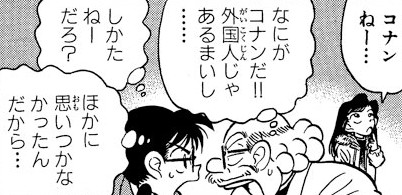
Shin’ichi’s teenage friend Ran enters Professor Agasa’s house looking for him, unaware that he was forced to take a poison that inadvertently turned the teenager into a young child. When Ran sees the boy and asks his name, Shin’ichi recalls Agasa’s suggestion to not reveal who he is. Panicking, he gives the name “Conan”, explaining the oddness of it by saying his father is a fan of author Arthur Conan Doyle.
欄( らん ) :「コナンねー…」
“Conan, huh?”
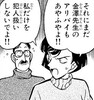
阿笠( あがさ ) :「なにがコナンだ!! 外国人( がいこくじん )
“What's with 'Conan'!? It's not like you're a foreigner...”
コナン:
「しかたねーだろ? ほかに思( おも ) いつかなかったんだから…」
“It couldn't be helped, all right? I couldn't think up anything else...”
Challenge Yourself
Show translation
Challenge
Why does Agasa object to the name Conan?
Clues
なにがコナンだ
what is this 'Conan' supposed to be?
外国人( がいこくじん ) じゃあるまいしit is not as if you are a foreigner
What does the speaker mean?
The foreign-sounding name seems unsuitable for Shin'ichi.
Agasa contrasts the name Conan with the fact that Shin'ichi is not a foreigner.
Conan is already the name of someone in Ran's family.
Agasa objects to the foreign name itself, not to a duplicate family name.
Shin'ichi pronounced the name incorrectly.
Nothing in the line concerns pronunciation.
The name would reveal Shin'ichi's real identity.
The improvised name hides his identity, even though Agasa finds it ridiculous.
Ran asked for a traditional foreign name.
Ran only asks who he is. Shin'ichi chooses the name in a panic.
Agasa thinks Shin'ichi should admit that he is a foreigner.
じゃあるまいし states the opposite: Shin'ichi is not a foreigner.
Agasa finds the conspicuously foreign name absurd for Shin’ichi. 外国人( がいこくじん ) じゃあるまいし means “it is not as if you are a foreigner”.
View Full Example