Reflection and optics with 鏡
鏡 refers to an object that reflects light to show one’s image, as well as a standard or model that serves as a basis for sound judgment.
Etymology
This kanji isa phono-semantic compound comprised of 金 (metal) as the semantic component and 竟 as the phonetic component (キョウ).
These invoke imagery of metal polished all the way to a finished, bright surface until it reflects a person’s form like a mirror.
Early mirrors were made from polished metal, so 鏡 first named a reflective object and then expanded to optical tools such as glasses, telescopes, microscopes, and scopes.
Optical Devices
眼鏡 (Glasses)眼鏡( めがね ) means glasses or spectacles worn to correct vision, protect the eyes, or as an accessory.
It combines 眼 (eye ) with 鏡 (lens ) to show lenses worn before the eyes for seeing.
名探偵コナン »
Volume 21 » Page 28
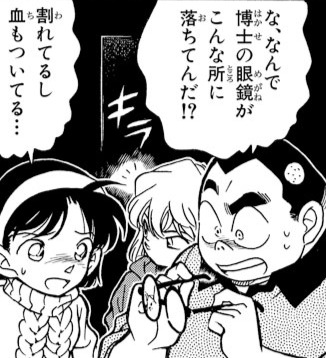
Professor Agasa and the Detective Boys stay overnight in a large villa in the woods after getting lost on a camping trip. Conan and Agasa go missing, leaving the rest of the kids to sneak around at night to search the property for them. After entering a secret passage, Haibana finds spots of blood on the ground, and then Genta finds Agasa’s glasses.
元太( げんた ) :「な、なんで博士( はかせ ) の眼鏡( めがね ) 所( ところ ) に落( お ) ちてんだ!?」
“W-what the heck? Why are the professor's glasses lying here !?”
歩美( あゆみ ) :「割( わ ) れてるし血( ち ) もついてる…」
“They're broken and there's blood on them...”
Challenge Yourself
Show translation
Challenge
What makes Agasa's glasses an alarming discovery?
Clues
こんな所( ところ ) に落( お ) ちてんだ
they are lying in a place like this
割( わ ) れてるし血( ち ) もついてるthey are broken and have blood on them too
What does the speaker mean?
They are broken, bloodied, and lying in the secret passage.
Ayumi adds the broken lenses and blood to Genta's shock at finding them there.
They are clean and carefully stored in their case.
The glasses are damaged and lying in an unexpected place.
They belong to an unknown visitor.
Genta identifies them as the professor's glasses.
They have been replaced with binoculars.
No replacement is mentioned. The concern is the condition of Agasa's glasses.
They prove that Agasa has already gone home.
Their location and condition instead suggest that something may have happened to him.
They are the only object in the villa without blood.
Ayumi explicitly says that blood is on them.
Genta finds Agasa’s glasses in the secret passage, and Ayumi notices that they are broken and bloodied. Those details make the discovery evidence of possible danger.
View Full Example
双眼鏡 (Binoculars)双眼鏡( そうがんきょう ) means binoculars, an optical device for viewing distant objects with both eyes.
It combines 双 (pair ), 眼 (eyes ), and 鏡 (lenses ) to show a paired viewing tool for both eyes .
名探偵コナン »
Volume 4 » Page 117
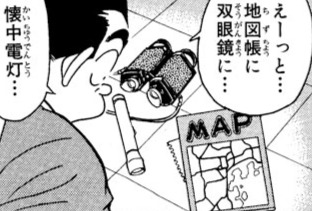
Ayumi leaves the bag with her new Masked Yaiba doll outside while she’s in the restroom. When she returns, she finds the bag waiting for her, but the doll is gone. Ran suggests someone may have taken her bag by mistake. Genta decides to see what’s in the bag Ayumi brought back, dumping its contents onto the ground.
元太( げんた ) :「えーっと… 地図帳( ちずちょう ) に双眼鏡( そうがんきょう )
“Um... an atlas, binoculars...”
「懐中電灯( かいちゅうでんとう ) …」
“...a flashlight...”
Challenge Yourself
Show translation
Challenge
What optical item does Genta find in the bag?
Clues
地図帳( ちずちょう ) にan atlas, and
双眼鏡( そうがんきょう ) にbinoculars, and
What does the speaker mean?
A pair of binoculars.
双眼鏡( そうがんきょう ) is the optical item in Genta's running list.
A microscope.
The listed viewing instrument is 双眼鏡( そうがんきょう ) , binoculars.
A pair of eyeglasses.
眼鏡( めがね ) would mean eyeglasses. The compound here is 双眼鏡( そうがんきょう ) .
A camera lens.
No camera is named among the bag's contents.
A telescope.
The item is a two-eyed handheld viewing instrument, binoculars.
A magnifying glass.
Genta explicitly names 双眼鏡( そうがんきょう ) , not a magnifier.
Genta finds binoculars along with an atlas and a flashlight. The repeated に lets him list the objects as he examines them.
View Full Example
万華鏡 (Kaleidoscope)万華鏡( まんげきょう ) means a kaleidoscope, which uses mirrors to turn colored pieces into shifting geometric patterns.
It combines 万 (ten thousand ) and 華 (splendor ) with 鏡 (mirror ) to show a mirror device producing countless beautiful reflections .
美少女戦士セーラームーン »
Volume 7 » Page 24
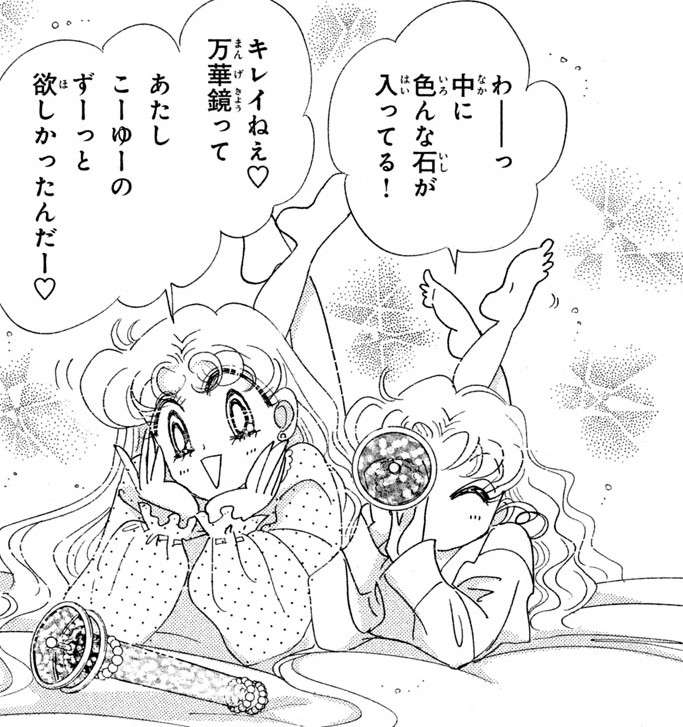
Usagi and Chibiusa look at the kaleidoscopes Mamoru bought them at the carnival.
ちびうさ:
「わーーーっ 中( なか ) に色( いろ ) んな石( いし ) が入( はい ) ってる」
“Wow! There are all kinds of stones inside!”
うさぎ:
「キレイねえ♡ 万華鏡( まんげきょう )
“It's so pretty♡ A kaleidoscope...”
「あたし こーゆーの ずーっと 欲( ほ ) しかったんだー♡」
“I've wanted one of these for so long♡”
Challenge Yourself
Show translation
Challenge
How does Usagi react to the kaleidoscope?
Clues
キレイねえ♡ 万華鏡( まんげきょう ) って
she admires how pretty a kaleidoscope is
こーゆーのずーっと欲( ほ ) しかったんだー♡
she says she has wanted this kind of thing for a long time
What does the speaker mean?
She thinks it is pretty and says she has long wanted one.
キレイ expresses admiration, and ずーっと欲しかった says the desire has lasted a long time.
She dislikes the stones inside and wants to return it.
Usagi calls the kaleidoscope pretty and speaks warmly about having wanted one.
She says Chibiusa has wanted one for a long time.
あたし makes Usagi the person with the long-held wish, not Chibiusa.
She is surprised that Mamoru made the kaleidoscope himself.
The scene says Mamoru bought the kaleidoscopes. Usagi comments on their beauty and her old wish.
She expected a mirror but received colored stones instead.
Usagi identifies the object as a kaleidoscope and admires it. She does not complain that it is the wrong gift.
She has only just learned what a kaleidoscope is.
Saying she has wanted this kind of thing for a long time shows prior interest, not a first introduction.
Usagi admires the kaleidoscope and says she has wanted this kind of object for a long time. ずーっと stretches the duration, while 欲しかったんだ gives the confession an emotional tone.
View Full Example
Physical Mirrors
手鏡 (Hand mirror)手鏡( てかがみ ) means a small handheld mirror.
It combines 手 (hand ) with 鏡 (mirror ) to show a mirror held in the hand .
美少女戦士セーラームーン »
Volume 5 » Page 160
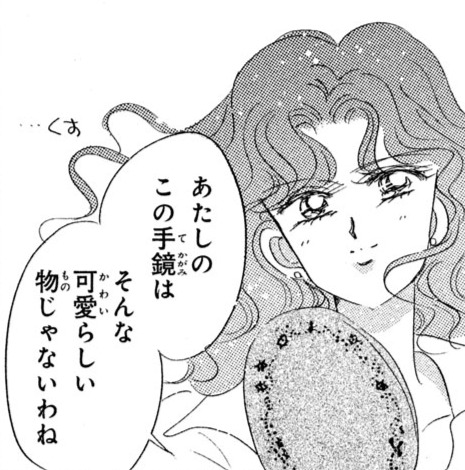
Seeing Chibausa leaving Hotaru’s house, Haruka and Michiru stop over to pick her up. Michiru asks what the two were talking about, and Chibausa explains that it was a conversation about amulets and their mysterious protective powers. She asks if Michiru has one. Michiru says her mirror may be protective, to which Chibausa says it must be an amulet.
みちる:
「あたしのこの手鏡( てかがみ ) 可愛( かわい ) らしい物( もの ) じゃないわね」
“This hand mirror of mine isn't something that cute.”
Challenge Yourself
Show translation
Challenge
What does Michiru say about her hand mirror?
Clues
あたしのこの手鏡( てかがみ )
she singles out the particular hand mirror she carries
そんな可愛( かわい ) らしい物( もの ) じゃないわね
she denies that it is the same kind of cute object Chibiusa described
What does the speaker mean?
It is not the sort of cute charm Chibiusa has in mind.
そんな points back to Chibiusa's idea, and 可愛らしい物じゃない rejects that description of Michiru's mirror.
It is a cute hand mirror that Chibiusa gave her.
じゃない negates the cute classification, and Michiru identifies the mirror as her own.
It has no protective power because it is only a mirror.
Michiru distinguishes its appearance from a cute charm. She does not deny that it may protect her.
It belongs to Usagi rather than Michiru.
あたしの explicitly identifies the hand mirror as Michiru's.
It is too large to hold in one hand.
手鏡 means a hand mirror. The contrast concerns whether it is a cute object, not its size.
It is prettier than Chibiusa's amulet.
Michiru says it is not that sort of cute thing. She does not compare which object is prettier.
Michiru says that her hand mirror is not the kind of cute object Chibiusa has been describing. The line rejects the appearance and category, not the possibility that the mirror has protective power.
View Full Example