Scorching and impatience with 焦
The kanji 焦 has a few meanings related to heat and burning :
physical scorching (blackening with heat)
impatience or irritated agitation (being inwardly burned with impatience)
longing (burning with longing)
Etymology This kanji is a phono-semantic compound comprised of 火 (fire) as the semantic component and 隹 (abbreviated from 雥) as the phonetic component (ショウ).
Scorching 焦げる (To burn)
焦(こ) げる refers to the process by which an object turns black or dark brown due to fire or heat.Vocabulary Explanation: Do it properly with ちゃんと (Future entry)
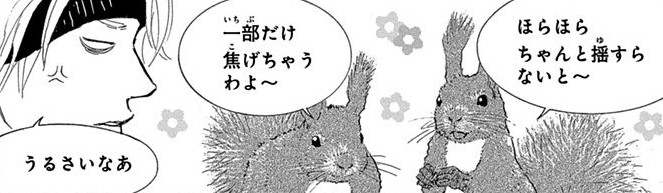
しろくまカフェ bis » Volume 3 » Page 43Masaki’s dream job making coffee turns out to be nothing like he expected, as he’s put to work sorting out good beans from bad. When he finally has the chance to roast beans, he’s eager to use the fancy roasting machine, but he’s instead given a handheld coffee roaster to hold over a portable stove’s flame.
エゾリスA: 「ほらほら ちゃんと揺(ゆ) すらないと〜」“Come on, come on. You have to shake it properly.” エゾリスB: 「一部(いちぶ) だけ焦(こ) げちゃうわよ〜」“Parts of it might get burnt.” マサキ: 「うるさいなあ」“Hush up!” Challenge Yourself Show translation
Challenge
Why must Masaki keep shaking the coffee roaster properly? Clues ちゃんと揺(ゆ) すらないと "if you do not shake it properly," warning that a consequence will follow 一部(いちぶ) だけ焦(こ) げちゃうわよ "only part of it will end up burning," describing the unwanted result What does the speaker mean? Otherwise only part of the beans may burn. ちゃんと揺(ゆ) すらないと sets the condition, and 一部(いちぶ) だけ焦(こ) げちゃう gives the uneven burning that may follow. Otherwise all the beans will fall out of the roaster. The warning concerns part of the batch burning, not beans falling out. Shaking makes the beans roast more slowly. The speakers want Masaki to shake the roaster so the beans do not scorch unevenly. The roaster will stop working unless it senses movement. Masaki is using a handheld roaster. The line describes the beans burning, not a machine safety feature. Proper shaking separates good beans from bad ones. Sorting happened earlier. Here ちゃんと refers to the technique needed during roasting. Shaking prevents every bean from roasting at all. The goal is even roasting. The warning is that insufficient shaking lets only one part burn.
The warning spans both speakers’ lines. If Masaki does not ちゃんと揺(ゆ) する, shake the roaster properly, one part of the beans may end up scorched.
View Full Example
Agitation 焦る (To be in a hurry)
焦(あせ) る refers to a state in which one becomes flustered because things aren’t going as planned, loses one’s composure in an attempt to hurry things along, or becomes irritated.Vocabulary Explanation: Vocabulary in the Kansai dialect (Future entry)
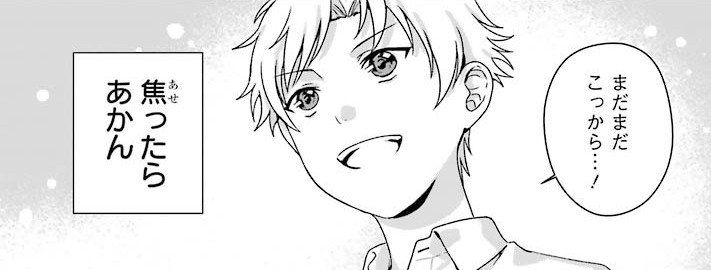
レンタルおにいちゃん » Volume 2 » Page 122After transferring schools, Daigo tries to become friends with everyone. However, Makoto repeated ignores Daigo before finally saying not to talk to him. The other classmates tell Daigo not to bother with Makoto.
大五(だいご) :「まだまだこっから…!」“There's still a long way to go.”「焦(あせ) ったらあかん」“If I hurry it's no good.” Challenge Yourself Show translation
Challenge
What is Daigo telling himself after the others discourage him? Clues まだまだこっから there is still more to come from here 焦(あせ) ったらあかん if I get impatient, that is no good, in Kansai speech What does the speaker mean? He still has a long way to go, so he should not rush. まだまだこっから keeps his effort going, while 焦(あせ) ったらあかん warns him against impatience. He needs to hurry before he loses his chance to make friends. あかん rejects the condition 焦(あせ) ったら, so he tells himself that rushing is the wrong response. He should give up because making friends is impossible. まだまだこっから looks ahead from this point. It does not signal that he is quitting. He is annoyed because another student is moving too slowly. Daigo applies the warning to himself. The line does not criticize another person's pace. He has already finished the hardest part of his effort. まだまだ says there is plenty left, not that the difficult work is behind him. He must leave immediately and start over somewhere else. こっから points forward from his present situation. There is no command to leave or restart elsewhere.
Daigo encourages himself to keep trying but not to become impatient. まだまだこっから says there is more ahead, and 焦(あせ) ったらあかん warns that rushing would be a mistake.
View Full Example