Searching and probing with 探
探 means “to probe”, “to search”, or “to seek out”. It is used to describe the act of actively trying to find something unknown or hidden.
Etymology
This kanji isa phono-semantic compound comprised of 扌 (hand) as the semantic component and 罙 as the phonetic component (タン).
These invoke imagery of a hand reaching deep into a hidden place, feeling around for something out of sight.
Exploration and Fieldwork
探検 (Exploration)探検( たんけん ) means exploring an unknown or little-known place firsthand, often on an expedition involving some danger.
It combines 探 (explore ) with 検 (inspect or examine ) to show exploration through close examination .
名探偵コナン »
Volume 25 » Page 152
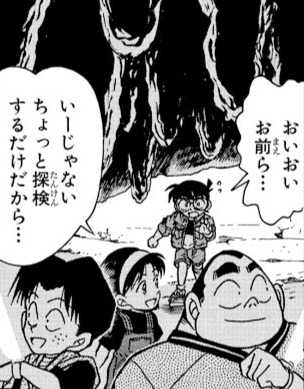
During a camping trip, Conan and his friends are out collecting firewood when they happen upon a cave. Seeing the entrance roped off, and an obsure message carved into a rock, Ayumi, Mitsuhiko, and Genta set their gathered sticks on the ground and they head inside.
コナン:
「おいおい お前( まえ ) ら…」
“Hey, you guys...”
歩美( あゆみ ) :「いーじゃない ちょっと探検( たんけん )
“It's okay. We're just going to explore a little.”
Challenge Yourself
Show translation
Challenge
How does Ayumi minimize what the group is about to do?
Clues
ちょっと
a little
探検( たんけん ) するだけだからbecause we are only going to explore
What does the speaker mean?
They are only going to explore for a little while.
ちょっと and だけ make entering the cave sound small and harmless.
They plan to live in the cave permanently.
Ayumi describes the trip as a brief, limited exploration.
They will wait outside without entering.
探検( たんけん ) する states that they intend to explore.
They have been ordered to map the entire cave.
The line frames the activity casually, not as an assigned survey.
They are returning only to collect firewood.
They set the wood down and head toward the cave to explore.
They want Conan to explore alone.
Ayumi uses the group's action as her reason that it should be fine.
Ayumi brushes off Conan’s concern by saying they are only going to explore a little. ちょっと and だけ both make the risky plan sound minor.
View Full Example
Investigation and Detection
探偵 (Detective)探偵( たんてい ) means a detective or private investigator who gathers information about people or incidents.
It combines 探 (search ) with 偵 (spy or scout ) to show a person who searches out hidden information .
名探偵コナン »
Volume 1 » Page 12
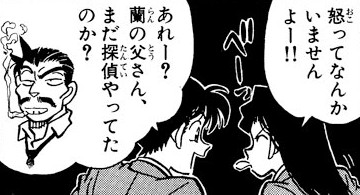
Ran seems angry as Shin’ichi basks in the media attention he’s getting for solving a difficult case. When Shin’ichi asks Ran why she’s angry, she points out that it’s because of Shin’ichi that her father’s been getting fewer case requests.
蘭( らん ) :「怒( おこ ) ってなんかいませんよー!!」
“I'm not at all angry!”
新一( しんいち ) :「あれー?蘭( らん ) の父( とう ) さん、まだ探偵( たんてい )
“Huh? Your dad was still working as a detective?”
Challenge Yourself
Show translation
Challenge
What surprises Shin'ichi about Ran's father?
Clues
まだ
still
探偵( たんてい ) やってたのか?was he still working as a detective?
What does the speaker mean?
He is still working as a detective.
まだ and 探偵( たんてい ) やってた show surprise that the work continues.
He has become a police officer.
The occupation named is 探偵( たんてい ) , detective, not police officer.
He has stopped accepting every case.
Shin'ichi asks whether he is still in the detective business at all.
He solved a case before Shin'ichi did.
No solved case is mentioned in the question.
He is angry with Ran.
Ran is the one denying that she is angry. Shin'ichi then asks about her father's work.
He wants Shin'ichi to join his agency.
The line checks the father's current occupation, not an invitation.
Shin’ichi is surprised that Ran’s father is still working as a detective. The explanatory のか turns that realization into a question for confirmation.
View Full Example
名探偵 (Great detective)名探偵( めいたんてい ) means a famous or brilliant detective, especially one known for outstanding deduction and investigative skill. It is common in mystery fiction, where it evokes the image of an exceptional sleuth who solves difficult cases.
It combines 名 (name or fame ) with 探偵 (detective ) to show a well-known detective .
名探偵コナン »
Volume 7 » Page 8
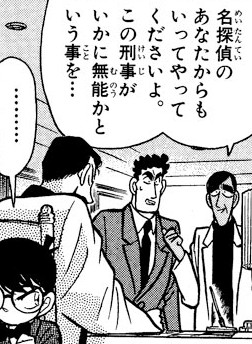
Police detective Yokomizo isn’t about to let Sasai, his prime murder suspect, leave. Sasai reminds the officer that he has photographic proof that he wasn’t near the victim at the time of the murder. He calls for Detective Mouri to back him up.
笹井( ささい ) :「名探偵( めいたんてい ) 刑事( けいじ ) がいかに無能( むのう ) かという事( こと ) を…」
“You, the great detective, should tell him yourself. Just how incompetent this police detective is...”
Challenge Yourself
Show translation
Challenge
What does Sasai want Mouri to tell the police detective?
Clues
いってやってくださいよ
please tell him
この刑事( けいじ ) がいかに無能( むのう ) か
just how incompetent this detective is
What does the speaker mean?
That the detective is thoroughly incompetent.
いかに無能( むのう ) か emphasizes the degree of the officer's supposed incompetence.
That the detective has solved the case correctly.
無能( むのう ) is a direct insult meaning incompetent.
That Mouri should take over the police department.
Sasai asks Mouri to support his criticism, not accept a new position.
That the detective is refusing to examine a photograph.
The photograph motivates Sasai's confidence, but his request is a broader insult about ability.
That Sasai has confessed to the murder.
Sasai insists that his photographic evidence proves his innocence.
That every officer is equally capable.
この刑事( けいじ ) singles out the officer Sasai is attacking.
Sasai asks the famous detective Mouri to confirm just how incompetent the police detective is. 無能( むのう ) bluntly says that the officer lacks ability.
View Full Example
Search and Inquiry
探索 (Exploration)探索( たんさく ) means searching or investigating to find a missing item, unknown information, or a possible solution.
It combines 探 (probe / explore ) with 索 (search ) to show searching into the unknown .
ふらいんぐうぃっち »
Volume 1 » Page 91
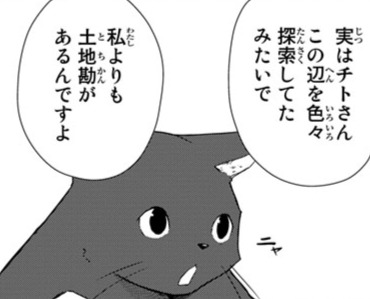
Not long after moving to a new town to stay with relatives, Makoto decides to head out for a walk. Her cousin is worried she’ll get lost. Makoto says not to worry, because she’ll have her witch familiar cat, Chito, with her.
真琴( まこと ) :「実( じつ ) はチトさん この辺( へん ) を色々( いろいろ ) 探索( たんさく ) 私( わたし ) よりも土地勘( とちかん ) があるんですよ」
“Actually, Chito seems to have explored this area quite a bit, so she knows her way around better than I do.”
Challenge Yourself
Show translation
Challenge
Why does Makoto believe Chito can guide her?
Clues
この辺( へん ) を色々( いろいろ ) 探索( たんさく ) してたみたい
Chito appears to have explored many parts of the neighborhood
私( わたし ) よりも土地勘( とちかん ) があるChito knows the area better than Makoto does
What does the speaker mean?
Chito has explored the area and knows it better than Makoto.
探索( たんさく ) してたみたい suggests previous exploration, and 土地勘( とちかん ) がある describes familiarity with the area.
Chito has a map that Makoto cannot read.
Makoto relies on Chito's firsthand familiarity with the neighborhood. No map appears in the line.
Chito lived with these relatives before Makoto arrived.
The reason given is that Chito explored the area, not that the cat previously lived in the household.
Chito can use magic to find the shortest route.
Makoto mentions exploration and local knowledge. She does not attribute the guidance to magic.
Chito is following someone who knows the town.
Chito herself has more 土地勘( とちかん ) than Makoto, so the cat is the knowledgeable guide.
Chito never leaves the house and cannot get lost.
The line says the opposite: Chito has gone around exploring the neighborhood.
Makoto thinks Chito has already explored many parts of the neighborhood and developed a feel for the area. That makes the cat a better guide than Makoto, who has only recently moved there.
View Full Example