Sections and departments with 部
部 represents a division of a whole into several parts, or a group such as an organization or field.
Etymology
This kanji isa phono-semantic compound comprised of 邑 / 阝 (place, settlement) as the semantic component and 咅 as the phonetic component (ブ).
Organization Structure
本部 (Headquarters)本部( ほんぶ ) means the headquarters or central governing office of an organization.
It combines 本 (main ) with 部 (department ) to show the main department .
ARIA The MASTERPIECE »
Volume 3 » Page 286
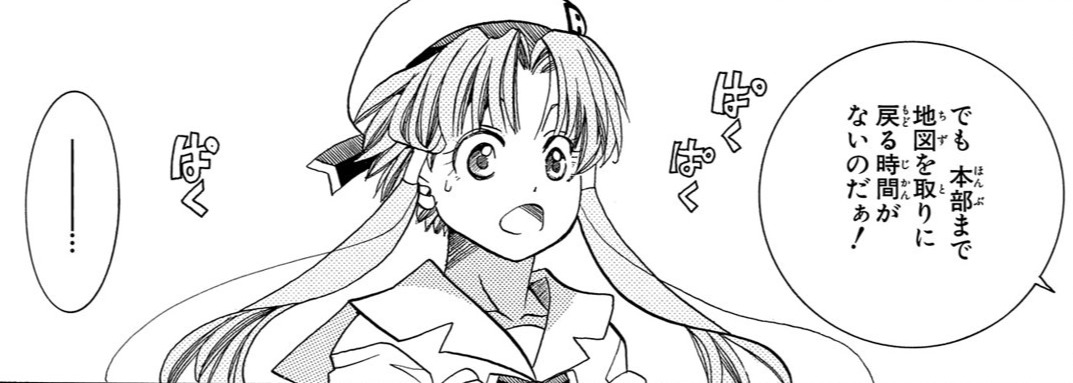
Akari encounters Woody while he’s out on a delivery run. He stopped to show off for some kids, but in the process, he seems to have lost his city map, and he has a terrible sense of direction. Akari asks if he has the delivery addresses, which he says he does.
ウッディー:
「でも 本部( ほんぶ ) 地図( ちず ) を取( と ) りに戻( もど ) る時間( じかん ) がないのだぁ!」
“But I don't have time to go back to headquarters to get a map!!”
View Full Example
Organizational Roles
部下 (Subordinate)部下( ぶか ) means a subordinate, someone who works under a superior in an organization or chain of command.
It combines 部 (section ) with 下 (lower ) to show someone lower in position .
Example 1 of 2: Experience with sleepovers with 〜た+ことがある Example 1 of 2
ご注文はうさぎですか? »
Volume 1 » Page 69
Cocoa thinks Rize is nervous about staying overnight with her and Chino.
リゼ:
「いや… 親父( おやじ ) の部下( ぶか ) 誘( さそ ) われたワイルドなキャンプしか経験( けいけん ) した事( こと ) ないから…」
“Well... I've only had the experience of those wild camping trips my dad's subordinates invited me on...”
「こんなの初( はじ ) めてで…」
“I've never done anything like this before...”
ココア:
「ワイルド?」
“Wild?”
Challenge Yourself
Show translation
Challenge
What does リゼ mean in the highlighted line?
Clues
経験( けいけん ) した事( こと ) ない〜た事( こと ) がある = have had the experience of...
What does the speaker mean?
Well... I've only had the experience of those wild camping trips my dad's subordinates invited me on...
The highlighted pattern expresses past experience at least once.
Rize says she often attends ordinary sleepovers with friends.
The highlighted form is 経験( けいけん ) した事( こと ) ない. Here 〜た事( こと ) がある = have had the experience of..., so this choice does not match the Japanese.
Rize says she has never gone camping before.
The highlighted form is 経験( けいけん ) した事( こと ) ない. Here 〜た事( こと ) がある = have had the experience of..., so this choice does not match the Japanese.
Rize says she invited her father's subordinates to stay at her home.
The highlighted form is 経験( けいけん ) した事( こと ) ない. Here 〜た事( こと ) がある = have had the experience of..., so this choice does not match the Japanese.
〜た事( こと ) がある = have had the experience of…. The highlighted pattern expresses past experience at least once.
View Full Example
Example 2 of 2: Getting onto a subway car with 飲み込む Example 2 of 2
名探偵コナン »
Volume 15 » Page 83
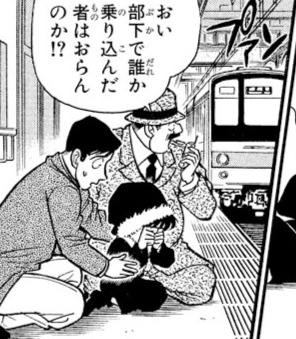
Following the kidnapping of a pop music duo, the police are forced to rely on Conan and his friends to deliver the ransom. The kids speak to one of the kidnappers by phone at the subway station, with the police force watching from a distance. When a subway car is about to close its doors, the kids suddenly bolt onto the nearest car, three of the four making it on before the doors close.
目暮( めぐれ ) :「おい部下( ぶか ) 誰( だれ ) か乗( の ) り込( こ ) んだ者( もの ) はおらんのか!?」
“Hey! Did any of you get on?!”
Challenge Yourself
Show translation
Challenge
What does Megure demand to know from his subordinates?
Clues
部下( ぶか ) で誰( だれ ) かanyone among the subordinates
乗( の ) り込( こ ) んだ者( もの ) はおらんのかis there nobody who boarded?
What does the speaker mean?
Whether any officer managed to board the subway car.
乗( の ) り込( こ ) んだ者( もの ) asks for a subordinate who got into the car.
Whether every officer got off at the same station.
The verb is 乗( の ) り込( こ ) む, to board, not to get off.
Who instructed the children to board.
Megure asks about his own subordinates' response, not who directed the children.
Whether the subway car was completely empty.
His concern is whether one of his officers made it aboard.
Which officer bought the subway tickets.
No ticket purchase is mentioned in the demand.
Whether anyone stopped the train from departing.
The doors closed, so Megure asks who got onto the moving pursuit route.
Megure demands to know whether any of his subordinates managed to board the subway car with the children. おらん is his blunt negative form of おる.
View Full Example
Parts of a Whole
全部 (Whole)全部( ぜんぶ ) means everything or the whole, with nothing left out.
It combines 全 (whole ) with 部 (parts ) to show all the parts together .
Example 1 of 2: Managing to distribute all fliers with 〜終える Example 1 of 2
ご注文はうさぎですか? »
Volume 1 » Page 8
Cocoa encounters Syaro standing outside.
ココア:
「今日( きょう ) はチラシ配( くば ) り?」
“You're handing out fliers today?”
シャロ:
「全部( ぜんぶ ) 配( くば ) り終( お ) えるまで帰( かえ ) れないわ」
“I can't go home until I finish handing out all of them.”
Challenge Yourself
Show translation
Challenge
What does シャロ mean in the highlighted line?
Clues
配( くば ) り終( お ) える配( くば ) り終( お ) える = finish handing them all out
What does the speaker mean?
I can't go home until I finish handing out all of them.
〜終( お ) える attaches to the verb stem, so 配( くば ) る becomes 配( くば ) り終( お ) える.
Syaro says she stopped distributing the fliers without finishing.
The highlighted form is 配( くば ) り終( お ) える. Here 配( くば ) り終( お ) える = finish handing them all out, so this choice does not match the Japanese.
Syaro says she is only beginning to hand out the fliers.
The highlighted form is 配( くば ) り終( お ) える. Here 配( くば ) り終( お ) える = finish handing them all out, so this choice does not match the Japanese.
Syaro says someone else will finish distributing them after she goes home.
The highlighted form is 配( くば ) り終( お ) える. Here 配( くば ) り終( お ) える = finish handing them all out, so this choice does not match the Japanese.
配( くば ) り終( お ) える = finish handing them all out. 〜終( お ) える attaches to the verb stem, so 配( くば ) る becomes 配( くば ) り終( お ) える.
View Full Example
Example 2 of 2: アタシ from an Osakan girl Example 2 of 2
名探偵コナン »
Volume 19 » Page 88
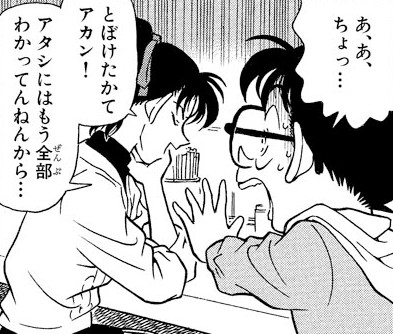
Heiji invites Conan, Ran, and Mouri on a tour of Osaka. While Heiji steps away, his childhood friend who’s been following the group confronts them. She opens by saying “You’re Kudo, right?” and that she heard it from Heiji. Conan, realizing his true identity is about to be revealed to Ran, tries to stop her.
コナン:
「あ、あ、ちょっ…」
“Ah, ah, wai--!”
和葉( かずは ) :「とぼけたかてアカン! アタシにはもう全部( ぜんぶ )
“It's no use playing dumb. Since I already know everything...”
Challenge Yourself
Show translation
Challenge
What does Kazuha claim despite Conan's attempt to stop her?
Clues
とぼけたかてアカン
it is no use playing dumb
アタシにはもう全部( ぜんぶ ) わかってんねん
I already know everything
What does the speaker mean?
She already knows everything, so pretending is useless.
もう全部( ぜんぶ ) わかってんねん states that Kazuha believes she has the full truth already.
She has forgotten everything Heiji told her.
She claims the opposite with 全部( ぜんぶ ) わかってる.
She wants Conan to explain the situation later.
Kazuha says playing dumb now will not work because she already understands.
She thinks Heiji has been pretending not to know her.
Her accusation is directed at the person she believes is Kudo.
She knows only one small part of the story.
全部( ぜんぶ ) means everything, not a limited piece.
She agrees to keep silent before saying anything.
Conan tries to stop her, but Kazuha continues with confidence.
Kazuha says that playing dumb will not work because she already knows everything. アタシ is her casual feminine first-person pronoun, colored by the Kansai speech around it.
View Full Example
一部 (Part)一部( いちぶ ) means one part, a portion, or some members of a larger whole.
It combines 一 (one ) with 部 (section ) to show one part of the whole .
しろくまカフェ bis »
Volume 3 » Page 43
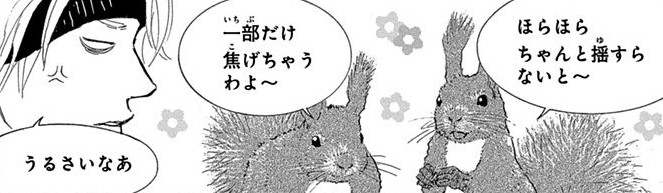
Masaki’s dream job making coffee turns out to be nothing like he expected, as he’s put to work sorting out good beans from bad. When he finally has the chance to roast beans, he’s eager to use the fancy roasting machine, but he’s instead given a handheld coffee roaster to hold over a portable stove’s flame.
エゾリスA:
「ほらほら ちゃんと揺( ゆ ) すらないと〜」
“Come on, come on. You have to shake it properly.”
エゾリスB:
「一部( いちぶ ) 焦( こ ) げちゃうわよ〜」
“Parts of it might get burnt.”
マサキ:
「うるさいなあ」
“Hush up!”
Challenge Yourself
Show translation
Challenge
Why must Masaki keep shaking the coffee roaster properly?
Clues
ちゃんと揺( ゆ ) すらないと
"if you do not shake it properly," warning that a consequence will follow
一部( いちぶ ) だけ焦( こ ) げちゃうわよ"only part of it will end up burning," describing the unwanted result
What does the speaker mean?
Otherwise only part of the beans may burn.
ちゃんと揺( ゆ ) すらないと sets the condition, and 一部( いちぶ ) だけ焦( こ ) げちゃう gives the uneven burning that may follow.
Otherwise all the beans will fall out of the roaster.
The warning concerns part of the batch burning, not beans falling out.
Shaking makes the beans roast more slowly.
The speakers want Masaki to shake the roaster so the beans do not scorch unevenly.
The roaster will stop working unless it senses movement.
Masaki is using a handheld roaster. The line describes the beans burning, not a machine safety feature.
Proper shaking separates good beans from bad ones.
Sorting happened earlier. Here ちゃんと refers to the technique needed during roasting.
Shaking prevents every bean from roasting at all.
The goal is even roasting. The warning is that insufficient shaking lets only one part burn.
The warning spans both speakers’ lines. If Masaki does not ちゃんと揺( ゆ ) する, shake the roaster properly, one part of the beans may end up scorched.
View Full Example
School Clubs
部活 (Club activities)部活( ぶかつ ) , short for 部活動( ぶかつどう ) , means a school club activity. It includes sports and cultural clubs that meet outside class.
It combines 部 (club ) with 活 (activity ) to show the activities of a club .
ひとりぼっちの○○生活 »
Volume 1 » Page 107
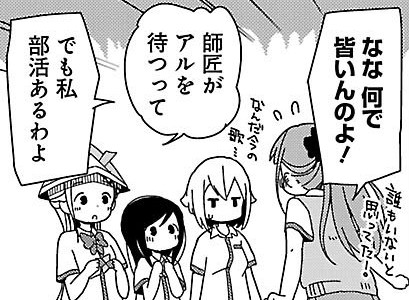
Aru returns to her classroom after club. Expecting the classroom to be empty, she’s singing a song about herself as she enters the room. There, she finds her friends idling away the time.
アル:
「なな 何( なん ) で皆( みな ) いんのよ!(誰( だれ ) もいないと思( おも ) ってた!)」
“Wh- why is it that you all are here?! (I was thinking no one was here!)”
なこ:
「(なんだ今( いま ) の歌( うた ) …)」
“(What was with that song just now...)”
ソトカ:
「師匠( ししょう ) がアルを待( ま ) つって」
“Master said she'd wait for you.”
アル:
「でも私( わたし ) 部活( ぶかつ )
“But I'm in a club!”
Challenge Yourself
Show translation
Challenge
Why are Bocchi and the others still in the classroom?
Clues
師匠( ししょう ) がアルを待( ま ) つBocchi will wait for Aru
って
casually reports what Bocchi said
What does the speaker mean?
Bocchi said she would wait for Aru.
師匠( ししょう ) refers to Bocchi, and アルを待( ま ) つ says that she will wait for Aru.
Aru told them that her club had been canceled.
Aru says she has club, but the reported statement is Bocchi's promise to wait for her.
They expected Aru to return and sing for them.
Nako reacts to Aru's song, but Sotoka says the group stayed because Bocchi would wait for Aru.
Sotoka asked everyone to wait for their teacher.
師匠( ししょう ) is Sotoka's name for Bocchi here, and アル is the person being waited for.
They thought the classroom would be empty after club.
That was Aru's expectation, not the reason the others remained in the room.
Bocchi said she would wait for Sotoka.
The object of 待( ま ) つ is アル, so Bocchi is waiting for Aru.
Sotoka reports that Bocchi said she would wait for Aru. The casual quotation marker って passes along Bocchi’s words and answers Aru’s startled question about why everyone is there.
View Full Example
入部 (Joining a club)入部( にゅうぶ ) means joining a school club or sports team.
It combines 入 (enter ) with 部 (club ) to show entering a club .
それでも歩は寄せてくる »
Volume 2 » Page 84
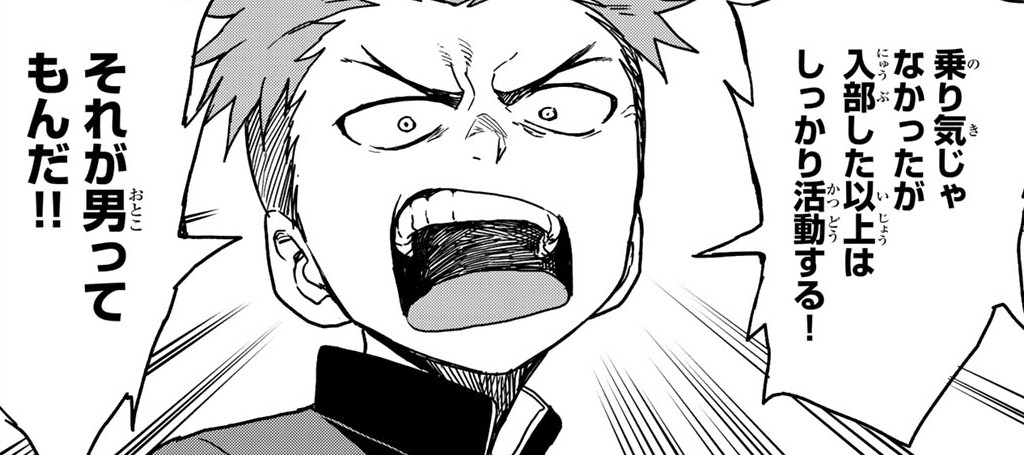
Sakurako forces Takeru to join the shogi club. When he suggests she join as well, she refuses and tells him not to go either, or else he’ll be in the way there.
タケル:
「乗( の ) り気( き ) じゃなかったが入部( にゅうぶ ) 以上( いじょう ) はしっかり活動( かつどう ) する!」
“I wasn't enthusiastic, but now that I'm in the club, I'll work hard!”
「それが男( おとこ ) ってもんだ!!」
“That's what it means to be a man!!”
Challenge Yourself
Show translation
Challenge
How has Takeru's attitude toward the shogi club changed?
Clues
乗( の ) り気( き ) じゃなかったが"I was not enthusiastic, but..." admitting his initial reluctance
入部( にゅうぶ ) した以上( いじょう ) は"now that I have joined," treating membership as grounds for obligation
しっかり活動( かつどう ) する
"I will participate properly and responsibly."
What does the speaker mean?
He was reluctant, but now feels obligated to participate seriously.
Takeru contrasts his earlier lack of 乗( の ) り気( き ) with his resolve to work properly once he has joined.
He was eager to join but now wants to quit.
This reverses the contrast. He starts reluctant and ends determined to participate.
He will attend only when Sakurako forces him.
入部( にゅうぶ ) した以上( いじょう ) は makes his membership itself the reason he will act responsibly.
He plans to join without taking part in club activities.
しっかり活動( かつどう ) する says he will participate properly.
He remains uninterested and regrets joining.
He admits the initial lack of enthusiasm, but the second half announces a firm change in conduct.
He thinks serious participation would be unmanly.
His follow-up says responsible participation is exactly what being a man means to him.
Takeru says he was not 乗( の ) り気( き ) at first. Once he has joined, however, he treats serious club participation as an obligation and even as proof of his manliness.
View Full Example
Spaces and Sections
部屋 (Room)部屋( へや ) means a room separated from other spaces in a building.
It combines 部 (section ) with 屋 (room ) to show a sectioned-off room within a larger building.
Example 1 of 3: A pretty clean room with 相当 Example 1 of 3
たいようのいえ »
Volume 1 » Page 87
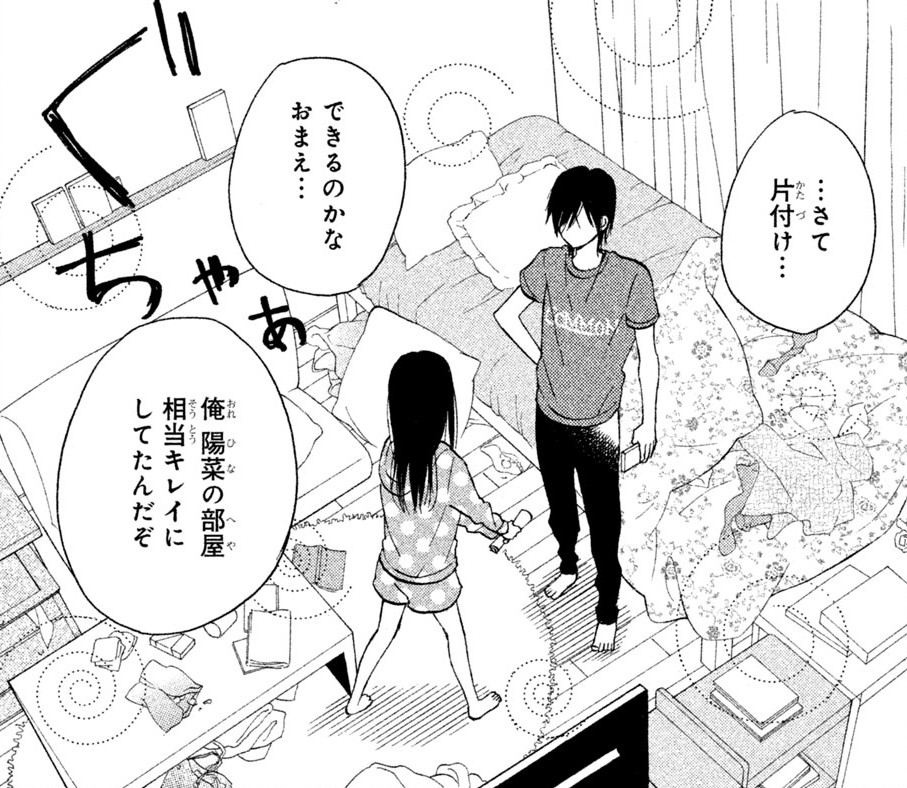
Hiro lets Mao move into his sister’s bedroom, as Hina is living with relatives. After, he comes up with a list of rules that Mao needs to follow if she’s to keep living there.
基( ひろ ) :「…さて 片付( かたづ ) け…」
“Now then, cleaning...”
「できるのかな おまえ…」
“I wonder if you can do it.”
「俺( おれ ) 陽菜( ひな ) の部屋( へや ) 相当( そうとう ) キレイにしてたんだぞ」
“I kept Hina's room pretty clean, you know.”
Challenge Yourself
Show translation
Challenge
What concern does Hiro raise about Mao using Hina's room?
Clues
片付( かたづ ) け…できるのかな おまえ…Hiro wonders whether Mao will be able to keep things tidy
陽菜( ひな ) の部屋( へや ) 相当( そうとう ) キレイにしてたんだぞ"I kept Hina's room quite clean, you know," stressing the standard he maintained.
What does the speaker mean?
He doubts whether Mao can keep the room as clean as he did.
Hiro questions whether Mao can manage 片付( かたづ ) け, then emphasizes that he kept the room 相当( そうとう ) キレイ.
He thinks Mao has already cleaned the room better than he did.
Hiro describes his own past care of the room and questions Mao's ability. He does not praise her cleaning.
He wants Mao to move into a different room because Hina's is dirty.
He says he kept Hina's room quite clean. The concern is whether Mao can maintain it.
He wonders whether Mao knows where the cleaning supplies are.
The line questions her ability to tidy up generally, not her knowledge of supplies.
He plans to clean the room for Mao every day.
Hiro points to the standard he maintained before Mao moved in. He does not promise to keep doing the work for her.
He believes the room is too clean for anyone to live in.
相当( そうとう ) キレイ describes degree, but Hiro treats cleanliness as a standard to preserve, not a problem.
Hiro wonders whether Mao can handle the cleaning. He then stresses that he had kept Hina’s room 相当( そうとう ) キレイ, quite clean, setting the standard he expects Mao to maintain.
View Full Example
Example 2 of 3: Clearing out a room with 〜ておく Example 2 of 3
ご注文はうさぎですか? »
Volume 1 » Page 50
After Cocoa suggests if she were saying at Chiya’s place rather than Chino’s, that she’s be working for Chiya’s family’s tea house, Chiya takes to the idea.
千夜( ちや ) :「じゃあ部屋( へや ) 空( あ ) けておくから早速( さっそく ) 荷物( にもつ ) をまとめて来( き ) てね」
“Then I'll clear out a room in advance, so go gather your things and come right away.”
ココア:
「誰( だれ ) か止( と ) めてよ!」
“Somebody stop her!”
Challenge Yourself
Show translation
Challenge
What does (千夜:ちや) mean in the highlighted line?
Clues
空( あ ) けておく空( あ ) けておく means clearing a room and keeping it available
What does the speaker mean?
Then I'll clear out a room in advance, so go gather your things and come right away.
Chiya proposes preparing the room before Cocoa arrives with her belongings.
Chiya says the room will remain occupied when Cocoa arrives.
The highlighted form is 空( あ ) けておく. Here 空( あ ) けておく means clearing a room and keeping it available, so this choice does not match the Japanese.
Chiya tells Cocoa to clear out her own room first.
The highlighted form is 空( あ ) けておく. Here 空( あ ) けておく means clearing a room and keeping it available, so this choice does not match the Japanese.
Chiya plans to prepare the room only after Cocoa moves in.
The highlighted form is 空( あ ) けておく. Here 空( あ ) けておく means clearing a room and keeping it available, so this choice does not match the Japanese.
空( あ ) けておく means clearing a room and keeping it available. Chiya proposes preparing the room before Cocoa arrives with her belongings.
View Full Example
Example 3 of 3: Furthermore, this room is too warm with さらに〜 Example 3 of 3
名探偵コナン »
Volume 1 » Page 139
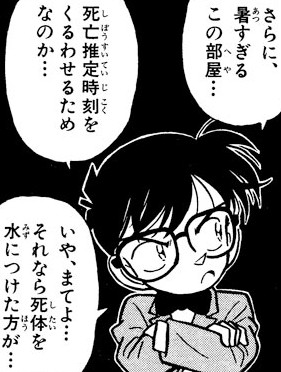
Upon walking in on a murder scene, Conan goes right to work making observations about the blood-covered body and its surroundings. He notes how the room is torn apart save for one upright chair beside the deceased.
コナン:
「さらに、暑( あつ ) すぎるこの部屋( へや )
“Furthermore, this room is too warm...”
「死亡推定時刻( しぼうすいていじこく ) をくるわせるためなのか…」
“Is it to confuse the estimated time of death...?”
「いや、まてよ… それなら死体( したい ) を水( みず ) につけた方( ほう ) が…」
“No, wait... If that's the case, it would be better to put the corpse in water...”
Challenge Yourself
Show translation
Challenge
What possible purpose does Conan consider for the overheated room?
Clues
暑( あつ ) すぎるこの部屋( へや ) this room that is too hot
死亡推定時刻( しぼうすいていじこく ) をくるわせるためなのかperhaps to throw off the estimated time of death
What does the speaker mean?
To distort the estimated time of death.
Conan explicitly considers whether the heat was meant to confuse the death-time estimate.
To make the victim leave the room voluntarily.
Conan connects the temperature to forensic timing, not to driving someone outside.
To melt the murder weapon.
No melting weapon is mentioned. The possible target is the estimated time of death.
To dry water from the floor.
Water appears only in Conan's alternative thought about the body.
To conceal the smell of poison.
The line considers heat as a way to alter the apparent death time.
To keep the investigators comfortable.
The room is 暑( あつ ) すぎる, excessively hot, and Conan treats that as suspicious.
Conan briefly suspects that someone overheated the room to disrupt the estimated time of death. He then questions the theory and considers another method.
View Full Example