Seeing and insight with 眼
眼 refers to the “eye” itself, which governs vision, as well as the “gaze” that sees through to the essence of things.
Etymology
This kanji isa phono-semantic compound comprised of 目 (eye) as the semantic component and 艮 as the phonetic component (ガン).
These invoke imagery of an eye fixed on something before it, holding it clearly in view.
Sight and View
肉眼 (Naked eye)肉眼( にくがん ) means the naked eye, without a telescope, microscope, or other optical aid.
It combines 肉 (flesh ) with 眼 (eye ) to show the natural bodily eye .
怪盗セイント・テール »
Volume 4 » Page 6
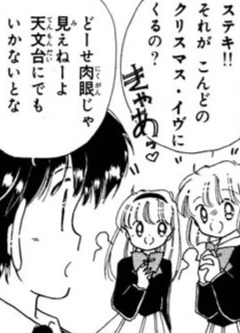
Before class, Asuka Jr. mentions a Graham Comet, which passes near the Earth once every fifty years.
涼子( りょうこ ) :「ステキ!! それが こんどのクリスマス・イヴにくるの?」
“Awesome!! Is it coming this Christmas Eve?”
アスカ Jr.:
「どーせ肉眼( にくがん ) 見( み ) えねーよ。天文台( てんもんだい ) にでもいかないとな」
“You won't be able to see it with the naked eye anyway. You'd have to go to an observatory or something.”
Challenge Yourself
Show translation
Challenge
What does Asuka Jr. say they would need to do to see the comet?
Clues
肉眼( にくがん ) じゃ見( み ) えねーthe comet cannot be seen with the unaided eye
天文台( てんもんだい ) にでもいかないとなthey would have to go somewhere such as an observatory
What does the speaker mean?
Go to an observatory or somewhere with viewing equipment.
肉眼じゃ見えねー rules out unaided viewing, and 天文台にでもいかないとな gives the necessary alternative.
Wait until the comet becomes visible to the naked eye.
Asuka Jr. says it cannot be seen with the naked eye. He does not suggest that waiting will change that.
Travel to the place where the comet will reach Earth.
The comet passes near Earth, but his practical suggestion is to visit an observatory.
Watch it from the school before class.
The conversation happens before class, but he says specialized viewing at an observatory is needed.
Look for it on a different night after Christmas Eve.
He discusses where and how to view it, not changing the date.
Ask someone at the observatory to describe it afterward.
いかないとな means they would need to go there themselves, not merely hear a description later.
Asuka Jr. says the comet is not visible to the naked eye. His casual 天文台にでもいかないとな means that they would have to go to an observatory or a similar place with the equipment needed to see it.
View Full Example
裸眼 (Unaided vision)裸眼( らがん ) means the unaided eye, without glasses or contact lenses.
It combines 裸 (bare ) with 眼 (eye ) to show the eye in its uncovered, unaided state .
僕が僕であるために。 »
Volume 2 » Page 50
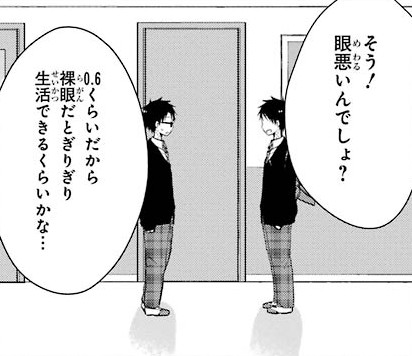
Shun asks Ayumu to continue switching places with him, since pretending to be Ayumu helps him be more open. Ayumu is game, but this requires Shun to go without his glasses, so Ayumu suggests he get contact lenses. Shun asks, “Contacts?”
歩( あゆむ ) :「そう!眼( め ) 悪( わる ) いんでしょ?」
“That's right! You have bad eyesight, don't you?”
駿( しゅん ) :「0.6くらいだから裸眼( らがん ) 生活( せいかつ ) できるくらいかな…」
“My vision's about 0.6, so without glasses, I can just barely get by in daily life...”
Challenge Yourself
Show translation
Challenge
What does Shun say about managing without his glasses?
Clues
裸眼( らがん ) だとwhen relying on his unaided vision
きりぎり生活( せいかつ ) できるくらい
to the extent that he can just barely manage daily life
What does the speaker mean?
He can just barely manage daily life.
きりぎり shows that ordinary life is possible for him, but only just.
He cannot function at all without his glasses.
He says that he can manage, although きりぎり makes that ability very limited.
He can see normally except when he is reading.
Shun describes his overall ability to manage daily life, not a problem limited to reading.
He has no difficulty because his vision is perfect.
His vision is about 0.6, and he describes getting by only with difficulty.
He can manage only if he wears contact lenses.
The statement concerns what he can do with 裸眼( らがん ) , without glasses or contacts.
He can see well enough to drive without correction.
He only says that he can barely manage everyday life. Driving is not mentioned.
Shun says his vision is about 0.6 and that he can still get through daily life without glasses. きりぎり makes clear that he can do so only barely.
View Full Example
双眼鏡 (Binoculars)双眼鏡( そうがんきょう ) means binoculars, an optical device for viewing distant objects with both eyes.
It combines 双 (pair ), 眼 (eyes ), and 鏡 (lenses ) to show a paired viewing tool for both eyes .
名探偵コナン »
Volume 4 » Page 117
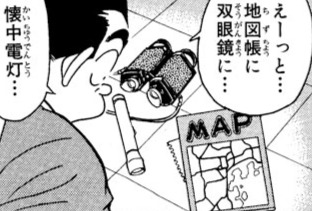
Ayumi leaves the bag with her new Masked Yaiba doll outside while she’s in the restroom. When she returns, she finds the bag waiting for her, but the doll is gone. Ran suggests someone may have taken her bag by mistake. Genta decides to see what’s in the bag Ayumi brought back, dumping its contents onto the ground.
元太( げんた ) :「えーっと… 地図帳( ちずちょう ) に双眼鏡( そうがんきょう )
“Um... an atlas, binoculars...”
「懐中電灯( かいちゅうでんとう ) …」
“...a flashlight...”
Challenge Yourself
Show translation
Challenge
What optical item does Genta find in the bag?
Clues
地図帳( ちずちょう ) にan atlas, and
双眼鏡( そうがんきょう ) にbinoculars, and
What does the speaker mean?
A pair of binoculars.
双眼鏡( そうがんきょう ) is the optical item in Genta's running list.
A microscope.
The listed viewing instrument is 双眼鏡( そうがんきょう ) , binoculars.
A pair of eyeglasses.
眼鏡( めがね ) would mean eyeglasses. The compound here is 双眼鏡( そうがんきょう ) .
A camera lens.
No camera is named among the bag's contents.
A telescope.
The item is a two-eyed handheld viewing instrument, binoculars.
A magnifying glass.
Genta explicitly names 双眼鏡( そうがんきょう ) , not a magnifier.
Genta finds binoculars along with an atlas and a flashlight. The repeated に lets him list the objects as he examines them.
View Full Example
Vision Tools and Protection
眼鏡 (Glasses)眼鏡( めがね ) means glasses or spectacles worn to correct vision, protect the eyes, or as an accessory.
It combines 眼 (eye ) with 鏡 (lens ) to show lenses worn before the eyes for seeing.
名探偵コナン »
Volume 21 » Page 28
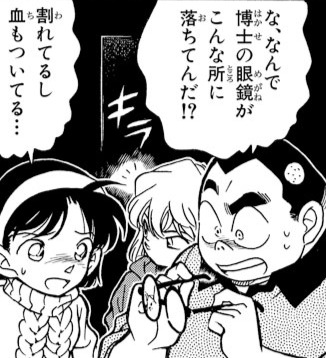
Professor Agasa and the Detective Boys stay overnight in a large villa in the woods after getting lost on a camping trip. Conan and Agasa go missing, leaving the rest of the kids to sneak around at night to search the property for them. After entering a secret passage, Haibana finds spots of blood on the ground, and then Genta finds Agasa’s glasses.
元太( げんた ) :「な、なんで博士( はかせ ) の眼鏡( めがね ) 所( ところ ) に落( お ) ちてんだ!?」
“W-what the heck? Why are the professor's glasses lying here !?”
歩美( あゆみ ) :「割( わ ) れてるし血( ち ) もついてる…」
“They're broken and there's blood on them...”
Challenge Yourself
Show translation
Challenge
What makes Agasa's glasses an alarming discovery?
Clues
こんな所( ところ ) に落( お ) ちてんだ
they are lying in a place like this
割( わ ) れてるし血( ち ) もついてるthey are broken and have blood on them too
What does the speaker mean?
They are broken, bloodied, and lying in the secret passage.
Ayumi adds the broken lenses and blood to Genta's shock at finding them there.
They are clean and carefully stored in their case.
The glasses are damaged and lying in an unexpected place.
They belong to an unknown visitor.
Genta identifies them as the professor's glasses.
They have been replaced with binoculars.
No replacement is mentioned. The concern is the condition of Agasa's glasses.
They prove that Agasa has already gone home.
Their location and condition instead suggest that something may have happened to him.
They are the only object in the villa without blood.
Ayumi explicitly says that blood is on them.
Genta finds Agasa’s glasses in the secret passage, and Ayumi notices that they are broken and bloodied. Those details make the discovery evidence of possible danger.
View Full Example