Seeing and viewpoints with 見 見 means see , look , or view . It covers seeing and being seen, finding things, how something looks, and a person’s view or judgment.
It also appears in words for meeting someone, as in 会見, and 見る itself can mean to look after someone, as in 面倒を見る.
Etymology This kanji shows a person with an enlarged eye , to indicate seeing . In the oldest forms the figure is kneeling. Dictionaries disagree on whether to classify it as a pictogram or as a compound of 目 and 儿.
Etymology Research CUHK identifies 目, an eye, and 卩, a kneeling person, in oracle-bone and bronze forms of 見. The enlarged eye emphasizes seeing. Its comparison with early 視 distinguishes the kneeling figure in 見 from the standing figure in 視, with an exception among the bronze forms. The later Shuowen analyzes 見 as 儿 plus 目 and defines it as seeing. These descriptions concern different stages of the written form. CUHK Multi-function Chinese Character Database, 見
Kanjipedia, following Kadokawa’s revised Shinjigen, calls the character 会意, a compound whose components convey meaning. Heibonsha’s Jitsu calls it 象形, a pictograph of a person with the eye emphasized. They agree on the eye and human figure but classify the formation differently. Neither account assigns a separate phonetic component to 見. Kanjipedia, 見 , Heibonsha Jitsu, 見
CUHK records seeing and having an audience in oracle-bone texts. Bronze inscriptions also use 見 for witnessing, appearing before a ruler, and marking the passive. Its audience example is on the Mai fangzun, where a lord has an audience at Zongzhou. These attestations show that meeting and grammatical uses already existed in early Chinese. Oracle-bone use for offering sacrifices is a loan use associated with 獻, not a Japanese reading rule. CUHK, 見
Jitsu associates early seeing with spiritual objects and ritual. That is its interpretation of the setting, not a detail established by the prominent eye on a human figure alone. CUHK’s examples support broader seeing and audience uses without making every occurrence religious. Heibonsha Jitsu, 見 , CUHK, 見
Seeing 見る (To see)見( み ) る is to see, look at, or watch something. It also means to check or judge something, or to look after someone, as in 面倒( めんどう ) を見( み ) る.
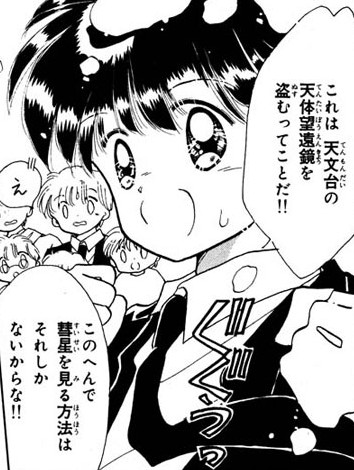
Example 1 of 11: A comet-viewing telescope with 望遠鏡 Example 1 of 11
怪盗セイント・テール » Volume 4 » Page 19Asuka Jr. receives a challenge notice from Saint Tail, stating her intent to steal Graham Comet on Christmas Eve. One of his friends wonders how Saint Tail will steal a comet. Asuka Jr. thinks it over for a moment.
アスカ Jr.: 「これは 天文台( てんもんだい ) の天体( てんたい ) 望遠鏡( ぼうえんきょう ) を盗( ぬす ) むってことだ!!」 “That means stealing the observatory's telescope!!” 「このへんで彗星( すいせい ) を見( み ) る方法( ほうほう ) はそれしかないからな!!」 “Since that's the only way to see a comet around here!!” Challenge Yourself Show translation
Challenge
What does Asuka Jr. conclude that Saint Tail plans to steal?
アスカ Jr.: 「これは 天文台( てんもんだい ) の天体( てんたい ) 望遠鏡( ぼうえんきょう ) 盗( ぬす ) むってことだ!!」 「このへんで彗星( すいせい ) を見( み ) る方法( ほうほう ) はそれしかないからな!!」 Clues 天文台( てんもんだい ) の天体( てんたい ) 望遠鏡( ぼうえんきょう ) を盗( ぬす ) むhe identifies the observatory's astronomical telescope as the object of the theft 彗星( すいせい ) を見( み ) る方法( ほうほう ) はそれしかないhe says that is the only way to view the comet nearby What does the speaker mean? The observatory's telescope. Asuka Jr. explicitly names the observatory's 天体望遠鏡 and explains that it is the only local way to see the comet. The Graham Comet itself. The notice says she will steal the comet, but Asuka Jr. interprets that as stealing the telescope used to see it. A mirror kept at the observatory. 望遠鏡 means telescope here. The final 鏡 is part of the word and does not identify a separate mirror. The observatory's records of past comets. He identifies an optical instrument needed to view the comet, not written records. A camera belonging to one of his friends. No camera is mentioned. The object marked by を is the astronomical telescope. The only map showing where the comet will appear. 方法 refers to the means of viewing the comet, and それ points back to the telescope, not a map.
Asuka Jr. reasons that stealing the comet must mean stealing the observatory’s astronomical telescope. He supports the deduction by saying that the telescope is the only way to view the comet in the area.
View Full Example Example 2 of 11: As if to say try and catch me 〜んばかり Example 2 of 11
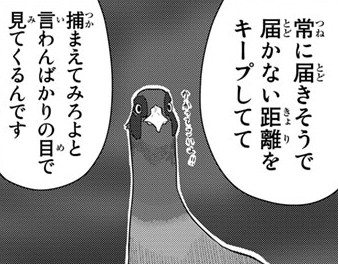
ふらいんぐうぃっち » Volume 1 » Page 78Kei and Chinatsu watch as their cousin, Makoto, chases a pheasant back and forth across the field. During a break in the chase, Makoto explains her fascination with the bird.
真琴( まこと ) :「常( つね ) に届( とど ) きそうで届( とど ) かない距離( きょり ) をキープしてて」 “Constantly seeming like you can reach and keeping a distance you can't...” 「捕( つか ) まえてみろよと言( い ) わんばかりの目( め ) で見( み ) てくるんです」 “It's been looking with eyes as if to say, try and catch me!” Challenge Yourself Show translation
Challenge
What does Makoto imagine the pheasant's look is saying?
真琴( まこと ) :「常( つね ) に届( とど ) きそうで届( とど ) かない距離( きょり ) をキープしてて」 「捕( つか ) まえてみろよと言( い ) わんばかり の目( め ) で見( み ) てくるんです」 Clues 捕( つか ) まえてみろよa taunting command to try catching it と言( い ) わんばかりの目( め ) eyes that appear to express those words without speaking What does the speaker mean? Try and catch me. 捕( つか ) まえてみろ is a forceful invitation to try catching it, and 言( い ) わんばかり makes that the message of its look. Stop following me. Makoto reads the bird's eyes as a challenge to catch it, not a request to end the chase. You have already caught me. The command uses 捕( つか ) まえてみろ, telling her to try. It does not describe a completed capture. Keep your distance from me. The bird maintains distance, but Makoto imagines that behavior as a teasing challenge to catch it. I cannot see where you are. The bird directs its gaze toward Makoto. The line does not suggest that it has lost sight of her. Follow me out of the field. The imagined message concerns catching the bird, not leading Makoto to another place.
The pheasant stays barely out of reach and looks at Makoto as though it is daring her to catch it. 言( い ) わんばかり describes a message conveyed by its eyes rather than literal speech.
View Full Example Example 3 of 11: Receiving a watching with 〜れる Example 3 of 11
ご注文はうさぎですか? » Volume 1 » Page 13After Chino shows Cocoa to the changing room, Chino goes to get Cocoa’s uniform. Left alone, Cocoa gets a feeling otherwise.
ココア: 「あれ… 誰( だれ ) もいないはずなのに誰( だれ ) かに見( み ) られているような」 “Huh? Even though nobody should be here, it feels like I'm being watched by someone.” Challenge Yourself Show translation
Challenge
What does ココア mean in the highlighted line?
ココア: 「あれ… 誰( だれ ) もいないはずなのに誰( だれ ) かに見( み ) られている ような」 Clues 見( み ) られている見( み ) られている means Cocoa is being watchedWhat does the speaker mean? Huh? Even though nobody should be here, it feels like I'm being watched by someone. 見( み ) る becomes 見( み ) られる in the receptive, so Cocoa is not doing the watching. She is receiving someone else's gaze. Cocoa says she is secretly watching someone else. The highlighted form is 見( み ) られている. Here 見( み ) られている means Cocoa is being watched, so this choice does not match the Japanese. Cocoa identifies the person watching her with certainty. The highlighted form is 見( み ) られている. Here 見( み ) られている means Cocoa is being watched, so this choice does not match the Japanese. Cocoa says she feels no gaze because the room is empty. The highlighted form is 見( み ) られている. Here 見( み ) られている means Cocoa is being watched, so this choice does not match the Japanese.
見( み ) られている means Cocoa is being watched. 見( み ) る becomes 見( み ) られる in the receptive, so Cocoa is not doing the watching. She is receiving someone else’s gaze.
View Full Example Example 4 of 11: Dazed by a wristwatch with 気が遠くなる Example 4 of 11
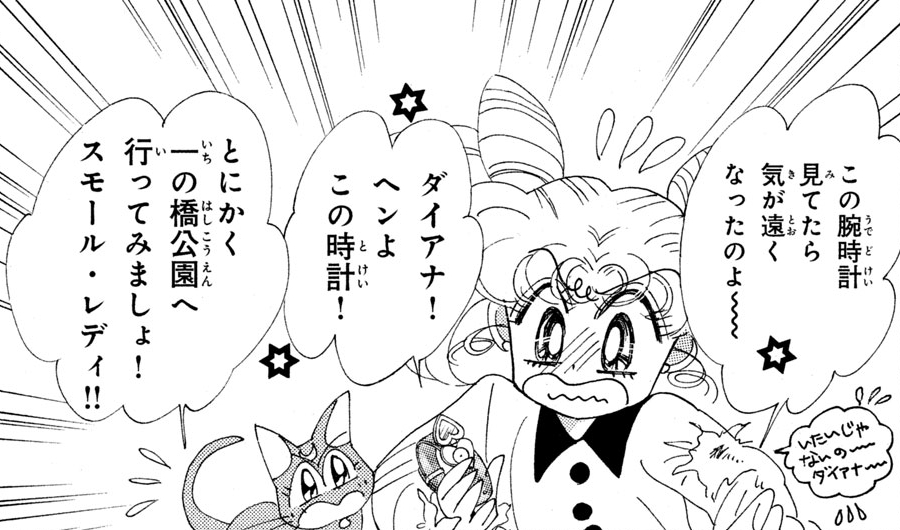
美少女戦士セーラームーン » Volume 6 » Page 264At the stroke of midnight, Chibiusa wakes to a mysterious glow from her new wristwatch. She gets out of bed in a daze, and begins to leave the room. Her cat, Diana, bites her on the arm, returning Chibiusa from her trance.
ちびうさ: 「この腕時計( うでどけい ) 見( み ) てたら気( き ) が遠( とお ) くなったのよ〰〰」 “When I looked at this wristwatch, I became lightheaded〰” 「ダイアナ! ヘンよ この時計( とけい ) !」 “Diana! Something is strange about this watch!” ダイアナ: 「とにかく 一( いち ) の橋( はし ) 公園( こうえん ) へ行( い ) ってみましょ! スモール・レディ!!」 “Anyway, let's try going to Ichinohashi Park! Small Lady!!” Challenge Yourself Show translation
Challenge
What does Chibiusa say happened while she looked at the wristwatch?
ちびうさ: 「この腕時計( うでどけい ) 見( み ) てたら気( き ) が遠( とお ) くなった 「ダイアナ! ヘンよ この時計( とけい ) !」 ダイアナ: 「とにかく 一( いち ) の橋( はし ) 公園( こうえん ) へ行( い ) ってみましょ! スモール・レディ!!」 Clues この腕時計( うでどけい ) 見( み ) てたら the event occurred while she was looking at this wristwatch 気( き ) が遠( とお ) くなったshe became faint, dazed, or detached from her surroundings What does the speaker mean? She became dazed while looking at it. 見てたら gives the situation in progress, and 気が遠くなった describes the dazed state that followed. She fell asleep before she had a chance to look at it. 見てたら says she was looking at the watch when the change happened. She remembered where she had lost the watch. 気が遠くなった concerns consciousness becoming faint or distant, not recovering a memory. Diana frightened her by suddenly showing her the watch. Chibiusa identifies looking at the watch as the trigger. Diana later snaps her out of the trance. She calmly decided to visit the park after checking the time. Her dazed reaction and ヘンよ show that the watch affected her strangely, not that she made a normal plan. The watch stopped working when midnight arrived. She says the watch is strange because it made her feel dazed. She does not say it stopped.
Chibiusa says that she became dazed while looking at the wristwatch. 気が遠くなった describes her fading awareness, and her next line identifies the watch as the source of the strange experience.
View Full Example Example 5 of 11: Watch the kid properly with ちゃんと Example 5 of 11
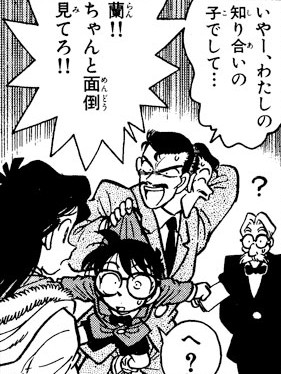
名探偵コナン » Volume 1 » Page 71Conan and Ran end up with Kogoro investigating a kidnapping case. As Kogoro questions the butler, Conan steps in with his own questions. The butler asks who the child is.
小五郎( こごろう ) :「いやー、わたしの知( し ) り合( あ ) いの子( こ ) でして…」 “Well, it's the child of an acquaintance, and...” 「蘭( らん ) !! ちゃんと面倒( めんどう ) 見( み ) てろ!!」 “Ran! Properly look after him!” Challenge Yourself Show translation
Challenge
What does Kogoro order Ran to do?
小五郎( こごろう ) :「いやー、わたしの知( し ) り合( あ ) いの子( こ ) でして…」 「蘭( らん ) !! ちゃんと 面倒( めんどう ) 見( み ) てろ!!」 Clues ちゃんと properly 面倒( めんどう ) 見( み ) てろkeep looking after him What does the speaker mean? Watch Conan properly. ちゃんと modifies the rough command 面倒( めんどう ) 見( み ) てろ, with Conan as the understood object. Introduce Conan as her own child. Kogoro has just described Conan as an acquaintance's child. Let Conan question the butler alone. He wants Ran to supervise Conan and keep him out of the questioning. Ask the butler to look after Conan. Kogoro addresses Ran directly and assigns the supervision to her. Take Conan home immediately. The command is to keep an eye on him, not necessarily to leave. Explain the kidnapping case to Conan. 面倒( めんどう ) 見( み ) る means to look after someone, not explain a case.
Kogoro orders Ran to supervise Conan properly. The object is omitted because everyone knows that Conan is the child he means.
View Full Example Example 6 of 11: While I didn't see you with 〜うちに Example 6 of 11
よつばと! » Volume 1 » Page 11Jumbo arrives to help Yotsuba and her father move into their new home.
よつば: 「しばらく見ないうちにまた大きくなった!」 “You've grown bigger since I last saw you!” ジャンボ: 「お?どこでおぼえたそのセリフ」 “Oh? Where'd you pick up that line?” Challenge Yourself Show translation
Challenge
What does Yotsuba claim happened since she last saw Jumbo?
よつば: 「しばらく見ない うちに また大きくなった!」 ジャンボ: 「お?どこでおぼえたそのセリフ」 Clues しばらく見( み ) ないうちに during the stretch of time when she did not see him また大( おお ) きくなった! he has grown bigger again What does the speaker mean? He grew bigger again. 見( み ) ないうちに sets the unseen interval, and 大( おお ) きくなった describes the change that supposedly occurred then. He became smaller while he was away. 大( おお ) きくなった means he became bigger, not smaller. He watched Yotsuba grow during the move. Yotsuba is the one who did not see Jumbo, and she comments on his size. He learned a new line to say to Yotsuba. Jumbo asks where Yotsuba learned her line. Her original claim is that he grew. He moved to a larger house without telling her. 大( おお ) きくなった describes Jumbo himself in this exchange, not his house. He stayed exactly the same since their last meeting. また and 大( おお ) きくなった present another noticeable increase in size.
Yotsuba tells Jumbo that he has grown bigger during the time she did not see him. Jumbo recognizes this as a stock adult remark and asks where she picked it up.
View Full Example Example 7 of 11: Have seen with 〜た+ことがある Example 7 of 11
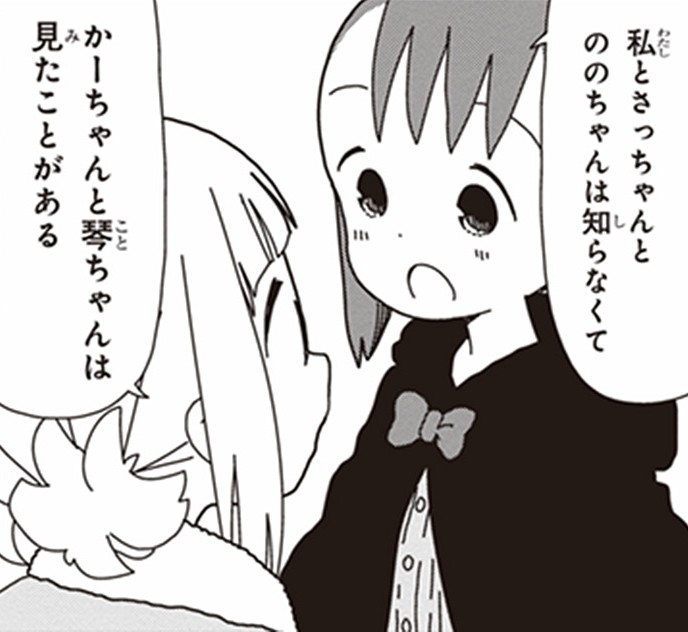
三ツ星カラーズ » Volume 5 » Page 115Sacchan and her friends come across a torn piece of paper with 「あたり100」 written on it. Thinking it may be for a 100,000 yen prize, the girls head to the shopping district to redeem it. Along the way, their friend Nonoko says she doesn’t recognize where the ticket is from, but Sacchan’s mother says it looks familiar somehow. Kotoha admits it seemed familiar to her as well, but she thought it was just her imagination until now.
結衣( ゆい ) :「私( わたし ) とさっちゃんとののちゃんは知( し ) らなくて」 “Even though Sacchan, Nono-chan, and I don't know it...” さっちゃん: 「かーちゃんと琴( こと ) ちゃんは見( み ) たことがある」 “My mom and Koto-chan have seen it before.” Challenge Yourself Show translation
Challenge
Who does Sacchan say has seen the mysterious ticket before?
結衣( ゆい ) :「私( わたし ) とさっちゃんとののちゃんは知( し ) らなくて」 さっちゃん: 「かーちゃんと琴( こと ) ちゃんは見( み ) たことがある 」 Clues 私( わたし ) とさっちゃんとののちゃんは知( し ) らなくてYui, Sacchan, and Nono-chan do not recognize it かーちゃんと琴( こと ) ちゃんは見( み ) たことがある Mom and Koto-chan have seen it before What does the speaker mean? Sacchan's mother and Kotoha. かーちゃんと琴( こと ) ちゃん are the people marked as having the experience 見( み ) たことがある. Yui, Sacchan, and Nono-chan. Those three are followed by 知( し ) らなくて, so they do not recognize it. Only Sacchan's mother. と joins かーちゃん and 琴( こと ) ちゃん as two people with the experience. Only Kotoha. Sacchan includes both Kotoha and her mother. Yui and Kotoha. Yui places herself among those who do not know it, while Kotoha is in the experienced group. Sacchan and her mother. Sacchan says she does not recognize it. Her mother and Kotoha do.
Sacchan divides the group in two. Yui, Sacchan, and Nono-chan do not recognize the ticket, but Sacchan’s mother and Kotoha have seen it before.
View Full Example Example 8 of 11: Misunderstanding an incriminating situation with 誤解 Example 8 of 11
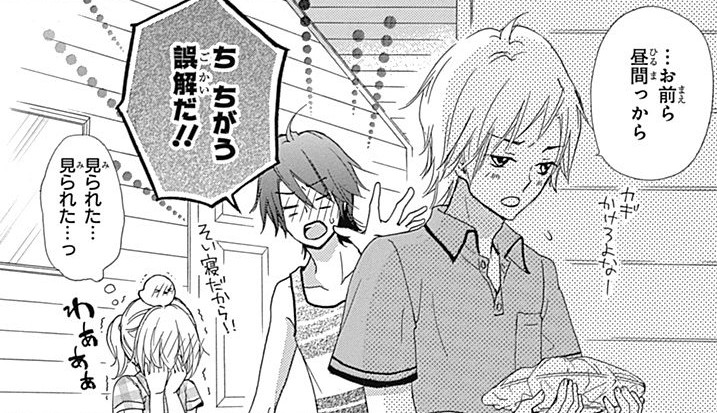
ひよ恋 » Volume 13 » Page 73Since Hiyori is resting on a bed inside, Junpei takes a plate from the barbecue to her room. As he walks in, he finds Hiyori and Yuushin in what looks like a compromising position.
淳平( じゅんぺい ) :「…お前( まえ ) ら昼間( ひるま ) っから (カギかけろよなー)」 “You guys, in the middle of the day… (At least lock the door!)” 結心( ゆうしん ) :「ち ちがう 誤解( ごかい ) だ!!(そい寝( ね ) だから!!)」 “N—No! You've got it wrong!! (We were just lying down together!)” ひより: 「見( み ) られた… 見( み ) られた…っ」 “We were seen… We were seen…!” Challenge Yourself Show translation
Challenge
How does Yuushin explain the scene Junpei saw?
淳平( じゅんぺい ) :「…お前( まえ ) ら昼間( ひるま ) っから (カギかけろよなー)」 結心( ゆうしん ) :「ち ちがう 誤解( ごかい ) 寝( ね ) だから!!)」 ひより: 「見( み ) られた… 見( み ) られた…っ」 Clues ち ちがう 誤解( ごかい ) だ!! he stammers that Junpei has misunderstood そい寝( ね ) だから!! he says they were only lying down or sleeping alongside each other What does the speaker mean? Junpei misunderstood; they were only lying down together. 誤解( ごかい ) rejects Junpei's interpretation, and そい寝( ね ) gives Yuushin's explanation for what he saw. Junpei was right about the scene, but Yuushin wants it kept secret. ちがう and 誤解( ごかい ) directly deny Junpei's interpretation rather than admit it. Hiyori had been sleeping alone before Yuushin entered. そい寝( ね ) describes lying or sleeping alongside someone, so Yuushin does not claim Hiyori was alone. Junpei walked into the wrong room. Yuushin calls Junpei's interpretation a misunderstanding. He does not dispute which room Junpei entered. They had locked the door because Hiyori needed rest. Junpei comments that they should have locked it, but Yuushin's explanation is that they were lying down together. Nobody actually saw Hiyori and Yuushin together. Hiyori repeats 見( み ) られた, showing that they were seen. The dispute is over what the scene meant.
Yuushin insists that Junpei has read too much into what he saw. He says it was そい寝( ね ) , lying down together, and calls the more suspicious interpretation a 誤解( ごかい ) .
View Full Example Example 9 of 11: Never seen a panda with 見たことない Example 9 of 11
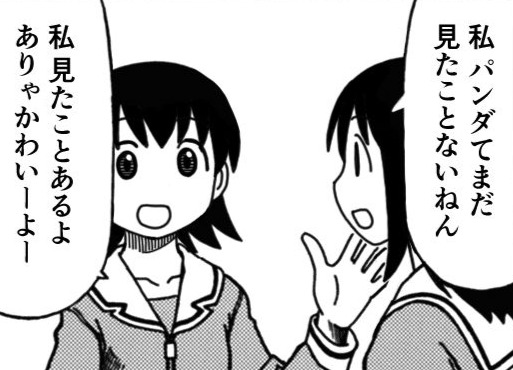
あずまんが大王 » Volume 1年生 » Page 132Chiyo shows her friends in class the panda picture book she bought.
歩( あゆむ ) :「私( わたし ) パンダてまだ見( み ) たことないねん」 “I haven't seen a panda yet.” とも: 「私( わたし ) 見( み ) たことあるよ ありゃかわいーよー」 “I've seen one. They're cute!” Challenge Yourself Show translation
Challenge
How do Ayumu's and Tomo's panda experiences differ?
歩( あゆむ ) :「私( わたし ) パンダてまだ見( み ) たことないねん」 とも: 「私( わたし ) 見( み ) たことあるよ ありゃかわいーよー」 Clues まだ見( み ) たことない has not seen one yet 見( み ) たことあるhas seen one before ありゃかわいーよ those are cute What does the speaker mean? Ayumu has never seen a panda, while Tomo has and says they are cute. Ayumu uses 見( み ) たことない, while Tomo answers with the affirmative 見( み ) たことある and comments that pandas are cute. Ayumu has seen a panda, while Tomo has not. This swaps the two experiences. Ayumu uses ない, and Tomo uses ある. Neither girl has ever seen a panda. Tomo explicitly says 見( み ) たことある, so she has seen one. Both girls have seen pandas and found them cute. Ayumu's まだ見( み ) たことない says she has not seen one yet. Ayumu saw a panda recently but Tomo saw one long ago. Ayumu describes no past viewing at all. まだ with the negative means not yet. Tomo has seen the picture book but not a real panda. Tomo's 見( み ) たことある answers Ayumu's statement about seeing a panda, not about seeing the book.
Ayumu says she has never seen a panda yet. Tomo contrasts that with her own experience and adds that pandas are cute.
View Full Example Example 10 of 11: Thought I would see her face with 〜ようと思う Example 10 of 11
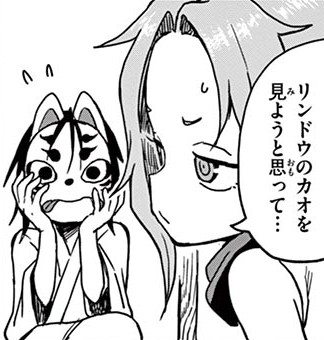
くノ一ツバキの胸の内 » Volume 3 » Page 107Seeing Rindou asleep, Sazanka reaches for her mask. Rindou wakens and backs away. Tsubaki asks what they’re doing so early in the morning.
サザンカ: 「リンドウのカオを見( み ) ようと思( おも ) って…」 “I thought I would see Rindou's face...” Challenge Yourself Show translation
Challenge
Why was Sazanka reaching toward Rindou's mask?
サザンカ: 「リンドウのカオを見( み ) ようと思( おも ) って …」 Clues リンドウのカオを "Rindou's face," marking what Sazanka wanted to see 見( み ) ようと思( おも ) って…"thinking I would try to see it..." explaining her intention What does the speaker mean? She intended to get a look at Rindou's face. リンドウのカオを names the target, and 見( み ) ようと思( おも ) って states Sazanka's intention. She wanted to fix Rindou's mask before it fell. The verb is 見( み ) る, to see, not a verb meaning to fix or adjust. She thought Rindou had asked her to remove the mask. Sazanka explains her own plan. The line contains no request from Rindou. She had already seen Rindou's face and wanted to describe it. The volitional 見( み ) よう marks an intended action, not a completed one. She wanted to check whether Rindou was awake. Sazanka specifically names Rindou's face as what she wanted to see. She was trying to hide Rindou's face from Tsubaki. 見( み ) ようと思( おも ) って expresses an attempt to see, not to conceal.
Sazanka says she was thinking of seeing リンドウのカオ. Her unfinished 見( み ) ようと思( おも ) って… sounds like a sheepish explanation after Rindou catches her.
View Full Example Example 11 of 11: Went to see a kindergarden sports day with 運動会 Example 11 of 11
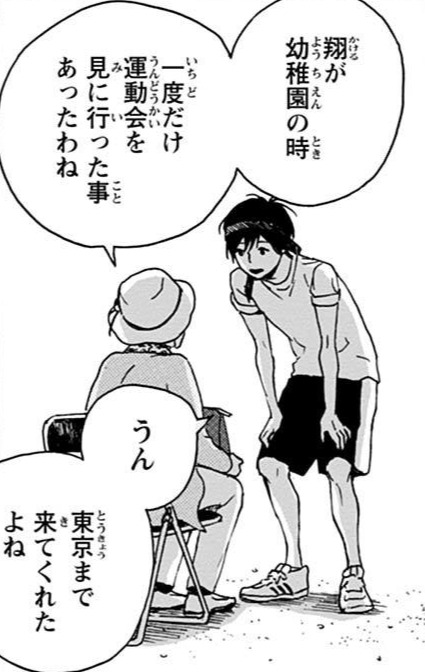
orange » Volume 4 » Page 67Kakeru’s grandmother unexpectedly shows up at the school sports day event.
おばあさん: 「翔( かける ) が幼稚園( ようちえん ) の時( とき ) 一度( いちど ) だけ運動会( うんどうかい ) を見( み ) に行( い ) った事( こと ) あったわね」 “I went to see your sports day just once when you were in kindergarten, didn't I?” 翔( かける ) :「うん 東京( とうきょう ) まで来( き ) てくれたよね」 “Yeah, you came all the way to Tokyo for me.” Challenge Yourself Show translation
Challenge
What past event are Kakeru and his grandmother recalling?
おばあさん: 「翔( かける ) が幼稚園( ようちえん ) の時( とき ) 一度( いちど ) だけ運動会( うんどうかい ) を見( み ) に行( い ) った事( こと ) あったわね」 翔( かける ) :「うん 東京( とうきょう ) まで来( き ) てくれたよね」 Clues 翔( かける ) が幼稚園( ようちえん ) の時( とき ) when Kakeru was in kindergarten 一度( いちど ) だけ運動会( うんどうかい ) を見( み ) に行( い ) ったwent just once to watch the sports day 東京( とうきょう ) まで来( き ) てくれたcame all the way to Tokyo for Kakeru What does the speaker mean? His grandmother came to Tokyo once to watch his kindergarten sports day. 翔( かける ) が幼稚園( ようちえん ) の時( とき ) sets the time, and 運動会( うんどうかい ) を見( み ) に行( い ) った states the purpose of her trip. Kakeru went to Tokyo to watch his grandmother compete. 東京( とうきょう ) まで来( き ) てくれた describes his grandmother coming to Tokyo, not Kakeru traveling there. His grandmother attended every sports day while he was in kindergarten. 一度( いちど ) だけ means she went only once, not every time. His grandmother came to take him home from kindergarten. Her stated purpose was 運動会( うんどうかい ) を見( み ) に行( い ) く, going to watch the sports day.
His grandmother made one trip to Tokyo to watch Kakeru’s sports day when he was in kindergarten. Kakeru remembers the trip as something she did for him.
View Full Example 見える (To be visible)見( み ) える is for something to be seen. It also means to seem or look a certain way.
Example 1 of 4: Difficult to see the text with 〜づらい Example 1 of 4
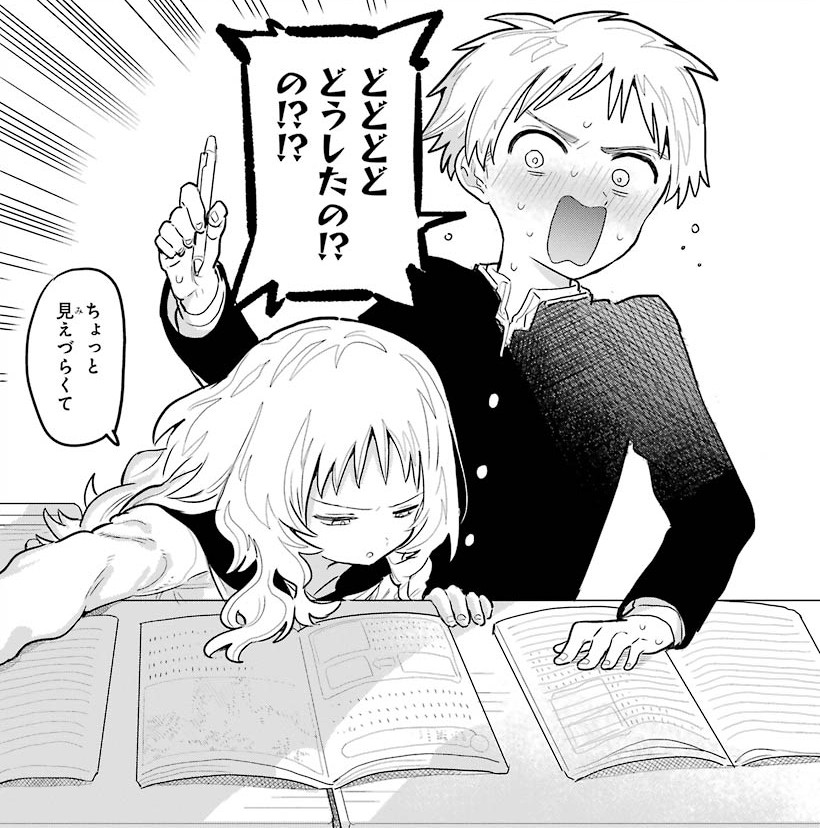
好きな子がめがねを忘れた » Volume 1 » Page 12Komura shares his history book with Mie. Since Mie forgot her glasses, she leans in as she strains to see the material written in the book.
小村( こむら ) :「どどどど どうしたの!? の!?!?」 “Wh-wh-what's wrong?!” 三重( みえ ) :「ちょっと見( み ) えづらくて」 “It's a bit difficult to see...” Challenge Yourself Show translation
Challenge
Why does Mie lean closer to Komura's book?
小村( こむら ) :「どどどど どうしたの!? の!?!?」 三重( みえ ) :「ちょっと見( み ) えづらくて 」 Clues ちょっと a little 見( み ) えづらくてbecause it is difficult to see What does the speaker mean? She is having trouble seeing the text. 見( み ) えづらい says that the writing is physically difficult for her to make out. She wants Komura to stop reading. Mie explains a problem with seeing, not an objection to the book. She cannot hear what Komura is saying. The difficulty comes from 見( み ) える, to be visible, rather than hearing. She has already finished the assignment. Her unfinished て-form explains why she needs to move closer now. She thinks the book belongs to someone else. Nothing in the line questions ownership. She is trying to read the shared page. She dislikes the history lesson. 〜づらい describes practical difficulty here, not dislike of the subject.
Mie leans close because she is having trouble seeing the text without her glasses. The trailing づらくて leaves that consequence for Komura to infer.
View Full Example Example 2 of 4: Far from seeing a fish with 〜どころか Example 2 of 4
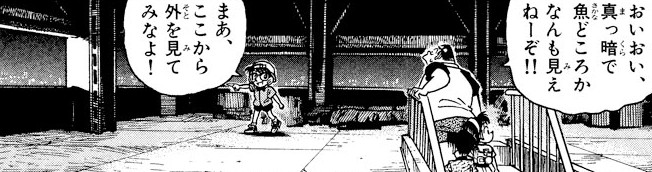
名探偵コナン » Volume 4 » Page 161The Detective Boys follow what appears to be an encoded treasure map. They’re able to locate each symbol from the map except for what appears to be a fish. Conan figures it out, and leads the group up a fire escape to the top floor of a nearby building.
元太( げんた ) :「おいおい、真( ま ) っ暗( くら ) で魚( さかな ) どころかなんも見( み ) えねーぞ!!」 “Hey, it's pitch black. Far from a fish, I can't even see anything!!” コナン: 「まあ、ここから外( そと ) を見( み ) てみなよ!」 “Well, try looking outside from here!” Challenge Yourself Show translation
Challenge
What can Genta see in the dark room?
元太( げんた ) :「おいおい、真( ま ) っ暗( くら ) で魚( さかな ) どころか なんも見( み ) えねーぞ!!」 コナン: 「まあ、ここから外( そと ) を見( み ) てみなよ!」 Clues 魚( さかな ) どころかfar from seeing a fish なんも見( み ) えねー I cannot see anything What does the speaker mean? Nothing at all. なんも with the negative 見( み ) えねー means that he cannot see anything. Only the fish-shaped clue. 魚( さかな ) どころか says he is far from being able to see the fish. The outside view clearly. Conan tells him to look outside afterward. Genta has not done so yet. A fire escape leading downward. The line only reports complete darkness and a lack of visibility. Everything except the fish. なんも見( み ) えねー means he sees nothing, not everything else. A different symbol from the map. Genta cannot make out any object or symbol in the dark.
Genta says it is pitch black and that he cannot see anything, much less the fish clue. 〜どころか sets up that stronger negative result.
View Full Example Example 3 of 4: Might appear bigger with 〜かもしれない Example 3 of 4
ご注文はうさぎですか? » Volume 1 » Page 81Due to Chino’s concerns about her height, Rize suggests a solution.
リゼ: 「声( こえ ) が大( おお ) きければ存在( そんざい ) も大( おお ) きく見( み ) える “If your voice is loud, your presence might seem bigger too.” ココア: 「錯覚( さっかく ) ですか」 “An optical illusion?” Challenge Yourself Show translation
Challenge
What does リゼ mean in the highlighted line?
リゼ: 「声( こえ ) が大( おお ) きければ存在( そんざい ) も大( おお ) きく見( み ) えるかもしれない 」 ココア: 「錯覚( さっかく ) ですか」 Clues かもしれない かもしれない keeps Rize's proposal uncertain What does the speaker mean? If your voice is loud, your presence might seem bigger too. Rize suggests that a louder voice might make Chino's presence seem bigger, but she does not promise that it will work. Rize promises that a loud voice will make Chino physically taller. The highlighted form is かもしれない. Here かもしれない keeps Rize's proposal uncertain, so this choice does not match the Japanese. Rize says a quieter voice might make Chino seem bigger. The highlighted form is かもしれない. Here かもしれない keeps Rize's proposal uncertain, so this choice does not match the Japanese. Rize says Chino already has a loud and commanding presence. The highlighted form is かもしれない. Here かもしれない keeps Rize's proposal uncertain, so this choice does not match the Japanese.
かもしれない keeps Rize’s proposal uncertain. Rize suggests that a louder voice might make Chino’s presence seem bigger, but she does not promise that it will work.
View Full Example Example 4 of 4: Seeing a comet with the naked eye with 肉眼 Example 4 of 4
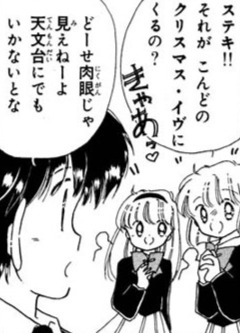
怪盗セイント・テール » Volume 4 » Page 6Before class, Asuka Jr. mentions a Graham Comet, which passes near the Earth once every fifty years.
涼子( りょうこ ) :「ステキ!! それが こんどのクリスマス・イヴにくるの?」 “Awesome!! Is it coming this Christmas Eve?” アスカ Jr.: 「どーせ肉眼( にくがん ) じゃ見( み ) えねーよ。天文台( てんもんだい ) にでもいかないとな」 “You won't be able to see it with the naked eye anyway. You'd have to go to an observatory or something.” Challenge Yourself Show translation
Challenge
What does Asuka Jr. say they would need to do to see the comet?
涼子( りょうこ ) :「ステキ!! それが こんどのクリスマス・イヴにくるの?」 アスカ Jr.: 「どーせ肉眼( にくがん ) 見( み ) えねーよ。天文台( てんもんだい ) にでもいかないとな」 Clues 肉眼( にくがん ) じゃ見( み ) えねーthe comet cannot be seen with the unaided eye 天文台( てんもんだい ) にでもいかないとなthey would have to go somewhere such as an observatory What does the speaker mean? Go to an observatory or somewhere with viewing equipment. 肉眼じゃ見えねー rules out unaided viewing, and 天文台にでもいかないとな gives the necessary alternative. Wait until the comet becomes visible to the naked eye. Asuka Jr. says it cannot be seen with the naked eye. He does not suggest that waiting will change that. Travel to the place where the comet will reach Earth. The comet passes near Earth, but his practical suggestion is to visit an observatory. Watch it from the school before class. The conversation happens before class, but he says specialized viewing at an observatory is needed. Look for it on a different night after Christmas Eve. He discusses where and how to view it, not changing the date. Ask someone at the observatory to describe it afterward. いかないとな means they would need to go there themselves, not merely hear a description later.
Asuka Jr. says the comet is not visible to the naked eye. His casual 天文台にでもいかないとな means that they would have to go to an observatory or a similar place with the equipment needed to see it.
View Full Example 見せる (To show)見( み ) せる is to let someone see something.
Example 1 of 2: Opportunity to make a bet with せっかく〜だから Example 1 of 2
ご注文はうさぎですか? » Volume 1 » Page 104Chiya and Chino prepare to play chess at an indoor hot spring.
千夜( ちや ) :「せっかくだから何( なに ) か賭( か ) けてみない?」 “Since we've got the chance, want to bet something?” 「私( わたし ) が勝( か ) ったらティッピーが頭( あたま ) まで濡( ぬ ) れたらどうなるか見( み ) せてもらうのはどう?」 “If I win, how about letting me see what Tippy looks like completely soaked?” Challenge Yourself Show translation
Challenge
What does 千夜( ちや ) mean in the highlighted line?
千夜( ちや ) :「せっかく だから 何( なに ) か賭( か ) けてみない?」 「私( わたし ) が勝( か ) ったらティッピーが頭( あたま ) まで濡( ぬ ) れたらどうなるか見( み ) せてもらうのはどう?」 Clues せっかくだから せっかくだから uses the chess game as an opportunity What does the speaker mean? Since we've got the chance, want to bet something? Chiya suggests adding a wager because they have the special chance to play together. Chiya says the special occasion is a reason not to make a wager. The highlighted form is せっかくだから. Here せっかくだから uses the chess game as an opportunity, so this choice does not match the Japanese. Chiya says the wager was settled before the chess game began. The highlighted form is せっかくだから. Here せっかくだから uses the chess game as an opportunity, so this choice does not match the Japanese. Chiya commands Cocoa to bet something against her will. The highlighted form is せっかくだから. Here せっかくだから uses the chess game as an opportunity, so this choice does not match the Japanese.
せっかくだから uses the chess game as an opportunity. Chiya suggests adding a wager because they have the special chance to play together.
View Full Example Example 2 of 2: That said, she'll still show her homework with 〜つつも Example 2 of 2
あしたは土曜日 » Volume 春・夏 » Page 122As summer break is half over, talk of summer homework comes up. Yukari says she won’t let Mina copy off of hers.
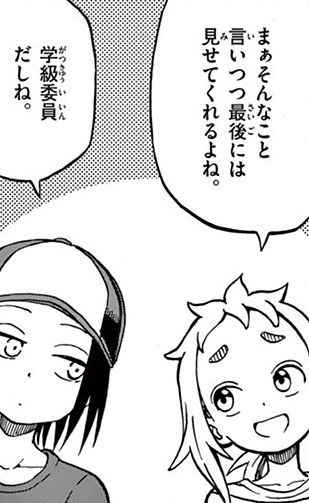
ミナ: 「まぁそんなこと言( い ) いつつ最後( さいご ) には見( み ) せてくれるよね」 “Well, even though she says that, she'll show it to me in the end, you know.” サナエ: 「学級委員長( がっきゅういいんちょう ) だしね」 “She is the class representative, after all.” Challenge Yourself Show translation
Challenge
What does Mina expect Yukari to do despite her refusal?
ミナ: 「まぁそんなこと言( い ) いつつ 最後( さいご ) には見( み ) せてくれるよね」 サナエ: 「学級委員長( がっきゅういいんちょう ) だしね」 Clues そんなこと言( い ) いつつ even while saying that 最後( さいご ) にはin the end 見( み ) せてくれるshow it as a favor to the speaker よね states an expectation and seeks agreement What does the speaker mean? Yukari will eventually show Mina her homework. 言( い ) いつつ contrasts Yukari's refusal with the expected result, and 最後( さいご ) には見( み ) せてくれる says she will show it in the end. Yukari will stand by her refusal and never show it. 言( い ) いつつ introduces a contrast. Mina expects Yukari's eventual action to differ from what she says now. Mina will show Yukari her own homework. The giver-oriented くれる presents the showing as something Yukari will do for Mina, not the reverse. Yukari will complete Mina's homework for her. 見( み ) せる means to show. The line does not say Yukari will write or complete Mina's work. The teacher will show both girls the answers. The omitted subject remains Yukari from the preceding refusal. No teacher is introduced in these lines. Sanae will use her class position to demand the homework. Sanae mentions the class representative afterward, but Mina's expectation is that Yukari will voluntarily show the homework.
Mina treats Yukari’s refusal as something she says now but will not maintain. She expects Yukari to show her the homework in the end.
View Full Example 見つめる (To stare at)見( み ) つめる is to look at something steadily for a long time.
ご注文はうさぎですか? » Volume 1 » Page 113Cocoa buys Chino a puzzle to make up for finishing the one Chino had been working on. The two and their friends work at putting the new puzzle together.
チノ: 「ココアさんさっきからピース見( み ) つめながら動( うご ) かない…」 “Cocoa-san has been staring at the puzzle piece while not moving for a while now...” 「その…責任( せきにん ) 取( と ) ろうと無理( むり ) しないでください」 “Um... Please don't push yourself trying to take responsibility.” Challenge Yourself Show translation
Challenge
What does チノ mean in the highlighted line?
チノ: 「ココアさんさっきからピース見( み ) つめながら 動( うご ) かない 「その…責任( せきにん ) 取( と ) ろうと無理( むり ) しないでください」 Clues 見( み ) つめながら動( うご ) かない見( み ) つめながら動( うご ) かない combines simultaneous actionsWhat does the speaker mean? Cocoa-san has been staring at the puzzle piece while not moving for a while now... Cocoa keeps staring at the piece while remaining motionless. Cocoa is the subject of both actions. Chino says Cocoa keeps moving without looking at the puzzle piece. The highlighted form is 見( み ) つめながら動( うご ) かない. Here 見( み ) つめながら動( うご ) かない combines simultaneous actions, so this choice does not match the Japanese. Chino says Cocoa stopped staring at the piece a moment ago. The highlighted form is 見( み ) つめながら動( うご ) かない. Here 見( み ) つめながら動( うご ) かない combines simultaneous actions, so this choice does not match the Japanese. Chino tells Cocoa to keep staring and avoid moving. The highlighted form is 見( み ) つめながら動( うご ) かない. Here 見( み ) つめながら動( うご ) かない combines simultaneous actions, so this choice does not match the Japanese.
見( み ) つめながら動( うご ) かない combines simultaneous actions. Cocoa keeps staring at the piece while remaining motionless. Cocoa is the subject of both actions.
View Full Example Appearance 見た目 (Looks)見( み ) た目( め ) is how someone or something looks, the impression it gives at a glance. It is more casual than 外見( がいけん ) .
It combines 見た (seen ) with 目 (eye ) to show how it looks to the eye .
からかい上手の高木さん » Volume 17 » Page 84On a nighttime walk, Hamaguchi sees Hokujou casually dressed and wearing glasses. She’s fine with Hamaguchi seeing her like this, as they’ve known each other for a long time, but she tells him not to tell their classmates. At school the next morning…
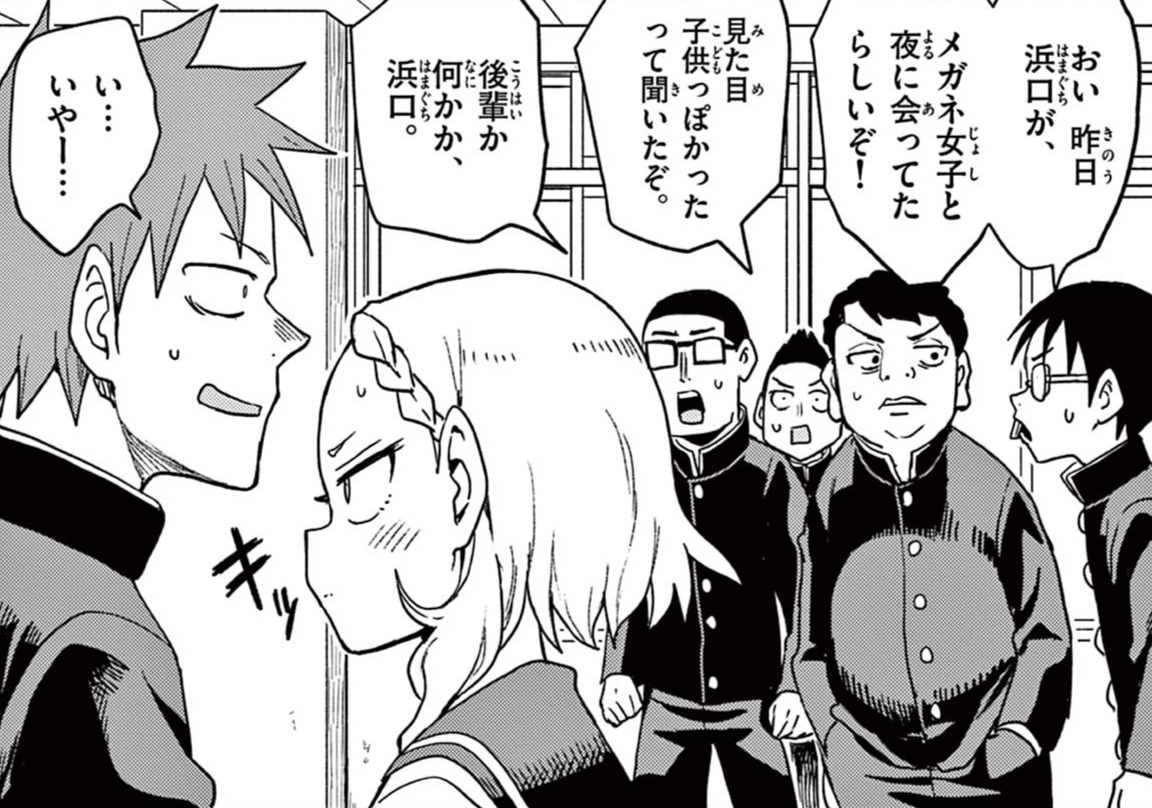
高尾( たかお ) :「おい 昨日( きのう ) 浜口( はまぐち ) が、メガネ女子( じょし ) と夜( よる ) に会( あ ) ってたらしいぞ!」 “Hey, I heard Hamaguchi was hanging out with a girl in glasses last night!” 生徒( せいと ) A:「見( み ) た目( め ) 子供( こども ) っぽかったって聞( き ) いたぞ。」 “I heard she looked kind of childish.” 生徒( せいと ) B:「後輩( こうはい ) か何( なに ) かか、浜口( はまぐち ) 。」 “Is she a junior or something, Hamaguchi?” 浜口( はまぐち ) :「い… いやー…」 “Uh... well...” Challenge Yourself Show translation
Challenge
What does the classmate guess about the girl Hamaguchi met?
高尾( たかお ) :「おい 昨日( きのう ) 浜口( はまぐち ) が、メガネ女子( じょし ) と夜( よる ) に会( あ ) ってたらしいぞ!」 生徒( せいと ) A:「見( み ) た目( め ) 子供( こども ) っぽかったって聞( き ) いたぞ。」 生徒( せいと ) B:「後輩( こうはい ) か何( なに ) か か、浜口( はまぐち ) 。」 浜口( はまぐち ) :「い… いやー…」 Clues メガネ女子( じょし ) the girl in glasses 後輩( こうはい ) か何( なに ) かa junior or something 〜か、浜口( はまぐち ) asks Hamaguchi to confirm the guess What does the speaker mean? She might be Hamaguchi's junior or someone like that. 後輩( こうはい ) か何( なに ) か offers junior as a tentative category for the girl in glasses. She is definitely Hamaguchi's younger sister. The guess is 後輩( こうはい ) , not younger sister, and か何( なに ) か keeps it uncertain. She is a teacher Hamaguchi met at school. No teacher is mentioned. The proposed category is a junior. Hamaguchi met several girls wearing glasses. The rumor concerns one メガネ女子( じょし ) . か何( なに ) か lists possible identity, not additional people. The girl asked Hamaguchi to become her junior. The classmate is guessing what relationship she already has to Hamaguchi, not reporting a request. Hamaguchi says he does not know the girl. Hamaguchi only hesitates in response. The identity claim comes from his classmate.
The classmate tentatively guesses that the girl in glasses might be Hamaguchi’s junior or someone in a similar relationship.
View Full Example Discovery 見つける (To find)見( み ) つける is to find something by searching for it, or to come across it by chance.
Example 1 of 3: Figuring out the password with 見つけ出す Example 1 of 3
ああっ女神さまっ » Volume 1 » Page 85Kei’ichi must enter the university system to add a record showing Belldandy is enrolled. He only has a brief window of opportunity before Professor Ozawa logs into the system and discovers she isn’t enrolled. The only thing standing in Kei’ichi’s way is the university’s enrollment records password protection.
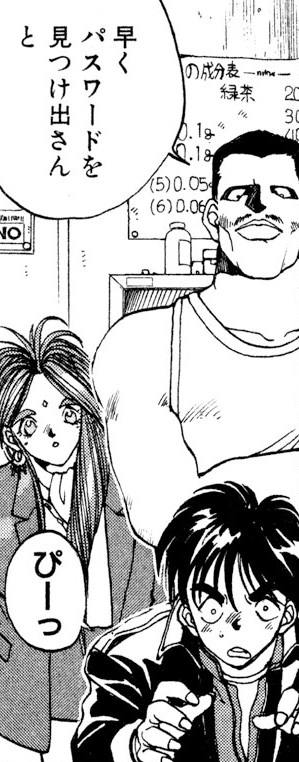
田宮( たみや ) :「早( はや ) く パスワードを見( み ) つけ出( だ ) さんと」 “If you don't hurry and figure out that password...” Challenge Yourself Show translation
Challenge
What urgent task does Tamiya leave unfinished?
田宮( たみや ) :「早( はや ) く パスワードを見( み ) つけ出( だ ) さん Clues 早( はや ) くquickly パスワードを the password, marked as the object 見( み ) つけ出( だ ) すto find or uncover after effort 〜んと a casual form of 〜ないと, if we do not What does the speaker mean? They must figure out the password quickly, or there will be trouble. 見( み ) つけ出( だ ) さんと contracts 見( み ) つけ出( だ ) さないと, and the unfinished conditional leaves the bad consequence understood. They have already found the password faster than expected. 見( み ) つけ出( だ ) さんと is not a completed past action. It means that they need to find it before an unstated consequence follows. They need to create a new password immediately. 見( み ) つけ出( だ ) す means to find or uncover something. Creating a password would require a verb such as 作( つく ) る. They should stop searching because the password is unnecessary. The negative element belongs to the condition 〜ないと, meaning if they do not find it. It does not tell them to stop. They must enter a password that Tamiya already knows. The verb is 見( み ) つけ出( だ ) す, to uncover. The line does not use a verb for entering or typing the password. They should ask Professor Ozawa to reveal the password. No request to Professor Ozawa appears in the line. Tamiya presses the group to find the password before time runs out.
Tamiya uses the casual conditional 見( み ) つけ出( だ ) さんと, from 見( み ) つけ出( だ ) さないと. He trails off after saying that they must uncover the password quickly, leaving the looming consequence unstated.
View Full Example Example 2 of 3: Going to buy mugs with 〜に行く Example 2 of 3
ご注文はうさぎですか? » Volume 1 » Page 51Cocoa discusses the café’s coffee cups with Chino.
ココア: 「この前( まえ ) 面白( おもしろ ) いカップ見( み ) つけたんだ」 “I found an interesting cup the other day.” 「今度( こんど ) 買( か ) いに行( い ) かない?」 “Why don't we go buy some?” リゼ: 「へぇ どんな」 “Oh? What kind?” Challenge Yourself Show translation
Challenge
Which interpretation best matches the highlighted line?
ココア: 「この前( まえ ) 面白( おもしろ ) いカップ見( み ) つけたんだ」 「今度( こんど ) 買( か ) いに行( い ) かない? 」 リゼ: 「へぇ どんな」 Clues 買( か ) いに行( い ) かない?買( か ) いに行( い ) く states the purpose of goingWhat does the speaker mean? Why don't we go buy some? The group would go to the shop in order to buy the cups Cocoa mentioned. Cocoa says she has already bought the interesting cups. The highlighted form is 買( か ) いに行( い ) かない?. Here 買( か ) いに行( い ) く states the purpose of going, so this choice does not match the Japanese. Cocoa asks Rize to go shopping alone. The highlighted form is 買( か ) いに行( い ) かない?. Here 買( か ) いに行( い ) く states the purpose of going, so this choice does not match the Japanese. Cocoa invites the others to search for a cup she lost. The highlighted form is 買( か ) いに行( い ) かない?. Here 買( か ) いに行( い ) く states the purpose of going, so this choice does not match the Japanese.
買( か ) いに行( い ) く states the purpose of going. The group would go to the shop in order to buy the cups Cocoa mentioned.
View Full Example Example 3 of 3: Worth selecting a costume with 〜がいある Example 3 of 3
藤原くんはだいたい正しい » Volume 1 » Page 172As a member of the student council, Hitsuji comes up with the idea of having a cosplay theme to help build up excitement among students for the school’s sports day. However, Fujiwara, the student council president, fails to dress up. Upon hearing him say he doesn’t have a costume prepared, one of the drama club students suggests he pick from their club’s costumes. While Fujiwara isn’t enthusiastic at the prospect of dressing up, Hitsuji is excited by the club’s wide selection.
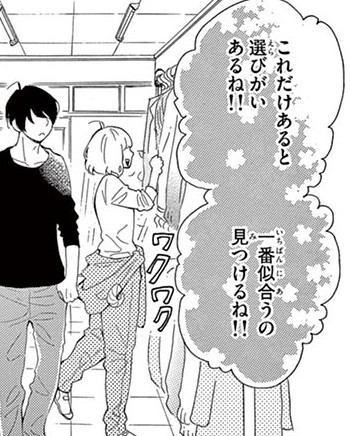
ヒツジ: 「これだけあると選( えら ) びがいあるね!!一番( いちばん ) 似( に ) 合( あ ) うの見( み ) つける “When there are this many, it's worth it to choose from! I'll find the one that suits you best!” Challenge Yourself Show translation
Challenge
Why does Hitsuji think choosing a costume will be worthwhile?
ヒツジ: 「これだけあると選( えら ) びがいある ね!!一番( いちばん ) 似( に ) 合( あ ) うの見( み ) つけるね!」 Clues これだけあると the drama club has this many costumes available 選( えら ) びがいあるね! 一番( いちばん ) 似( に ) 合( あ ) うの見( み ) つけるねthe large selection makes choosing rewarding as they look for the best fit What does the speaker mean? There are many costumes to choose from, so they can find the best one. これだけあると points to the large selection, and 一番似合うの identifies finding the costume that suits Fujiwara best. There are only a few costumes, so the decision will be quick. これだけあると emphasizes how many choices the club has, not a limited selection. Fujiwara has already selected the costume he likes most. Hitsuji is excited to begin choosing and promises to find the best match. The choice is not settled yet. The drama club requires Fujiwara to make a costume himself. The club offers its existing costume collection. No one asks Fujiwara to sew a new one. Choosing is worthwhile because every costume fits him equally well. 一番似合うの means they are looking for the one that suits him best, not treating all choices as equal. The sports day costume theme has been canceled. Hitsuji remains excited about dressing Fujiwara for the event. The line does not cancel the theme.
The drama club has a large costume collection, which makes the search itself satisfying for Hitsuji. She wants to use all those options to find the costume that suits Fujiwara best.
View Full Example 見つかる (To be found)見( み ) つかる is for something to be found. It also means to be caught by someone.
Example 1 of 2: Can't be found with 〜っこない Example 1 of 2
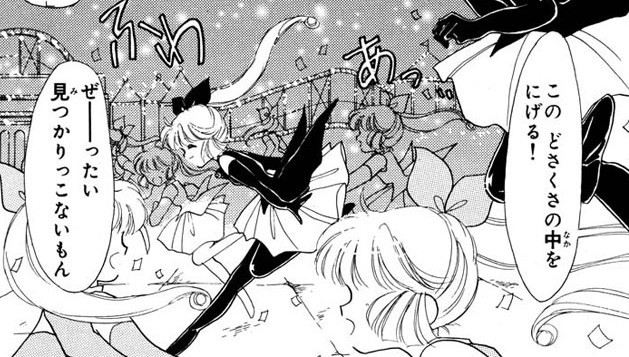
怪盗セイント・テール » Volume 2 » Page 34Saint Tail sends out a parade of copies of herself to confuse Asuka Jr. and the police.
セイント・テール: 「この どさくさの中( なか ) をにげる!」 “I'll escape in the midst of all this confusion!” 「ぜーーったい見つかりっこないもん」 “There's absolutely no way that I can be found.” Challenge Yourself Show translation
Challenge
What does Saint Tail expect to happen while everyone is confused?
セイント・テール: 「この どさくさの中( なか ) をにげる!」 「ぜーーったい見つかり っこない もん」 Clues このどさくさの中( なか ) をにいげる she plans to use the commotion as her chance to escape ぜーーったい見( み ) つかりっこない she strongly denies any possibility of being found What does the speaker mean? She will escape, and there is no chance anyone will find her. どさくさの中をにいげる states her plan, while 見つかりっこない rules out any chance of being found. She will hide until the police finish searching the area. Saint Tail says she will escape through the confusion, not wait in hiding for the search to end. She expects one of her copies to be found instead. The copies create the confusion, but her statement is about her own escape and confidence that she will not be found. She thinks the confusion will make it hard for her to escape. She treats the confusion as an opportunity to escape, not as an obstacle. She will let herself be found after leaving the crowd. 見つかりっこない is an emphatic denial that she will be found at all. She is unsure whether the police have noticed the commotion. ぜーーったい and 〜っこない express complete confidence, not uncertainty.
Saint Tail plans to slip away through the commotion caused by her copies. 見つかりっこない expresses her certainty that no one has any chance of finding her.
View Full Example Example 2 of 2: Drawing a conclusion about a murder with 結論 Example 2 of 2
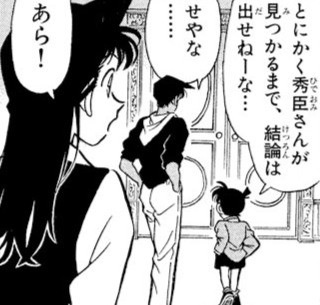
名探偵コナン » Volume 16 » Page 18Conan and Heiji end up staying at the same mansion when a murder occurs. They decide to put their heads together to try and determine who the culprit is.
コナン: 「とにかく秀臣( ひでおみ ) さんが見( み ) つかる結論( けつろん ) は出( だ ) せねーな…」 “Anyway, I guess we can't come to a conclusion until we find Hideomi...” 平次( へいじ ) :「せやな……」 “That's right.” 蘭( らん ) :「あら!」 “Oh!” Challenge Yourself Show translation
Challenge
Why do Conan and Heiji hold off on reaching a conclusion?
コナン: 「とにかく秀臣( ひでおみ ) さんが見( み ) つかるまで、結論( けつろん ) 出( だ ) せねーな…」 平次( へいじ ) :「せやな……」 蘭( らん ) :「あら!」 Clues 秀臣( ひでおみ ) さんが見( み ) つかるまでuntil Hideomi is found 結論( けつろん ) は出( だ ) せねーwe cannot reach a conclusion What does the speaker mean? They need Hideomi to be found first. 〜まで with the negative says they cannot conclude the case before Hideomi is found. They have already agreed on the culprit. 結論( けつろん ) は出( だ ) せねー says they cannot yet settle on an answer. They are waiting for Ran to choose between their theories. The stated condition is finding Hideomi, not Ran's judgment. They need the police to leave the mansion. No departure by the police is tied to their conclusion. They cannot understand each other's dialect. Heiji immediately agrees with Conan using せやな. They have decided there was no murder. They are still investigating the murder and lack a final conclusion.
Conan says they cannot draw a conclusion until Hideomi is found, and Heiji agrees. The negative potential 出( だ ) せねー means they are not yet able to reach one.
View Full Example 見抜く (To see through)見( み ) 抜( ぬ ) く is to see through a lie, disguise, or surface appearance to the truth behind it.
It combines 見 (see ) with 抜く (pierce ) to show seeing right through .
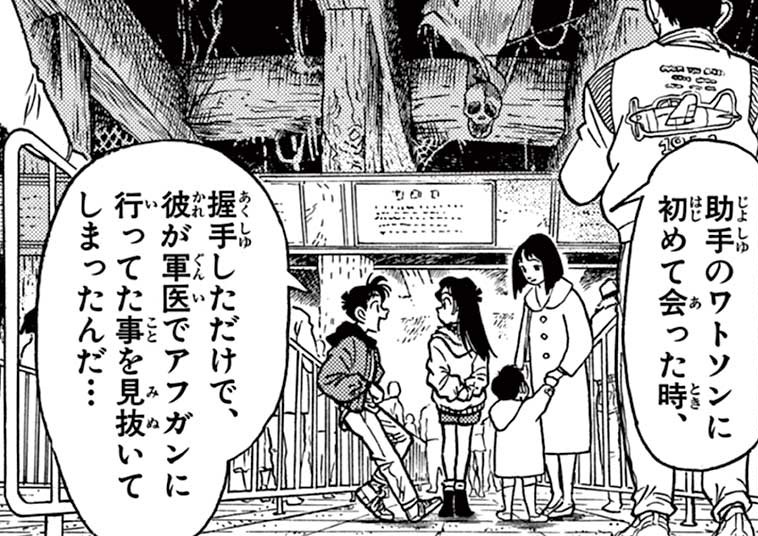
名探偵コナン » Volume 1 » Page 17Shin’ichi treats Ran to a day at Tropical Land as a reward for winning the city karate tournament. As they wait in line for a ride on the roller coaster, Shin’ichi explains all the reasons why Sherlock Holmes was the greatest detective.
新一( しんいち ) :「助手( じょしゅ ) のワトソンに初( はじ ) めて会( あ ) った時( とき ) 、握手( あくしゅ ) しただけで、彼( かれ ) が軍医( ぐんい ) でアフガンに行( い ) ってた事( こと ) を見( み ) 抜( ぬ ) いてしまったんだ…」 “The first time he met his assistant Watson, Holmes could tell just from a handshake that he was a military doctor who had been stationed in Afghanistan...” Challenge Yourself Show translation
Challenge
What did Holmes deduce merely from shaking Watson's hand?
新一( しんいち ) :「助手( じょしゅ ) のワトソンに初( はじ ) めて会( あ ) った時( とき ) 、握手( あくしゅ ) しただけで、彼( かれ ) が軍医( ぐんい ) でアフガンに行( い ) ってた事( こと ) を見( み ) 抜( ぬ ) いてしまったんだ…」 Clues 握手( あくしゅ ) しただけでmerely by shaking hands 彼( かれ ) が軍医( ぐんい ) でアフガンに行( い ) ってた事( こと ) that he was a military doctor who had been to Afghanistan What does the speaker mean? Watson was a military doctor who had been to Afghanistan. The long 事( こと ) clause gives the fact Holmes saw through from the handshake alone. Watson had never worked as a doctor. Shin'ichi identifies him specifically as a 軍医( ぐんい ) , military doctor. Watson planned to travel to Afghanistan next. 行( い ) ってた describes a past experience, not a future plan. Watson wanted to become Holmes's enemy. The scene concerns their first meeting and Holmes's deduction, not hostility. Watson injured Holmes during the handshake. The handshake provides evidence. No injury occurs. Watson had served as a detective in London. The role named in the deduction is military doctor.
Holmes inferred from a single handshake that Watson was a military doctor who had been to Afghanistan. だけで stresses how little evidence he needed.
View Full Example Views 甘く見る (To underestimate)甘( あま ) く見( み ) る is to treat someone or something as weaker or easier than it really is.
怪盗セイント・テール » Volume 7 » Page 46Meimi’s mother stops by Meimi’s room with a couple of movie tickets. She says she and Meimi’s father have already seen the movie, so she’s offering them to Meimi. She says the movie is very romantic, and suggests Meimi has someone she’d want to see it with.
芽美( めいみ ) :「マ… ママ知( し ) って…」 “Mom, you knew...?” ママ: 「ママを甘( あま ) く見( み ) ないことね」 “Don't underestimate Mom.” Challenge Yourself Show translation
Challenge
What warning does Meimi's mother give her?
芽美( めいみ ) :「マ… ママ知( し ) って…」 ママ: 「ママを甘( あま ) く見( み ) ない Clues ママを甘( あま ) く見( み ) ない she tells Meimi not to judge her mother too lightly 〜ないことね frames the warning as firm, knowing advice What does the speaker mean? Do not underestimate how much her mother knows. ママを甘く見ない warns Meimi not to assume that her mother is easy to fool or unaware. Do not tell her mother about the movie tickets. Her mother brought the tickets herself. The warning concerns underestimating her, not hiding the tickets. Do not assume the movie will be romantic. Her mother has already described the movie as romantic. 甘く見ない is about taking a person lightly. Do not invite her father to see the movie. Her parents have already seen it, but the warning does not tell Meimi whom to invite. Do not expect her mother to approve of any date. The line shows that her mother has noticed Meimi's feelings. It does not state that she disapproves. Do not ask how her mother learned about Saint Tail. The scene concerns Meimi's romantic interest, not her secret identity as Saint Tail.
Meimi is startled that her mother has noticed her feelings. Her mother replies ママを甘く見ないことね, warning Meimi not to underestimate how perceptive she is.
View Full Example Oversights 見逃す (To overlook)見( み ) 逃( のが ) す is to miss seeing something, such as a show or a clue. It also means to let a wrongdoing go on purpose.
It combines 見 (see ) with 逃す (let slip ) to show letting something slip past one's eyes .
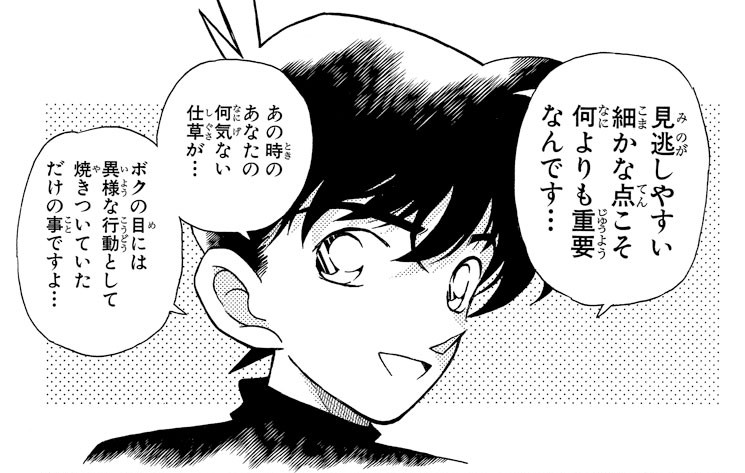
名探偵コナン » Volume 21 » Page 119Shin’ichi reveals the details of a murder. The culprit asks how Shin’ichi discovered the hidden weapon, and he explains it was due to a specific movement the culprit made.
新一( しんいち ) :「見逃( みのが ) しやすい細( こま ) かな点( てん ) こそ何( なに ) よりも重要( じゅうよう ) なんです…」 “It's precisely those subtle details that are easy to overlook that matter most of all...” 「あの時( とき ) のあなたの何気( なにげ ) ない仕草( しぐさ ) が…」 “That casual gesture of yours back then...” 「僕( ぼく ) の目( め ) には異様( いよう ) な行動( こうどう ) として焼( や ) きついてただけの事( こと ) ですよ…」 “It's just that it was etched in my mind as strange behavior...” Challenge Yourself Show translation
Challenge
Why did the culprit's casual gesture stay in Shin'ichi's memory?
新一( しんいち ) :「見逃( みのが ) しやすい細( こま ) かな点( てん ) こそ何( なに ) よりも重要( じゅうよう ) なんです…」 「あの時( とき ) のあなたの何気( なにげ ) ない仕草( しぐさ ) が…」 「僕( ぼく ) の目( め ) には異様( いよう ) 行動( こうどう ) として焼( や ) きついてただけの事( こと ) ですよ…」 Clues 僕( ぼく ) の目( め ) には異様( いよう ) な行動( こうどう ) としてin my eyes, as strange behavior 焼( や ) きついてたit was etched into my memory What does the speaker mean? It struck him as unnaturally strange behavior. 異様( いよう ) な行動( こうどう ) explains why the otherwise casual gesture stood out. It was the most ordinary action at the scene. Shin'ichi says it appeared 異様( いよう ) , abnormal or out of place. The culprit repeated it after confessing. The line refers to the gesture at the earlier moment, not a later confession. Someone photographed the movement for him. 焼( や ) きつく is figurative here, meaning the sight remained vividly in his mind. It caused him to overlook all the smaller details. He says small, easily missed details are especially important. The gesture directly revealed the culprit's name. It served as suspicious behavioral evidence, not a spoken identification.
The gesture looked casual, but Shin’ichi saw it as strangely out of place. That abnormal impression caused it to remain vividly etched in his memory.
View Full Example 見間違う (To mistake)見( み ) 間( ま ) 違( ちが ) う is to see something wrong and take it for something else.
It combines 見 (see ) with 間違う (be wrong ) to show seeing wrongly .
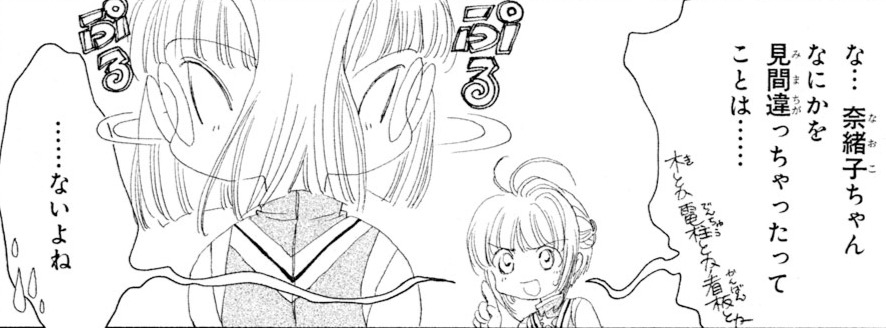
カードキャプターさくら » Volume 1 » Page 131After piano class, Naoko hurries home only to see a ghostly figure appear from within a lake at the park. She recalls the events to her friends at school.
桜( さくら ) :「な…奈緒子( なおこ ) ちゃん なにかを見( み ) 間( ま ) 違( ちが ) っちゃったってことは…… (木( き ) とか電柱( でんちゅう ) とか看板( かんばん ) とか)」 “Na... Naoko, could it be that you ended up seeing something wrong...... (like a tree or a utility pole or a sign or something)?” 「……ないよね」 “......I guess not.” Challenge Yourself Show translation
Challenge
What possibility does Sakura hesitantly suggest?
桜( さくら ) :「な…奈緒子( なおこ ) ちゃん なにかを見( み ) 間( ま ) 違( ちが ) っちゃった ってことは…… (木( き ) とか電柱( でんちゅう ) とか看板( かんばん ) とか)」 「……ないよね」 Clues なにかを見( み ) 間( ま ) 違( ちが ) っちゃった Naoko accidentally mistook something she saw 木( き ) とか電柱( でんちゅう ) とか看板( かんばん ) とかexamples of ordinary objects such as a tree, utility pole, or sign ってことは……ないよね could it be that, followed by Sakura backing away from the suggestion What does the speaker mean? Naoko may have mistaken an ordinary object for the ghostly figure. 見( み ) 間( ま ) 違( ちが ) っちゃった suggests an accidental misidentification, and Sakura lists ordinary objects Naoko might have seen. Naoko may have seen the ghost turn into a tree. The tree is one possible object Naoko mistook for the figure. Sakura does not say the figure transformed. Naoko may have invented the story to frighten her friends. Sakura wonders whether Naoko misidentified what she saw, not whether she deliberately lied. Naoko may have gone to the wrong park after class. 見( み ) 間( ま ) 違( ちが ) う concerns seeing something incorrectly. It does not mean choosing the wrong location. Naoko may have read a warning on a sign incorrectly. 看板( かんばん ) is listed as an object she might have mistaken for the figure, not as text she misread. Naoko may have confused Sakura with someone near the lake. Sakura proposes a tree, utility pole, or sign as the mistaken object. She does not place herself at the lake.
Sakura wonders whether Naoko accidentally mistook an ordinary object for the ghostly figure. Her examples make the suggestion concrete, but ……ないよね shows that she doubts her own explanation.
View Full Example