Sending and escorting with 送
送 means “to move a person or object to another place”, “to see off”, or “to send”.
Etymology
This kanji isa phono-semantic compound comprised of 辶 (movement radical, "to walk") as the semantic component and 关 as the phonetic component (ソウ).
The movement radical invokes imagery of traveling or going, while 关 supplies the sound.
The meanings of sending and escorting are clear from this imagery of movement and travel. From these core meanings, the kanji extends to include transmitting (sending information), dispatching (sending goods), broadcasting (sending signals), and seeing off (escorting someone on departure).
Broadcasting and Transmission
放送 (Broadcast)放送( ほうそう ) means broadcasting audio or video to a public audience by television, radio, or the internet.
It combines 放 (send out ) with 送 (send ) to show content being sent outward to the public .
からかい上手の高木さん »
Volume 19 » Page 88
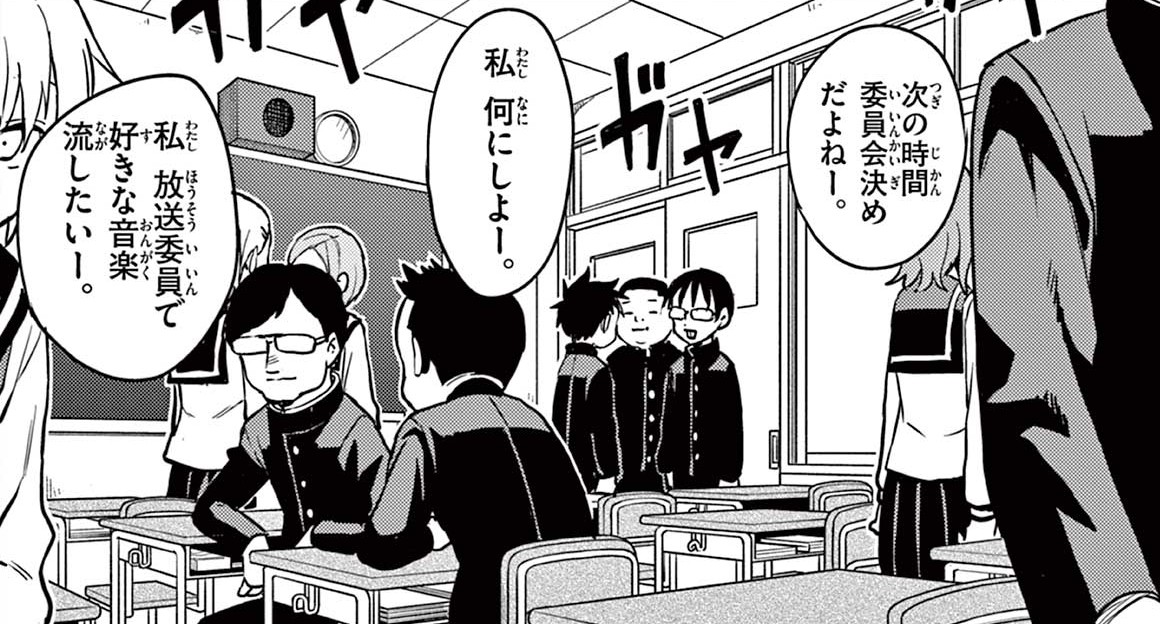
Nishika and Takagi’s class discusses what committees they plan to join.
生徒( せいと ) :「次( つぎ ) の時間( じかん ) 委員会( いいんかい ) 決( ぎ ) めだよねー。」
“Next up is deciding the committee schedule, right?”
生徒( せいと ) :「私( わたし ) 何( なに ) にしよー」
“What should I pick?”
生徒( せいと ) :「私( わたし ) 放送( ほうそう ) 委員( いいん ) で好( す ) きな音楽( おんがく ) 流( なが ) したいー。」
“I want to play my favorite music as a member of the broadcasting committee.”
Challenge Yourself
Show translation
Challenge
Which committee does the student want, and why?
Clues
放送( ほうそう ) 委員( いいん ) で"as a member of the broadcasting committee"
好( す ) きな音楽( おんがく ) 流( なが ) したい"want to play music I like," with the object marker を omitted
What does the speaker mean?
The broadcasting committee, so she can play music she likes.
放送( ほうそう ) 委員( いいん ) names the committee, and 流( なが ) したい states what she wants to do there.
The music committee, so she can perform her own songs.
She says 放送( ほうそう ) 委員( いいん ) , not a music committee, and 流( なが ) す means to play or broadcast music here.
The broadcasting committee, so she can make school announcements.
The committee is right, but her stated goal is to play music she likes.
The class committee, so she can choose the schedule.
委員会( いいんかい ) 決( ぎ ) め is the class activity. It is not the committee she chooses.
The library committee, so she can listen to music while working.
The line names the broadcasting committee and says she wants to send music over the system.
She has not decided which committee she wants.
Her earlier question is followed by a specific choice, 放送( ほうそう ) 委員( いいん ) .
The student settles on the 放送( ほうそう ) 委員( いいん ) , the broadcasting committee. Her reason is 好( す ) きな音楽( おんがく ) 流( なが ) したい, she wants to play music she likes.
View Full Example
送信 (Transmission)送信( そうしん ) means sending data, a message, or a signal to another location.
It combines 送 (send ) with 信 (message ) to show sending a message or communication .
ひらやすみ »
Volume 1 » Page 63
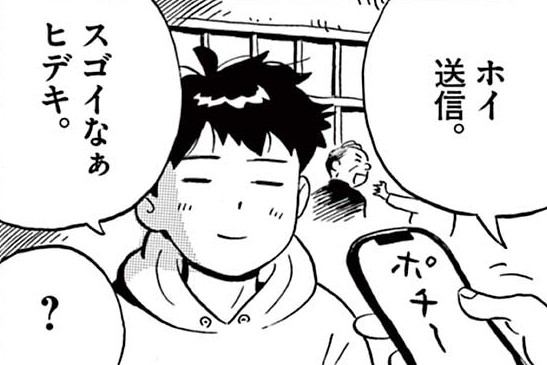
Hiroto is having dinner with his friend Hideki. After Hideki reveals that his wife is going to have a baby, he looks down at his phone and sees a text message he needs to respond to.
ヒデキ:
「ホイ 送信( そうしん )
“And...sent.”
ヒロト:
「スゴイなぁ ヒデキ。」
“You're amazing, Hideki.”
Challenge Yourself
Show translation
Challenge
What has Hideki just done when he says ホイ 送信?
Clues
ホイ
a light 'there' or 'done' said as he completes the action
送信( そうしん ) sending an electronic message
What does the speaker mean?
He has sent a text message.
送信( そうしん ) names an electronic transmission, and ホイ marks the moment Hideki finishes sending it.
He has received a reply to his message.
送信( そうしん ) refers to sending data, not receiving an incoming response.
He has deleted a message from his phone.
The clipped noun 送信( そうしん ) stands for the action of sending. It does not mean deletion.
He has read the message aloud to Hiroto.
The line marks a message being sent electronically. It does not describe reading its contents.
He has started a phone call.
Hideki sends a text. 送信( そうしん ) does not indicate that he placed a voice call.
He has saved the message as a draft.
ホイ and 送信( そうしん ) indicate completion of the send action, not saving the message for later.
Hideki taps send on a text message and says ホイ 送信( そうしん ) , roughly “There, sent.” The noun stands alone as a clipped announcement that the electronic message has gone out.
View Full Example
Escorting and Transfer
送迎 (Picking up and dropping off)送迎( そうげい ) means taking someone to a destination and picking them up, usually by car.
It combines 送 (send (off) ) with 迎 (welcome ) to show both seeing someone off and going to meet them .
アオのハコ »
Volume 10 » Page 182
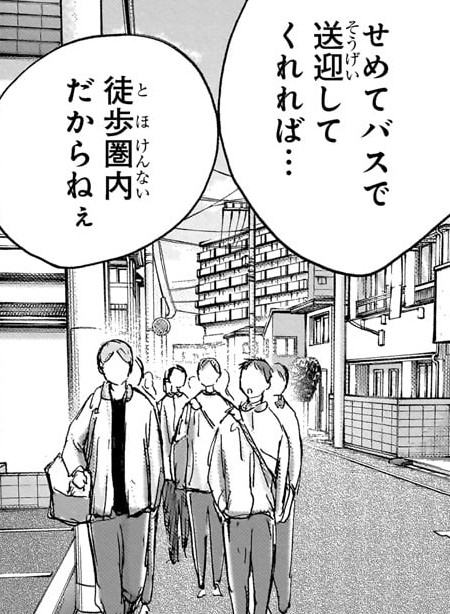
After school, the girls’ basketball team walks to the location where they’re practicing for an upcoming match.
生徒:
「せめてバスで送迎( そうげい )
“If only they'd at least provide a bus to pick us up and drop us off”
生徒:
「徒歩( とほ ) 圏内( けんない ) だからねぇ」
“It's within walking distance, after all.”
Challenge Yourself
Show translation
Challenge
What does the first student wish someone would provide?
Clues
せめて
at least, presenting this as a minimum request
〜で送迎( そうげい ) してくれれば…
if only they would provide pickup and drop-off transportation by that means
What does the speaker mean?
A bus to pick the team up and drop them off.
〜で marks the bus as the means of travel, and 送迎( そうげい ) する covers taking the team there and bringing them back.
Permission for the team to walk to practice.
Walking distance appears in the reply as the reason no shuttle is provided. It is not the first student's request.
A bus that the team members can drive themselves.
〜てくれれば asks for someone else to provide the transportation. The students are not offering to drive.
Someone to escort the team on foot.
The requested 送迎( そうげい ) is explicitly by bus, not an escort for the walk.
A shorter route within walking distance.
The second student says the destination is already within walking distance. The wish is for transportation anyway.
A different place where the team can practice.
The line asks for pickup and drop-off service. It does not propose changing the practice location.
The first student wishes the team had a bus shuttle. せめて frames that as the least the school could do, while 送迎( そうげい ) includes both pickup and drop-off.
View Full Example
Transport and Delivery
輸送 (Transport)輸送( ゆそう ) means transporting people or goods by road, rail, sea, or air.
It combines 輸 (transport ) with 送 (send ) to show transporting and sending goods or people in organized fashion .
ARIA The MASTERPIECE »
Volume 4 » Page 221
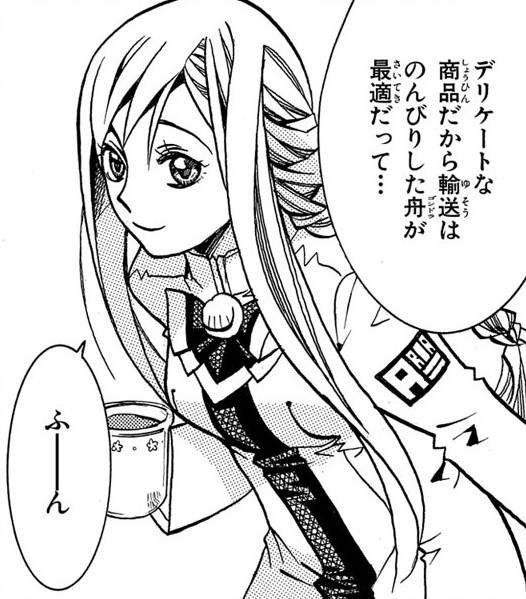
Akari receives her first commission as an Undine gondolier, but rather than taking someone sightseeing, it’s for transporting glassware.
灯里( あかり ) :「デリケートな商品( しょうひん ) だから輸送( ゆそう ) 船( ゴンドラ ) が最適( さいてき ) だって…」
“Since it's a delicate item, a slow-moving gondola is the best for transport...”
View Full Example
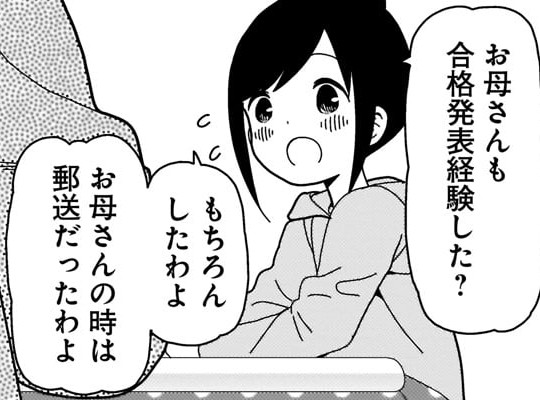
郵送 (Mailing)郵送( ゆうそう ) means sending a letter, document, or package by post.
It combines 郵 (post ) with 送 (send ) to show sending by mail .
ひとりぼっちの○○生活 »
Volume 8 » Page 55
Bocchi’s mother confirms with Bocchi that her exam results will be available online.
ぼっち:
「お母( かあ ) さん合格( ごうかく ) 発表( はっぴょう ) 経験( けいけん ) した?」
“Mom, have you ever been through the experience of waiting for exam results?”
お母( かあ ) さん:
「もちろん したわよ」
“Of course!”
「お母( かあ ) さんの時( とき ) は郵送( ゆうそう )
“Back in my day, it was sent by mail.”
Challenge Yourself
Show translation
Challenge
How did Bocchi's mother receive her exam results?
Clues
お母( かあ ) さんの時( とき ) は
sets up the method used when her mother took the exam
郵送( ゆうそう ) だったsays the results came through postal delivery
What does the speaker mean?
They were sent by mail.
郵送( ゆうそう ) means delivery through the postal service, and だった places that method in the past.
She checked them online.
Bocchi can use an online announcement, but her mother says her own results arrived by 郵送( ゆうそう ) .
The school called her by phone.
The delivery method named in the line is 郵送( ゆうそう ) , not a phone call.
A teacher told her in person.
郵送( ゆうそう ) refers to sending something through the mail, so the result was not delivered face to face.
She received them by email.
The line specifies postal delivery. It does not refer to electronic mail.
She read them in a newspaper announcement.
郵送( ゆうそう ) だった identifies mail as the old delivery method. No newspaper is mentioned.
Bocchi’s mother says that exam results were sent by mail when she took the exam. 郵送( ゆうそう ) だった contrasts that older method with Bocchi’s ability to check her result online.
View Full Example