Separating and understanding with 解
解 means “to separate into parts”, “to untangle”, and “to clarify the meaning or principle”.
Etymology
This kanji is an ideogramic compound comprised of 角 (horn), 刀 (knife), and 牛 (cow). These invoke imagery of a knife separating a horn from a cow .
Mnemonics
WaniKani and Migaku both create a mnemonic from 角 (corner ), 刀 (knife ), and 牛 (cow ) to derive unravel . WaniKani extends the mnemonic with the word kayak for the common on reading かい.
Analysis and Breakdown
解体 (Dismantling)解体( かいたい ) means taking something apart. It can refer to dismantling a machine, demolishing a building, disbanding an organization, or dissecting a body.
It combines 解 (separate ) with 体 (body ) to show a body being taken apart .
名探偵コナン »
Volume 23 » Page 12
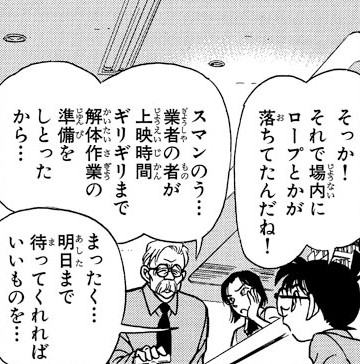
Conan and his friends go to the theater to see a movie. There, they discover this is the last day before the theater closes.
コナン:
「そっか!それで場内( じょうない ) にロープとかが落( お ) ちてたんだね!」
“Oh, I see! That's why there were ropes and stuff lying around the venue!”
オーナー:
「スマンのう… 業者( ぎょうしゃ ) の者( もの ) が上映( じょうえい ) 時間( じかん ) キリキリまで解体( かいたい ) 作業( さぎょう ) の準備( じゅんび ) をしとったから…」
“Sorry about that... The contractor's crew was rushing to get the dismantling ready right up until showtime...”
スタッフ:
「まったく… 明日( あした ) まで待( ま ) ってくれればいいものを…」
“Honestly... They could've at least waited until tomorrow...”
Challenge Yourself
Show translation
Challenge
Why were ropes and other materials lying around the theater?
Clues
解体( かいたい ) 作業( さぎょう ) の準備( じゅんび ) preparations for demolition work
上映( じょうえい ) 時間( じかん ) キリキリまでright up until showtime
What does the speaker mean?
Contractors had been preparing to demolish the theater until showtime.
The owner connects the materials to last-minute preparations for 解体( かいたい ) 作業( さぎょう ) .
The staff had decorated the theater for a festival.
The materials belonged to demolition preparations, not decorations.
The audience brought ropes for the final screening.
The owner says the contractor's crew left them during its work.
Workers had finished rebuilding the theater.
解体( かいたい ) means dismantling or demolition, not reconstruction.
The ropes were clues deliberately planted by Conan.
Conan notices them and then learns their practical source from the owner.
The staff planned to move the screening outside.
The issue is demolition work being prepared too close to the screening time.
The contractor’s crew had been preparing the theater for demolition right up until showtime. That work explains the ropes and other materials left inside.
View Full Example
解剖 (Dissection)解剖( かいぼう ) means dissecting a body to study its internal structure. Figuratively, it means analyzing something in detail.
It combines 解 (take apart ) with 剖 (cut open ) to show opening something by separating its parts.
名探偵コナン »
Volume 16 » Page 25
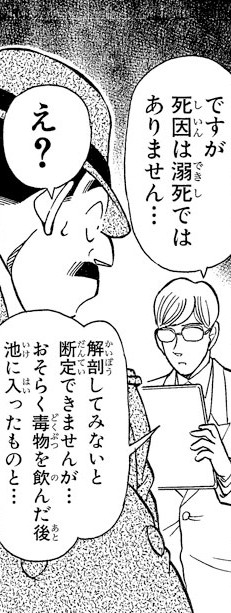
Inspector Megure suggests the murder suspect committed suicide by drowning himself. The medical examiner disagrees.
監察医( かんさつい ) :「ですが死因( しいん ) は溺死( できし ) ではありません…」
“However, drowning wasn't the cause of death...”
目暮( めぐれ ) :「え?」
“What?”
監察医( かんさつい ) :「解剖( かいぼう ) 断定( だんてい ) できませんが… おそらく毒物( どくぶつ ) を飲( の ) んだあと池( いけ ) に入( はい ) ったものと…」
“I can't say for certain without an autopsy... but it's likely he took poison and then entered the pond...”
Challenge Yourself
Show translation
Challenge
What does the medical examiner suspect happened before the victim entered the pond?
Clues
おそらく毒物( どくぶつ ) を飲( の ) んだあと
probably after drinking poison
池( いけ ) に入( はい ) ったhe entered the pond
What does the speaker mean?
He drank poison.
The examiner tentatively places drinking 毒物( どくぶつ ) before entering the pond.
He drowned before taking any poison.
The examiner says drowning was not the cause of death and suspects poison first.
He performed an autopsy on someone else.
The examiner needs an autopsy performed on this victim to confirm the cause.
He was rescued from the pond alive.
The scene concerns determining the cause of the victim's death.
He accidentally drank pond water.
The suspected substance is 毒物( どくぶつ ) , poison.
He entered the pond before consuming anything.
あと places the pond entry after the suspected poisoning.
The examiner suspects that the victim drank poison and then entered the pond. An autopsy is still needed before that cause can be stated with certainty.
View Full Example
分解 (Decomposition)分解( ぶんかい ) means taking something apart or breaking it down into its components.
It combines 分 (divide ) with 解 (separate ) to show separating something into pieces .
老女的少女ひなたちゃん »
Volume 2 » Page 120
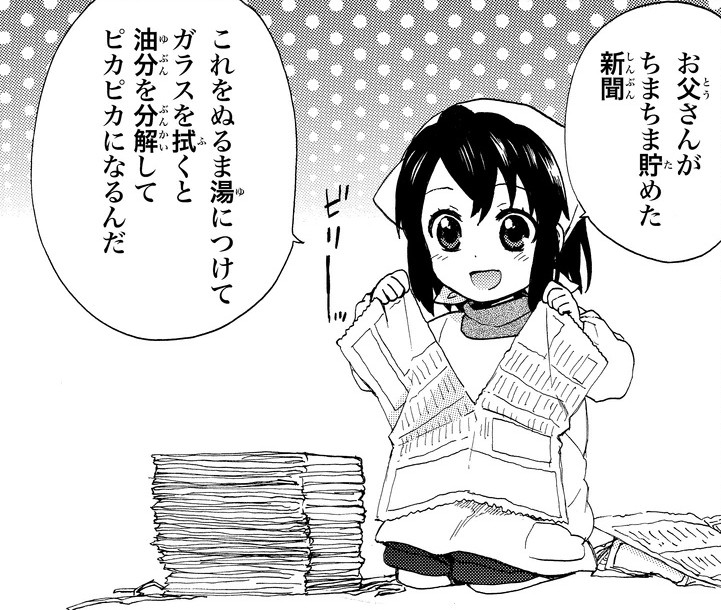
Hinata dedicates the month of December to giving her home a complete cleaning.
ひなた:
「お父さんがちまちま貯( た ) めた新聞( しんぶん ) …」
“The old newspapers Dad's been saving forever...”
「これをぬるま湯( ゆ ) につけてガラスを拭( ふ ) くと油分( ゆぶん ) を分解( ぶんかい )
“Soak them in warm water and wipe the glass, and they cut through the grease and get it sparkling clean.”
Challenge Yourself
Show translation
Challenge
What does Hinata say the soaked newspapers do when used on the glass?
Clues
油分( ゆぶん ) を分解( ぶんかい ) してthey break down the oily residue
ピカピカになるんだ
the result is that the glass becomes sparkling clean
What does the speaker mean?
They break down the grease and leave the glass sparkling.
油分を分解して describes breaking down the grease, and ピカピカになる gives the clean, shiny result.
They break the glass into pieces so it can be replaced.
The object marked by を is 油分, the grease, not the glass. 分解 acts on the residue.
They add an oily coating that protects the glass.
Hinata says the grease is broken down and removed, not added as a protective layer.
They polish the newspapers until the paper becomes shiny.
The newspapers are the cleaning tool. ピカピカになる describes the result on the glass.
They dissolve completely when placed in warm water.
The newspapers are soaked and then used to wipe the glass. The line does not say the paper dissolves.
They prevent Hinata's father from saving more newspapers.
Hinata repurposes the newspapers her father saved. She explains their cleaning effect, not a way to stop him collecting them.
Hinata soaks the old newspapers in warm water and uses them to wipe the glass. She says they break down the oily residue, which leaves the glass sparkling clean.
View Full Example
Release and Removal
解放 (Liberation)解放( かいほう ) means release or liberation from confinement, restriction, oppression, or another burden.
It combines 解 (untie ) with 放 (release ) to show freeing something by undoing what holds it back .
ひらやすみ »
Volume 1 » Page 88
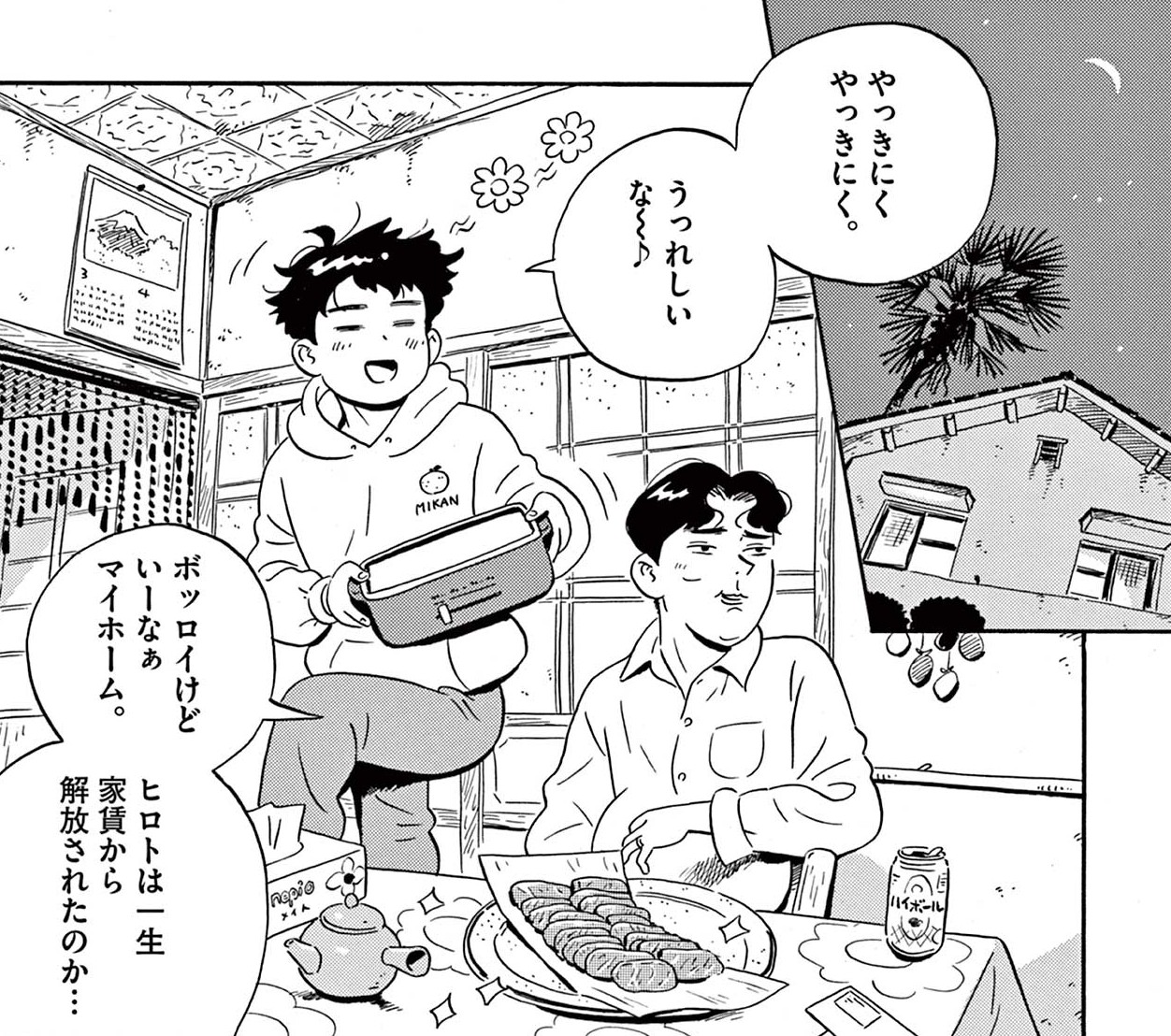
Hiroto’s friend Hideki stops by Hiroto’s workplace looking for a place to stay for the night. He has with him a shopping bag with beef.
ヒロト:
「やっきにく やっきにく。うっれしいな〜♪」
“Grilllled meat, grilllled. So happy~~♪”
ヒデキ:
「ボッロイけどいーなぁマイホーム。」
“It's a bit run down, but how nice, having your own home.”
「ヒロトは一生( いっしょう ) 家賃( やちん ) から解放( かいほう )
“Have you been freed from rent forever...?”
Challenge Yourself
Show translation
Challenge
What does Hideki think Hiroto has been freed from?
Clues
一生( いっしょう ) 家賃( やちん ) からfrom paying rent for the rest of his life
解放( かいほう ) されたのかasks whether Hiroto has been released from that burden
What does the speaker mean?
Paying rent for the rest of his life.
家賃( やちん ) is rent, 一生( いっしょう ) extends it across Hiroto's life, and から marks what he has been freed from.
Working at his current job forever.
The burden named before から is 家賃( やちん ) , not employment.
Repairing his run-down home by himself.
Hideki calls the home run-down, but 解放( かいほう ) された refers specifically to rent.
Sharing the house with his friends.
The line says nothing about housemates. Hideki is impressed that Hiroto may no longer owe rent.
Buying food for visiting friends.
The scene includes food, but the phrase 家賃( やちん ) から解放( かいほう ) された names rent as the burden removed.
Saving money to buy a home someday.
Hideki treats Hiroto as already having a home and asks whether that has freed him from rent.
Hideki realizes that owning the house may mean Hiroto never has to pay rent again. 家賃( やちん ) から解放( かいほう ) された presents rent as a lifelong burden from which Hiroto has been released.
View Full Example
解除 (Cancellation)解除( かいじょ ) means lifting a restriction, prohibition, lock, or other imposed state.
It combines 解 (release ) with 除 (remove ) to show a restriction being taken away .
三ツ星カラーズ »
Volume 1 » Page 125
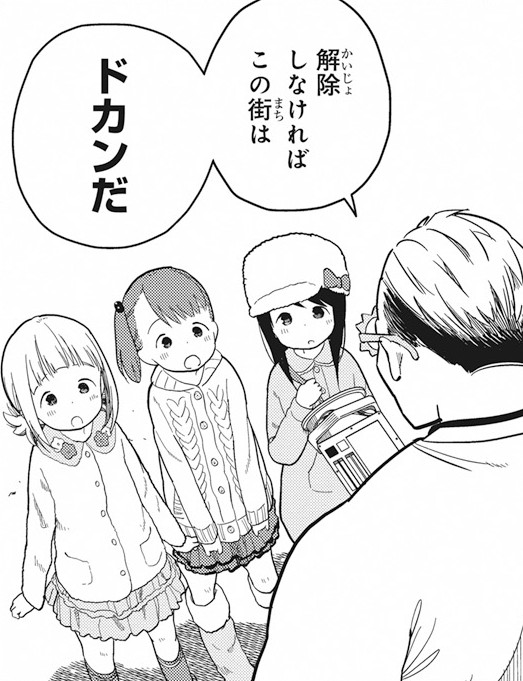
A shop owner tells the Colors trio that he’s crafted a bomb.
おやじ:
「解除( かいじょ ) 街( まち ) はドカンだ」
“If you're not able to deactivate it, this district will go kaboom!”
Challenge Yourself
Show translation
Challenge
What does Oyaji say will happen if the Colors fail to deactivate the bomb?
Clues
解除( かいじょ ) しなければif they do not deactivate it
この街( まち ) はドカンだ
this district will go kaboom
What does the speaker mean?
The district will be blown up.
しなければ sets failure to deactivate as the condition, and ドカン supplies the explosive result.
The district will be safely evacuated.
ドカン imitates an explosion. The line says nothing about evacuation.
The bomb will deactivate itself.
The consequence follows if the Colors do not perform 解除( かいじょ ) , so no automatic deactivation is promised.
Oyaji will move the bomb to another district.
The threatened result affects この街( まち ) , and no movement is mentioned.
The Colors will lose access to their clubhouse.
The stated consequence is an explosion in the district, not a clubhouse penalty.
Saitou will arrest Oyaji before anything happens.
No arrest appears in the condition or result. Oyaji presents the explosion as what follows failure.
Oyaji says that unless the Colors deactivate the bomb, the district will go kaboom. しなければ supplies the negative condition, and ドカン gives the mock-dramatic consequence.
View Full Example
解散 (Dissolution)解散( かいさん ) means dispersing a group or formally dissolving an organization.
It combines 解 (untie ) with 散 (scatter ) to show a body breaking apart .
名探偵コナン »
Volume 20 » Page 125
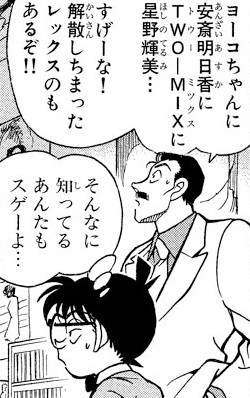
Detective Kogoro gives a young woman a ride home in exchange for concert tickets. While waiting for her to get the tickets, Kogoro notices the livingroom is filled with pop star posters.
小五郎( こごろ ) :「ヨーコちゃんに安斎( あんざい ) 明日香( あすか ) にTWO―MIXに星野( ほしの ) 輝美( てるみ ) …」
“There's Yoko, and Asuka Anzai, and Two-Mix, and Terumi Hoshino...”
「すげーな!解散( かいさん )
“Amazing! There's even the disbanded group Lex!”
コナン:
「そんなに知( し ) ってるあんたもスゲーよ…」
“It's also amazing that you know that much about them...”
Challenge Yourself
Show translation
Challenge
Why does Kogoro find the Lex memorabilia noteworthy?
Clues
解散( かいさん ) しちまったレックスLex, the group that went and disbanded
のもあるぞ
there is even one of theirs
What does the speaker mean?
The collection includes a group that has already broken up.
解散( かいさん ) しちまった identifies Lex as a disbanded group represented in the collection.
Lex is the only active group in the collection.
Kogoro specifically remarks that Lex has disbanded.
The Lex poster has been torn into pieces.
解散( かいさん ) refers to the group breaking up, not physical damage to the poster.
Lex is performing in the house that evening.
He sees memorabilia, not the group itself.
The homeowner has never heard of Lex.
The item is part of a broad music collection, and Kogoro recognizes it.
Conan is surprised that Kogoro broke up the group.
Kogoro did not cause the breakup. Conan is surprised by how much he knows.
Kogoro notices that the collection even contains memorabilia from Lex, a group that has already disbanded. しちまった gives his comment a rough, conversational emphasis.
View Full Example
解消 (Elimination)解消( かいしょう ) means resolving a problem, grievance, or anxiety. It can also mean ending a contract, relationship, or organization.
It combines 解 (undo / dissolve ) with 消 (make disappear ) to show a dissolution that removes the problem .
名探偵コナン »
Volume 12 » Page 65
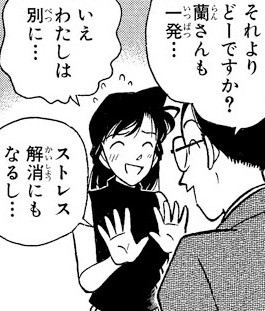
Kogorao, Ran, and Conan are at a convention for game software makers, since Kogoro helped as a consultant for a murder mystery video game. There, a punch strength test game catches Ran’s eye. She sees one of the developers throw a punch at it.
竹下( たけした ) :「それよりとーですか?蘭( らん ) さんも一発( いっぱつ ) …」
“What about you? Would you like to take a shot at it, too?”
蘭( らん ) :「いえ わたしは別( べつ ) に」
“No, I'm not particularly...”
竹下( たけした ) :「ストレス解消( かいしょう )
“It's also a great way to relieve stress...”
Challenge Yourself
Show translation
Challenge
What additional benefit does Takeshita give for trying the punching game?
Clues
ストレス解消( かいしょう )
stress relief
にもなるし
it can also serve as that, and besides
What does the speaker mean?
It can also relieve stress.
ストレス解消( かいしょう ) にもなる presents stress relief as another benefit.
It guarantees a perfect score.
The reason concerns releasing stress, not the result of the strength test.
It teaches formal karate technique.
Takeshita pitches the machine as recreation and stress relief.
It prevents the player from throwing a punch.
He is inviting Ran to take a shot at the machine.
It records stress without reducing it.
解消( かいしょう ) means eliminating or relieving the stress.
It lets Ran avoid the convention.
The suggestion is to try an activity at the convention.
Takeshita encourages Ran to try the punching game by adding that it can serve as stress relief. Final し leaves the persuasive thought open.
View Full Example
Solutions and Resolution
正解 (Correct answer)正解( せいかい ) means the correct answer, solution, or interpretation, especially in a quiz or puzzle.
It combines 正 (correct ) with 解 (understand ) to show a correct understanding or correct solution .
からかい上手の高木さん »
Volume 14 » Page 44
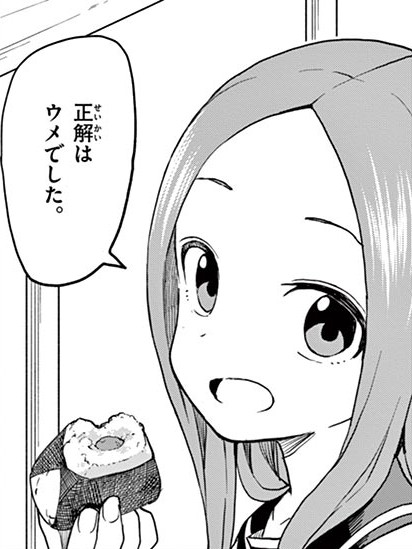
Takagi challenges Nishikata to guess what ingredient is inside a riceball in her lunch box. Seeing a bit of salmon from the other riceball, Nishika goes with salmon as his guess.
高木:
「正解( せいかい )
“The correct answer was apricot.”
Challenge Yourself
Show translation
Challenge
What ingredient does Takagi reveal was the correct answer?
Clues
正解( せいかい ) は"as for the correct answer"
〜でした
the polite past copula, "was"
What does the speaker mean?
Ume, a Japanese apricot or plum.
ウメ is the ingredient placed before でした, so Takagi says it was the correct answer.
Salmon.
Salmon was Nishikata's guess, but Takagi names ウメ as the correct answer.
Tuna.
The line contains ウメ, not the word for tuna.
Pickled vegetables.
ウメ refers to ume. It does not mean pickled vegetables in general.
Baked sweet potato.
There is no word for sweet potato in Takagi's answer.
Takagi says there was no correct answer.
正解( せいかい ) はウメでした explicitly identifies the correct answer.
Takagi sets up the result with 正解( せいかい ) は and completes it with ウメでした. The ingredient was ume.
View Full Example
Understanding and Interpretation
理解 (Understanding)理解( りかい ) means understanding the meaning or logic of something. It can also mean appreciating another person’s feelings or circumstances.
It combines 理 (reason ) with 解 (untangle / understand ) to show understanding through reason .
それでも歩は寄せてくる »
Volume 2 » Page 98
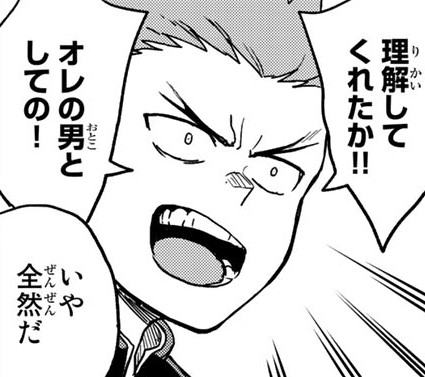
Sakurako tells Takeru not to go to the shogi club as he’ll get in the way of Ayumu being with Urushi. However, as a new member of shogi club, and as a man, Takeru feels it’s his duty to show up. On his way to the shogi club room, he encounters Ayumu who implores him to come to the shogi club room.
タケル:
「理解( りかい )
“You understood me, huh?”
「オレの男( おとこ ) としての!」
“As a man, my (duty)!”
歩( あゆむ ) :「いや全然( ぜんぜん ) だ」
“No, not at all.”
Challenge Yourself
Show translation
Challenge
What misunderstanding does Takeru make?
Clues
理解( りかい ) してくれたか!!Takeru excitedly assumes Ayumu has understood him
オレの男( おとこ ) としての!
"my ... as a man," leaving his supposed duty or resolve unstated
いや全然( ぜんぜん ) だ
Ayumu replies, "No, not at all."
What does the speaker mean?
He thinks Ayumu understands and supports his manly resolve.
Takeru treats Ayumu's invitation as 理解( りかい ) してくれた, understanding granted for his benefit, but Ayumu immediately denies it.
He thinks Ayumu has decided to leave the shogi club.
Ayumu is asking Takeru to come to the clubroom, not announcing that he will leave.
He believes Ayumu understands Sakurako's objection.
Takeru refers dramatically to his own stance オレの男( おとこ ) としての, not Sakurako's reasoning.
He thinks Ayumu wants him to stay away from Urushi.
Ayumu asks him to come. Takeru wrongly reads that request as support for his resolve.
He assumes Ayumu has understood the club rules.
The supposed understanding concerns Takeru's personal duty or resolve, not formal rules.
He believes Ayumu agrees that men should not play shogi.
Takeru sees attending the club as his duty. Neither line argues that men should avoid shogi.
Takeru hears Ayumu’s invitation and assumes Ayumu has understood his dramatic resolve as a man. Ayumu’s いや全然( ぜんぜん ) だ flatly shows that Takeru read him wrong.
View Full Example
誤解 (Misunderstanding)誤解( ごかい ) means a misunderstanding or mistaken interpretation of facts or someone’s words.
It combines 誤 (mistaken ) with 解 (understanding ) to show understanding something wrongly .
ひよ恋 »
Volume 13 » Page 73
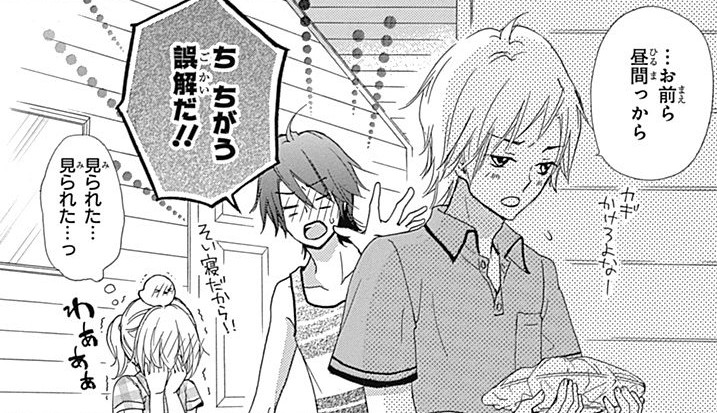
Since Hiyori is resting on a bed inside, Junpei takes a plate from the barbecue to her room. As he walks in, he finds Hiyori and Yuushin in what looks like a compromising position.
淳平( じゅんぺい ) :「…お前( まえ ) ら昼間( ひるま ) っから (カギかけるよなー)」
“You guys, in the middle of the day… (At least lock the door!)”
結心( ゆうしん ) :「ち ちがう 誤解( ごかい ) 寝( ね ) だから!!)」
“N—No! You've got it wrong!! (We were just lying down together!)”
ひより:
「見( み ) られた… 見( み ) られた…っ」
“We were seen… We were seen…!”
Challenge Yourself
Show translation
Challenge
How does Yuushin explain the scene Junpei saw?
Clues
ち ちがう 誤解( ごかい ) だ!!
he stammers that Junpei has misunderstood
そい寝( ね ) だから!!
he says they were only lying down or sleeping alongside each other
What does the speaker mean?
Junpei misunderstood; they were only lying down together.
誤解( ごかい ) rejects Junpei's interpretation, and そい寝( ね ) gives Yuushin's explanation for what he saw.
Junpei was right about the scene, but Yuushin wants it kept secret.
ちがう and 誤解( ごかい ) directly deny Junpei's interpretation rather than admit it.
Hiyori had been sleeping alone before Yuushin entered.
そい寝( ね ) describes lying or sleeping alongside someone, so Yuushin does not claim Hiyori was alone.
Junpei walked into the wrong room.
Yuushin calls Junpei's interpretation a misunderstanding. He does not dispute which room Junpei entered.
They had locked the door because Hiyori needed rest.
Junpei comments that they should have locked it, but Yuushin's explanation is that they were lying down together.
Nobody actually saw Hiyori and Yuushin together.
Hiyori repeats 見( み ) られた, showing that they were seen. The dispute is over what the scene meant.
Yuushin insists that Junpei has read too much into what he saw. He says it was そい寝( ね ) , lying down together, and calls the more suspicious interpretation a 誤解( ごかい ) .
View Full Example
了解 (Understanding)了解( りょうかい ) means understanding and accepting what someone has said or requested.
It combines 了 (fully ) with 解 (understand ) to show complete understanding .
たいようのいえ »
Volume 5 » Page 107
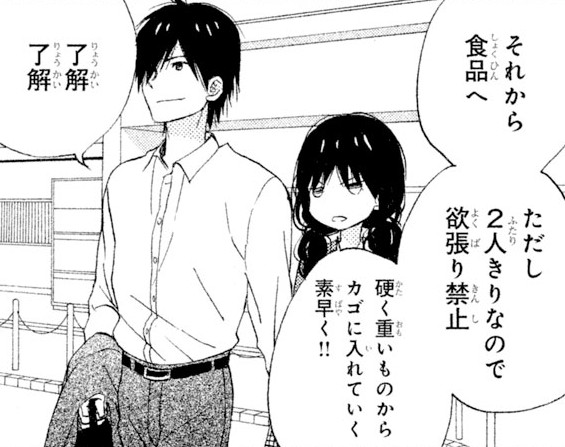
Mao needs Hiro to go grocery shopping with her due to a sale that’s limited per customer. She tells him the plan is to start by grabbing everyday household items first.
真魚( まお ) :「それから食品( しょくひん ) へ」
“Then move on to food.”
「ただし2人きりなので欲張( よくば ) り禁止( きんし ) 」
“But since it's just the two of us, no hoarding allowed!”
「硬( かた ) く重( おも ) いものからカゴに入( い ) れていく素早( すばや ) く!!」
“Quickly start putting hard, heavy items into the basket!!”
基( ひろ ) :「了解( りょうかい ) 了解( りょうかい )
“Roger that.”
Challenge Yourself
Show translation
Challenge
それから食品( しょくひん ) へ
"Then move on to food," giving the next section to visit.
2人( ふたり ) きりなので欲張( よくば ) り禁止( きんし )
"Since it is just the two of us, no getting greedy."
硬( かた ) く重( おも ) いものからカゴに入( い ) れていく 素早( すばや ) くquickly start loading the basket with hard, heavy items first
What does the speaker mean?
Move to food next, avoid overbuying, and load hard, heavy items first.
Hiro's repeated 了解( りょうかい ) acknowledges Mao's sequence, limit, and loading instructions.
Buy food first, then fill the basket with light items.
Mao says それから食品( しょくひん ) , food comes next, and hard, heavy goods go into the basket first.
Split up so each person can buy as much as possible.
Mao says it is just the two of them and explicitly sets 欲張( よくば ) り禁止( きんし ) , no greedy buying.
Put soft food underneath the heavier household goods.
Her instruction is to begin with hard, heavy items before moving on.
Wait for another shopper before using the sale limit.
Mao's plan assumes only the two of them and tells Hiro how to proceed now.
Shop slowly so they can compare every product.
素早( すばや ) く tells them to act quickly, not take their time.
Mao gives Hiro a rapid shopping strategy. They will move on to food, avoid getting greedy because there are only two of them, and quickly place hard, heavy goods in the basket first. Hiro’s repeated 了解( りょうかい ) confirms that he understands.
View Full Example
解釈 (Interpretation)解釈( かいしゃく ) means interpretation or explanation. It involves giving a particular understanding of something.
It combines 解 (understand ) with 釈 (explain ) to show understanding by explaining .
キラキラとギラギラ »
Volume 2 » Page 32
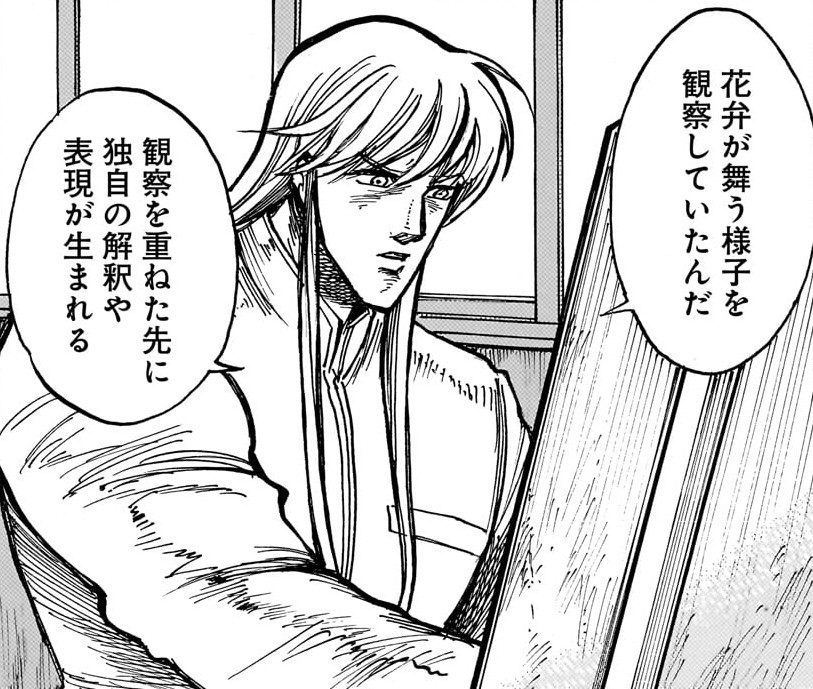
As she models for a sketch, Lulu recalls seeing Hideki blowing flower petals into the air. She brings it up to him.
秀樹( ひでき ) :「花弁( はなびら ) が舞( ま ) う様子( ようす ) を賢察( けんさつ ) していたんだ」
“I was observing the petals as they danced.”
「観察( かんさつ ) を重( かさ ) ねた先( さき ) に独自( どくじ ) の解釈( かいしゃく ) 表現( ひょうげん ) が生( う ) まれる」
“Through repeated observation, unique interpretations and expressions emerge.”
Challenge Yourself
Show translation
Challenge
What does Hideki say repeated observation can produce?
Clues
観察( かんさつ ) を重( かさ ) ねた先( さき ) にbeyond the stage of repeated observation
独自( どくじ ) の解釈( かいしゃく ) や表現( ひょうげん ) が生( う ) まれるone's own interpretations and expressions emerge
What does the speaker mean?
Original interpretations and ways of expressing them.
独自( どくじ ) marks the interpretations as one's own, and 解釈( かいしゃく ) や表現( ひょうげん ) names what repeated observation produces.
A perfectly literal copy of the flower petals.
Hideki says observation leads to 独自( どくじ ) の解釈( かいしゃく ) , a personal reading, rather than mere duplication.
An explanation of why the petals stopped moving.
The petals' movement is what he observes. The result he names is artistic interpretation and expression.
A faster method for finishing the sketch.
観察( かんさつ ) を重( かさ ) ねる stresses repeated looking, not saving time.
Proof that every artist sees the same thing.
独自( どくじ ) means unique or one's own, so the line points to individual readings.
A decision to stop observing and rely on memory.
Hideki treats repeated observation as the process that gives rise to the later interpretation.
Hideki says that sustained observation eventually gives an artist a personal interpretation and a way to express it. 先( さき ) に places those results beyond the repeated observation that produces them.
View Full Example