Shelter and shops with 屋
屋 means house , building , or roof . In compounds and as the suffix や, it often refers to a shop, dealer, or person associated with a trade or characteristic.
Etymology
This kanji is traditionally explained as an ideogrammic compound comprised of 尸 (a sheltering structure, treated as an abbreviated form of 居, “dwelling”) and 至 (arrive, reach). These invoke imagery of reaching a place suitable for living and settling beneath its shelter.
Dwellings
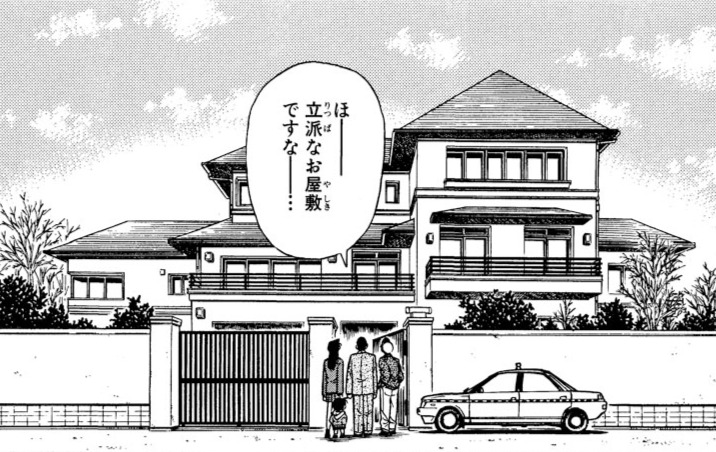
屋敷 (Estate)屋敷( やしき ) means a residence together with its grounds, often a large mansion or estate.
It combines 屋 (dwelling ) with 敷 (spread out ) to show a residence spread across a substantial plot .
名探偵コナン »
Volume 10 » Page 35
Heiji shows up at Detective Mouri’s office looking for the missing Shin’ichi. While there, a case presents itself. Heijii tags along with Mouri to investigate.
毛利( もうり ) :「ほーーーーー 立派( りっぱ ) なお屋敷( やしき )
“Oh, what a splendid estate.”
Challenge Yourself
Show translation
Challenge
How does Mouri describe the residence?
Clues
立派( りっぱ ) なsplendid or impressive
お屋敷( やしき ) ですな
it is an estate, isn't it?
What does the speaker mean?
It is a splendid estate.
立派( りっぱ ) な directly praises the impressive お屋敷( やしき ) .
It is an ordinary rented room.
屋敷( やしき ) suggests a substantial residence, and 立派( りっぱ ) praises it.
It is a ruined shop.
Mouri describes a grand private residence, not a commercial building.
It is smaller than he expected.
His drawn-out reaction expresses admiration at how impressive it is.
It belongs to Mouri.
Mouri is visiting the property as part of the investigation.
It is too dangerous to enter.
The line comments on its grandeur, not a danger at the entrance.
Mouri reacts with admiration and calls the residence a splendid estate. The honorific お adds politeness to 屋敷( やしき ) .
View Full Example
小屋 (Hut)小屋( こや ) means a small, simple building such as a hut, shed, or animal shelter.
It combines 小 (small ) with 屋 (dwelling ) to show a small shelter or hut .
俺物語!! »
Volume 4 » Page 165
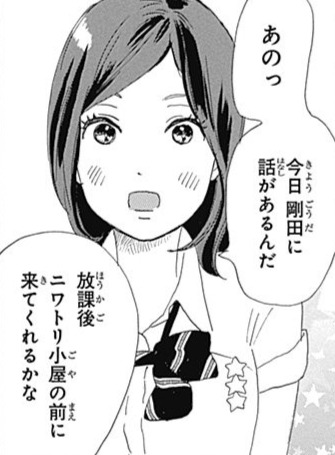
After Takeo (Gouda) has helped her out multiple times, Saijou considers confessing her feelings to him. She waits for him near the shoe lockers before class.
西城( さいじょう ) :「あのっ 今日( きょう ) 剛田( ごうだ ) に話( はなし ) があるんだ」
“Um... I need to talk to you today.”
「放課後( ほうかご ) ニワトリ小屋( ごや ) 前( まえ ) に来( き ) てくれるかな」
“Could you come to the chicken coop after school?”
Challenge Yourself
Show translation
Challenge
What does Saijou ask Takeo to do?
Clues
今日( きょう ) 剛田( ごうだ ) に話( はなし ) があるんだshe has something to discuss with Takeo today
放課後( ほうかご ) ニワトリ小屋( ごや ) の前( まえ ) に来( き ) てくれるかなshe wonders whether he will come to the chicken coop after school
What does the speaker mean?
Meet her in front of the chicken coop after school.
放課後( ほうかご ) gives the time, ニワトリ小屋( ごや ) の前( まえ ) gives the place, and 来( き ) てくれるかな makes the request.
Bring a chicken to her before class.
ニワトリ小屋( ごや ) is the meeting place. She does not ask Takeo to bring an animal.
Meet her at the shoe lockers during lunch.
The requested time is after school and the requested place is the chicken coop.
Clean the chicken coop for her after school.
She asks him to come there for a conversation, not to perform cleaning.
Tell her immediately what he wants to discuss.
Saijou is the one who has something to say, and she postpones the meeting until after school.
Ask Gouda to meet someone else at the coop.
Saijou directly asks Takeo to come, with herself as the implied beneficiary of 来( き ) てくれる.
Saijou tells Takeo that she has something to discuss and asks him to meet her in front of the chicken coop after school. 来( き ) てくれるかな keeps the request hesitant and soft.
View Full Example
Exterior Spaces
屋上 (Rooftop)屋上( おくじょう ) means a rooftop, especially a flat roof people can use.
It combines 屋 (building ) with 上 (top ) to show the top of a building .
一週間フレンズ。 »
Volume 1 » Page 54
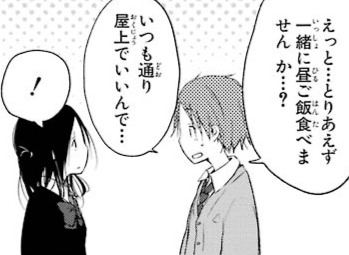
After Hase finally became friends with Fujimiya, her warning came to pass: her weekly memory reset, which causes her to forget her friends on Monday morning, left her with no recollection of spending time with Hase last week. Hase asks Fujimiya to be his friend, but realizes that it was too sudden, so he decides to create an opportunity to remind her of last week.
長谷( はせ ) :「えっと…とりあえず 一緒( いっしょ ) に昼( ひる ) ご飯( はん ) 食( た ) べません か…?」
“Um, for now, how about we have lunch together...?”
「いつも通( どお ) り屋上( おくじょう )
“On the rooftop, as usual, is fine...”
Challenge Yourself
Show translation
Challenge
What does Hase nervously propose to Fujimiya?
Clues
一緒( いっしょ ) に昼( ひる ) ご飯( はん ) 食( た ) べませんかa polite invitation to eat lunch together
いつも通( どお ) り屋上( おくじょう ) でいいんで
the rooftop is fine, as usual, with the thought trailing off
What does the speaker mean?
Eat lunch together on the rooftop as they usually do.
一緒( いっしょ ) に makes lunch a shared activity, and いつも通( どお ) り屋上( おくじょう ) で names the usual place.
Meet on the rooftop after they have eaten separately.
Hase uses 一緒( いっしょ ) に with 昼( ひる ) ご飯( はん ) を食( た ) べる, so he wants them to eat together.
Have lunch together in their classroom instead.
Hase names the 屋上( おくじょう ) as the place and says it is fine.
Let Fujimiya choose a completely new lunch spot.
いつも通( どお ) り points to their established rooftop routine, not a new location.
Skip lunch today and try again tomorrow.
食( た ) べませんか is an invitation to eat. It is not a negative statement about skipping lunch.
Allow Hase to eat alone on the rooftop.
一緒( いっしょ ) に directly includes Fujimiya in the proposed lunch.
Hase asks Fujimiya to eat lunch with him on the rooftop, their usual place before her memory reset. The pauses and trailing んで show how cautiously he makes the invitation.
View Full Example
Rooms
部屋 (Room)部屋( へや ) means a room separated from other spaces in a building.
It combines 部 (section ) with 屋 (room ) to show a sectioned-off room within a larger building.
Example 1 of 3: A pretty clean room with 相当 Example 1 of 3
たいようのいえ »
Volume 1 » Page 87
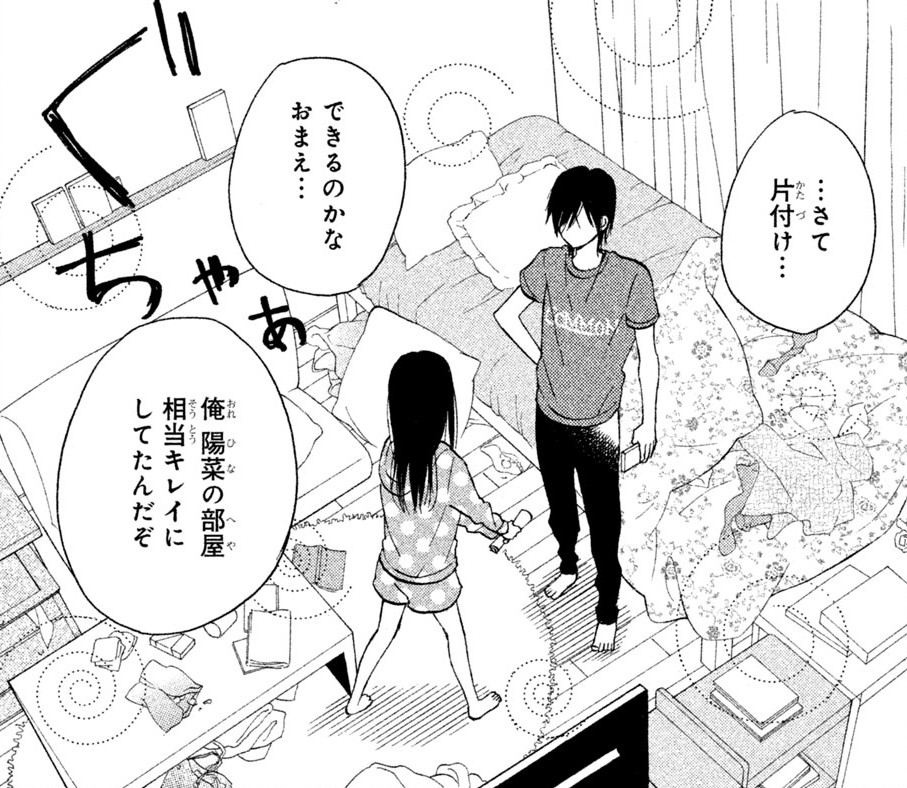
Hiro lets Mao move into his sister’s bedroom, as Hina is living with relatives. After, he comes up with a list of rules that Mao needs to follow if she’s to keep living there.
基( ひろ ) :「…さて 片付( かたづ ) け…」
“Now then, cleaning...”
「できるのかな おまえ…」
“I wonder if you can do it.”
「俺( おれ ) 陽菜( ひな ) の部屋( へや ) 相当( そうとう ) キレイにしてたんだぞ」
“I kept Hina's room pretty clean, you know.”
Challenge Yourself
Show translation
Challenge
What concern does Hiro raise about Mao using Hina's room?
Clues
片付( かたづ ) け…できるのかな おまえ…Hiro wonders whether Mao will be able to keep things tidy
陽菜( ひな ) の部屋( へや ) 相当( そうとう ) キレイにしてたんだぞ"I kept Hina's room quite clean, you know," stressing the standard he maintained.
What does the speaker mean?
He doubts whether Mao can keep the room as clean as he did.
Hiro questions whether Mao can manage 片付( かたづ ) け, then emphasizes that he kept the room 相当( そうとう ) キレイ.
He thinks Mao has already cleaned the room better than he did.
Hiro describes his own past care of the room and questions Mao's ability. He does not praise her cleaning.
He wants Mao to move into a different room because Hina's is dirty.
He says he kept Hina's room quite clean. The concern is whether Mao can maintain it.
He wonders whether Mao knows where the cleaning supplies are.
The line questions her ability to tidy up generally, not her knowledge of supplies.
He plans to clean the room for Mao every day.
Hiro points to the standard he maintained before Mao moved in. He does not promise to keep doing the work for her.
He believes the room is too clean for anyone to live in.
相当( そうとう ) キレイ describes degree, but Hiro treats cleanliness as a standard to preserve, not a problem.
Hiro wonders whether Mao can handle the cleaning. He then stresses that he had kept Hina’s room 相当( そうとう ) キレイ, quite clean, setting the standard he expects Mao to maintain.
View Full Example
Example 2 of 3: Clearing out a room with 〜ておく Example 2 of 3
ご注文はうさぎですか? »
Volume 1 » Page 50
After Cocoa suggests if she were saying at Chiya’s place rather than Chino’s, that she’s be working for Chiya’s family’s tea house, Chiya takes to the idea.
千夜( ちや ) :「じゃあ部屋( へや ) 空( あ ) けておくから早速( さっそく ) 荷物( にもつ ) をまとめて来( き ) てね」
“Then I'll clear out a room in advance, so go gather your things and come right away.”
ココア:
「誰( だれ ) か止( と ) めてよ!」
“Somebody stop her!”
Challenge Yourself
Show translation
Challenge
What does (千夜:ちや) mean in the highlighted line?
Clues
空( あ ) けておく(空:あ)けておく means clearing a room and keeping it available
What does the speaker mean?
Then I'll clear out a room in advance, so go gather your things and come right away.
Chiya proposes preparing the room before Cocoa arrives with her belongings.
Chiya says the room will remain occupied when Cocoa arrives.
The highlighted form is 空( あ ) けておく. Here 空( あ ) けておく means clearing a room and keeping it available, so this choice does not match the Japanese.
Chiya tells Cocoa to clear out her own room first.
The highlighted form is 空( あ ) けておく. Here 空( あ ) けておく means clearing a room and keeping it available, so this choice does not match the Japanese.
Chiya plans to prepare the room only after Cocoa moves in.
The highlighted form is 空( あ ) けておく. Here 空( あ ) けておく means clearing a room and keeping it available, so this choice does not match the Japanese.
空( あ ) けておく means clearing a room and keeping it available. Chiya proposes preparing the room before Cocoa arrives with her belongings.
View Full Example
Example 3 of 3: Furthermore, this room is too warm with さらに〜 Example 3 of 3
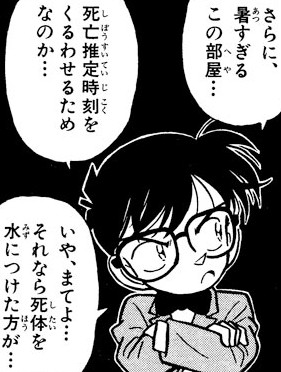
名探偵コナン »
Volume 1 » Page 139
Upon walking in on a murder scene, Conan goes right to work making observations about the blood-covered body and its surroundings. He notes how the room is torn apart save for one upright chair beside the deceased.
コナン:
「さらに、暑( あつ ) すぎるこの部屋( へや )
“Furthermore, this room is too warm...”
「死亡推定時刻( しぼうすいていじこく ) をくるわせるためなのか…」
“Is it to confuse the estimated time of death...?”
「いや、まてよ… それなら死体( したい ) を水( みず ) につけた方( ほう ) が…」
“No, wait... If that's the case, it would be better to put the corpse in water...”
Challenge Yourself
Show translation
Challenge
What possible purpose does Conan consider for the overheated room?
Clues
暑( あつ ) すぎるこの部屋( へや ) this room that is too hot
死亡推定時刻( しぼうすいていじこく ) をくるわせるためなのかperhaps to throw off the estimated time of death
What does the speaker mean?
To distort the estimated time of death.
Conan explicitly considers whether the heat was meant to confuse the death-time estimate.
To make the victim leave the room voluntarily.
Conan connects the temperature to forensic timing, not to driving someone outside.
To melt the murder weapon.
No melting weapon is mentioned. The possible target is the estimated time of death.
To dry water from the floor.
Water appears only in Conan's alternative thought about the body.
To conceal the smell of poison.
The line considers heat as a way to alter the apparent death time.
To keep the investigators comfortable.
The room is 暑( あつ ) すぎる, excessively hot, and Conan treats that as suspicious.
Conan briefly suspects that someone overheated the room to disrupt the estimated time of death. He then questions the theory and considers another method.
View Full Example
Shops
本屋 (Bookstore)本屋( ほんや ) means a bookstore or bookseller.
It combines 本 (book ) with 屋 (shop ) to show a shop for books .
この美術部には問題がある! »
Volume 8 » Page 94
Upon hearing Usami say she’s stopping by the school library, Uchimaki says he wants to go with, and Colette tags along.
内巻( うちまき ) :「本( ほん ) だらけだ!!」
“It's nothing but books!!”
コレット:
「本屋( ほんや )
“It's like a book store!!”
宇佐美( うさみ ) :「2人( ふたり ) とも静( しず ) かにしなさい」
“Quiet down, you two.”
Challenge Yourself
Show translation
Challenge
What surprises Uchimaki and Colette about the library?
Clues
本( ほん ) だらけだthe place is full of books or covered in books
本屋( ほんや ) さんみたいだ"It is like a bookstore," comparing the library to another book-filled place
What does the speaker mean?
The room is packed with books and looks like a bookstore.
本( ほん ) だらけ says books dominate the room, and 本屋( ほんや ) さんみたいだ reinforces that impression.
Books have been left scattered messily across the floor.
だらけ can describe a messy covering, but Colette's bookstore comparison shows that the surprise here is the sheer number of books.
The library has fewer books than a bookstore.
Their exclamations stress abundance. Nothing in either line makes a comparison about having fewer books.
They accidentally entered a bookstore instead of the library.
みたいだ marks resemblance. Colette says the library is like a bookstore, not that it actually is one.
Every book in the library is for sale.
The bookstore comparison describes how the room looks. It does not say the books can be purchased.
The library contains nothing except art books.
本( ほん ) だらけ identifies books generally. The dialogue does not limit them to art books.
Uchimaki reacts to the library as 本( ほん ) だらけ, overwhelmingly full of books. Colette makes the same point by saying it looks like a bookstore.
View Full Example
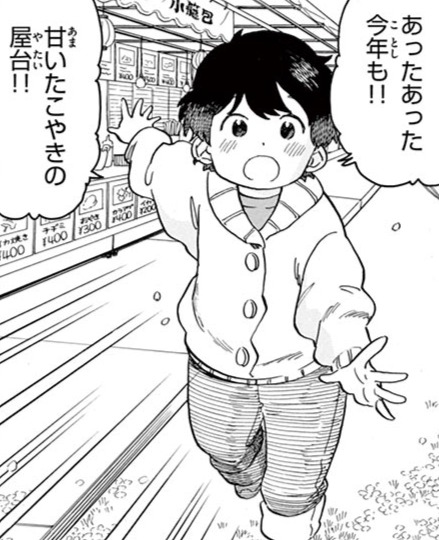
屋台 (Food stall)屋台( やたい ) means a portable street stall selling food, drinks, or goods, often at festivals and shrine events.
It combines 屋 (roofed shelter ) with 台 (stand ) to show a roofed stand used as a stall .
舞妓さんちのまかないさん »
Volume 8 » Page 84
At a local festival, Kiyo hurries over to Sumire and Kenta.
キヨ:
「あったあった 今年( ことし ) も!!」
“It's here, it's here, again this year!”
「甘( あま ) いたこやきの屋台( やたい )
“The sweet takoyaki booth!”
Challenge Yourself
Show translation
Challenge
What has Kiyo excitedly found at the festival?
Clues
あったあった 今年( ことし ) も
she has found something familiar that returned this year
甘( あま ) いたこやきの屋台( やたい ) she identifies it as the food stall selling sweet takoyaki
What does the speaker mean?
The sweet takoyaki stall that returns each year.
甘いたこやきの屋台 names the stall, and 今年も shows that Kiyo recognizes it from a previous year.
A new shop selling sweet tea for the first time.
The food is たこやき, not tea, and 今年も says the stall has appeared before.
The platform where the festival performance will begin.
屋台 can contain 台, but at this festival it means a food stall, as shown by 甘いたこやき.
A takoyaki stall that has stopped serving sweet food.
Kiyo identifies it directly as the sweet takoyaki stall. Nothing says its menu has changed.
The booth where Sumire and Kenta are waiting to work.
Kiyo hurries toward her friends after spotting the stall, but she does not say they work there.
A stall Kiyo was unable to find in earlier years.
今年も means it is here again this year, so she treats it as a returning favorite.
Kiyo spots the sweet takoyaki food stall and celebrates that it has returned this year. Her repeated あった conveys the excitement of finding a familiar festival favorite.
View Full Example
茶屋 (Teahouse)茶屋( ちゃや ) means a teahouse, tea shop, or tea dealer. In Kyoto’s geisha districts, it refers to an establishment that arranges banquets with maiko and geiko.
It combines 茶 (tea ) with 屋 (shop or building ) to show a teahouse or tea shop .
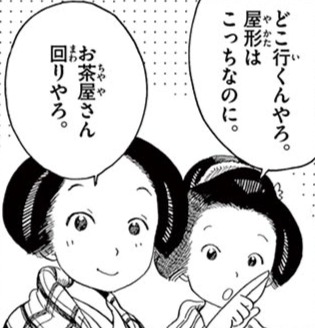
舞妓さんちのまかないさん »
Volume 4 » Page 18
A couple of maiko see Momohana leave a shop and head in the other direction.
まいこ1:
「どこ行( い ) くんやろ。屋形( やかた ) はこっちなのに。」
“I wonder where she's going. The lodge is this way, though.”
まいこ2:
「お茶屋( ちゃや ) 回( まわ ) りやろ。」
“She's probably doing the teahouse rounds.”
Challenge Yourself
Show translation
Challenge
Where does the second maiko think Momohana is going?
Clues
屋形( やかた ) はこっちなのにMomohana is heading away even though the lodge is in this direction
お茶屋( ちゃや ) さん回( まわ ) りやろ
the second maiko guesses that she is making the teahouse rounds
What does the speaker mean?
Around to the teahouses she visits for work.
お茶屋さん回り names the rounds, and やろ presents that destination as the second maiko's likely explanation.
Back to the lodge in the direction the maiko points.
屋形はこっちなのに stresses that Momohana is walking away from the lodge, not toward it.
To an ordinary café to buy tea for the lodge.
In this setting, お茶屋さん refers to establishments that arrange maiko and geiko entertainment, not ordinary cafés.
To one teahouse where she plans to stay all day.
お茶屋さん回り describes going around to multiple teahouses rather than remaining at one.
Somewhere unknown that neither maiko can guess.
The first maiko wonders where she is going, but the second offers a specific likely answer.
Home because she has finished all of her visits.
The second maiko thinks Momohana is currently making her rounds, not heading home after completing them.
Momohana is walking away from the lodge, so the first maiko wonders where she is going. The second answers お茶屋さん回りやろ, guessing that Momohana is making her work-related rounds among the teahouses.
View Full Example