Tea and tea culture with 茶
茶 means tea , including the plant, its leaves, and the drink.
Etymology
茶 is a plant character built with 艹 (grass ) over a sound-bearing element related to 余. Its oldest use centers on the tea plant and leaves prepared for drinking.
Tea Drinks
紅茶 (Black tea)紅茶( こうちゃ ) means black tea, named for the reddish color of the brewed drink.
It combines 紅 (crimson ) with 茶 (tea ) to show a red-colored tea .
ふらいんぐうぃっち »
Volume 3 » Page 33
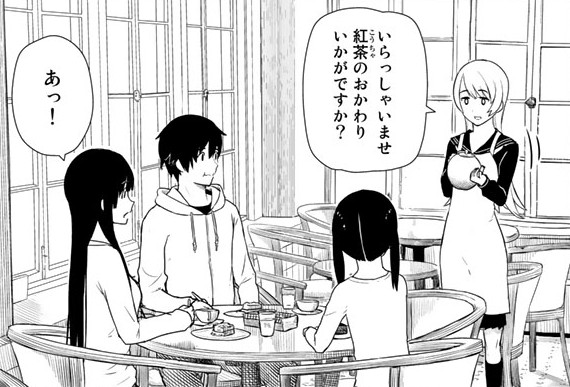
Makoto and her cousins visit a trendy witch-owned café. As the trio chats over tea and cake, the café’s owner and her daughter, Anzu, return home. Anzu goes out to greet the guests.
杏子( あんず ) :「いらっしゃいませ。紅茶( こうちゃ )
“Welcome. Can I offer you some more tea?”
Challenge Yourself
Show translation
Challenge
What does Anzu offer the guests?
Clues
紅茶( こうちゃ ) のおかわりanother serving or refill of black tea
いかがですか?
a polite way to ask whether they would like it
What does the speaker mean?
Another serving of tea.
紅茶( こうちゃ ) names the drink, and おかわり means an additional serving of the same thing.
A different kind of cake.
The item linked to おかわり is 紅茶( こうちゃ ) , so Anzu is offering more tea.
Their first cups of tea.
おかわり is a refill or another serving, which means the guests have already had some.
A chance to order from the menu.
Anzu offers a specific refill of tea rather than asking for a new order.
Coffee instead of tea.
The drink named before の is 紅茶( こうちゃ ) , black tea, not coffee.
Permission to enter the café.
いらっしゃいませ welcomes them, but the question itself offers another serving of tea.
Anzu politely offers the guests more black tea. 紅茶( こうちゃ ) identifies what will be refilled, and おかわり means another helping of the same food or drink.
View Full Example
抹茶 (Green tea)抹茶( まっちゃ ) is a finely powdered green tea whisked with hot water or used to flavor foods and sweets.
It combines 抹 (rub into powder ) with 茶 (tea ) to show powdered tea .
ご注文はうさぎですか? »
Volume 1 » Page 46
Visiting her new friend’s family’s café, Cocoa ponders over which menu item to order.
ココア:
「わー抹茶( まっちゃ ) 白玉( しらたま ) ぜんざいも 捨( す ) てがたいなあ」
“Wow, the green tea parfait is good, but the cream anmitsu and dumpling red bean soup are difficult to pass on.”
リゼ:
「わかるのか!?」
“You understand that!?”
Challenge Yourself
Show translation
Challenge
What does ココア mean in the highlighted line?
Clues
捨( す ) てがたい捨( す ) てがたい means difficult to reject as an option
What does the speaker mean?
Wow, the green tea parfait is good, but the cream anmitsu and dumpling red bean soup are difficult to pass on.
Cocoa is not discussing throwing food away; she finds the other desserts too appealing to pass up.
Cocoa says the desserts are physically difficult to eat.
The highlighted form is 捨( す ) てがたい. Here 捨( す ) てがたい means difficult to reject as an option, so this choice does not match the Japanese.
Cocoa says she wants the unwanted desserts thrown away.
The highlighted form is 捨( す ) てがたい. Here 捨( す ) てがたい means difficult to reject as an option, so this choice does not match the Japanese.
Cocoa says she has already chosen one dessert and rejected the rest.
The highlighted form is 捨( す ) てがたい. Here 捨( す ) てがたい means difficult to reject as an option, so this choice does not match the Japanese.
捨( す ) てがたい means difficult to reject as an option. Cocoa is not discussing throwing food away; she finds the other desserts too appealing to pass up.
View Full Example
Tea Spaces
茶屋 (Teahouse)茶屋( ちゃや ) means a teahouse, tea shop, or tea dealer. In Kyoto’s geisha districts, it refers to an establishment that arranges banquets with maiko and geiko.
It combines 茶 (tea ) with 屋 (shop or building ) to show a teahouse or tea shop .
舞妓さんちのまかないさん »
Volume 4 » Page 18
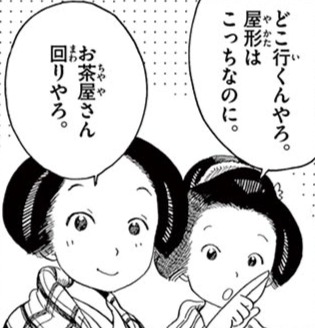
A couple of maiko see Momohana leave a shop and head in the other direction.
まいこ1:
「どこ行( い ) くんやろ。屋形( やかた ) はこっちなのに。」
“I wonder where she's going. The lodge is this way, though.”
まいこ2:
「お茶屋( ちゃや ) 回( まわ ) りやろ。」
“She's probably doing the teahouse rounds.”
Challenge Yourself
Show translation
Challenge
Where does the second maiko think Momohana is going?
Clues
屋形( やかた ) はこっちなのにMomohana is heading away even though the lodge is in this direction
お茶屋( ちゃや ) さん回( まわ ) りやろ
the second maiko guesses that she is making the teahouse rounds
What does the speaker mean?
Around to the teahouses she visits for work.
お茶屋さん回り names the rounds, and やろ presents that destination as the second maiko's likely explanation.
Back to the lodge in the direction the maiko points.
屋形はこっちなのに stresses that Momohana is walking away from the lodge, not toward it.
To an ordinary café to buy tea for the lodge.
In this setting, お茶屋さん refers to establishments that arrange maiko and geiko entertainment, not ordinary cafés.
To one teahouse where she plans to stay all day.
お茶屋さん回り describes going around to multiple teahouses rather than remaining at one.
Somewhere unknown that neither maiko can guess.
The first maiko wonders where she is going, but the second offers a specific likely answer.
Home because she has finished all of her visits.
The second maiko thinks Momohana is currently making her rounds, not heading home after completing them.
Momohana is walking away from the lodge, so the first maiko wonders where she is going. The second answers お茶屋さん回りやろ, guessing that Momohana is making her work-related rounds among the teahouses.
View Full Example
喫茶店 (Café)喫茶店( きっさてん ) means a café or Japanese-style coffeehouse serving drinks and light food.
It combines 喫 (consume ), 茶 (tea ), and 店 (shop ) to show a shop for drinking tea or coffee .
ご注文はうさぎですか? »
Volume 1 » Page 53
Rize explains to Syaro why she and her friends are at the store.
リゼ:
「喫茶店( きっさてん ) 使( つか ) うカップ買( か ) いに来( き ) たんだよ」
“We came to buy cups to use at the café.”
シャロ:
「そうだったんですか」
“Oh, I see.”
Challenge Yourself
Show translation
Challenge
What does リゼ mean in the highlighted line?
Clues
買( か ) いに来( き ) た買( か ) いに来( き ) た states the purpose of coming
What does the speaker mean?
We came to buy cups to use at the café.
Rize and her friends came to the store in order to buy cups for the café.
Rize says they came to sell cups to the café.
The highlighted form is 買( か ) いに来( き ) た. Here 買( か ) いに来( き ) た states the purpose of coming, so this choice does not match the Japanese.
Rize says they came to use the cups inside this store.
The highlighted form is 買( か ) いに来( き ) た. Here 買( か ) いに来( き ) た states the purpose of coming, so this choice does not match the Japanese.
Rize says they already bought the cups before coming.
The highlighted form is 買( か ) いに来( き ) た. Here 買( か ) いに来( き ) た states the purpose of coming, so this choice does not match the Japanese.
買( か ) いに来( き ) た states the purpose of coming. Rize and her friends came to the store in order to buy cups for the café.
View Full Example