Things and kinds with 物
物 refers broadly to “any entity that humans can perceive as an object”, encompassing not only physical objects but also matters, concepts, and even human characteristics.
Etymology
This kanji is a phono-semantic compound . It combines 牛 (cow) with 勿 as the sound element, originally referring to a cow with mixed or mottled coloring. Over time, it shifted from a specific visible creature to the broader idea of “various things”.
Goods
荷物 (Luggage)荷物( にもつ ) means luggage, a package, or another load being carried. Figuratively, it can mean a burden.
It combines 荷 (load ) with 物 (thing ) to show a load of things .
ご注文はうさぎですか? »
Volume 1 » Page 50
After Cocoa suggests if she were saying at Chiya’s place rather than Chino’s, that she’s be working for Chiya’s family’s tea house, Chiya takes to the idea.
千夜( ちや ) :「じゃあ部屋( へや ) を空( あ ) けておくから早速( さっそく ) 荷物( にもつ ) 来( き ) てね」
“Then I'll clear out a room in advance, so go gather your things and come right away.”
ココア:
「誰( だれ ) か止( と ) めてよ!」
“Somebody stop her!”
Challenge Yourself
Show translation
Challenge
What does (千夜:ちや) mean in the highlighted line?
Clues
空( あ ) けておく(空:あ)けておく means clearing a room and keeping it available
What does the speaker mean?
Then I'll clear out a room in advance, so go gather your things and come right away.
Chiya proposes preparing the room before Cocoa arrives with her belongings.
Chiya says the room will remain occupied when Cocoa arrives.
The highlighted form is 空( あ ) けておく. Here 空( あ ) けておく means clearing a room and keeping it available, so this choice does not match the Japanese.
Chiya tells Cocoa to clear out her own room first.
The highlighted form is 空( あ ) けておく. Here 空( あ ) けておく means clearing a room and keeping it available, so this choice does not match the Japanese.
Chiya plans to prepare the room only after Cocoa moves in.
The highlighted form is 空( あ ) けておく. Here 空( あ ) けておく means clearing a room and keeping it available, so this choice does not match the Japanese.
空( あ ) けておく means clearing a room and keeping it available. Chiya proposes preparing the room before Cocoa arrives with her belongings.
View Full Example
Identity
本物 (Real thing)本物( ほんもの ) means the real thing or genuine article. It contrasts with copies, fakes, or imitations.
It combines 本 (real / original ) with 物 (thing ) to show the genuine thing .
ご注文はうさぎですか? »
Volume 1 » Page 70
Chiya and Syaro unexpectedly have to stay the night at Chino’s home.
シャロ:
「チノちゃんにパジャマ借( か ) りたのはいいけどちょっとかわいすぎない?」
“Borrowing pajamas from Chino-chan is fine, but aren't they a little too cute?”
「いつもはジャージなのに」
“Even though she usually wears a tracksuit.”
千夜( ちや ) :「本物( ほんもの ) 嬢様( じょうさま ) みたい♪」
“You look like a real young lady♪”
Challenge Yourself
Show translation
Challenge
What does シャロ mean in the highlighted line?
Clues
かわいすぎない
かわいすぎない? is a negative question about excess
What does the speaker mean?
Borrowing pajamas from Chino-chan is fine, but aren't they a little too cute?
Syaro asks whether the pajamas are too cute, inviting the others to agree with her discomfort.
Syaro complains that Chino's pajamas are not cute enough.
The highlighted form is かわいすぎない. Here かわいすぎない? is a negative question about excess, so this choice does not match the Japanese.
Syaro says she usually wears Chino's cute pajamas.
The highlighted form is かわいすぎない. Here かわいすぎない? is a negative question about excess, so this choice does not match the Japanese.
Syaro refuses the pajamas because they are the wrong size.
The highlighted form is かわいすぎない. Here かわいすぎない? is a negative question about excess, so this choice does not match the Japanese.
かわいすぎない? is a negative question about excess. Syaro asks whether the pajamas are too cute, inviting the others to agree with her discomfort.
View Full Example
Life Forms
動物 (Animal)動物( どうぶつ ) means an animal. In everyday use, it usually means a nonhuman creature.
It combines 動 (move ) with 物 (thing ) to show a moving living thing .
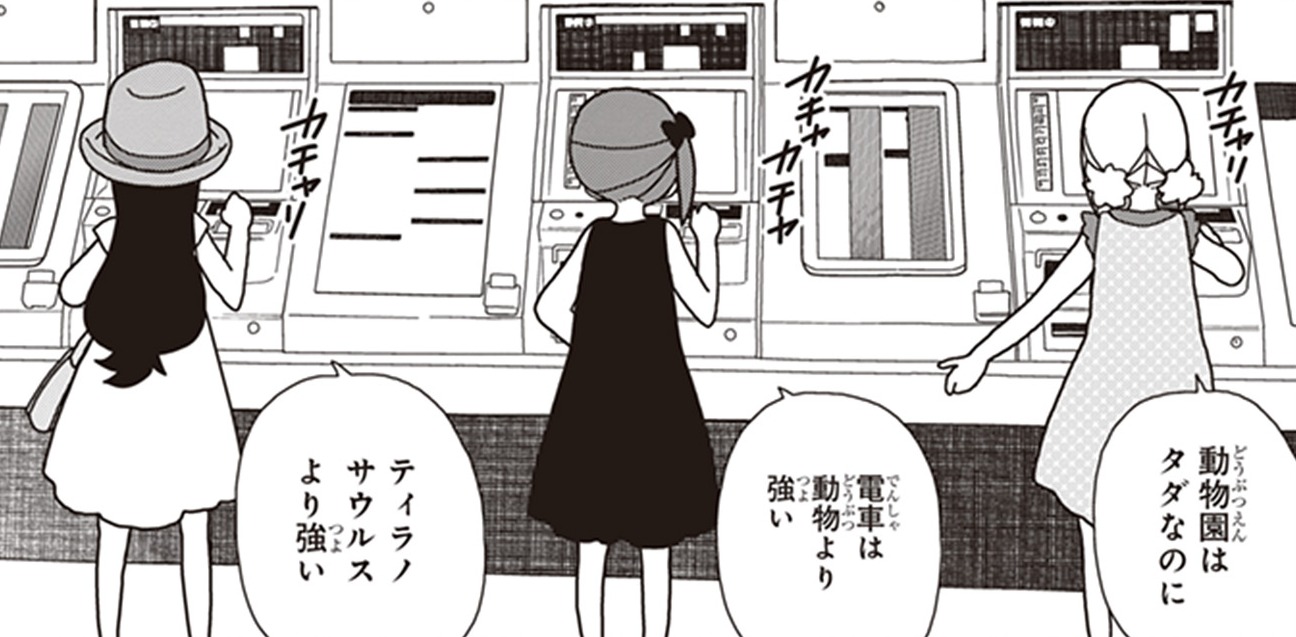
Example 1 of 3: Cost to ride the train with 電車 Example 1 of 3
三ツ星カラーズ »
Volume 6 » Page 79
Yui and her friends get permission to ride the train to continue their search for the legendary giant robot. Tickets are listed as 70 yen for children.
さっちゃん:
「動物園( どうぶつえん ) はタダなのに」
“Even though the zoo is free...”
結衣( ゆい ) :「電車( でんしゃ ) は動物( どうぶつ ) 強( つよ ) い」
“Trains are stronger than animals.”
琴葉( ことは ) :「ティラノサウルスより強( つよ ) い」
“Stronger than a Tyrannosaurus.”
Challenge Yourself
Show translation
Challenge
What comparison do Yui and Kotoha make about the train?
Clues
電車( でんしゃ ) は動物( どうぶつ ) より強( つよ ) いthe train is stronger than animals
ティラノサウルスより強( つよ ) い
stronger than a Tyrannosaurus
What does the speaker mean?
The train is stronger than animals, even a Tyrannosaurus.
より marks animals and then a Tyrannosaurus as the things the train exceeds in strength.
Animals are stronger than the train.
In ⒶはⒷより強( つよ ) い, Ⓐ is the stronger item, so the comparison is not reversed.
The train is faster than every animal.
The adjective is 強( つよ ) い, strong, not 速( はや ) い, fast.
A Tyrannosaurus could ride the train for free.
The dinosaur appears as a strength comparison, not as a passenger.
The zoo charges more than the train.
Sacchan says the zoo is free. The others answer with a playful strength comparison rather than prices.
The train is powered by animals.
The line compares strength and does not describe how the train is powered.
Yui says the train is stronger than animals, and Kotoha raises the comparison to a Tyrannosaurus. Their childlike logic treats the fare as evidence of the train’s greater power.
View Full Example
Example 2 of 3: Heard about getting along with animals with 〜らしい Example 2 of 3
ご注文はうさぎですか? »
Volume 1 » Page 49
Chino is fascinated by the rabbit at a rival tea shop, but she keeps her distance.
ココア:
「触( さわ ) らないの?」
“You're not going to touch it?”
リゼ:
「チノはティッピー以外( いがい ) の動物( どうぶつ ) 懐( なつ ) かないらしい」
“It seems that animals other than Tippy don't warm up to Chino.”
Challenge Yourself
Show translation
Challenge
What does リゼ mean in the highlighted line?
Clues
らしい
らしい presents the animal problem as reported information
What does the speaker mean?
It seems that animals other than Tippy don't warm up to Chino.
Rize passes on something she has heard or inferred about Chino rather than claiming direct certainty.
Rize says Chino dislikes every animal except Tippy.
The highlighted form is らしい. Here らしい presents the animal problem as reported information, so this choice does not match the Japanese.
Rize says Tippy is the only animal that avoids Chino.
The highlighted form is らしい. Here らしい presents the animal problem as reported information, so this choice does not match the Japanese.
Rize knows from direct observation that all animals like Chino.
The highlighted form is らしい. Here らしい presents the animal problem as reported information, so this choice does not match the Japanese.
らしい presents the animal problem as reported information. Rize passes on something she has heard or inferred about Chino rather than claiming direct certainty.
View Full Example
Example 3 of 3: Skilled clock maker with 職人 Example 3 of 3
名探偵コナン »
Volume 17 » Page 118
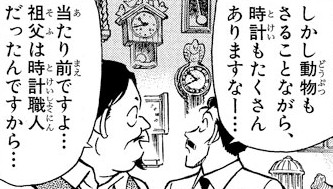
Having received a letter requesting help solving a mystery, Kogoro finds himself in a house filled with animal designs everywhere, including the doors, the chairs, and the plates. His attention turns to the clocks covering the walls.
小五郎( こごろう ) :「しかし動物( どうぶつ ) 時計( とけい ) もたくさんありますなー...」
“But aside from the animals, there are also a lot of clocks, huh...”
男( おとこ ) :「当( あ ) たり前( まえ ) ですよ... 祖父( そふ ) は時計( とけい ) 職人( しょくにん ) だったんですから...」
“Of course there are... Grandfather was a clock maker, after all...”
Challenge Yourself
Show translation
Challenge
Why does the house contain so many clocks?
Clues
当( あ ) たり前( まえ ) ですよof course
祖父( そふ ) は時計( とけい ) 職人( しょくにん ) だったんですからbecause Grandfather was a clockmaker
What does the speaker mean?
The grandfather was a clockmaker.
だったんですから gives the grandfather's work as the reason the clocks are unsurprising.
The grandfather collected clocks but never worked on them.
時計( とけい ) 職人( しょくにん ) identifies his occupation as a skilled clock artisan.
Kogoro brought the clocks for the investigation.
The clocks were already part of the house because of its former resident.
Every animal design in the house hides a clock.
The speaker explains the abundance through the grandfather's trade, not a design trick.
The house currently operates as a clock shop.
The line tells us what the grandfather used to do, not the building's present business.
The clocks were gifts from Kogoro's clients.
Their source is tied to the grandfather being a clockmaker.
The many clocks are natural to the household because the speaker’s grandfather was a clockmaker. だったんですから supplies that explanatory reason.
View Full Example
Materials
毒物 (Poisonous substance)毒物( どくぶつ ) means a poisonous substance that can damage health or cause death.
It combines 毒 (poison ) with 物 (thing ) to show a poisonous thing .
名探偵コナン »
Volume 16 » Page 25
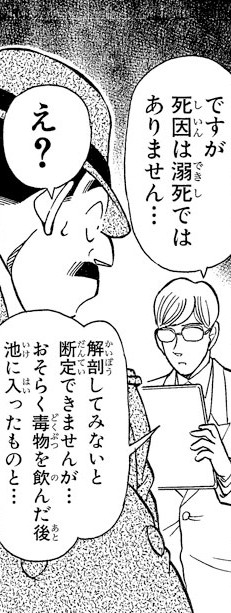
Inspector Megure suggests the murder suspect committed suicide by drowning himself. The medical examiner disagrees.
監察医( かんさつい ) :「ですが死因( しいん ) は溺死( できし ) ではありません…」
“However, drowning wasn't the cause of death...”
目暮( めぐれ ) :「え?」
“What?”
監察医( かんさつい ) :「解剖( かいぼう ) してみないと断定( だんてい ) できませんが… おそらく毒物( どくぶつ ) 飲( の ) んだあと池( いけ ) に入( はい ) ったものと…」
“I can't say for certain without an autopsy... but it's likely he took poison and then entered the pond...”
Challenge Yourself
Show translation
Challenge
What does the medical examiner suspect happened before the victim entered the pond?
Clues
おそらく毒物( どくぶつ ) を飲( の ) んだあと
probably after drinking poison
池( いけ ) に入( はい ) ったhe entered the pond
What does the speaker mean?
He drank poison.
The examiner tentatively places drinking 毒物( どくぶつ ) before entering the pond.
He drowned before taking any poison.
The examiner says drowning was not the cause of death and suspects poison first.
He performed an autopsy on someone else.
The examiner needs an autopsy performed on this victim to confirm the cause.
He was rescued from the pond alive.
The scene concerns determining the cause of the victim's death.
He accidentally drank pond water.
The suspected substance is 毒物( どくぶつ ) , poison.
He entered the pond before consuming anything.
あと places the pond entry after the suspected poisoning.
The examiner suspects that the victim drank poison and then entered the pond. An autopsy is still needed before that cause can be stated with certainty.
View Full Example