Time and occasions with 時
時 represents time, a specific moment, or a particular period.
Etymology
This kanji isa phono-semantic compound comprised of 日 (sun) as the semantic component and 寺 as the phonetic component (ジ).
The sun anchors the meaning because the movement of the sun is what lets people measure the passing of time. A measured point under the sun becomes both a clock moment and the broader sense of “when”.
Time Boundaries and Limits
時限装置 (Timing device)時限装置( じげんそうち ) means a timing device set to operate at a preset time or after a fixed delay.
It combines 時限 (preset time ) with 装置 (device ) to show a device controlled by a set time .
名探偵コナン »
Volume 3 » Page 79
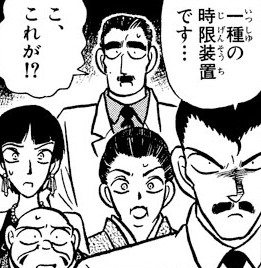
Two murders on a yacht leave the passengers on edge. A blackout occurs followed by another attempted murder. This should narrow down the list of suspects to those who weren’t gathered in the dining room. However, Detective Kogoro finds the power switch had a weight tied to it by rope, with a candle having burned the rope to drop the weight. This allowed the power to be turned off unattended.
小五郎( こごろう ) :「一種( いっしゅ ) の時限( じげん ) 装置( そうち ) です」
“It's a timing device of sorts.”
Challenge Yourself
Show translation
Challenge
How does Kogoro classify the candle-and-rope mechanism?
Clues
一種( いっしゅ ) のa kind of
時限( じげん ) 装置( そうち ) ですit is a timing device
What does the speaker mean?
A kind of timing device.
一種( いっしゅ ) の presents the improvised mechanism as one type of timed device.
A manually operated light switch.
The mechanism delays the switch action without someone operating it at that moment.
A device that measures room temperature.
時限( じげん ) points to a preset time, not temperature.
A rope designed to restrain a suspect.
The rope is part of a delayed mechanism for the power switch.
A permanent repair to the electrical system.
Kogoro describes an improvised setup used to cause the blackout.
A clock that records when people enter.
The device triggers an action after time passes. It does not record arrivals.
Kogoro calls the setup a kind of timing device because the candle burns through the rope after a delay and allows the weight to pull the power switch.
View Full Example
Time Periods and Duration
時間 (Time)時間( じかん ) means time, an amount of time, or the interval between two points.
It combines 時 (time ) with 間 (interval ) to show a measured span of time .
Example 1 of 5: Broadcasting music at school with 放送 Example 1 of 5
からかい上手の高木さん »
Volume 19 » Page 88
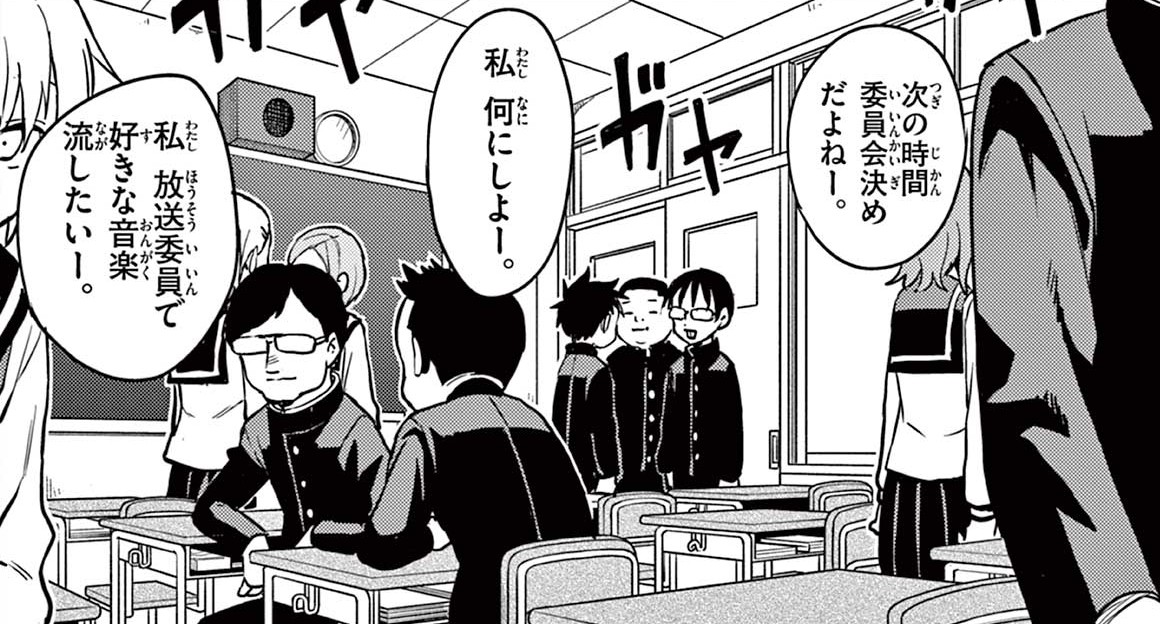
Nishika and Takagi’s class discusses what committees they plan to join.
生徒( せいと ) :「次( つぎ ) の時間( じかん ) 委員会( いいんかい ) 決( ぎ ) めだよねー。」
“Next up is deciding the committee schedule, right?”
生徒( せいと ) :「私( わたし ) 何( なに ) にしよー」
“What should I pick?”
生徒( せいと ) :「私( わたし ) 放送( ほうそう ) 委員( いいん ) で好( す ) きな音楽( おんがく ) 流( なが ) したいー。」
“I want to play my favorite music as a member of the broadcasting committee.”
Challenge Yourself
Show translation
Challenge
Which committee does the student want, and why?
Clues
放送( ほうそう ) 委員( いいん ) で"as a member of the broadcasting committee"
好( す ) きな音楽( おんがく ) 流( なが ) したい"want to play music I like," with the object marker を omitted
What does the speaker mean?
The broadcasting committee, so she can play music she likes.
放送( ほうそう ) 委員( いいん ) names the committee, and 流( なが ) したい states what she wants to do there.
The music committee, so she can perform her own songs.
She says 放送( ほうそう ) 委員( いいん ) , not a music committee, and 流( なが ) す means to play or broadcast music here.
The broadcasting committee, so she can make school announcements.
The committee is right, but her stated goal is to play music she likes.
The class committee, so she can choose the schedule.
委員会( いいんかい ) 決( ぎ ) め is the class activity. It is not the committee she chooses.
The library committee, so she can listen to music while working.
The line names the broadcasting committee and says she wants to send music over the system.
She has not decided which committee she wants.
Her earlier question is followed by a specific choice, 放送( ほうそう ) 委員( いいん ) .
The student settles on the 放送( ほうそう ) 委員( いいん ) , the broadcasting committee. Her reason is 好( す ) きな音楽( おんがく ) 流( なが ) したい, she wants to play music she likes.
View Full Example
Example 2 of 5: Coming all the way out here with 足を運ぶ Example 2 of 5
orange »
Volume 3 » Page 68
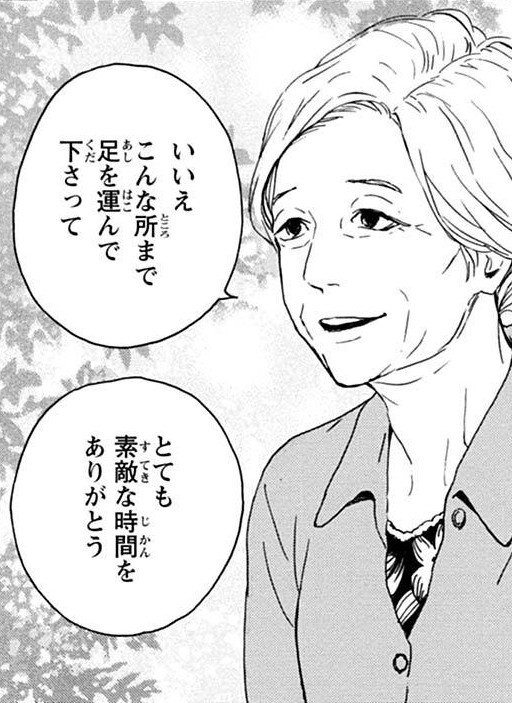
As Suwa and his friends leave Kakeru’s grandmother’s house, Suwa apologizes for the bother.
おばあさん:
「いいえ こんな所( ところ ) まで足( あし ) を運( はこ ) んで下( くだ ) さってとても素敵( すてき ) な時間( じかん )
“No, thank you very much for coming all the way here and having such a wonderful time.”
Challenge Yourself
Show translation
Challenge
What is Kakeru's grandmother thanking the group for?
Clues
こんな所( ところ ) まで
all the way to a place like this
足( あし ) を運( はこ ) ぶto make the effort to visit
〜て下( くだ ) さって
for kindly doing something for the speaker
素敵( すてき ) な時間( じかん ) をありがとうthank you for the wonderful time
What does the speaker mean?
She thanks them for making the trip and sharing a wonderful time with her.
足( あし ) を運( はこ ) ぶ means making the effort to visit, and the final ありがとう also covers the 素敵( すてき ) な時間( じかん ) they shared.
She thanks them for carrying her somewhere on foot.
足( あし ) を運( はこ ) ぶ is an idiom here. It means that the visitors came to her house, not that they physically carried her.
She apologizes for making them deliver something to her house.
The object 足( あし ) belongs to the idiom 足( あし ) を運( はこ ) ぶ. No package or delivery appears in the line.
She thanks Suwa for inviting her to visit his home next time.
The visitors came to her location, marked by こんな所( ところ ) まで. She does not discuss a future visit to Suwa's home.
She says their visit was pleasant but lasted too long.
素敵( すてき ) な時間( じかん ) praises the time together. The sentence has no complaint about how long they stayed.
She thanks them only for bringing her a gift.
Her thanks names their visit and the wonderful time. Nothing in the line refers to a present or other object they brought.
The idiom 足( あし ) を運( はこ ) ぶ recognizes the effort it took to visit. The grandmother uses 下( くだ ) さって respectfully, then thanks the group for the time they spent with her.
View Full Example
Example 3 of 5: Hidden behind the short hand with 短針 Example 3 of 5
怪盗セイント・テール »
Volume 1 » Page 54
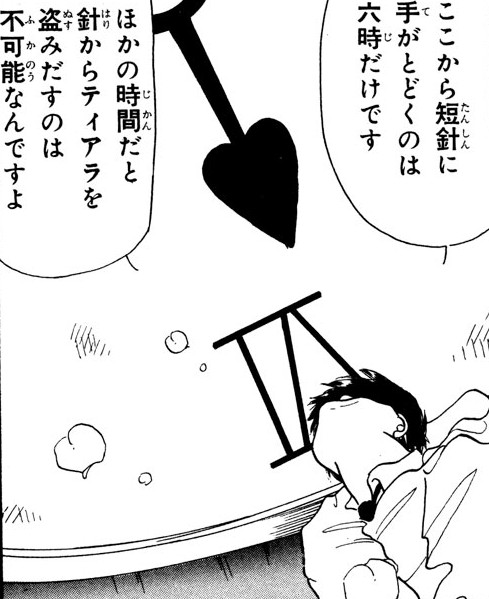
Asuka Jr. is tasked with guarding a jeweled tiara, which Saint Tail has stated her intention to steal. The owner tells Asuka Jr. it’s been hidden behind the short hand on a clock tower, so Asuka Jr. waits below the face of the clock for Saint Tail’s arrival. He tells the owner that Saint Tail will likely arrive precisely at 6 o’clock.
アスカ Jr.:
「ここから短針( たんしん ) に手( て ) がとどくのは六( ろく ) 時( じ ) だけです」
“The hour hand is only within reach from here at six o'clock.”
「ほかの時間( じかん ) 針( はり ) からティアラを盗( ぬす ) みだすのは不可能( ふかのう ) なんですよ」
“At any other time, it would be impossible to steal the tiara from the hand, you see.”
Challenge Yourself
Show translation
Challenge
What does Asuka Jr. say about reaching the hour hand from here?
Clues
手( て ) がとどくto be within reach
六( ろく ) 時( じ ) だけonly at six o'clock
What does the speaker mean?
The hour hand is within reach only at six o'clock.
六( ろく ) 時( じ ) だけ identifies the only time when 手( て ) がとどく is true.
The hour hand stays within reach until six o'clock.
だけ means "only". The line would need まで to express "until six o'clock".
The hour hand is within reach for six hours.
六( ろく ) 時( じ ) means six o'clock. A duration of six hours would be 六時間( ろくじかん ) .
ここから sets the viewpoint to “from here”. The clause ending in のは introduces what Asuka Jr. is discussing, and 六( ろく ) 時( じ ) だけです identifies six o’clock as the only time the hour hand is within reach.
View Full Example
Example 4 of 5: Never mind the time with いいから Example 4 of 5
あしたは土曜日 »
Volume 春・夏 » Page 60
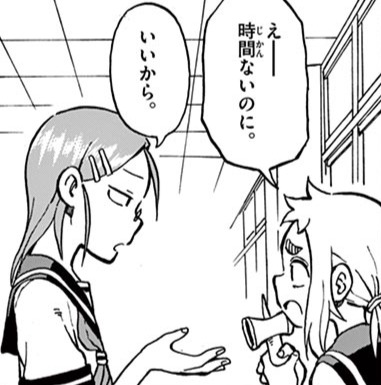
Yukari sees Mina with a kendama while between classes. She tells Mina they need to get to their next class, but Mina has decided not to head to the classroom until she successfully gets the ball onto the spike. Yukari tells Mina to hand it over to her to try.
ミナ:
「えーーー 時間( じかん )
“No way... I don't have time.”
ユカリ:
「いいから。」
“Never mind that.”
Challenge Yourself
Show translation
Challenge
How does Yukari respond to Mina's concern about time?
Clues
時間( じかん ) ないthere is no time
〜のに
even though, marking Mina's objection
いいから
never mind that, just go along with it
What does the speaker mean?
She dismisses the time concern and presses ahead.
Mina raises 時間( じかん ) ない as an objection, and Yukari's いいから tells her to set that concern aside.
She agrees that they should stop because time is short.
いいから dismisses Mina's objection. Yukari is not agreeing to stop.
She assures Mina that they have plenty of time left.
Yukari does not contradict 時間( じかん ) ない with a statement about how much time remains.
She says the kendama is good enough already.
いい does not evaluate the kendama here. The full response いいから brushes aside Mina's concern.
She tells Mina to keep trying by herself.
The line does not name Mina as the person who should continue. In context, Yukari wants to take over.
She explains why they are running late.
The から in いいから supports an implied instruction. It does not introduce an explanation of their delay.
Yukari uses いいから to brush aside Mina’s complaint that there is no time and move on with what she wants to do.
View Full Example
Example 5 of 5: No time to return to headquarters with 本部 Example 5 of 5
ARIA The MASTERPIECE »
Volume 3 » Page 286
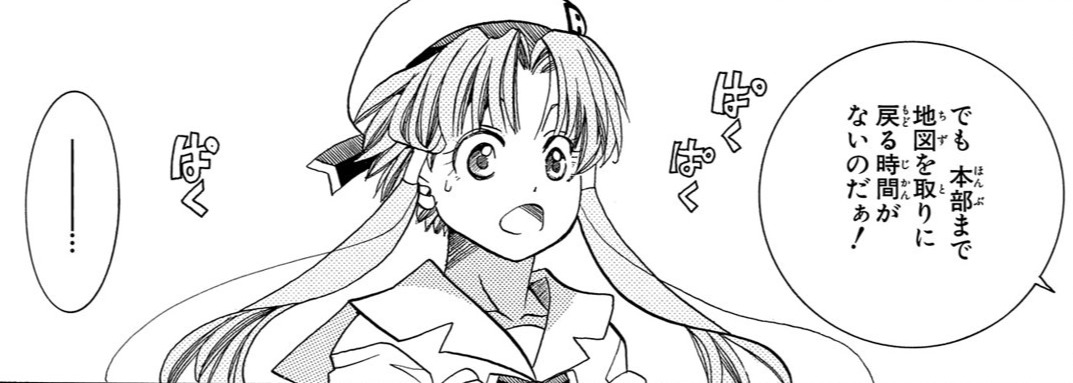
Akari encounters Woody while he’s out on a delivery run. He stopped to show off for some kids, but in the process, he seems to have lost his city map, and he has a terrible sense of direction. Akari asks if he has the delivery addresses, which he says he does.
ウッディー:
「でも 本部( ほんぶ ) まで地図( ちず ) を取( と ) りに戻( もど ) る時間( じかん )
“But I don't have time to go back to headquarters to get a map!!”
View Full Example
Timekeeping and Measurement
時計 (Clock)時計( とけい ) means a clock, watch, or other device that measures and displays time.
It combines 時 (time ) with 計 (measure ) to show a device that measures time .
Example 1 of 2: Dazed by a wristwatch with 気が遠くなる Example 1 of 2
美少女戦士セーラームーン »
Volume 6 » Page 264
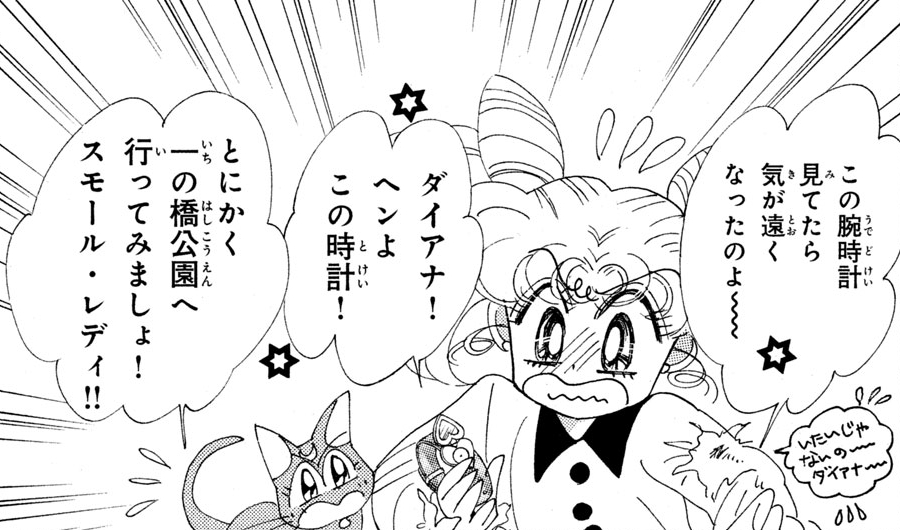
At the stroke of midnight, Chibiusa wakes to a mysterious glow from her new wristwatch. She gets out of bed in a daze, and begins to leave the room. Her cat, Diana, bites her on the arm, returning Chibiusa from her trance.
ちびうさ:
「この腕時計( うでとけい ) 見( み ) てたら気( き ) が遠( とお ) くなったのよ〰〰」
“When I looked at this wristwatch, I became lightheaded〰”
「ダイアナ! ヘンよ この時計( とけい )
“Diana! Something is strange about this watch!”
「とにかく 一( いち ) の橋( はし ) 公園( こうえん ) へ行( い ) ってみましょ! スモール・レディ!!」
“Anyway, let's try going to Ichinohashi Park! Small Lady!!”
Challenge Yourself
Show translation
Challenge
What does Chibiusa say happened while she looked at the wristwatch?
Clues
この腕時計( うでとけい ) 見( み ) てたら
the event occurred while she was looking at this wristwatch
気( き ) が遠( とお ) くなったshe became faint, dazed, or detached from her surroundings
What does the speaker mean?
She became dazed while looking at it.
見てたら gives the situation in progress, and 気が遠くなった describes the dazed state that followed.
She fell asleep before she had a chance to look at it.
見てたら says she was looking at the watch when the change happened.
She remembered where she had lost the watch.
気が遠くなった concerns consciousness becoming faint or distant, not recovering a memory.
Diana frightened her by suddenly showing her the watch.
Chibiusa identifies looking at the watch as the trigger. Diana later snaps her out of the trance.
She calmly decided to visit the park after checking the time.
Her dazed reaction and ヘンよ show that the watch affected her strangely, not that she made a normal plan.
The watch stopped working when midnight arrived.
She says the watch is strange because it made her feel dazed. She does not say it stopped.
Chibiusa says that she became dazed while looking at the wristwatch. 気が遠くなった describes her fading awareness, and her next line identifies the watch as the source of the strange experience.
View Full Example
Example 2 of 2: Skilled clock maker with 職人 Example 2 of 2
名探偵コナン »
Volume 17 » Page 118
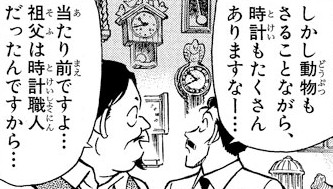
Having received a letter requesting help solving a mystery, Kogoro finds himself in a house filled with animal designs everywhere, including the doors, the chairs, and the plates. His attention turns to the clocks covering the walls.
小五郎( こごろう ) :「しかし動物( どうぶつ ) もさることながら、時計( とけい )
“But aside from the animals, there are also a lot of clocks, huh...”
男( おとこ ) :「当( あ ) たり前( まえ ) ですよ... 祖父( そふ ) は時計( とけい ) 職人( しょくにん ) だったんですから...」
“Of course there are... Grandfather was a clock maker, after all...”
Challenge Yourself
Show translation
Challenge
Why does the house contain so many clocks?
Clues
当( あ ) たり前( まえ ) ですよof course
祖父( そふ ) は時計( とけい ) 職人( しょくにん ) だったんですからbecause Grandfather was a clockmaker
What does the speaker mean?
The grandfather was a clockmaker.
だったんですから gives the grandfather's work as the reason the clocks are unsurprising.
The grandfather collected clocks but never worked on them.
時計( とけい ) 職人( しょくにん ) identifies his occupation as a skilled clock artisan.
Kogoro brought the clocks for the investigation.
The clocks were already part of the house because of its former resident.
Every animal design in the house hides a clock.
The speaker explains the abundance through the grandfather's trade, not a design trick.
The house currently operates as a clock shop.
The line tells us what the grandfather used to do, not the building's present business.
The clocks were gifts from Kogoro's clients.
Their source is tied to the grandfather being a clockmaker.
The many clocks are natural to the household because the speaker’s grandfather was a clockmaker. だったんですから supplies that explanatory reason.
View Full Example
時刻 (Time)時刻( じこく ) means a specific clock time or appointed hour.
It combines 時 (time ) with 刻 (moment ) to show a marked point in time .
名探偵コナン »
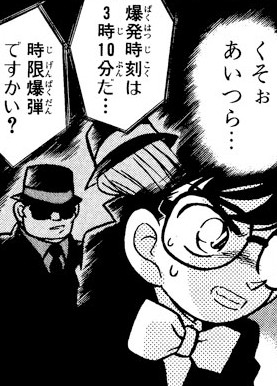
Volume 4 » Page 89
Conan overhears Gin and Vodka discuss a bomb they’ve planted. There’s little time left for Conan to find the bomb and get it off the bullet train before it explodes. As he tries to determine who is unknowingly carrying the bomb, he thinks back to what the two had said.
ジン:
「爆発( ばくはつ ) 時刻( じこく ) 時( じ ) 10分( ぷん ) だ...」
“The explosion time is 3:10.”
ウォッカ:
「時限( じげん ) 爆弾( ばくだん ) ですかい?」
“Is it a time bomb?”
Challenge Yourself
Show translation
Challenge
What does Vodka infer from the scheduled explosion time?
Clues
爆発( ばくはつ ) 時刻( じこく ) は3時( じ ) 10分( ぷん ) the explosion time is 3:10
時限( じげん ) 爆弾( ばくだん ) ですかい?is it a time bomb?
What does the speaker mean?
The explosive is a time bomb.
The exact preset explosion time leads Vodka to ask whether it is a 時限( じげん ) 爆弾( ばくだん ) .
The bomb has already exploded.
The detonation is scheduled for 3:10 and has not happened yet.
Someone must detonate it by hand at 3:10.
時限( じげん ) 爆弾( ばくだん ) implies a preset timed trigger.
The train will arrive at 3:10.
The time specifically belongs to the explosion.
The bomb stops working after ten minutes.
3:10 is a clock time, not a ten-minute operating limit.
The device is only a clock with no explosive.
Vodka explicitly identifies it as a type of bomb.
Gin gives the precise detonation time, and Vodka infers that the device is a time bomb set to explode on that schedule.
View Full Example