Topics and assigned problems with 題
題 means a topic or assigned problem . It appears in words for conversation topics, agenda items, and assignments.
Etymology
題 is a phono-semantic compound made from 頁 and 是 as the sound-bearing element. The original meaning was forehead . The forehead being the most prominent part of the head, it extended in meaning to the front of somethig, a label or sign, and the title or subject that heads a discussion.
Assignments
宿題 (Homework)宿題( しゅくだい ) means homework or another assigned task to be completed later. It usually refers to schoolwork done outside class, but it can also mean unfinished business.
It combines 宿 (remain lodged ) with 題 (topic ) to show an assignment topic carried away to work on .
あずまんが大王 »
Volume 1年生 » Page 9
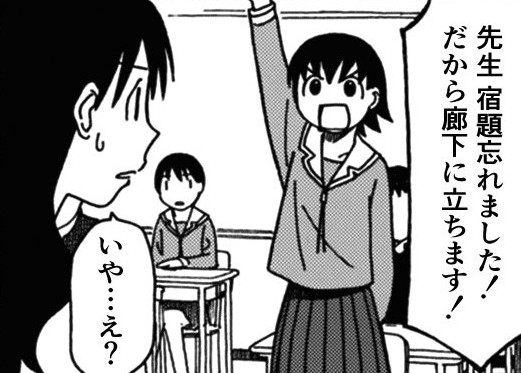
Tomo stands from her desk and raises her hand.
とも:
「先生( せんせい ) 宿題( しゅくだい ) 忘( わす ) れました!だから廊下( ろうか ) に立( た ) ちます!」
“Teacher, I forgot my homework! So I'll stand in the hall!”
Challenge Yourself
Show translation
Challenge
What consequence does Tomo announce for forgetting her homework?
Clues
宿題( しゅくだい ) 忘( わす ) れましたI forgot the homework
だから
so or therefore
廊下( ろうか ) に立( た ) ちますI will stand in the hallway
What does the speaker mean?
She says she will stand in the hallway.
だから links forgetting the homework to Tomo's announced response, 廊下( ろうか ) に立( た ) ちます.
She says she will finish the homework in the hallway.
立( た ) ちます means she will stand there. No action of completing homework appears.
She asks the teacher to stand in the hallway.
Tomo is the omitted subject of 立( た ) ちます. She is announcing what she herself will do.
She promises to bring the homework tomorrow.
The line gives an immediate consequence, not a plan for the next day.
She says the teacher forgot to assign homework.
先生( せんせい ) is the person Tomo addresses. Tomo is the one who forgot the homework.
She concludes that there was no homework.
宿題( しゅくだい ) 忘( わす ) れました assumes the homework existed and says Tomo forgot it.
Tomo reports that she forgot her homework and then uses だから to present standing in the hallway as the consequence.
View Full Example
Problems
問題 (Problem)問題( もんだい ) means a problem, issue, or question under discussion. It is used for school problems, social issues, and trouble alike.
It combines 問 (question ) with 題 (topic ) to show a matter raised for answer or discussion .
ご注文はうさぎですか? »
Volume 1 » Page 88
During a library study session, Syaro helps Chino with her homework.
シャロ:
「この問題( もんだい ) 答( こた ) えをここに当( あ ) てはめて…」
“For this problem, substitute the answer from before here...”
チノ:
「すごく分( わ ) かりやすいです!」
“That's very easy to understand!”
Challenge Yourself
Show translation
Challenge
What does チノ mean in the highlighted line?
Clues
分( わ ) かりやすい(分:わ)かりやすい means easy to understand
What does the speaker mean?
That's very easy to understand!
分( わ ) かる changes to the stem 分( わ ) かり before やすい.
Chino says the problem is easy even without Syaro's explanation.
The highlighted form is 分( わ ) かりやすい. Here 分( わ ) かりやすい means easy to understand, so this choice does not match the Japanese.
Chino says she still cannot understand Syaro's explanation.
The highlighted form is 分( わ ) かりやすい. Here 分( わ ) かりやすい means easy to understand, so this choice does not match the Japanese.
Chino complains that Syaro made the explanation too simple.
The highlighted form is 分( わ ) かりやすい. Here 分( わ ) かりやすい means easy to understand, so this choice does not match the Japanese.
分( わ ) かりやすい means easy to understand. 分( わ ) かる changes to the stem 分( わ ) かり before やすい.
View Full Example
Topics
題材 (Subject matter)題材( だいざい ) means the subject matter or theme chosen for a creative work or study.
It combines 題 (topic ) with 材 (material ) to show subject matter used as material .
ああっ女神さまっ »
Volume 2 » Page 75
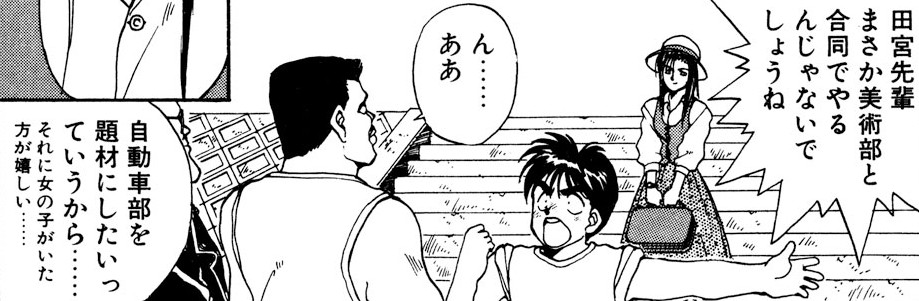
Kei’ichi is excited to spend four days at the beach with his university automobile club and Belldandy. His mood changes when he hears Sayoko call out to him.
螢一( けいいち ) :「田宮( たみや ) 先輩( せんぱい ) まさか美術部( びじゅつぶ ) と合同( ごうどう ) でやるんじゃないでしょうね」
“Tamiya, don't tell me we're doing this with the art club!”
田宮( たみや ) :「ん……ああ。自動車部( じどうしゃぶ ) を題材( だいざい ) 女( おんな ) の子( こ ) がいた方( ほう ) が嬉( うれ ) しい…」
“It's because they said they wanted to use the automobile club as a subject... Additionally, I'm happier having girls here.”
Challenge Yourself
Show translation
Challenge
What reason does Tamiya add for welcoming the joint trip?
Clues
それに
besides that, in addition
女( おんな ) の子( こ ) がいたgirls were there
〜方( ほう ) が
the option that is preferable
嬉( うれ ) しいhappy or pleased
What does the speaker mean?
He would be happier if girls were there too.
それに adds Tamiya's personal reason, and 女( おんな ) の子( こ ) がいた方( ほう ) が嬉( うれ ) しい says he would prefer having girls there.
He thinks the art club would be happier without the automobile club.
The line does not say the art club wants to be separate. Tamiya says that he would welcome having girls present.
He wants the girls to use the automobile club as their art subject.
That belongs to the earlier reason given by the art club. それに introduces Tamiya's separate reason for liking the plan.
He is relieved that the two clubs canceled their joint trip.
合同( ごうどう ) でやる describes doing the trip jointly. Nothing in the exchange says it has been canceled.
He tells Kei'ichi to be happy that Sayoko called out.
嬉( うれ ) しい describes Tamiya's reaction to having girls along, not an instruction to Kei'ichi.
He would rather replace the automobile club members with girls.
女( おんな ) の子( こ ) がいた方( ほう ) が compares having girls present with not having them present. It does not say anyone will be replaced.
Tamiya first states the art club’s reason for joining the trip. With それに, he adds his own reason. He would be happier with girls there.
View Full Example