Wholeness and completion with 全
全 “everything (entirely)” or “having no missing parts and being completely whole”.
Completeness
完全 (Complete)完全( かんぜん ) means complete or perfect, with nothing missing or deficient.
It combines 完 (complete ) with 全 (whole ) to show total completeness .
ご注文はうさぎですか? »
Volume 1 » Page 14
While changing into her uniform, Rize hid in the closet when she sensed someone unfamiliar nearby. Cocoa, feeling as though she was being watched, opened the closet door.
ココア:
「下着( したぎ ) 姿( すがた ) の…ドロボーさん?」
“A burglar… in their underwear?”
リゼ:
「完全( かんぜん ) 気配( けはい ) を殺( ころ ) してたつもりなのに」
“I thought I completely suppressed my presence, and yet...”
Challenge Yourself
Show translation
Challenge
What does リゼ mean in the highlighted line?
Clues
殺( ころ ) してたつもり〜たつもり shows Rize's belief about what she had done
What does the speaker mean?
I thought I completely suppressed my presence, and yet...
In 気配( けはい ) を殺( ころ ) してたつもり, Rize means she thought she had successfully hidden her presence.
Rize says she intended to make her presence obvious to Cocoa.
The highlighted form is 殺( ころ ) してたつもり. Here 〜たつもり shows Rize's belief about what she had done, so this choice does not match the Japanese.
Rize says she hid perfectly and Cocoa never found her.
The highlighted form is 殺( ころ ) してたつもり. Here 〜たつもり shows Rize's belief about what she had done, so this choice does not match the Japanese.
Rize says Cocoa was the one hiding in the closet.
The highlighted form is 殺( ころ ) してたつもり. Here 〜たつもり shows Rize's belief about what she had done, so this choice does not match the Japanese.
〜たつもり shows Rize’s belief about what she had done. In 気配( けはい ) を殺( ころ ) してたつもり, Rize means she thought she had successfully hidden her presence.
View Full Example
Protection and Condition
安全 (Safety)安全( あんぜん ) means safety or freedom from danger, harm, or loss.
It combines 安 (safe ) with 全 (whole, complete ) to show a state of being completely free from danger .
三ツ星カラーズ »
Volume 3 » Page 142
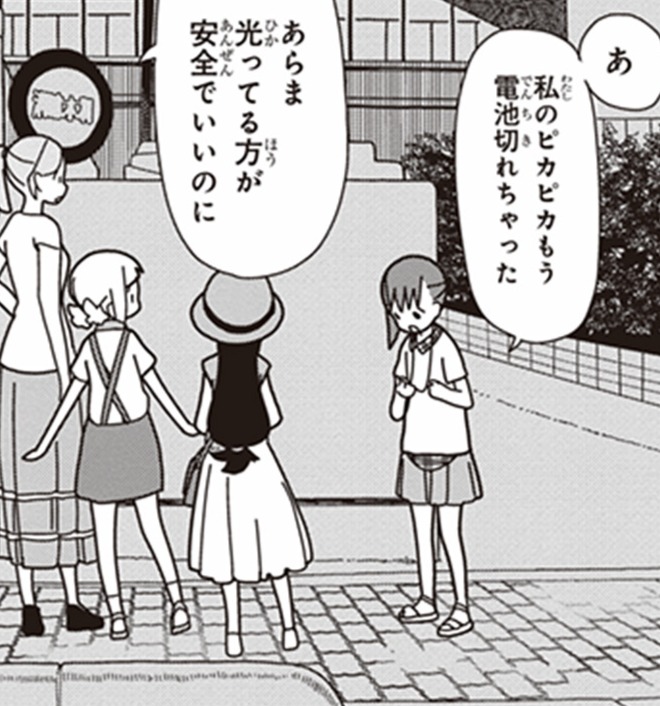
At a nighttime festival, Sacchan, Yui, and Kotoha receive glowing star necklaces to wear. After some time, Sacchan’s mother arrives to pick them up.
結衣( ゆい ) :「あ 私( わたし ) のピカピカもう電池( でんち ) 切( き ) れちゃった」
“Ah, my sparkler's battery has already run out.”
母( かあ ) さん:「あらま 光( ひか ) ってる方( ほう ) が安全( あんぜん )
“Oh dear, it's safer and better when it's lit up.”
Challenge Yourself
Show translation
Challenge
Why does Sacchan's mother wish Yui's necklace were still glowing?
Clues
光( ひか ) ってる方( ほう ) がthe glowing state is the preferable option
安全( あんぜん ) でいいのにit would be safe and good, with regret that it is not
What does the speaker mean?
The light would make Yui safer and easier to see at night.
光( ひか ) ってる方( ほう ) selects the lit state, and 安全( あんぜん ) gives the practical reason for preferring it.
The necklace would keep Yui warm.
The mother mentions safety, not warmth.
The light would show that the festival is still open.
Her comparison concerns Yui's glowing necklace and safety, not the festival's hours.
The battery would be cheaper while the necklace glowed.
Yui says the battery has run out, but her mother does not discuss its cost.
The necklace is unsafe whenever its light is on.
光( ひか ) ってる方( ほう ) が安全( あんぜん ) says the glowing option is safer, not more dangerous.
The light would help them find Sacchan's mother.
The mother has already arrived. Her comment is about the girl's nighttime visibility.
Sacchan’s mother prefers the necklace to keep glowing because it makes Yui more visible and therefore safer at night. Sentence-final のに adds regret that the battery has already died.
View Full Example
Scope and Range
全然 (Not at all)全然( ぜんぜん ) means not at all when used with a negative expression. In casual modern speech, it can also strengthen an affirmative statement to mean completely or entirely.
It combines 全 (entirely ) with 然 (in that state ) to express complete degree .
Example 1 of 3: Not understanding at all with 全然〜ない Example 1 of 3
ご注文はうさぎですか? »
Volume 1 » Page 106
During an underwater-breath-holding contest, Cocoa begins a game of charades.
シャロ:
「全然( ぜんぜん )
“I don't understand at all.”
リゼ:
「ナルシストか?」
“A narcissist?”
Challenge Yourself
Show translation
Challenge
What does シャロ mean in the highlighted line?
Clues
全然( ぜんぜん ) わからない(全然:ぜんぜん)〜ない means not at all
What does the speaker mean?
I don't understand at all.
全然( ぜんぜん ) works with negative わからない to deny any understanding of Cocoa's gestures.
Syaro says she understands Cocoa's gestures perfectly.
The highlighted form is 全然( ぜんぜん ) わからない. Here 全然( ぜんぜん ) 〜ない means not at all, so this choice does not match the Japanese.
Syaro says she understands only the first part of the charade.
The highlighted form is 全然( ぜんぜん ) わからない. Here 全然( ぜんぜん ) 〜ない means not at all, so this choice does not match the Japanese.
Syaro says Rize is the one who does not understand.
The highlighted form is 全然( ぜんぜん ) わからない. Here 全然( ぜんぜん ) 〜ない means not at all, so this choice does not match the Japanese.
全然( ぜんぜん ) 〜ない means not at all. 全然( ぜんぜん ) works with negative わからない to deny any understanding of Cocoa’s gestures.
View Full Example
Example 2 of 3: Understanding my resolve as a man with 理解 Example 2 of 3
それでも歩は寄せてくる »
Volume 2 » Page 98
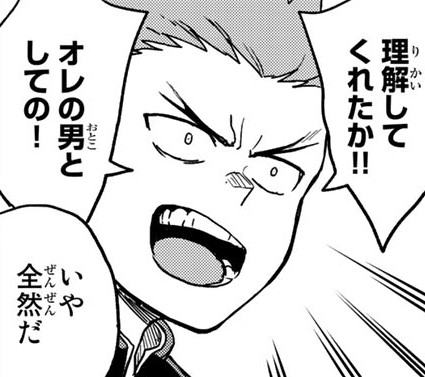
Sakurako tells Takeru not to go to the shogi club as he’ll get in the way of Ayumu being with Urushi. However, as a new member of shogi club, and as a man, Takeru feels it’s his duty to show up. On his way to the shogi club room, he encounters Ayumu who implores him to come to the shogi club room.
タケル:
「理解( りかい ) してくれたか!!」
“You understood me, huh?”
「オレの男( おとこ ) としての!」
“As a man, my (duty)!”
歩( あゆむ ) :「いや全然( ぜんぜん )
“No, not at all.”
Challenge Yourself
Show translation
Challenge
What misunderstanding does Takeru make?
Clues
理解( りかい ) してくれたか!!Takeru excitedly assumes Ayumu has understood him
オレの男( おとこ ) としての!
"my ... as a man," leaving his supposed duty or resolve unstated
いや全然( ぜんぜん ) だ
Ayumu replies, "No, not at all."
What does the speaker mean?
He thinks Ayumu understands and supports his manly resolve.
Takeru treats Ayumu's invitation as 理解( りかい ) してくれた, understanding granted for his benefit, but Ayumu immediately denies it.
He thinks Ayumu has decided to leave the shogi club.
Ayumu is asking Takeru to come to the clubroom, not announcing that he will leave.
He believes Ayumu understands Sakurako's objection.
Takeru refers dramatically to his own stance オレの男( おとこ ) としての, not Sakurako's reasoning.
He thinks Ayumu wants him to stay away from Urushi.
Ayumu asks him to come. Takeru wrongly reads that request as support for his resolve.
He assumes Ayumu has understood the club rules.
The supposed understanding concerns Takeru's personal duty or resolve, not formal rules.
He believes Ayumu agrees that men should not play shogi.
Takeru sees attending the club as his duty. Neither line argues that men should avoid shogi.
Takeru hears Ayumu’s invitation and assumes Ayumu has understood his dramatic resolve as a man. Ayumu’s いや全然( ぜんぜん ) だ flatly shows that Takeru read him wrong.
View Full Example
Example 3 of 3: You say that, but it's not important with だって Example 3 of 3
三ツ星カラーズ »
Volume 1 » Page 5
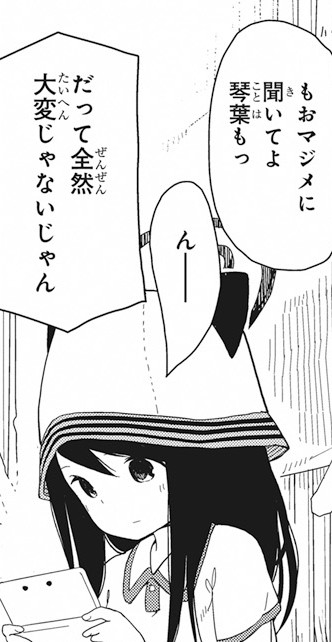
Yui hurries to her clubhouse to tell her friends, Kotoha and Sacchan, about a big case: there’s a cat that looks like a panda. However, Sacchan doesn’t engage in the topic and Kotoha continues playing her video game.
結衣( ゆい ) :「もおマジメに聞( き ) いてよ 琴葉( ことは ) もっ」
“Geez, listen seriously. You too, Kotoha.”
さっちゃん:
「だって全然( ぜんぜん ) 大変( たいへん ) じゃないじゃん」
“You say that, but it's not a big deal at all, right?”
Challenge Yourself
Show translation
Challenge
Why does Sacchan refuse to take Yui's case seriously?
Clues
だって
but or because, introducing Sacchan's reason
全然( ぜんぜん ) 大変( たいへん ) じゃないじゃんit is not a big deal at all, right
What does the speaker mean?
She thinks the case is not serious at all.
全然( ぜんぜん ) with 大変( たいへん ) じゃない dismisses the situation as no big deal.
She cannot hear Yui over Kotoha's game.
Sacchan gives a judgment about the case itself. She does not say that noise prevents her from hearing.
She believes Kotoha has already solved the case.
The line does not mention a solution. It says the supposed problem is not serious.
She is angry that Yui did not tell her sooner.
だって introduces Sacchan's dismissive reason, not a complaint about timing.
She thinks the cat poses a serious danger.
大変( たいへん ) じゃない is negative, so Sacchan says the opposite.
She wants Yui to explain the case more carefully.
Sacchan uses じゃん to press agreement with her dismissal, not request more information.
Sacchan brushes off Yui’s report because she sees nothing serious about it. 全然 strengthens the negative 大変( たいへん ) じゃない, and じゃん pushes Yui to agree.
View Full Example
Totality
全部 (Whole)全部( ぜんぶ ) means everything or the whole, with nothing left out.
It combines 全 (whole ) with 部 (parts ) to show all the parts together .
Example 1 of 2: Managing to distribute all fliers with 〜終える Example 1 of 2
ご注文はうさぎですか? »
Volume 1 » Page 8
Cocoa encounters Syaro standing outside.
ココア:
「今日( きょう ) はチラシ配( くば ) り?」
“You're handing out fliers today?”
シャロ:
「全部( ぜんぶ ) 配( くば ) り終( お ) えるまで帰( かえ ) れないわ」
“I can't go home until I finish handing out all of them.”
Challenge Yourself
Show translation
Challenge
What does シャロ mean in the highlighted line?
Clues
配( くば ) り終( お ) える(配:くば)り(終:お)える = finish handing them all out
What does the speaker mean?
I can't go home until I finish handing out all of them.
〜終( お ) える attaches to the verb stem, so 配( くば ) る becomes 配( くば ) り終( お ) える.
Syaro says she stopped distributing the fliers without finishing.
The highlighted form is 配( くば ) り終( お ) える. Here 配( くば ) り終( お ) える = finish handing them all out, so this choice does not match the Japanese.
Syaro says she is only beginning to hand out the fliers.
The highlighted form is 配( くば ) り終( お ) える. Here 配( くば ) り終( お ) える = finish handing them all out, so this choice does not match the Japanese.
Syaro says someone else will finish distributing them after she goes home.
The highlighted form is 配( くば ) り終( お ) える. Here 配( くば ) り終( お ) える = finish handing them all out, so this choice does not match the Japanese.
配( くば ) り終( お ) える = finish handing them all out. 〜終( お ) える attaches to the verb stem, so 配( くば ) る becomes 配( くば ) り終( お ) える.
View Full Example
Example 2 of 2: アタシ from an Osakan girl Example 2 of 2
名探偵コナン »
Volume 19 » Page 88
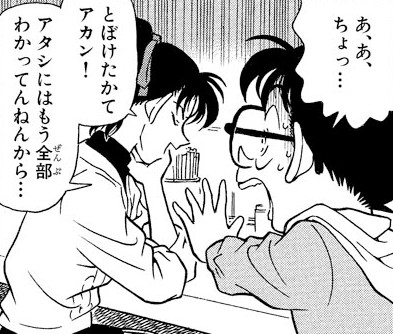
Heiji invites Conan, Ran, and Mouri on a tour of Osaka. While Heiji steps away, his childhood friend who’s been following the group confronts them. She opens by saying “You’re Kudo, right?” and that she heard it from Heiji. Conan, realizing his true identity is about to be revealed to Ran, tries to stop her.
コナン:
「あ、あ、ちょっ…」
“Ah, ah, wai--!”
和葉( かずは ) :「とぼけたかてアカン! アタシにはもう全部( ぜんぶ )
“It's no use playing dumb. Since I already know everything...”
Challenge Yourself
Show translation
Challenge
What does Kazuha claim despite Conan's attempt to stop her?
Clues
とぼけたかてアカン
it is no use playing dumb
アタシにはもう全部( ぜんぶ ) わかってんねん
I already know everything
What does the speaker mean?
She already knows everything, so pretending is useless.
もう全部( ぜんぶ ) わかってんねん states that Kazuha believes she has the full truth already.
She has forgotten everything Heiji told her.
She claims the opposite with 全部( ぜんぶ ) わかってる.
She wants Conan to explain the situation later.
Kazuha says playing dumb now will not work because she already understands.
She thinks Heiji has been pretending not to know her.
Her accusation is directed at the person she believes is Kudo.
She knows only one small part of the story.
全部( ぜんぶ ) means everything, not a limited piece.
She agrees to keep silent before saying anything.
Conan tries to stop her, but Kazuha continues with confidence.
Kazuha says that playing dumb will not work because she already knows everything. アタシ is her casual feminine first-person pronoun, colored by the Kansai speech around it.
View Full Example
全員 (Everyone)全員( ぜんいん ) means everyone or every member of a group, without exception.
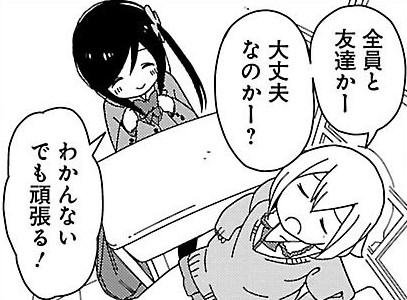
ひとりぼっちの○○生活 »
Volume 1 » Page 36
Nako learns of Bocchi’s necessity to become friends with everyone in class.
なこ:
「全員( ぜんいん ) 友達( ともだち ) かー」
“Friends with the whole class, huh?”
「大丈夫( だいじょうぶ ) なのかー?」
“Will you be okay...?”
ぼっち:
「わかんないでも頑張( がんば ) る!」
“I don't know, but I'll try my best!”
Challenge Yourself
Show translation
Challenge
How does Bocchi respond to Nako's concern?
Clues
わかんない
she does not know whether she will be okay
でも頑張( がんば ) る!
but she will do her best
What does the speaker mean?
She is unsure, but she will try her best.
わかんない admits uncertainty, while でも頑張( がんば ) る shows that Bocchi intends to try anyway.
She knows she cannot do it, so she gives up.
Bocchi does not claim certain failure. She says she does not know, then commits to doing her best.
She is certain that making friends will be easy.
わかんない expresses uncertainty, not confidence about the outcome.
She asks Nako to make friends with everyone for her.
頑張( がんば ) る describes Bocchi's own decision to try. She does not pass the task to Nako.
She plans to wait until she knows she will succeed.
でも connects her uncertainty directly to action. Bocchi will try despite not knowing the result.
She says Nako should not worry about the class.
The response concerns Bocchi's uncertainty and effort. It does not tell Nako how to feel.
Bocchi cannot say whether she will be okay, but that does not stop her. でも contrasts わかんない with her firm decision to do her best and try to befriend everyone.
View Full Example