Work and vocation with 業
The kanji 業 is something a person does or carries through. The meanings of words using this kanji can be categorized by the kanji’s reading:
ギョウ usually points to work , a profession or industry, study, or an undertaking and its results.
わざ is a deed or skill.
ゴウ is Buddhist action whose effects return to the doer: karma .
Etymology
This kanji is a pictograph of a large board on a musical instrument rack. Over time, it’s taken meanins from a board used for writing, to learning or skill, and finally to work.
Work to Be Done
These words relate to the work itself.
作業 (Work)作業( さぎょう ) means work, a task, or an operation. It usually refers to practical activity carried out toward a specific result.
It combines 作 (make ) with 業 (work ) to show productive work .
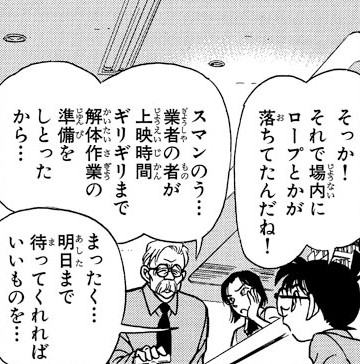
名探偵コナン »
Volume 23 » Page 12
Conan and his friends go to the theater to see a movie. There, they discover this is the last day before the theater closes.
コナン:
「そっか!それで場内( じょうない ) にロープとかが落( お ) ちてたんだね!」
“Oh, I see! That's why there were ropes and stuff lying around the venue!”
オーナー:
「スマンのう… 業者( ぎょうしゃ ) の者( もの ) が上映( じょうえい ) 時間( じかん ) キリキリまで解体( かいたい ) 作業( さぎょう ) 準備( じゅんび ) をしとったから…」
“Sorry about that... The contractor's crew was rushing to get the dismantling ready right up until showtime...”
スタッフ:
「まったく… 明日( あした ) まで待( ま ) ってくれればいいものを…」
“Honestly... They could've at least waited until tomorrow...”
Challenge Yourself
Show translation
Challenge
Why were ropes and other materials lying around the theater?
Clues
解体( かいたい ) 作業( さぎょう ) の準備( じゅんび ) preparations for demolition work
上映( じょうえい ) 時間( じかん ) キリキリまでright up until showtime
What does the speaker mean?
Contractors had been preparing to demolish the theater until showtime.
The owner connects the materials to last-minute preparations for 解体( かいたい ) 作業( さぎょう ) .
The staff had decorated the theater for a festival.
The materials belonged to demolition preparations, not decorations.
The audience brought ropes for the final screening.
The owner says the contractor's crew left them during its work.
Workers had finished rebuilding the theater.
解体( かいたい ) means dismantling or demolition, not reconstruction.
The ropes were clues deliberately planted by Conan.
Conan notices them and then learns their practical source from the owner.
The staff planned to move the screening outside.
The issue is demolition work being prepared too close to the screening time.
The contractor’s crew had been preparing the theater for demolition right up until showtime. That work explains the ropes and other materials left inside.
View Full Example
Occupations
This set ranges from one person’s livelihood to an economic sector.
業者 (Contractor)業者( ぎょうしゃ ) means a business, contractor, supplier, or dealer. The best English term depends on the service or trade involved.
It combines 業 (trades ) with 者 (person ) to show a person or company engaged in a trade .
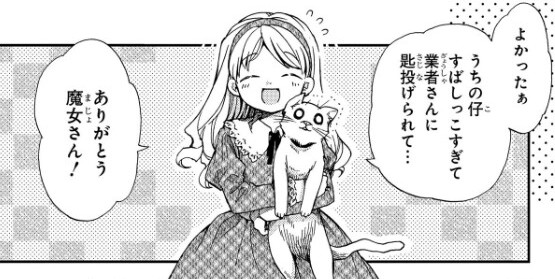
骨ドラゴンのマナ娘 »
Volume 1 » Page 74
Eve takes the job of catching a cat that ran away from its owner. Following a successful mid-air catch off the roof and into a tree, Eve returns the cat to its owner.
お城( じょう ) ちゃん:
「よかったぁ うちの仔( こ ) すばしっこすぎて業者( ぎょうしゃ ) 匙( さじ ) 投( な ) げられて…」
“Thank goodness! Our little one was so quick that the hired help gave up on us...”
「ありがとう 魔女( まじょ ) さん」
“Thank you, Miss Mage.”
Challenge Yourself
Show translation
Challenge
Why had the hired cat-catchers given up on the job?
Clues
うちの仔( こ ) すばしっこすぎて
the owner's cat was excessively quick and nimble
業者( ぎょうしゃ ) さんに匙( さじ ) 投( な ) げられてthe hired professionals abandoned the job as hopeless
What does the speaker mean?
The cat was too quick for them to catch.
すばしっこすぎて gives the cat's excessive quickness as the reason the professionals gave up.
The owner refused to tell them where the cat went.
The line blames the cat's speed, not missing information from the owner.
They caught the cat but would not return it.
匙を投げられて means they abandoned the attempt, not that they kept the cat.
They thought the cat had already returned home.
The professionals gave up because it was too nimble to catch, not because they believed the job was finished.
The owner canceled the job before they began.
The owner was left without help after the professionals gave up; she did not cancel their work.
They were frightened because Eve used magick nearby.
The account concerns their failed attempt before Eve returned the cat. Magick is not given as the cause.
The owner says her cat was so nimble that the hired professionals gave up trying to catch it. 匙を投げられて presents the owner as the person left without help when they abandoned the job.
View Full Example
Study
This cluster preserves the “study” sense of the kanji.
授業 (Lesson)授業( じゅぎょう ) means a class, lesson, or school instruction.
It combines 授 (teach / impart ) with 業 (work ) to show the work of teaching .
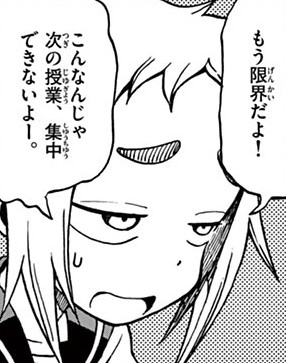
あしたは土曜日 »
Volume 秋・冬 » Page 16
Mina wants to hurry and eat her lunch, as she’s very hungry. Yukari reminders her they still have one more class first.
ミナ:
「もう限界( げんかい ) だよ!こんなんじゃ次( つぎ ) の授業( じゅぎょう ) 集中( しゅうちゅう ) できないよー。」
“I'm already at my limit! As things are, come next class I won't be able to concentrate.”
Challenge Yourself
Show translation
Challenge
Why does Mina think the next class will go badly?
Clues
もう限界( げんかい ) だ
already at one's limit
こんなんじゃ
if things stay like this
集中( しゅうちゅう ) できないcannot concentrate
What does the speaker mean?
She is too hungry to concentrate through another class.
もう限界( げんかい ) だ describes Mina's hunger as unbearable, and こんなんじゃ connects that condition to being unable to concentrate.
She thinks the next class will be too difficult to understand.
Mina says she cannot 集中( しゅうちゅう ) , but she does not criticize the class material as difficult.
She is worried that she will arrive late for class.
The problem is her condition during class, not whether she can arrive on time.
She wants to skip class because she is sleepy.
Nothing in the line mentions sleep. Her 限界( げんかい ) comes from the hunger described in the scene.
She believes the next class has been canceled.
次( つぎ ) の授業( じゅぎょう ) is treated as something she still has to sit through.
She says eating lunch has already ruined her concentration.
Mina has not eaten lunch yet. こんなんじゃ refers to remaining as hungry as she is now.
Mina says she has reached her limit from hunger. If she has to remain like this, she believes she will be unable to concentrate in the next class.
View Full Example
卒業 (Graduation)卒業( そつぎょう ) means graduation. Figuratively, it can mean leaving behind a phase, habit, or role.
It combines 卒 (finish ) with 業 (study or work ) to show finishing one's course of work .
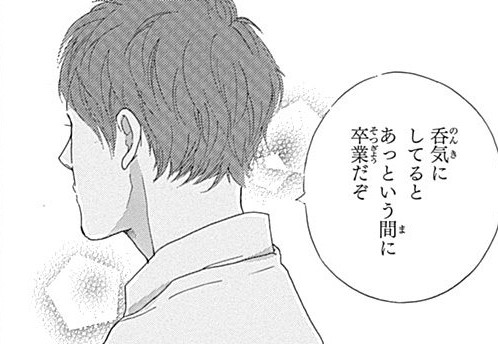
アオハライド »
Volume 13 » Page 18
Aya has mostly given up hope of attracting Shuko’s interest away from their teacher, Mr. Tanaka. Tanaka, having no interest in pursuing a relationship with a student, pushes for Aya to keep trying before the situation changes.
田中( たなか ) :「呑気( のんき ) にしてるとあっという間( ま ) に卒業( そつぎょう )
“If you act carelessly, it'll be graduation before you know it.”
Challenge Yourself
Show translation
Challenge
What does Tanaka warn will happen if Aya remains carefree?
Clues
呑気( のんき ) にしてるとif he keeps taking things too casually
あっという間( ま ) に卒業( そつぎょう ) だぞ
graduation will arrive before he knows it
What does the speaker mean?
He will reach graduation before he has taken action.
呑気( のんき ) にしてると sets continued inaction as the condition, and あっという間( ま ) に says graduation will arrive quickly.
He will have to graduate earlier than the other students.
The warning is that time will feel short, not that Aya's graduation date will change.
He will lose interest as soon as graduation begins.
呑気( のんき ) describes how he is acting now. The line does not predict a change in his interest.
He will be able to relax once graduation is over.
Tanaka criticizes relaxing now because the opportunity will soon pass. He is not promising rest later.
He will decide to confess only after graduating.
The line urges Aya not to wait. It does not describe a plan to act after graduation.
He will forget when the graduation ceremony is scheduled.
あっという間( ま ) に means time will pass quickly. It does not mean forgetting a date.
Tanaka warns Aya that graduation will arrive before he knows it if he keeps waiting. 呑気( のんき ) criticizes his lack of urgency, and 〜と links that behavior to the approaching deadline.
View Full Example