Changing and swapping with かえる and かわる
かえる and its partner かわる have four official spellings. 変える is making something different from before, such as a plan, a hairstyle, or your mind. The other three swap one thing for another. 換える trades one thing for another, such as goods for cash or one train for the next. 替える replaces something with a new one, such as your clothes. 代える has someone or something stand in for another, such as a relief pitcher. かえる is transitive and かわる is intransitive: 席を替える is “change seats”, and 席が替わる is “the seats change”.
A rough test: if the point is a change in state or content, as with a revised plan or a change of subject, write 変. If one thing swaps for another, ask how. Trading takes 換, new for old takes 替, and standing in takes 代. All four are official, so they show up in formal writing as well as in manga. Same reading, different kanji explains where the official list comes from, and Going home and giving back with かえる covers 帰る and 返る.
The Spellings at a Glance
| Spelling | Used for | Standing |
|---|---|---|
| 変える・変わる | become different from before | Official |
| 換える・換わる | exchange one thing for another | Official |
| 替える・替わる | replace with something new | Official |
| 代える・代わる | have something or someone take another's role | Official |
Changing with 変える and 変わる
変える is making something different from how it was. 形を変える is “change the shape”, 気が変わる is “change your mind”, and 声変わり is “a voice breaking”. It’s by far the most common of the four in manga. 変わった人, “an unusual person”, and 相変わらず, “as always”, both take it, and so does 生まれ変わる, “be reborn”, which in this site’s manga corpus is written with 変 hundreds of times and with 代 only once.
1 source
【変える・変わる】前と異なる状態になる。
形を変える。観点を変える。位置が変わる。顔色を変える。気が変わる。
心変わりする。声変わり。変える, 変わる: come to be in a different state from before. "Change the shape." "Change your point of view." "The position changes." "Change color," as a face does in anger or shock. "Change your mind." "Have a change of heart." "A voice breaking."
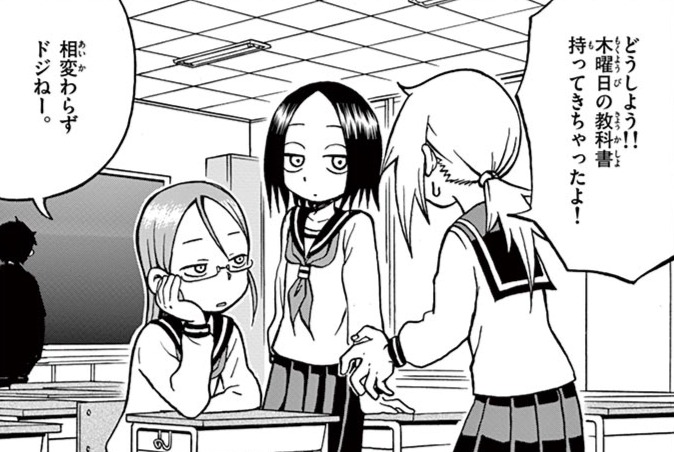
Mina is startled to learn that today is Friday.
- ミナ:
- 「どうしよう!!木曜日の教科書持ってきちゃったよ!」
- “What'll I do?! I ended up bringing my textbook for Thursday!”
- ユカリ:
- 「相変わらずドジねー。」
- “You're such a klutz, as usual.”
Mina has brought her Thursday textbook on a Friday, and Yukari sighs that she’s as clumsy as ever. 相変わらず is “as always”, with nothing about Mina changed.
Exchanging with 換える and 換わる
換える is trading one thing for another. 物を金に換える is “turn goods into cash”, and 電車を乗り換える is “change trains”. Rewording and substituting take it too, as in 言い換える, “put it another way”, and 置き換える, “replace one thing with another”. The kanji is the 換 of 交換, “exchange”.
Manga mostly follow the guide here. In this site’s manga corpus, 乗り換える is several times as common as 乗り替える, and 金に換える is several times as common as 金に替える.
1 source
【換える・換わる】物と物を交換する。
物を金に換える。名義を書き換える。電車を乗り換える。現金に換わる。換える, 換わる: exchange one thing for another. "Turn goods into cash." "Change the name on a record." "Change trains." "Be turned into cash."
Example 1 of 2: Swapping out the toilet light with 換える
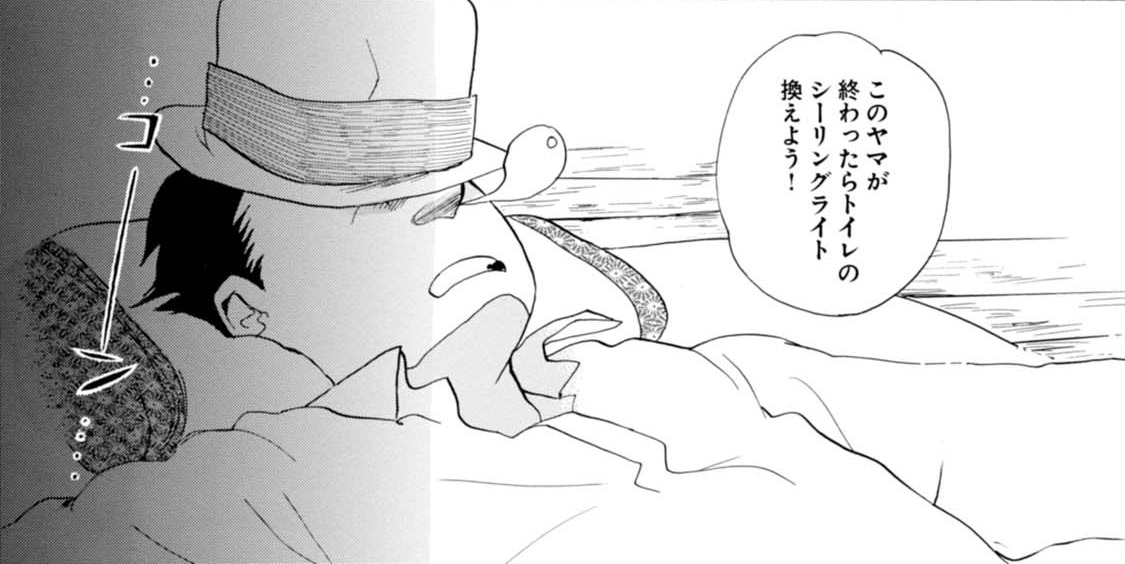
Detectives Bekkan and Steve are investigating an attack on Machi, and with the bridge out of the village down, they’re staying the night in an old house. Bekkan tells Steve to keep watch, but Steve falls asleep. Writing his notes under a bare bulb, Bekkan first grumbles that it’s dark, then decides it’s stylish in its own way, and oddly calming.
- ベッカン:
- 「このヤマが終わったらトイレのシーリングライト換えよう!」
- “Once this case is wrapped up, I'm swapping out the ceiling light in my toilet!”
Detective Bekkan, stuck overnight in the village, has warmed to the bare bulb he’s writing under. Once the case is over, he’ll swap out the ceiling light in his toilet. Replacing a fixture with a new one is often written 替える, but this manga treats it as a trade, one light for another.
Example 2 of 2: Swapping for yellow-stalked bamboo with 換える
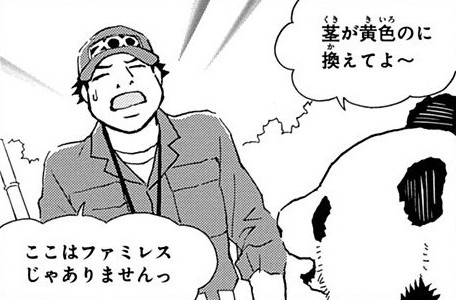
Zookeeper Handa is sweeping near the panda enclosure when the zoo’s full-time panda presses a restaurant-style call button that the pandas have set up on their table without his noticing. Handa hurries over, and the panda complains that this bamboo doesn’t taste good.
- 常勤パンダさん:
- 「茎が黄色のに換えてよ〜」
- “Swap it for the kind with yellow stalks!”
- 半田:
- 「ここはファミレスじゃありませんっ」
- “This isn't a family restaurant!”
The zoo’s panda doesn’t like today’s bamboo and wants Handa to bring a different kind. 〜に換える is “swap for ~”, and the panda orders like a diner sending back a dish.
Replacing with 替える and 替わる
替える is replacing something with something new. 服を着替える is “change clothes”, 頭を切り替える is “switch gears”, and 日替わり is “changing daily”, as in a lunch special. School life is full of it: 席替え is “a seat change”, クラス替え is “a class reshuffle”, and 衣替え is “the seasonal uniform change”.
The most frequent 〜かえる compounds in manga take 替. In this site’s manga corpus, 着替える is written with 替 thousands of times and with 換 only a handful, and 取り替える and 入れ替える both favor 替 by a wide margin.
1 source
【替える・替わる】新しく別のものにする。
頭を切り替える。クラス替えをする。振り替え休日。図表を差し替える*。
入れ替わる。日替わり定食。替え歌。替える, 替わる: replace what was there with something new. "Switch gears." "Reshuffle the classes." "A substitute holiday." "Swap out a chart." "Trade places." "A daily lunch special." "A song with new lyrics set to an existing tune."
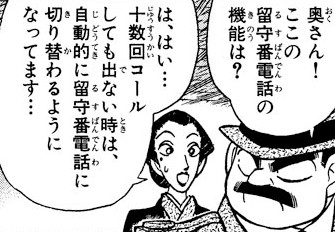
After a suspect recalls that his call to the victim’s house rang many times before the answering machine picked up, Inspector Megure asks the woman of the house how the machine works.
- 目暮:
- 「奥さん!ここの留守番電話の機能は?」
- “Ma'am! How does this answering machine function?”
- 奥さん:
- 「は、はい… 十数回コールしても出ない時は、自動的に留守番電話に切り替わるようになってます…」
- “Well... When nobody answers even after a dozen or so rings, it automatically switches to the answering machine...”
Inspector Megure asks how the victim’s answering machine works. The wife explains that after a dozen or so unanswered rings, it switches over automatically. 切り替わる is “switch over”, one mode replaced by another.
Taking Someone’s Place with 代える and 代わる
代える is having one person or thing fill another’s role. 父に代わって言う is “speak on your father’s behalf”, and 投手を代える is “change pitchers”. The noun is 代わり, “a substitute”, and 〜の代わりに is “instead of” or “in place of”. 身代わり is “a stand-in”, someone who takes another’s place, often taking the hit for them, and 親代わり is “a stand-in parent”. On the phone, お電話代わりました is “I’ve taken over the call”.
Manga hold to 代 for “instead”. In this site’s manga corpus, 代わりに turns up thousands of times, and 替わりに only a few dozen. Instead of with 〜の代わりに covers the pattern.
1 source
【代える・代わる】ある役割を別のものにさせる。
書面をもって挨拶に代える。父に代わって言う。身代わりになる。投手を代える。
余人をもって代え難い。親代わり。代える, 代わる: have something else take on a role. "Let this letter serve as my greeting." "Speak on your father's behalf." "Take someone's place." "Change pitchers." "Nobody else could fill the role." "A stand-in parent."
Example 1 of 3: Not a replacement with 〜の代わりに
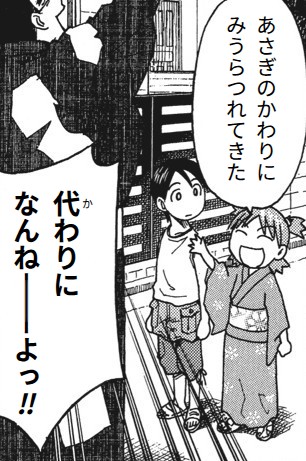
Yotsuba’s father plans to take her to see fireworks. When Jumbo hears that Yotsuba’s neighbor, Asagi, had previously invited her to use sparklers, Jumbo says Yotsuba needs to invite Asagi to see the fireworks as a thank-you. She heads next door to ask, but Asagi already has plans to see the fireworks with a friend, so Yotsuba invites Ena instead, and agrees for Ena’s friend Miura to come along. Yotsuba returns home and assures Jumbo that Asagi will go to see the fireworks. They head out the following day.
- よつば:
- 「あさぎのかわりにみうらつれてきた」
- “I brought Miura instead of Asagi.”
- ジャンボ:
- 「代わりになんねーーーよっ!!」
- “She's not a replacement!!!”
Yotsuba was supposed to invite Asagi to the fireworks, but brings Miura instead. Jumbo protests that Miura is no substitute. 代わり is the noun, “a replacement”.
Example 2 of 3: Picked up in my place with 〜の代わりに
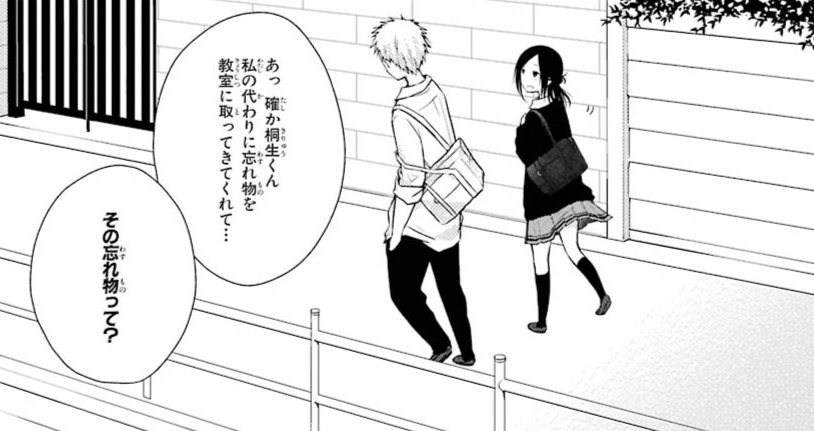
Fujimiya was able to work around forgetting her friends every Monday by using a journal to record her time spent with Hase. After Fujimiya discovers she can remember Hase’s friend Kiryuu, Hase gets jealous and reacts poorly. The following Monday, Fujimiya arrives at school with no memory of Hase or her journal, and Hase isn’t able to regain her trust. After school, Kiryuu walks with Fujimiya. Without mentioning Fujimiya eating lunch with Hase each day, he asks about how she spent her lunches last week. She isn’t certain. Without mentioning that Fujimiya previously had forgotten her journal at her desk and classmates found it, Kiryuu questions her about the after-school event.
- 藤宮:
- 「あっ 確か桐生くん私の代わりに忘れ物を教室に取ってきてくれて…」
- “Ah, right… Kiryuu, you went to the classroom and picked up my forgotten item in place of me, didn't you…?”
- 桐生:
- 「その忘れ物って?」
- “That forgotten item was...?”
Fujimiya remembers that Kiryuu went back to the classroom for something she’d left behind. 私の代わりに is “in my place”.
Example 3 of 3: Too much to handle as the relay runner for the class with 荷が重い
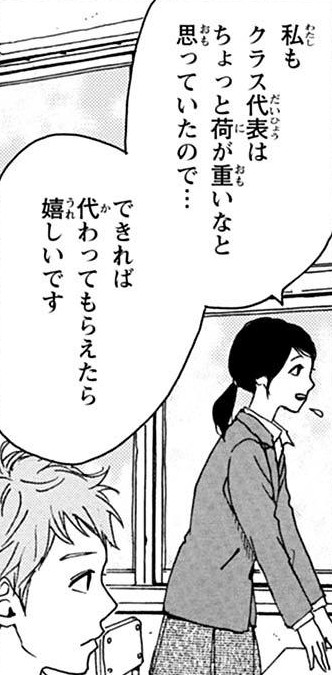
Takako and Azu tell their teacher they want to participate in the sports day relay race. The teacher points out that participants have already been decided, then one of the decided participants chimes in to say she’d gladly give up her spot.
- 生徒:
- 「私もクラス代表はちょっと荷が重いなと思っていたので…」
- “I was also thinking that running for the class is a bit much for me.”
- 「できれば代わってもらえたら嬉しいです」
- “If possible, I'd be happy if someone could take my place.”
A classmate already picked to represent the class in the relay admits it feels like too much for her, and she’d be glad if someone took her place. 代わってもらう is “have someone take over for you”.
When the Spellings Overlap
換える, 替える, and 代える write one word. デジタル大辞泉 lists the three under a single headword and gives a rule of thumb for all four spellings: 換 is trading one thing for another, 替 is replacing with something new, 代 is having something else fill the same role, and 変 is making something different from before.
換 and 替 overlap most. The guide’s note says compounds like 差しかえる, 入れかえる, and 組みかえる take 替, as replacing with something new, but can take 換, seen as an exchange. Manga mostly pick 替 for these. 組み換える comes closest to an even split, since 遺伝子組み換え, “genetic modification”, is a set term.
替 and 代 overlap when a person is replaced. The 1972 list that the 2014 guide replaced wrote 社長が替わる, “the company president changes”, while the 2014 guide puts 投手を代える, “change pitchers”, under 代. The noun 交代, “a changeover” or “taking turns”, has both spellings too. 交代 is the more common in manga, but 交替 turns up as well.
2 sources
か・える〔かへる〕【換える/替える/代える】
表記は、次の観点で使い分けることが多い。
換える…物と物をとりかえる。「小切手を現金に換える」
替える…新しいものにする。「かみそりの刃を替える」
代える…別のものに同じ役割をさせる。「書面をもって挨拶に代える」
変える…以前と違ったものにする。「話題を変える」かえる, written 換える, 替える, or 代える. The spelling is often chosen from these viewpoints. 換える: trade one thing for another. "Cash a check." 替える: replace with something new. "Change a razor blade." 代える: have something else fill the same role. "Let this letter serve as my greeting." 変える: make something different from before. "Change the subject."
「差しかえる」「入れかえる」「組みかえる」などの「かえる」については,「新しく別のものにする」意で「替」を当てるが,別のものと「交換する」という視点から捉えて,「換」を当てることもある。
For the かえる in 差しかえる, 入れかえる, 組みかえる, and so on, 替 is used in the sense of "replace what was there with something new", but 換 is sometimes used, seeing it as exchanging one thing for another.
When かえる Stays in Kana
Kana works for every かえる and かわる, and the 2014 guide says its spelling examples don’t rule out writing a word in kana where it suits. Yotsuba’s あさぎのかわりに above is one case. The best known is Sailor Moon’s 月にかわっておしおきよ, “In the name of the moon, I’ll punish you”. Sailor Moon itself writes the line in kana, and so do most of the other series in this site’s manga corpus that quote it. 月に代わって turns up only twice. For ordinary “take over” lines, though, 代わって is still more common than kana かわって.
1 source
また,この使い分け例は,必要に応じて,仮名で表記することを妨げるものでもない。
Nor do these spelling examples rule out writing a word in kana as needed.
Check Yourself
Guess the Meaning from the Kanji
Each spelling's kanji points at one sense of かえる・かわる. Say what each one means, then open it.
変える・変わる
become different from before換える・換わる
exchange one thing for another替える・替わる
replace with something new代える・代わる
have something or someone take another's role
Pick the Spelling
Each phrase has かえる・かわる in kana. Decide which kanji fits, then open it.
形をかえる
形を変える. 変える・変わる: become different from before.
物を金にかえる
物を金に換える. 換える・換わる: exchange one thing for another.
頭を切りかえる
頭を切り替える. 替える・替わる: replace with something new.
父にかわって言う
父に代わって言う. 代える・代わる: have something or someone take another's role.
考えがかわる
考えが変わる. 変える・変わる: become different from before.
名義を書きかえる
名義を書き換える. 換える・換わる: exchange one thing for another.
服を着かえる
服を着替える. 替える・替わる: replace with something new.
書面をもって挨拶にかえる
書面をもって挨拶に代える. 代える・代わる: have something or someone take another's role.
Spell a Manga Line
Mina has brought the wrong day’s textbook to school. Which kanji fits あいかわらず?
「あいかわらずドジねー。」
Show the answer
相変わらず. Nothing is being swapped. Mina is the same as ever, so it’s 変, the kanji for a thing’s state. “You’re such a klutz, as usual.”
The victim’s wife explains how the answering machine works. Which kanji fits きりかわる?
「十数回コールしても出ない時は、自動的に留守番電話にきりかわるようになってます…」
Show the answer
切り替わる. One mode is swapped out for another, the guide’s “replace what was there with something new”, so it’s 替, as in its 頭を切り替える. “When nobody answers even after a dozen or so rings, it automatically switches to the answering machine…”
Shin’ichi needs someone to reveal the culprit for him. Which kanji fits かわりに?
「オレのかわりに事件の真相をみんなに話してくれ!」
Show the answer
代わりに. Ran is standing in for Shin’ichi, so it’s 代, the kanji for filling someone’s role. “In my place, tell everyone the truth about the case!”
A relay runner wants someone else to take her spot. Which kanji fits かわって?
「できればかわってもらえたら嬉しいです」
Show the answer
代わって. Someone would be filling her role on the team, so it’s 代, like the guide’s 投手を代える. “If possible, I’d be happy if someone could take my place.”