Japanese cooking verbs pair with particular nouns, and the pairs don’t always line up with English. Learn the noun and its verb together, along with the particle that joins them.
Cooking with 料理
料理 means cooking and also a finished dish. The verb you choose decides which of the two you mean.
Cooking with 料理をする and 料理を作る
料理をする names the activity, as in 毎日料理をする, “I cook every day.” 料理を作る focuses on the dish that comes out of it. For an everyday meal, ご飯を作る is more common than either.
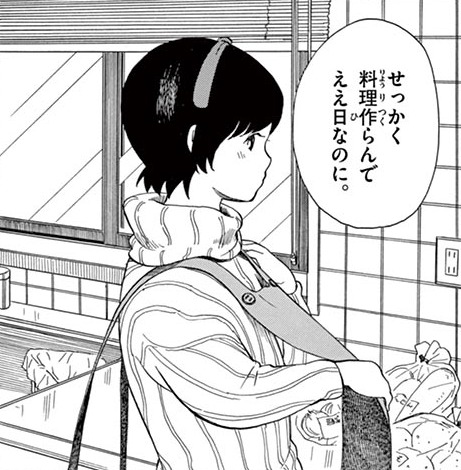
Kiyo, the house cook, spends her day off visiting the woman who cooked there before her. 料理作らんでええ is Kyoto speech for 料理を作らなくていい, “you don’t have to cook”. The を drops, and 〜んでええ is the Kansai version of 〜なくていい.
Example 2 of 2: Who knew Kiyo could cook with 料理を作る
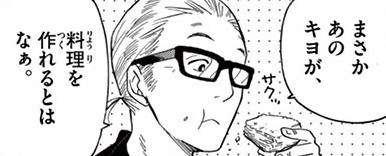
The house mother asks a retired dresser, who used to dress the house’s maiko, to help Kiyo get back something she dropped behind the refrigerator. To thank him, Kiyo serves him coffee and scones she baked.
お兄さん:
「まさかあのキヨが、料理を作れるとはなあ。」
“Who'd have thought Kiyo, of all people, could cook?”
Kiyo thanks a retired dresser with coffee and scones she baked herself. 作れる is the potential form, so 料理を作れる means “can cook”. まさか〜とは carries his surprise.
腕 means arm, and by extension skill. 腕を振るう means to put your skill to work, and cooking is where it shows up most. 腕によりをかける means to put all your skill into something, often a meal for someone special.
手料理 is food cooked by a particular person, usually at home. In romance manga, getting to eat 彼女の手料理, a girlfriend’s cooking, is a milestone. 振る舞う means to treat someone to food or drink.
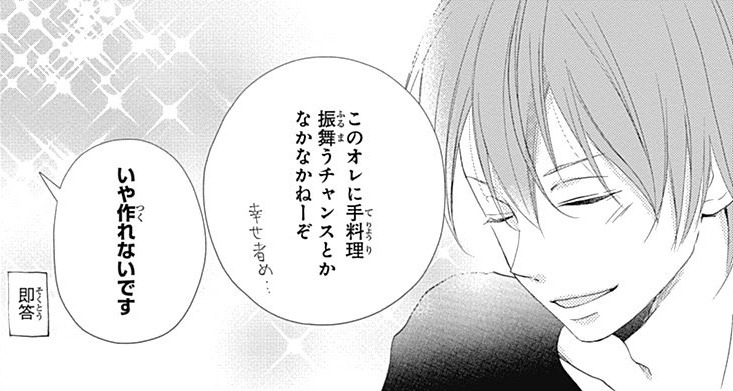
Ayato Kousaka, an actor with a fever, stops at the shop Yusa’s family runs, and her mother lets him rest at their house. Yusa says he should probably eat something before taking his medicine, and Ayato tells her to make him rice porridge or something.
絢人:
「このオレに手料理振舞うチャンスとかなかなかねーぞ。」
“You don't often get a chance to treat someone like me to your home cooking.”
Ayato, a famous actor with a fever, tells Yusa to make him rice porridge as if he were doing her a favor. 手料理振舞う drops the を, and the spelling 振舞う leaves out the る of 振る舞う. Yusa answers at once with the everyday verb 作る: 作れないです, “I can’t cook.”
Rice with 米 and ご飯
米 is rice as a grain, usually uncooked. ご飯 is cooked rice, and also a meal. The verbs follow the rice from the bag to the bowl.
Washing Rice with 米を研ぐ
研ぐ means to sharpen or polish, the same verb used for knives. Rubbing rice grains together in water to rinse them is 米を研ぐ. The cloudy water left over is 研ぎ汁. Plenty of people just say 米を洗う.
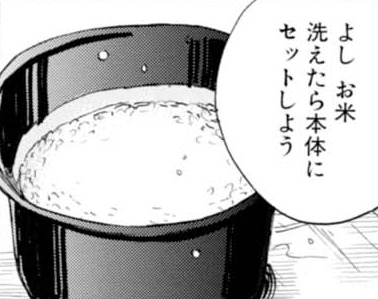
Machi has always cooked rice over a wood fire, so Natsu brings her a new pressure IH rice cooker. Wary of electrical appliances, Machi has taken the inner pot out of the cooker.
ナツ:
「よし お米洗えたら本体にセットしよう」
“Okay, once the rice is washed, let's put it in the cooker.”
Machi has always cooked rice over a wood fire, and Natsu is walking her through her first electric rice cooker. Natsu uses the everyday verb 洗う, not 研ぐ. 洗えたら is the potential form plus たら, “once you’ve got it washed”.
炊く is the verb for cooking rice, in a pot or a rice cooker. Both 米を炊く and ご飯を炊く are normal, though the second names the result instead of the ingredient. The intransitive ご飯が炊ける, “the rice is done”, is what people say when the rice cooker beeps. 炊きたて means freshly cooked.
Example 1 of 2: Cooking rice for whoever comes home with ご飯を炊く
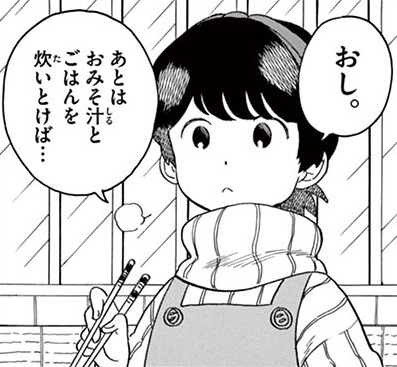
During the spring dance performances, everyone at the house keeps a different schedule, so they each eat when they can. Kiyo comes home from shopping, sees that the rice balls she left out have been eaten, and makes a set of side dishes that taste fine even cold.
キヨ:
「おし。」
“All right.”
「あとはおみそ汁とごはんを炊いとけば...」
“Now if I just make the miso soup and cook the rice...”
During the spring dances the maiko eat whenever their schedules allow, so Kiyo is making side dishes that taste fine cold. ごはんを炊いとけば is 炊いておけば, “if I cook the rice ahead of time”, so it’s ready whenever someone walks in.
Example 2 of 2: Praising rice from the new cooker with 米を炊く
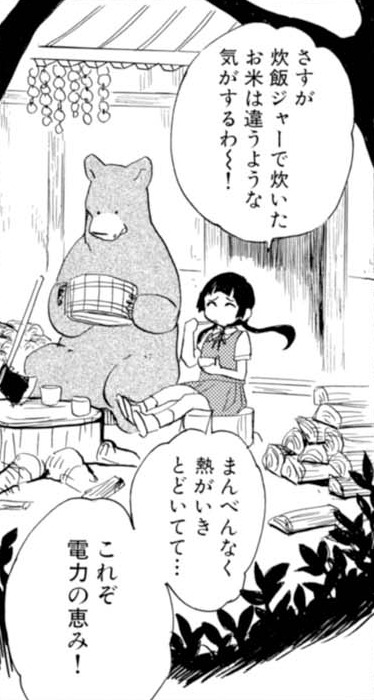
Machi has always cooked rice over a wood fire, so Natsu brings her a new pressure IH rice cooker. The appliance frightens her so much that she nearly gives up, but Natsu talks her into trying again. Now the rice is ready, and Machi takes her first bite.
まち:
「さすが炊飯ジャーで炊いたお米は違うような気がするわ~!」
“I just knew it! Rice cooked in a rice cooker feels different somehow!”
Machi takes her first bite of rice from the new cooker. 炊いたお米 is a common phrase, so 米 can mean cooked rice once a verb like 炊いた says so. 炊飯ジャー, “rice cooker”, uses the same 炊, read すい.
よそう means to scoop food from a pot into individual bowls. It’s used for rice and soup. 盛る is for heaping food into a bowl or onto a plate, as in 大盛り, “a large serving”, and 盛り付ける means to arrange food on a plate.
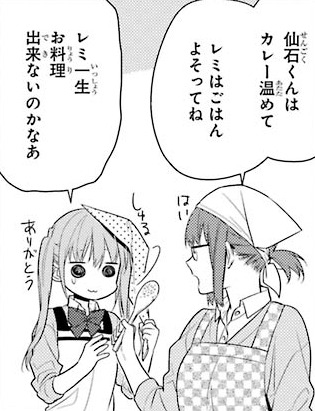
In cooking class, Sakura is in the same group as Remi and Sengoku, who can barely cook. Sakura has banned Remi from using a knife, and Sengoku peeled the potatoes and onions until nothing was left. The rest of the class saw this coming and gave the group a little of their own curry.
桜:
「仙石くんはカレー温めて レミはごはんよそってね」
“Sengoku, you heat up the curry. Remi, you serve the rice, okay?”
Sakura has banned Remi from using a knife, so Remi gets the one job with no knife and no stove. ごはんよそって drops the を. Sakura hands her a しゃもじ, the rice paddle used for よそう.
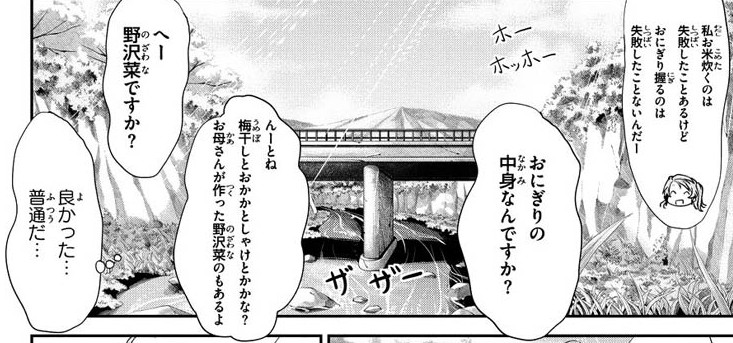
Hotaru and Komari agreed to trade homemade lunches while viewing the cherry blossoms. Komari’s lunch came out badly, with burnt noodles and a hamburger covered in melted chocolate, but Hotaru ate it anyway and insisted it was delicious. Now Komari offers her a rice ball, and Hotaru takes a bite and finds it good.
小鞠:
「私お米炊くのは失敗したことあるけどおにぎり握るのは失敗したことないんだー」
“I've messed up cooking rice before, but I've never messed up making rice balls!”
蛍:
「おにぎりの中身なんですか?」
“What's in the rice balls?”
小鞠:
「んーとね 梅干しとおかかとしゃけとかかな? お母さんが作った野沢菜のもあるよ」
“Let's see... pickled plum, bonito flakes, salmon, that kind of thing? There's also one with the nozawana pickles my mom made.”
Komari’s lunch for the cherry blossom viewing went badly, but she’s confident about her rice balls. Her line puts two rice verbs side by side. She has failed at お米炊く, cooking the rice, but never at おにぎり握る, shaping it.
Example 2 of 2: Taking rice balls to Sadao with にぎり飯
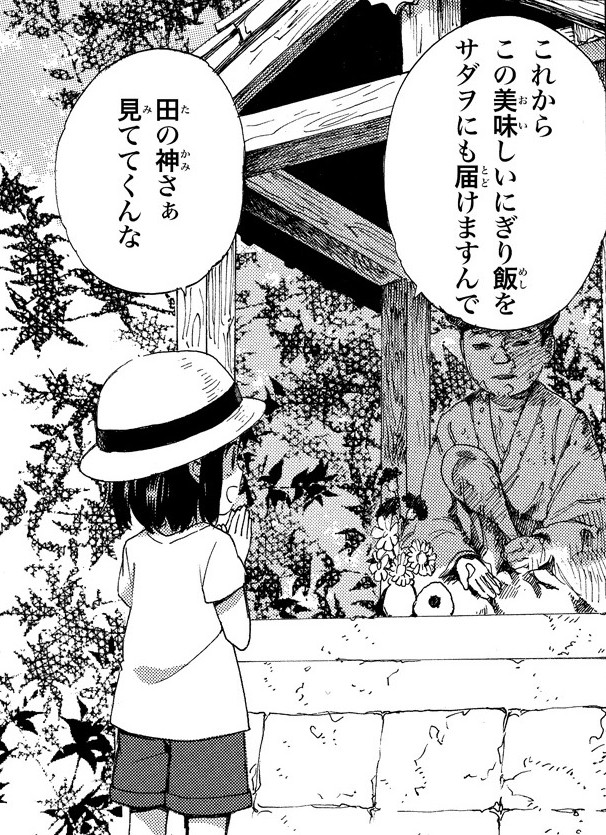
Hinata lived her first life as an old woman, and she misses her grandson Sadao, whom she hasn’t seen in over six years. She packs a lunch and sets out by bicycle for her old home to see him. After a long ride she notices it’s already noon, and she stops at a roadside shrine to the god of the rice fields.
ひなた:
「これからこの美味しいにぎり飯をサダヲにも届けますんで」
“I'm off to take these delicious rice balls to Sadao too,”
Hinata lived her first life as an old woman, and she still talks like one from the countryside. にぎり飯, the older word for おにぎり, fits her. She tells the god of the rice fields that she’s taking them to her grandson Sadao.
包丁 is a kitchen knife. The knife that a detective story’s culprit grabs from the kitchen is a 包丁 too.
Sharpening Knives with 包丁を研ぐ
This is the same 研ぐ used for washing rice. Someone who sharpens knives for a living is a 研ぎ師. 包丁研ぎ is knife sharpening, and also the tool you sharpen with.
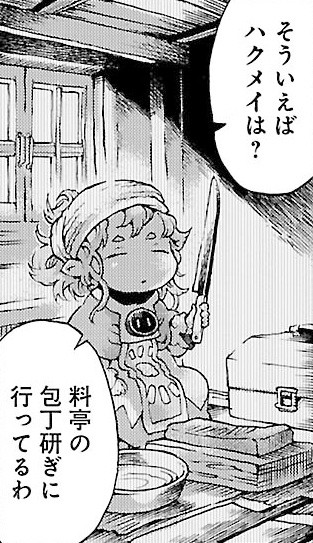
Example 1 of 3: Sharpening the restaurant's knives with 包丁研ぎ
Konju asks where Hakumei is, and Mikochi says she’s out on a job. 料亭の包丁研ぎ names the work, “knife sharpening for a restaurant”, with 研ぎ as the noun form of 研ぐ. A 料亭 is a traditional high-end restaurant.
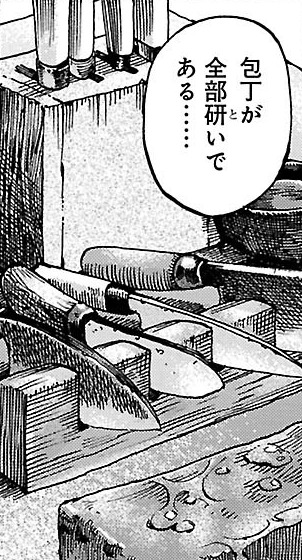
Example 2 of 3: Every kitchen knife sharpened with 包丁を研ぐ
Hakumei is helping the crew repairing the town’s stone walls by washing and sharpening their tools. She stays up all night making them a chart and shows up exhausted, so Iwashi sends her home to sleep. She promises to sharpen twice as much tomorrow. Later, Mikochi comes home and finds Hakumei asleep in bed.
Mikochi comes home to find Hakumei asleep and every kitchen knife in the house already sharpened. 包丁が全部研いである puts 研ぐ in the 〜てある form. The knives become the subject, and Mikochi sees the result of work someone else did.
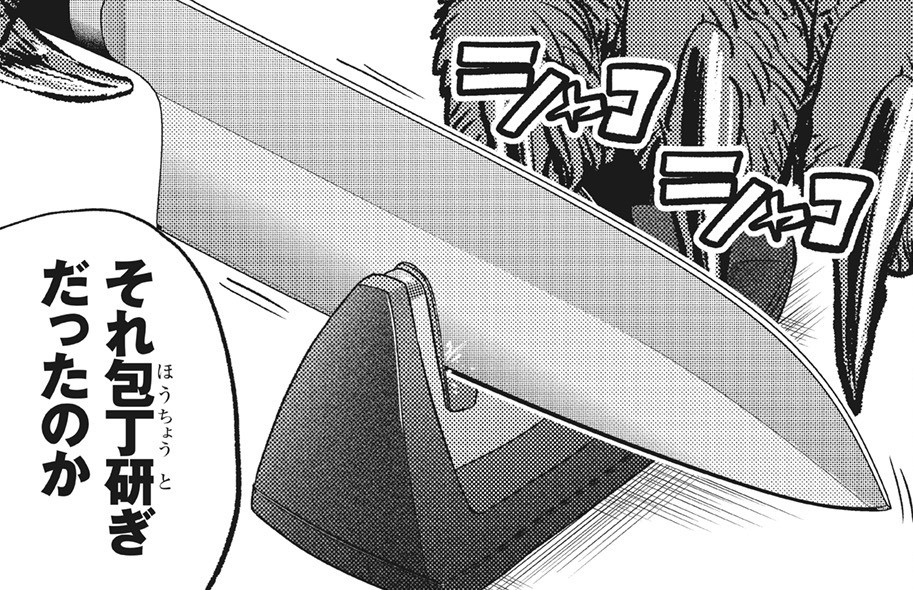
Example 3 of 3: So that was a knife sharpener with 包丁研ぎ
Kumada has long wondered how the bear pays for all the gadgets it keeps ordering online, and he confronts it. Another delivery arrives, and the bear indicates that everything in the box is for him. Kumada picks up a small object he can’t identify and asks what it is. The bear takes a kitchen knife and runs it through the object.
Kumada couldn’t tell what the little gadget was until the bear drew a kitchen knife through it. Here 包丁研ぎ is the tool, not the job, and context decides which one is meant. それ〜だったのか means “so that’s what it was”.
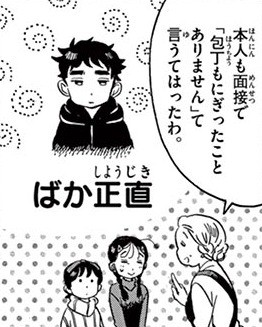
Kiyo and Sumire visit a Western-style restaurant whose card their childhood friend Kenta left them, guessing he works there as a waiter. When they can’t cover the bill, the woman serving them says a staff member already paid for their meal out of his wages. That turns out to be Kenta, who works in the kitchen as an apprentice cook. Sumire admits the news surprised them, since Kenta never used to cook.
店員さん:
「本人も面接で『包丁もにぎったことありません』て言うてはったわ。」
“He said so himself at his interview. 'I've never even held a kitchen knife.'”
Kenta now works as an apprentice cook, though he never cooked as a kid. In his interview line, 包丁もにぎったことありません, the も means “even”. He had never so much as held a knife. The server’s 言うてはった is Kyoto speech for 言っていた, with 〜はる adding light respect.
切る is the general verb for cutting. Specific cuts are nouns built on 切り, and they take にする: みじん切りにする “mince”, 千切りにする “shred into thin strips”, 乱切りにする “cut into irregular chunks”.
Example 1 of 3: Leave the vegetables to me with 野菜を切る
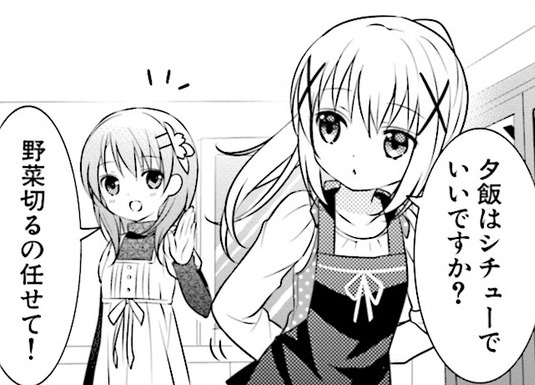
Cocoa has just moved in as a lodger with Chino’s family at the Rabbit House café. After closing, she suggested the two of them make dinner together. Chino said she could manage on her own, but Cocoa joined her in the kitchen.
Cocoa has just moved in and wants to help Chino make stew. 野菜切るの任せて drops both を, and の turns the phrase into a noun, “the vegetable cutting”. 任せて means “leave it to me”.
Example 2 of 3: A cat's paw for cutting vegetables with 野菜を切る
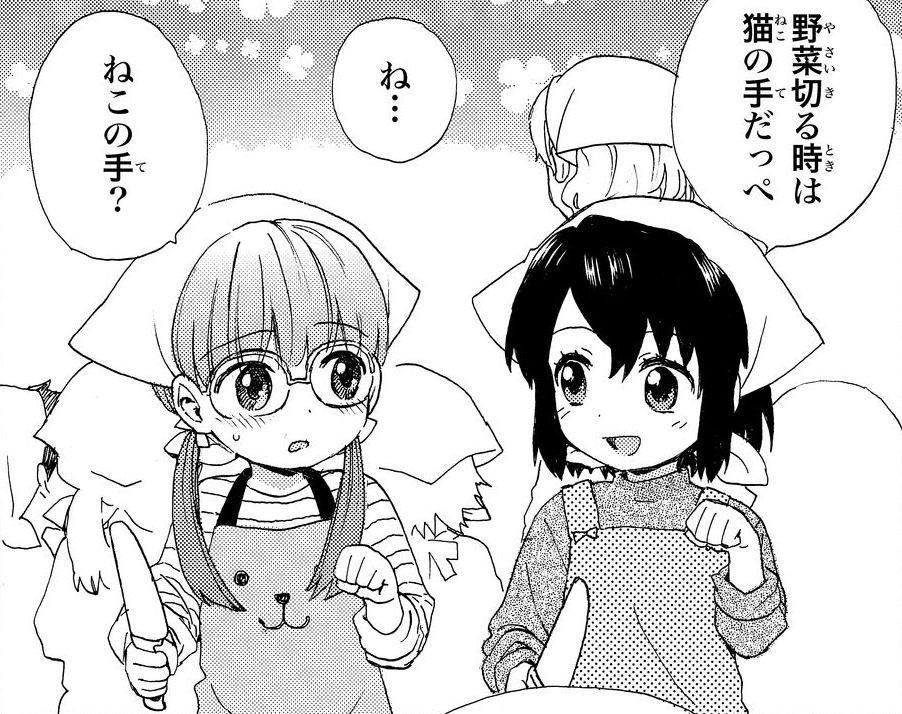
Hinata’s second-grade class is on an overnight school trip, and each team is cooking curry. Touma has bet that their team will beat Chiharu’s, though he has never made curry before. He has started peeling the potatoes, and Midori now has a knife in hand to start cutting.
Midori is about to cut vegetables for the team’s curry, and Hinata gives her a tip. 猫の手, “cat’s paw”, is the standard knife-safety advice in Japan. You curl the fingertips of the hand holding the food. だっぺ is Hinata’s countryside だよ.
Example 3 of 3: Making Nako cry over onions with 玉ねぎを切る
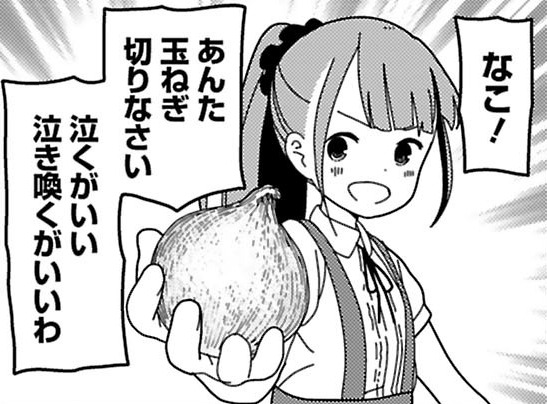
Bocchi, Aru, and Nako are spending the night at Sotoka’s apartment. When the group came up one futon short, Nako told Aru to go home, and Aru refused. Now Sotoka has suggested they start making dinner.
Aru is still angry that Nako told her to go home, so she gives Nako the job that makes you cry. 玉ねぎ切りなさい uses the same 切る as any vegetable, with 〜なさい for a firm command. 泣くがいい means “go ahead and cry”.
むく means to peel, and it’s often written in kana instead of 剥く. It works for fruit and vegetables alike: りんごの皮をむく. The idiom 一皮むける means to grow or reach a new level, as if you’d shed a layer.
Example 1 of 2: Megure wants his apple peeled with 皮をむく
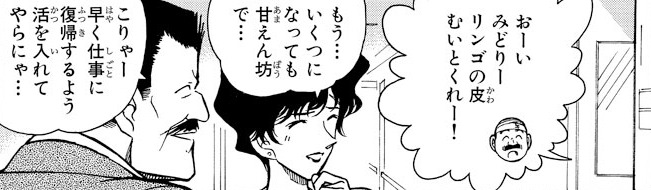
Inspector Megure is in the hospital after an old head wound reopened during a case. Superintendent Matsumoto has just told Kogoro and the others how Megure got the scar twenty years ago. Now Megure’s wife, Midori, has stepped out of his room to greet the visitors.
目暮:
「おーい みどりー リンゴの皮むいとくれー!」
“Heeey, Midori! Peel an apple for me!”
みどり:
「もう… いくつになっても甘えん坊で…」
“Honestly... He's such a baby, no matter how old he gets...”
松本:
「こりゃー早く仕事に復帰するよう活を入れてやらにゃ…」
“Looks like I'll have to light a fire under him so he gets back to work soon...”
Megure calls to his wife from his hospital bed. リンゴの皮むいとくれ drops the を, and むいとくれ is むいておくれ, an old-fashioned, familiar way to ask. A peeled apple for a hospital patient is a stock scene in Japanese stories.
Example 2 of 2: Peeling a daikon Ayune's way with 皮を剥く
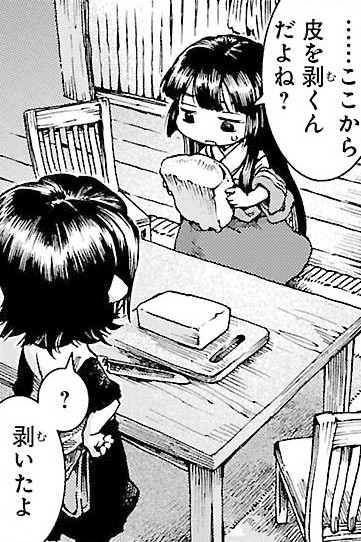
Mikochi’s older sister Ayune has turned up unannounced to stay. She brought a whole daikon for steamed daikon, far more than they need, and Mikochi puts her to work peeling it. Ayune agrees cheerfully, then takes a big knife to the daikon and slices it with a few hard chops.
Mikochi asked her sister to peel the daikon, and Ayune hacked at it with a big knife instead. Mikochi assumes the peeling comes next. Ayune says she already did it. Both of them use the kanji 剥く.
Chopping Fine with 刻む
刻む means to chop into small pieces, usually herbs, green onion, or ginger. The same verb means to carve or engrave, and 時を刻む is a clock ticking away the time.
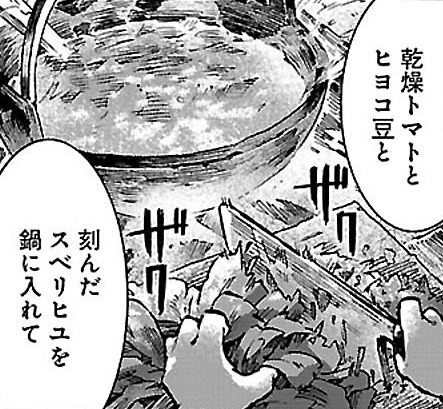
Hakumei and her boss Iwashi came to survey an empty house before it’s torn down, and Mikochi tagged along. A sudden downpour has trapped all three there for the night, so they’ve built a makeshift hearth. Mikochi found the owner’s recipe notebook in the kitchen, along with a dish that uses purslane, a slimy weed growing out front. She’s making it while the other two put together beds.
ミコチ:
「乾燥トマトとヒヨコ豆と刻んだスベリヒユを鍋に入れて」
“Put the dried tomatoes, chickpeas, and chopped purslane in the pot...”
Mikochi is cooking from a recipe notebook she found in an empty house. 刻んだスベリヒユ uses 刻む to describe the noun, “chopped purslane”. Purslane is a leafy weed, so it gets cut fine for the pot, which is what 刻む means.
Grating with すりおろす
すりおろす means to grate. Ginger, daikon, and apple all get grated. The grater is an おろし金, and grated daikon is 大根おろし. すりおろしりんご is the standard food for a child home sick in bed.
Example 1 of 3: Grating apple into the curry with すりおろす
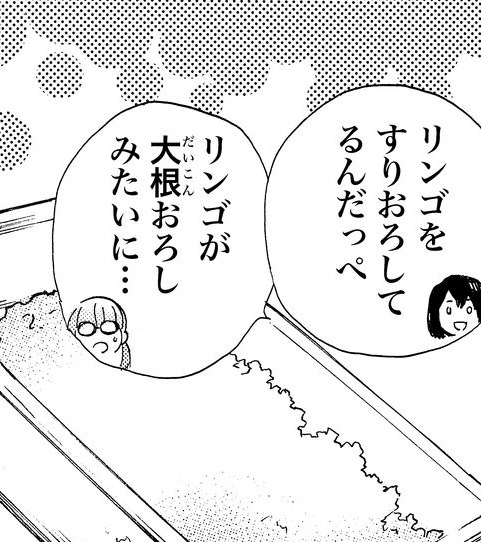
Hinata’s second-grade class is cooking curry on an overnight school trip. Midori has just noticed that the curry roux her team brought is medium-hot, and most of the children are sure it will be too spicy for them. While they argue, Hinata spots an apple among the ingredients and gets to work over a bowl. Midori asks her what she’s doing.
The team’s curry roux is medium-hot, and the second graders are sure it’ll be too spicy. Hinata has a fix. Grated apple sweetens a curry and softens the heat. リンゴをすりおろしてる is すりおろしている, “I’m grating”, and Midori compares the result to 大根おろし.
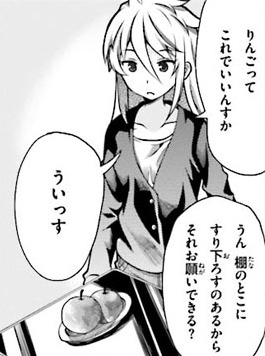
Renge is home in bed with a cold, and Kaede from the candy shop has dropped by with snacks, though she claims she only came to deliver a pillow. Renge’s older sister Kazuho heads off to make dinner and promises Renge some grated apple. Kaede offers to help, and the two go to the kitchen.
楓:
「りんごってこれでいいんすか」
“Are these the apples you want?”
一穂:
「うん 棚のとこにすり下ろすのあるから それお願いできる?」
“Yeah. There's a grater over by the shelf, so could you do that for me?”
Renge has a cold, so her sister is making the classic sick-day food, grated apple. In すり下ろすの, the の stands in for a thing, “the grating thing”, so Kazuho never needs the word おろし金. すり下ろす is a less common spelling of すりおろす.
Example 3 of 3: Ginger grated for karaage with すりおろす
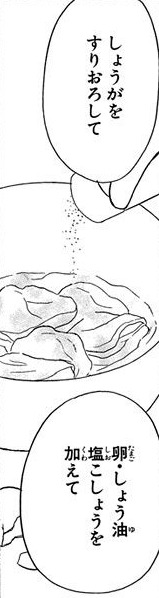
Miku has almost no confidence in her cooking, but after a classmate showed off a homemade boxed lunch from his girlfriend, she offered to make one for Shibuya, and he was thrilled. Now she’s in the kitchen with a boxed lunch cookbook. With the eggs on to boil, she decides to make karaage and reads the recipe aloud as she goes, starting with cutting the chicken into bite-sized pieces.
Miku reads a lunch-box cookbook aloud as she makes karaage for Shibuya. しょうがをすりおろして is recipe language. Recipes chain their steps with the て-form, and the next line picks up with 加えて.
割る means to break or split. Watch for 卵割れる?. 割れる can be the potential form, “can you crack an egg?”, or the intransitive “the egg breaks”. Context decides.
溶く usually means to dissolve. With eggs, it means to beat them until the yolk and white mix. The result is 溶き卵, the beaten egg that goes into soups and onto fried cutlets.
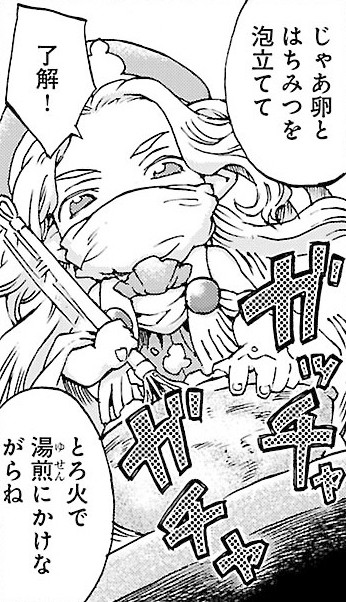
Konju drops by Hakumei and Mikochi’s new house and finds Mikochi testing a new product, honey waffles. Konju has just learned that Mikochi makes the cookies and tea she loves. She doesn’t want to be in Mikochi’s debt, so she begs to help, and Mikochi gives in.
Konju begged to help, so Mikochi gives her the eggs and honey. 泡立てて is a て-form request, “whisk them”. The double boiler, 湯煎, that Mikochi mentions next is where things go wrong.
茹でる means to cook something in boiling water, then take it out. Eggs, pasta, noodles, and vegetables are 茹でる foods. A boiled egg is a ゆで卵. Food that stays in a seasoned liquid is 煮る instead.
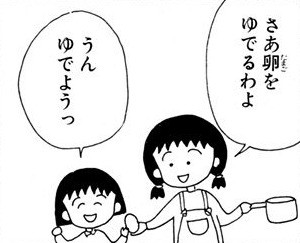
It’s Mother’s Day, and Maruko has a present ready for Mom. Her older sister suggests the two of them cook a feast to surprise her. She announces the menu, sandwiches, gratin, and dessert, and Maruko can’t believe she knows how to make all that.
Maruko’s sister is running a surprise feast for Mom, and the sandwiches need boiled eggs. Her sister says 卵をゆでるわよ, and Maruko answers with the volitional ゆでよう, “let’s boil them”. Manga usually write ゆでる in kana.
さばく (捌く) means to gut and cut up a whole fish. Its potential form さばける often comes up in confessions like 魚とかさばけない, “I can’t do fish.” The same verb also means to handle a crowd or a pile of work.
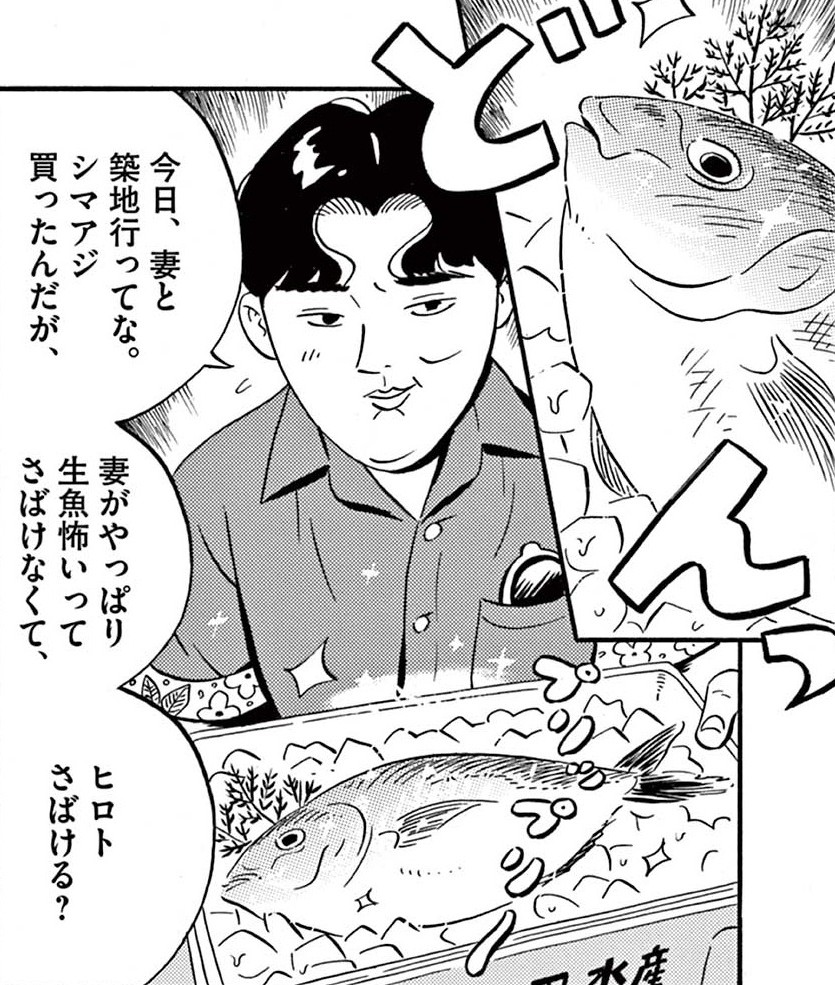
Hiroto and his cousin Natsumi have nothing but rice in the house and can’t decide what to do about lunch. Just then, Hiroto’s friend Hideki pulls up in his car.
ヒデキ:
「今日、妻と築地行ってな。シマアジ買ったんだが、」
“My wife and I went to Tsukiji today. We bought a striped jack, but...”
「妻がやっぱり生魚怖いってさばけなくて、」
“...my wife says raw fish scares her after all, so she couldn't fillet it.”
Hiroto and Natsumi have nothing but rice for lunch, and Hideki shows up with a whole striped jack. さばけなくて is the potential form: his wife “couldn’t fillet it”. His question, ヒロトさばける?, is also an offer of the fish.
Filleting with 三枚におろす
おろす here means to cut a fish into pieces. 三枚おろし leaves two fillets and the backbone. Delinquents in manga use 三枚におろしてやる as a threat.
焼く covers grilling, broiling, pan-frying, toasting, and baking. Japanese homes grill fish on a net or in the small fish grill built into most stoves. Notice the intransitive in 魚焼けた, “the fish is done”.
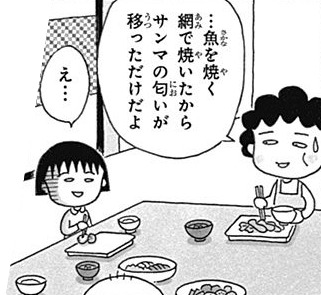
A neighbor brought the family some matsutake mushrooms, and Maruko begged Mom to grill one on the stove. At dinner she takes her first bite and beams. Matsutake are a surprise, she says, delicious with a slight taste of saury.
お母さん:
「…魚を焼く網で焼いたからサンマの匂いが移っただけだよ」
“…I only grilled it on the net I use for grilling fish, so it picked up the smell of the saury.”
Maruko thinks she’s found a hint of saury in her matsutake. Mom explains that she grilled it on the fish net. 魚を焼く網 is a relative clause, “the net for grilling fish”, and 焼いた is the same verb in the past tense for the mushroom.
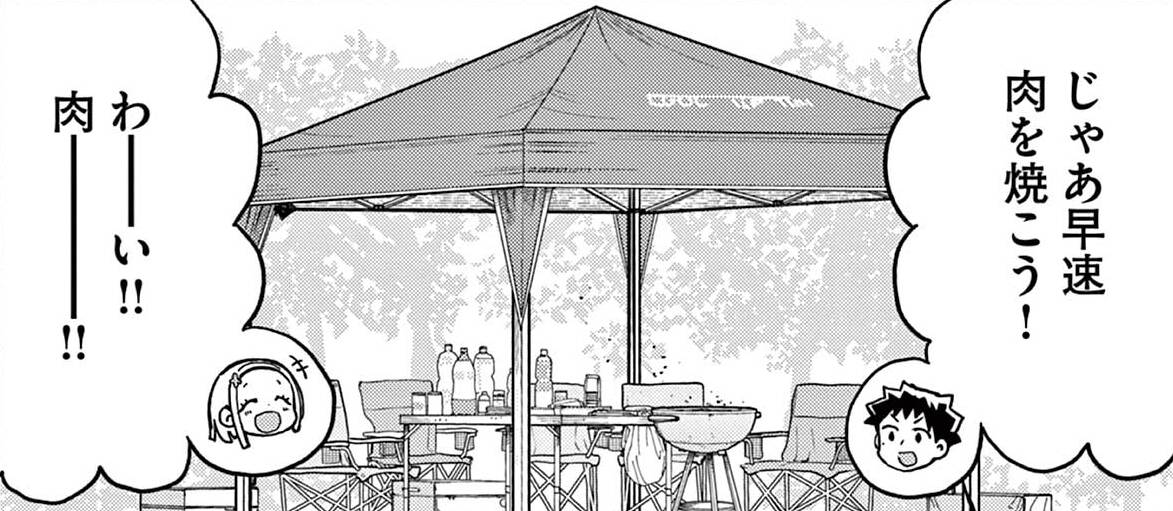
Sami stayed out until evening at the home of Misuzu, an older girl who had helped her, and her father was worried sick. To thank Misuzu, he invites her to a barbecue in the yard. Misuzu’s older sister brings her over, insisting they’ve come to apologize, not to enjoy the barbecue, though Misuzu is already drooling.
Sami’s dad is throwing a barbecue to thank Misuzu, who is already drooling. 肉を焼こう is the volitional, “let’s grill the meat”. Over coals in the yard, the verb is still 焼く.
たたく means to hit. With a knife, it means chopping meat or fish over and over until it’s minced. Ground meat bought at the store is ひき肉, from 挽く, “to grind”.
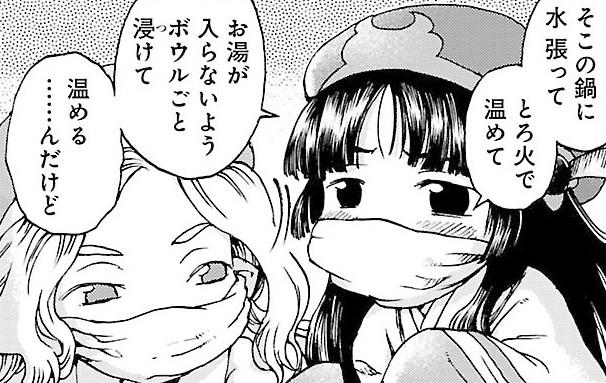
Konju drops by Hakumei and Mikochi’s new house and talks Mikochi into letting her help make honey waffles. Mikochi tells her to whisk the eggs and honey over a double boiler on low heat. Konju asks what a double boiler is, and Mikochi realizes she has to start from the basics.
ミコチ:
「そこの鍋に水張って」
“Fill that pot there with water.”
「とろ火で温めて」
“Heat it on a low flame.”
「お湯が入らないようボウルごと浸けて」
“Set the whole bowl in it without letting the water get inside.”
Konju has no idea what a double boiler is, so Mikochi walks her through it step by step. 鍋に水張って drops the を. に marks the pot as the container that gets filled.
Boiling Over with 鍋がふく
吹く means to blow. A pot that boils over does 吹く, or more fully 吹きこぼれる.
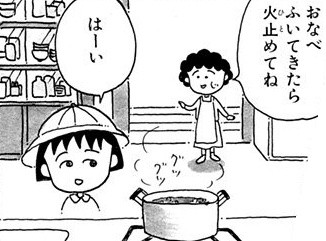
Mom goes to bring in the laundry and leaves Maruko on pot duty. おなべふいてきたら uses 〜てくる for a change that’s starting, “once it starts boiling over”. The same line tells her what to do then, 火止めて.
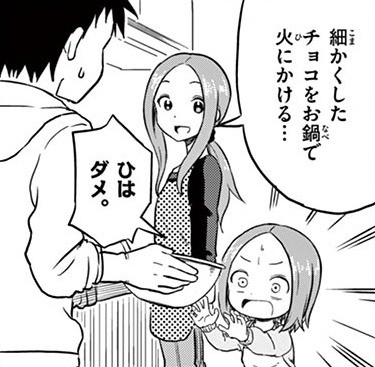
On Valentine’s Day, Chii wants to bake a chocolate cake, and she talks her dad into helping. Takagi announces that the first step is melting the chocolate, and Chii says she wants to do it.
高木:
「細かくしたチョコをお鍋で火にかける...」
“You put the chopped chocolate in a pot and set it over the heat...”
Takagi starts to explain how to melt the chocolate, and Chii wants to do it herself. 火にかける means to set the pot over the burner. Chii cries ひはダメ, “no fire!”, and Takagi finishes with っていう失敗が多いんだよ, “that’s a common mistake”. They melt the chocolate in hot water instead.
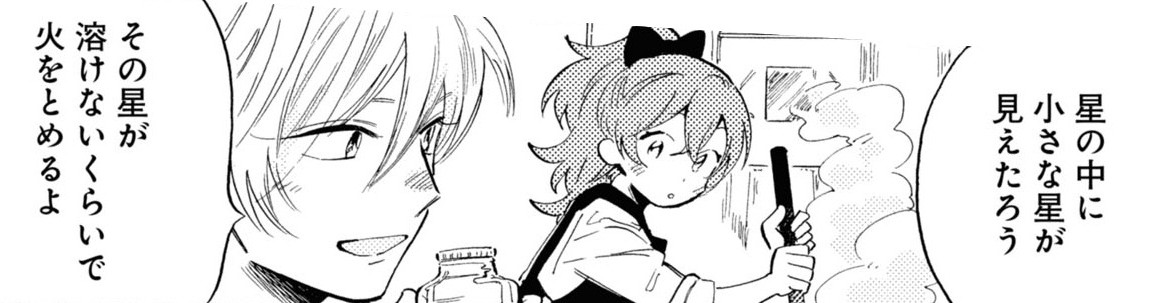
Mira and her master are making jam from stars that fell into the clouds. The master stirs the stars and sugar in a pot until they begin to melt, then lets Mira take over. As she stirs, a glint streaks through one of the melting stars, and she says it looks like a shooting star.
師匠:
「星の中に小さな星が見えたろう」
“You saw little stars inside the star, didn't you?”
「その星が溶けないくらいで火をとめるよ」
“We take it off the heat before those stars melt.”
Mira’s master has her stir the star jam and tells her when to stop. とめる is written in kana here. くらいで marks the point to stop, before the little stars inside melt.
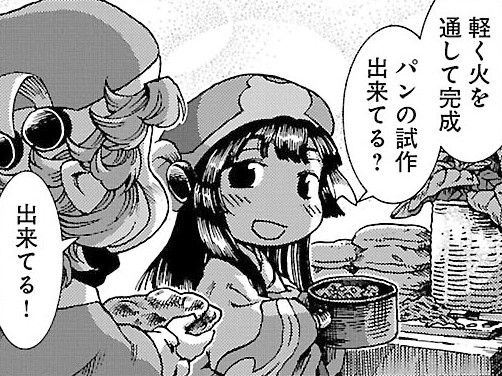
Mikochi wants to sell a jam-and-bread set at the festival, and she and Hakumei have cooked a big pot of raspberry jam through the night. Mikochi had Hakumei fetch a small pot for a test batch, added a splash of rum, then chopped basil leaves fine and put them into the jam.
Mikochi’s test batch of jam gets rum and chopped basil, then a last bit of heat. 軽く火を通して pairs the transitive 火を通す with 軽く, “lightly”, the way recipes say to heat something briefly.
The heat levels are 強火, 中火, 弱火, and the very low とろ火. They take で for how you cook something, as in 弱火で煮る, and に for changing the setting, as in 弱火にする.
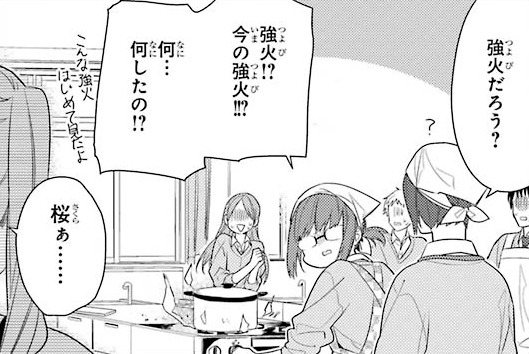
Example 1 of 3: Sengoku's idea of high heat with 強火
In cooking class, Sakura is in the same group as Remi and Sengoku, who can barely cook. Sakura told Sengoku to heat up the curry. He turned the burner up until flames roared around the pot, and Sakura asked what kind of heat he thought he was using.
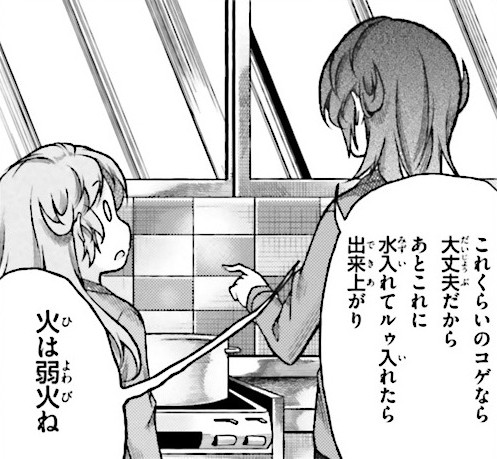
Komari insisted on making dinner by herself to prove to her sister Natsumi that she can cook. She settled on curry, using last night’s leftover meat and potato stew as the base, but while she was searching the kitchen for sugar, the pot began to smoke. Her mother came in, turned off the burner, and told her a little smoke was nothing to panic over.
お母さん:
「これくらいのコゲなら大丈夫だから あとこれに水入れてルゥ入れたら出来上がり」
“This little bit of scorching is fine. Now just add water and the roux, and it's done.”
Komari panicked when the pot started to smoke, but her mother calms her down and gives her the last steps. 火は弱火ね makes 火 the topic, “keep the heat low”.
Example 3 of 3: Not knowing what a low flame means with とろ火
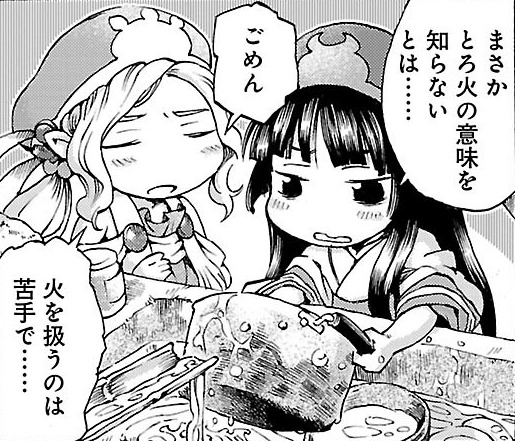
Konju is helping Mikochi make honey waffles, and Mikochi told her to warm the bowl of eggs and honey in a pot of water kept at a simmer. While Mikochi was lost in thought about the recipe, the flame roared up and the eggs and honey cooked into a solid lump. Konju insisted she’d kept it at a simmer, and Mikochi had her turn the heat off.
ミコチ:
「まさかとろ火の意味を知らないとは……」
“I never dreamed you wouldn't know what simmer means…”
Konju was told to keep the double boiler on とろ火, and she let the flame roar until the eggs and honey cooked solid. とろ火 is the lowest setting, below 弱火. Mikochi never imagined she’d have to explain the word.
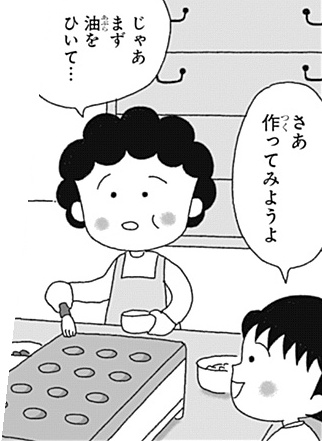
Maruko begged for a takoyaki maker, and Mom said no. Grandpa bought her one anyway, and Maruko talked him into the pricier model with its own burner so they could cook at the table. Mom grumbled, but the two of them pressed her to start making takoyaki right away.
Grandpa bought the takoyaki maker over Mom’s objections, and now she’s the one showing them how to use it. Her first step is 油をひいて, a thin coat of oil over the plate.
Deep-Frying with 油で揚げる
揚げる means to deep-fry. The oil is the means, so it takes で. 揚げたて means fresh out of the fryer, and 揚げ物 is fried food in general.
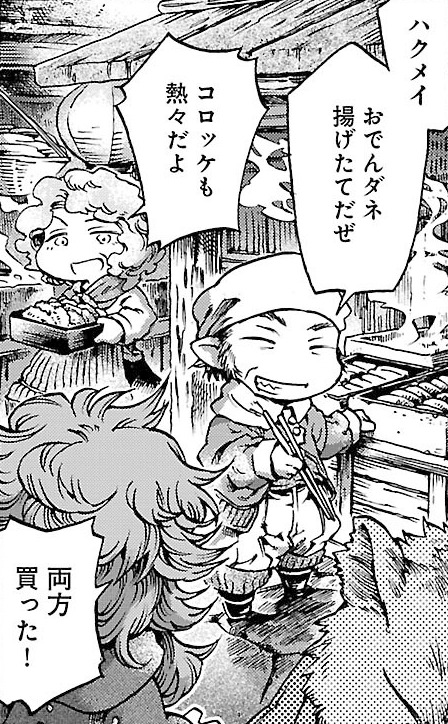
Hakumei and Mikochi are showing Iwashi around the city and want to find a restaurant he’d like for dinner. Nothing works out. One place is too cramped for him, another is closed, and he wants nothing sweet for dinner. They give up and head into a busy street of food stalls.
店主Ⓐ:
「ハクメイ おでんダネ揚げたてだぜ」
“Hakumei! The oden fixings are fresh out of the fryer!”
Hakumei and Mikochi gave up on finding a restaurant and took Iwashi to a street of food stalls. A stall owner calls out that the oden fixings are 揚げたて. 〜たて after a verb stem means “fresh from”, and many oden ingredients are fried fish cakes.
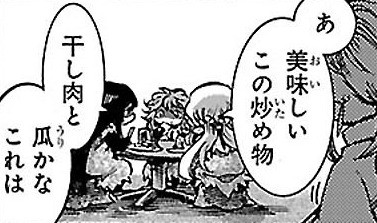
Hakumei, Mikochi, and Konju spent the evening of a Makinata festival dressed as the forest demon whose job is to scare the local children. Now the festival is over, and the three have gathered at a pub, toasted the trees of Makinata, and started on the food.
After the festival, the three sit down to eat at a pub. 炒め物 is 炒める plus 物, the general word for a stir-fried dish. Mikochi guesses it’s dried meat and gourd.
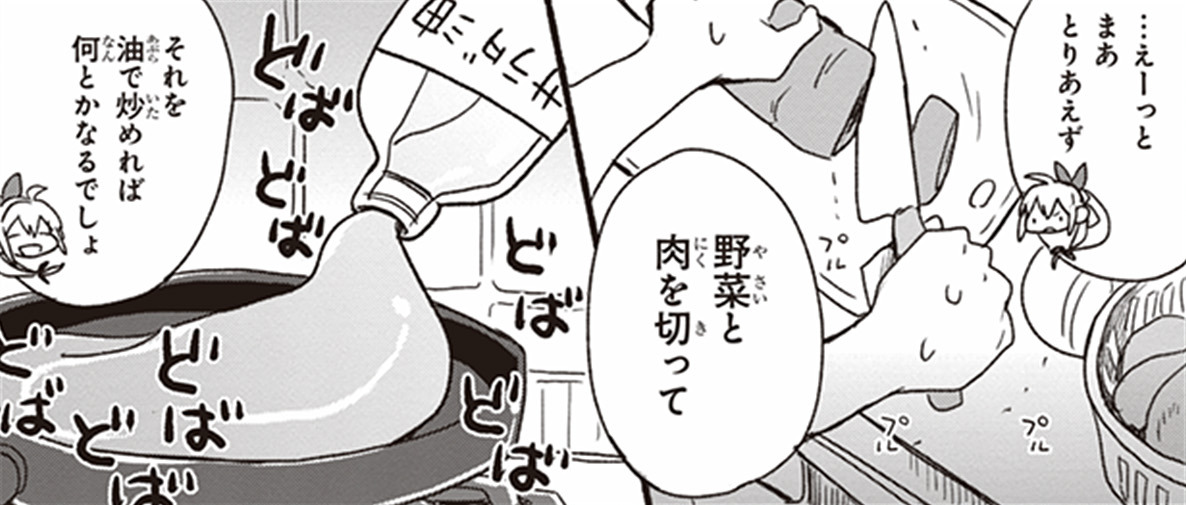
Neko puts on an apron and declares that today she’ll make a meal all by herself. She has rehearsed it in her head and pictures a perfect dish, one tasty enough to show up “that shrine maiden”.
禰子:
「…えーっと まあ とりあえず 野菜と肉を切って」
“…Um, well, for now, I'll cut the vegetables and meat...”
「それを油で炒めれば何とかなるでしょ」
“...and if I fry it all in oil, it'll work out somehow, right?”
Neko has pictured a perfect meal, but she has no real plan for making it. 油で炒めれば uses で for the oil as the means, and 〜ば何とかなる means “if I do that, it’ll work out”. Her whole recipe is cut and fry.
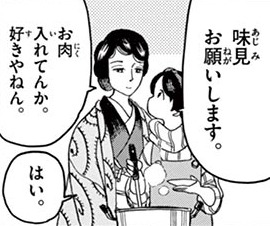
Momoko has dropped by the house and sat quietly watching Kiyo work in the kitchen. When Kiyo starts on dinner, she invites Momoko to stay and eat with everyone, and Momoko brightens when she hears it will be tonjiru, a miso soup full of pork and vegetables. Now the soup is done.
Momoko has been watching Kiyo cook, and Kiyo asks her to taste the tonjiru. 味見お願いします is a polite request built on the noun alone. Momoko’s 入れてんか is Kyoto speech for “would you put some in?”
Example 2 of 2: Takagi's miso soup taste test with 味見する
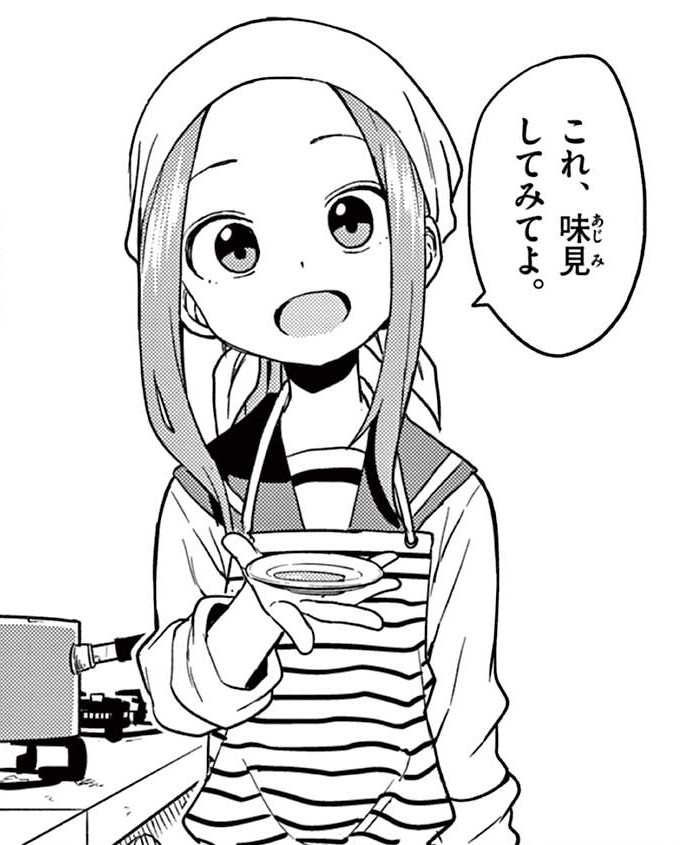
During cooking class, Takagi is making the miso soup while Nishikata, who has hardly ever cooked, works on the salad. She has just sipped from a small dish to check the soup, and now she calls Nishikata over.
Takagi has already tasted the soup, and now she calls Nishikata over from the salad. 味見してみて adds 〜てみる, “try tasting it”.
Adjusting Seasoning with 味を調える
味を調える means to adjust the seasoning at the end. It’s the standard recipe phrase: 塩とコショウで味を調える. The standard spelling is 調える, though 整える and kana ととのえる are common too.
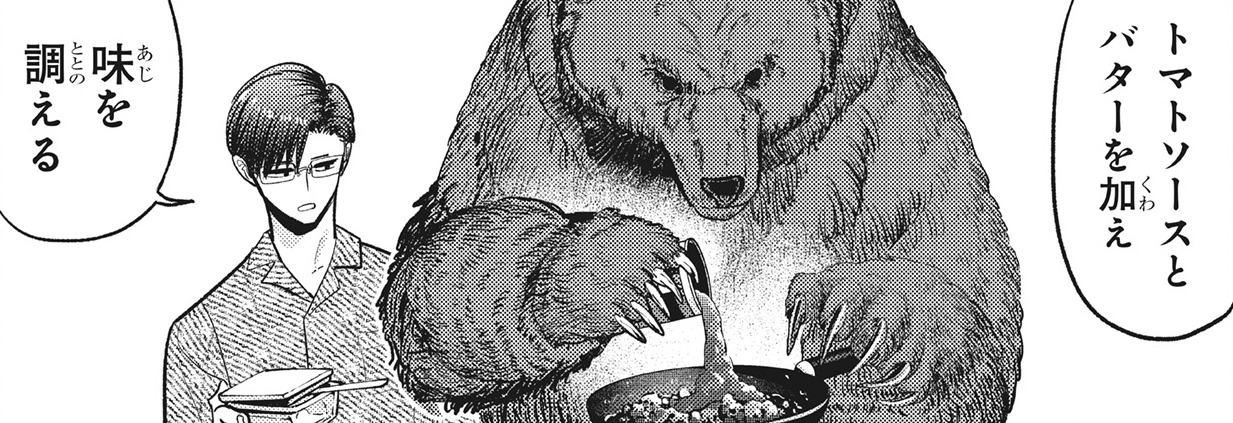
Kumada’s bear has bought a pile of kitchen gadgets and indicates they’re all for him. To show them off, it chops onion, carrot, and celery in a pull-cord chopper and starts on a meat sauce. Kumada calls out each step as the bear cooks, like the narrator of a cooking show.
Kumada narrates the bear’s meat sauce like a cooking show host. 味を調える is the closing step in many Japanese recipes, and he says it in the dictionary form that recipes use.
Soaking In with 味がしみる
しみる (染みる) means to seep in. When flavor soaks into food, as with daikon left in simmering broth, 味がしみる. To make flavor soak in is 味をしみ込ませる.
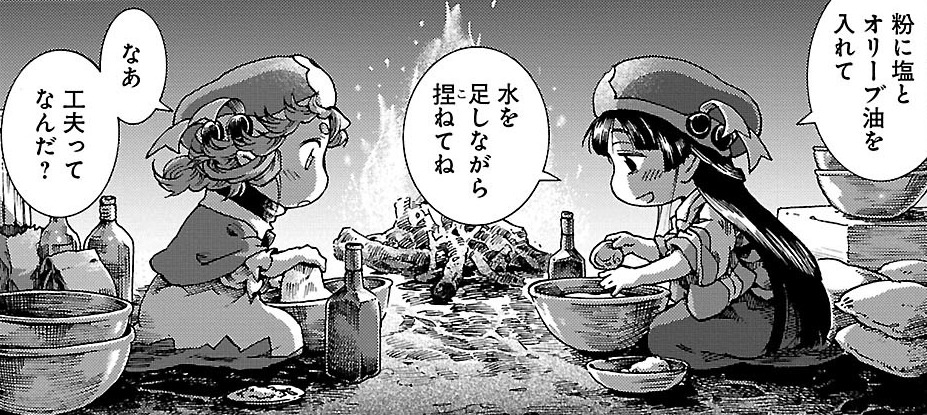
Mikochi is making a jam-and-bread set to sell at the festival, and she and Hakumei are cooking outdoors. They layered raspberries and sugar in a big pot, and when Hakumei worried the jam would come out too sweet, Mikochi said she had a little trick in mind. With the berries left to sit, Mikochi says it’s time to get the bread ready.
With the berries left to sit, Mikochi puts Hakumei to work on the bread dough. 捏ねてね uses the kanji 捏ねる, which is less common than kana こねる. 水を足しながら, “while adding water”, has her knead and pour at the same time.
Example 2 of 2: A bread machine that kneads the dough with 生地をこねる
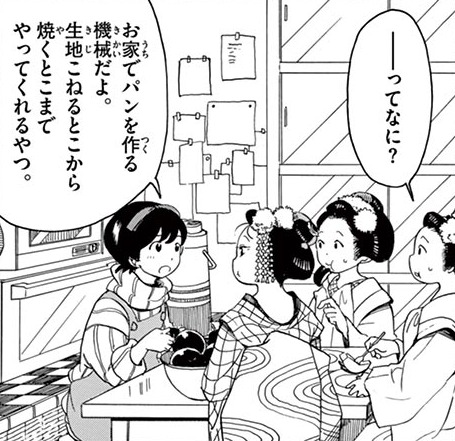
Kiyo and the maiko of the house sit around a bowl of apples in the kitchen. The talk has turned to a “home bakery”, and one of the maiko repeats the unfamiliar words.
舞妓さん:
「――ってなに?」
“...What's that?”
キヨ:
「お家でパンを作る機械だよ。生地こねるとこから焼くとこまでやってくれるやつ。」
“It's a machine for making bread at home. It does it all for you, from kneading the dough to baking the bread.”
The maiko have never heard of a home bakery, so Kiyo explains. 生地こねるとこから焼くとこまで names the first and last steps, “from kneading the dough to baking it”. とこ is short for ところ.
Resting Dough with 生地を寝かせる
寝かせる means to put someone to bed. For dough, it means letting it rest. The same verb covers other food left to sit, like curry overnight.
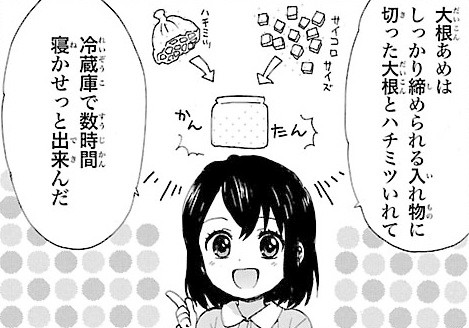
Moka has a sore throat. Hinata scolds her so harshly that Moka cries, then makes up for it with a jar of daikon syrup. Moka tastes it and is surprised that it’s sweet and nothing like daikon.
日向:
「大根あめはしっかり締められる入れ物に切った大根とハチミツいれて」
“For daikon syrup, you put cut daikon and honey in a container that seals tight...”
「冷蔵庫で数時間寝かせっと出来んだ」
“...and once you let it sit in the fridge for a few hours, it's ready.”
Hinata makes daikon syrup, a home remedy, for Moka’s sore throat. 寝かせっと is 寝かせると in her dialect. Here 寝かせる means leaving the jar alone in the fridge while the honey draws the juice out of the daikon.
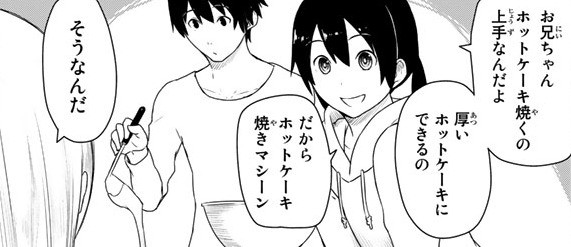
After seeing the sky whale together, Makoto and her family invite Anzu home for a late breakfast of hotcakes, cooked on a hot plate in the middle of the table. Kei stands over the batter and does all the cooking. Chinatsu asks if her brother has turned into a hotcake-making machine, and Kei says that grilling hotcakes is all he can do now. Anzu asks what that’s about.
千夏:
「お兄ちゃん ホットケーキ焼くの上手なんだよ 厚いホットケーキにできるの」
“My brother's good at making hotcakes. He can make them really thick.”
Kei cooks hotcakes for everyone on a hot plate at the table. ホットケーキ焼く drops the を, and 焼く covers a griddle too. Chinatsu turns the phrase into a nickname, ホットケーキ焼きマシーン.
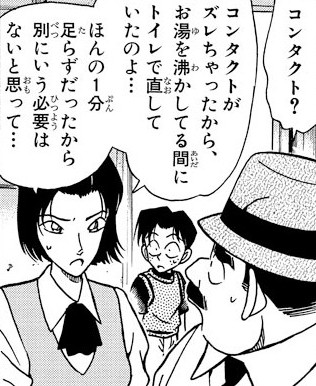
During a screening at an old movie theater, a man is found hanged in front of the projection window. Yuriko, who works the theater’s snack counter, says she was in the projection booth making tea for the projectionist when his shadow appeared on the screen. Mitsuhiko then says he saw her pressing her eyes in front of the mirror in the women’s restroom just before that. When Inspector Megure asks why she wasn’t in the booth, she stammers that it was her contact lens.
目暮:
「コンタクト?」
“Your contact lens?”
百合子:
「コンタクトがズレちゃったから、お湯を沸かしてる間にトイレで直していたのよ…」
“My contact lens slipped, so I fixed it in the restroom while the water was heating up...”
「ほんの1分足らずだったから別にいう必要はないと思って…」
“It took less than a minute, so I didn't think I needed to mention it...”
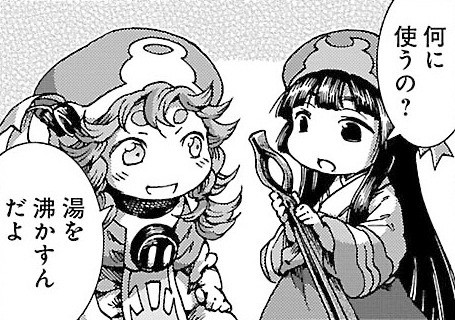
Yuriko has to explain why she wasn’t in the projection booth. She says she fixed her contact lens while the water heated, お湯を沸かしてる間に. 〜ている間に marks something done during another action.
Example 2 of 2: Heating water for a bamboo bath with 湯を沸かす
Hakumei and Mikochi went to a newly opened hot spring, only to find it closed for cleaning. Instead of giving up, they decided to build their own open-air bath by splitting a giant bamboo stalk in half. Hakumei split the bamboo while Mikochi cooked over a campfire. Then Hakumei, gathering stones near the fire, called for Mikochi to bring a pair of tongs.
Hakumei split a giant bamboo stalk for a bath and wants tongs for the stones by the fire. The stones heat in the fire and go into the water, so 湯を沸かす here means heating bathwater. Hakumei drops the お, which sounds plainer.
Water Boiling with お湯が沸く
沸く is the intransitive partner of 沸かす. お湯が沸いたよ, “the water’s boiling”, is what you call out when the kettle whistles.
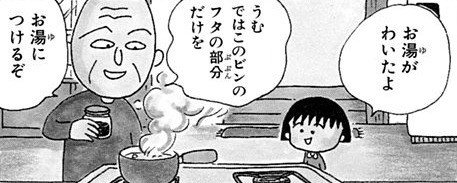
Mrs. Takamaru brings the family a jar of black beans, and Maruko and Grandpa want to eat some right away. Mom, Maruko, and Grandpa can’t budge the lid, and Grandma fails even with rubber gloves. When Mom tells Maruko to wait for Dad to get home, Grandpa gets the idea of warming the lid, and the two of them head to the kitchen and put a pot of water on the stove.
まる子:
「お湯がわいたよ」
“The water's boiling!”
おじいちゃん:
「うむ、ではこのビンのフタの部分だけをお湯につけるぞ」
“Right. Now, I'll dip just the lid of this jar in the hot water.”
Grandpa plans to loosen a stuck jar lid with hot water, and Maruko watches the pot. お湯がわいた uses the intransitive 沸く. Kana わく is common in casual writing.
Pouring with お湯を注ぐ
注ぐ means to pour. The instructions on instant noodles say お湯を注いで3分, “pour hot water and wait three minutes”.
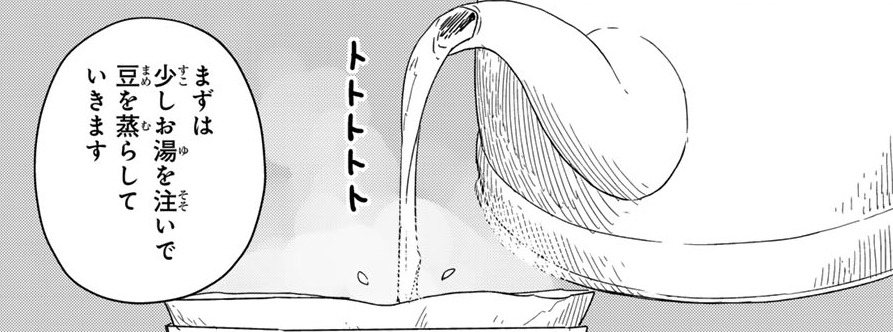
At a coffee shop, Makoto tastes a cup so good that she’s hooked on coffee. The owner sells her some beans and shows her how to brew them by hand. Back home, Makoto makes drip coffee for the household and walks them through each step as she goes.
真琴:
「まずは少しお湯を注いで豆を蒸らしていきます」
“First, I pour in a little hot water and let the grounds bloom.”
Makoto brews drip coffee for the household and narrates each step. The first is お湯を注いで豆を蒸らす, wetting the grounds with a little water so they swell. 蒸らす means to let something sit in its own steam, and coffee brewers use it for the bloom.
Tea and Coffee with お茶
Making Tea with お茶を淹れる
淹れる is the verb for steeping tea or brewing coffee. 淹 isn’t a jōyō kanji, so many writers use 入れる or いれる with the same reading. お茶を入れる and お茶を淹れる mean the same thing.
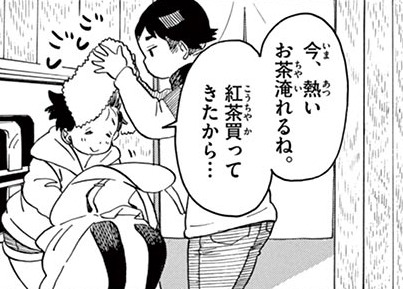
Kiyo and Riko come home from a grocery run in the cold rain. Kiyo is relieved that the groceries in her backpack stayed dry, but she is soaked through herself, so Riko dries her hair with a towel.
理子:
「今、熱いお茶淹れるね。紅茶買ってきたから…」
“I'll make you some hot tea right now. I picked up some black tea, so...”
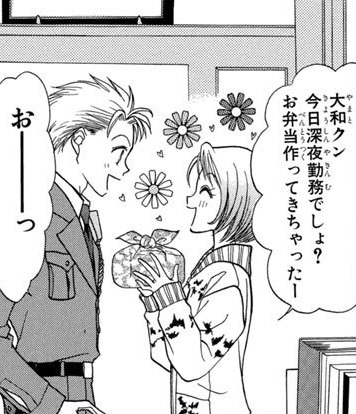
Ran has been hauled into the Shibuya police box, where her older brother Yamato works as an officer, and he has just finished lecturing her. Then Ran’s friend Miyu bursts in with a cheerful greeting.
美由:
「大和クン 今日深夜勤務でしょ? お弁当作ってきちゃったー」
“Yamato, you're on the late-night shift today, right? I made you a lunch and brought it over!”
Miyu shows up at the police box with a lunch for Ran’s brother Yamato, who’s working the late shift. お弁当作ってきちゃった adds 〜てくる, “made it and brought it”, and 〜ちゃった, a cheerful “I went and did it”.
Packing a Lunch Box with 弁当箱に詰める
詰める means to pack something into a container. The side dishes, おかず, get packed into the 弁当箱.
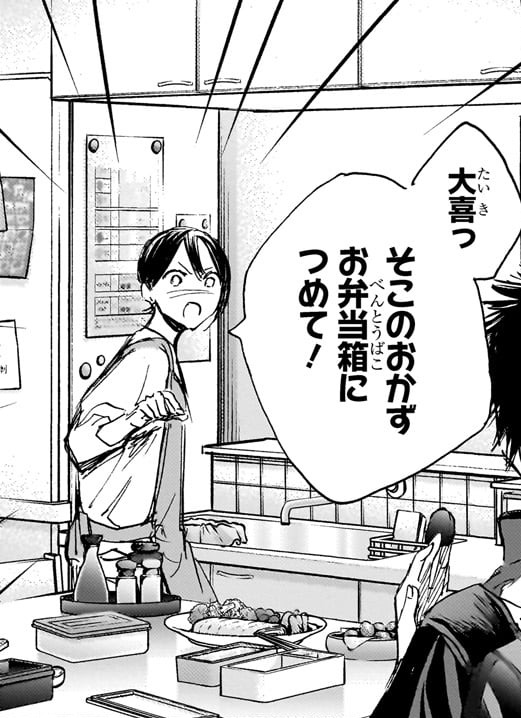
It’s morning at the Inomata house. Taiki shuffles into the kitchen half asleep and mumbles a good morning to his mother, who is at the counter getting the day’s lunches ready.
お母さん:
「大喜っ そこのおかずお弁当箱につめて!」
“Taiki! Pack those side dishes into the lunch boxes!”
Taiki’s mother is making the day’s lunches and puts him to work as soon as he walks in. おかずお弁当箱につめて drops the を after おかず. に marks the box as where the food goes.