Crowds and packing in with こむ
こむ has two official spellings. 混む is a place being crowded, such as a train, a road, or a shop. 込む is things piling up or being intricate, and it’s the 込 at the end of many compound verbs, such as 落ち込む, “feel down”, and 飛び込む, “jump in”.
A quick test for こむ on its own: if you could say 混雑する, “be crowded”, write 混, though 込 is accepted there too. Anywhere else, write 込. Both are official, so they show up in formal writing as well as in manga. Same reading, different kanji explains where the official list comes from.
The Spellings at a Glance
| Spelling | Used for | Standing |
|---|---|---|
| 混む | be crowded | Official |
| 込む | pile up; be intricate | Official |
Crowded Places with 混む
混む is a place filling up with people or cars. 電車が混む is “the train gets crowded”, 道が混んでる is “the roads are jammed”, and 人混み is “a crowd”. Its opposite is 空く, as in 空いてる, “not crowded”. The kanji is the 混 of 混雑, “congestion”.
Manga mostly use 混 for this. In this site’s manga corpus, forms of 道が混む turn up a dozen times and never with 込, and 人混み is several times as common as 人込み.
1 source
【混む】混雑する。
電車が混(込)む*。混(込)み合う店内*。人混(込)みを避ける*。混む: be crowded. "The train is crowded," with 込 allowed. "A crowded shop," with 込 allowed. "Avoid the crowds," with 込 allowed.
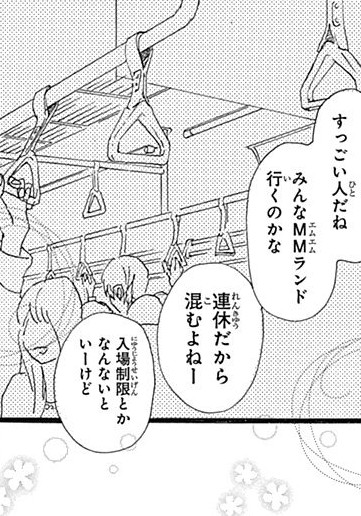
Takeo and his friends board the train bound for the amusement park, MM Land.
- 凛子:
- 「すっごい人だね。みんなMMランド行くのかな」
- “There's a lot of people here. I wonder if everyone's going to MM Land.”
- 隼人:
- 「連休だから混むよねー」
- “It's a long holiday, so it'll be crowded.”
- 愛:
- 「入場制限とかなんないといーけど」
- “I hope they don't restrict admission or anything.”
Takeo and his friends board a packed train to the amusement park. Hayato isn’t surprised, since it’s a long holiday. 混む is the place getting crowded.
Piles and Intricate Work with 込む
On its own, 込む is things piling up or being intricately put together. 負けが込む is “rack up losses”, 日程が込んでいる is “the schedule is packed”, and 手の込んだ is “elaborate”. The guide sums it up as “pile up” and “be intricate”. In this site’s manga corpus, 手の込んだ turns up dozens of times, often for a trick or a carefully made dish.
1 source
【込む】重なる。入り組む。
負けが込む。日程が込んでいる。仕事が立て込む。手の込んだ細工を施す。込む: pile up. Be intricate. "Rack up losses." "The schedule is packed." "Be swamped with work." "Do elaborate work."
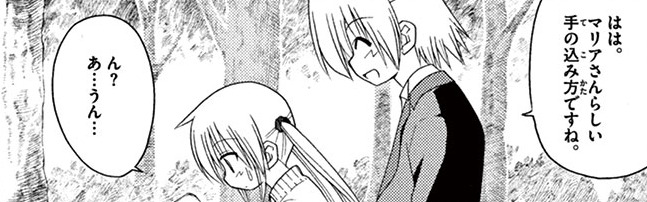
Hayate and Nagi stop on a mountain trail to eat the bento Maria sent with them. Nagi carried it the whole way and grumbles that she’ll complain to Maria if it isn’t delicious. When they open it, the rice is shaped into a bear and a rabbit, and the words がんばったね, “You did your best”, are spelled out across the top.
- ハヤテ:
- 「はは。マリアさんらしい手の込み方ですね。」
- “Haha. It's elaborate, just like Maria.”
- ナギ:
- 「ん? あ…うん…」
- “Hm? Oh... yeah...”
Maria packed a bento with rice shaped into animals and a message spelled out on top. Hayate calls it マリアさんらしい手の込み方, “elaborate, just like Maria”. 手の込み方 is how much work went into it.
Verbs Ending in 〜込む
After another verb’s stem, 〜込む adds “into”, “all the way”, or “and stay that way”. 飛び込む is “jump in”, 書き込む is “write in”, 座り込む is “sit down and stay put”, and 煮込む is “stew for a long time”. In kanji, these take 込, not 混. Words ending in 込む covers them in more detail.
They’re far more common in manga than either spelling on its own. In this site’s manga corpus, 巻き込む, “drag into”, and 落ち込む, “feel down”, each turn up more than 1,000 times.
1 source
3(込む)動詞の連用形に付いて、複合語の形で用いる。
㋐中に入る。「風が吹き―・む」「飛び―・む」「殴り―・む」
㋑中に入れる。「書き―・む」「詰め―・む」「呼び―・む」
㋒ある状態をそのままずっとしつづける。「座り―・む」「黙り―・む」
㋓すっかりその状態になる。「冷え―・む」「老い―・む」
㋔徹底的に事を行う。「教え―・む」「煮―・む」「使い―・んだ万年筆」3. Written 込む: attached to a verb's stem, forming compound verbs. Go in. "The wind blows in." "Jump in." "Storm in for a fight." Put in. "Write in." "Pack in." "Call in." Keep on in the same state. "Sit and stay put." "Fall silent and stay that way." Become completely so. "Get bitterly cold." "Grow frail with age." Do something thoroughly. "Drill something into someone." "Stew." "A well-used fountain pen."
Example 1 of 4: Plunging one's hand into fire with 突っ込む
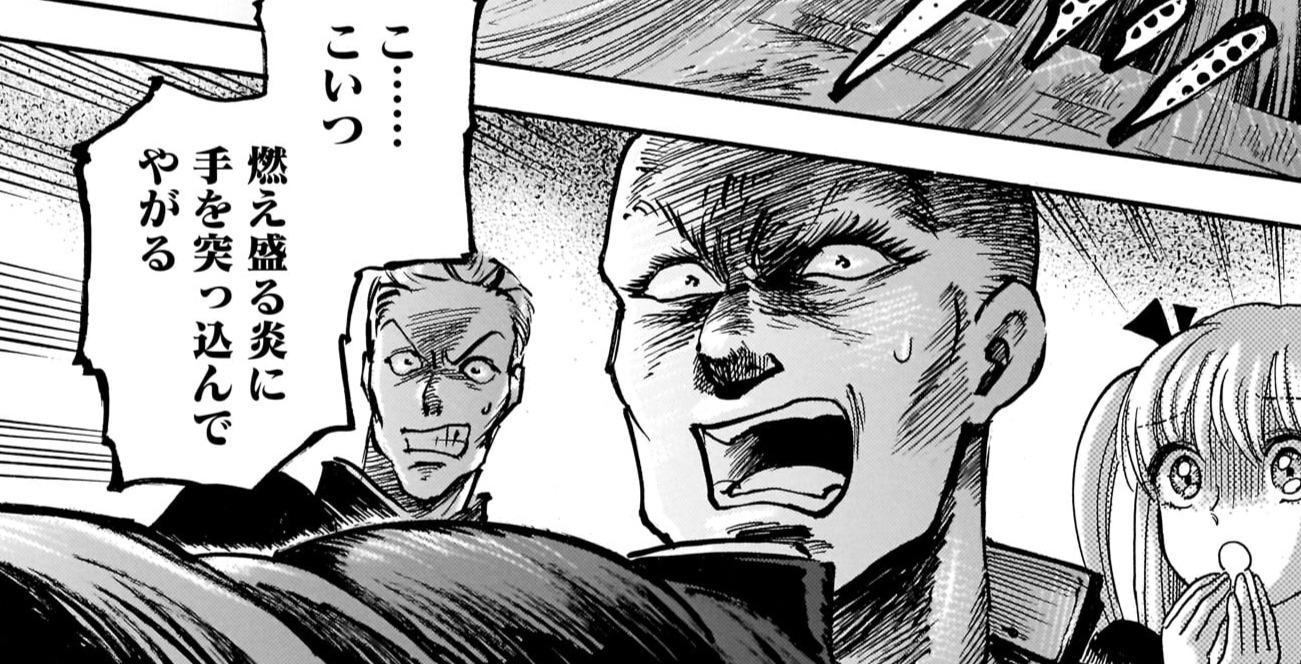
Lulu recognizes the dropped charm she found as the one she made for her childhood friend Zen before he moved away. A delinquent classmate takes it from her and throws it into the school incinerator to defy Zen. Lulu tries to retrieve it, but the fire forces her back. Zen appears and reaches into the flames.
- 不良:
- 「こ…こいつ」
- “Th-this guy...”
- 「燃え盛る炎に手を突っ込んでやがる」
- “He's thrusting his hand into the raging flames!”
Zen reaches into the incinerator to save the charm Lulu made for him. 突っ込む is “thrust into”.
Example 2 of 4: In another world with 異世界
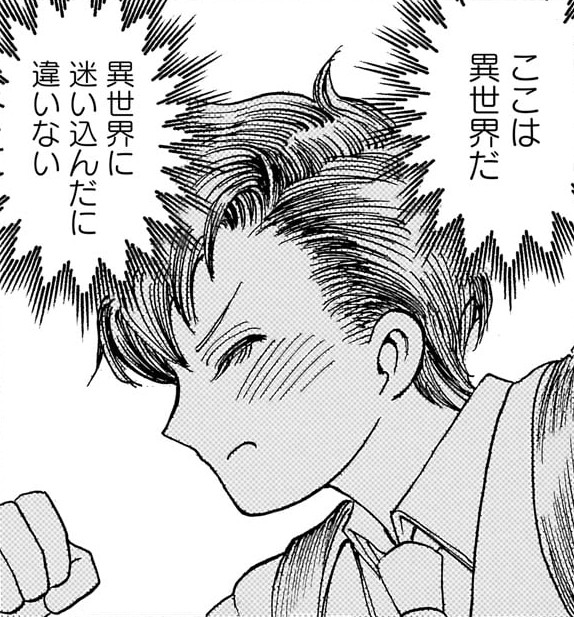
Zen lived in a glittering, idyllic town until his family moved. During his first day of school, he found everyone to be glaring and rugged. Rather than being gentle and playful, his classmates sought a brawl and chased after him.
- 禅:
- 「ここは異世界だ」
- “This is another world.”
- 「異世界に迷い込んだに違いない」
- “I must have wandered into another world.”
On his first day at a school full of glaring delinquents, Zen decides he must have wandered into another world. 迷い込む is “stray into”.
Example 3 of 4: Stewed greenbeans with 煮込む
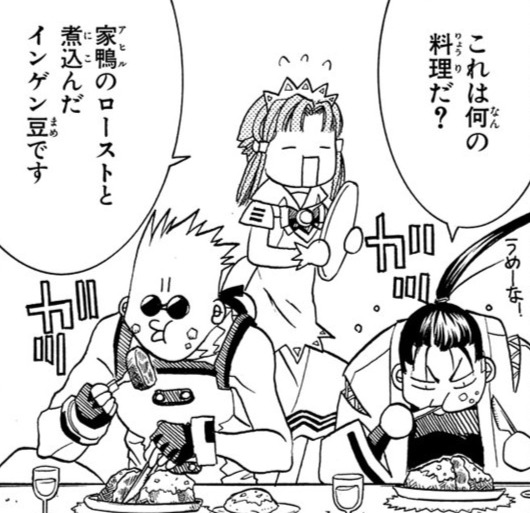
As part of their training, Akari, Aika, and Alice prepare a meal and host a large dinner.
- 暁:
- 「これは何の料理だ?」
- “What dish is this?”
- 灯里:
- 「家鴨のローストと煮込んだインゲン豆です」
- “It's roast duck and stewed green beans.”
Akari serves roast duck and green beans at the dinner she helped cook. 煮込む is “stew”, simmering for a long time.
Example 4 of 4: Depressed over a snatched dumpling with 落ち込む
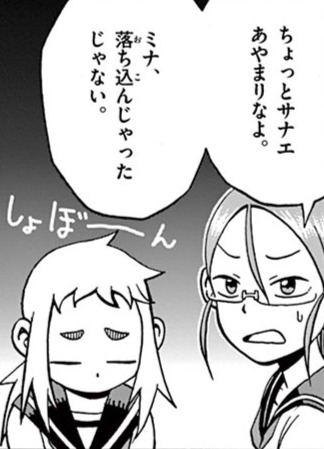
Yukari doesn’t like carrots, so she offers the ones from her lunch to Mina, who gladly accepts. Mina offers one of her dumplings in return, but Yukari is hesitant to accept because Mina did her a favor by taking the carrots. Sanae takes the opportunity to snatch the dumpling and eat it herself, claiming that neither of the other two seemed to want it. Mina mutters that she never said that.
- ユカリ:
- 「ちょっとサナエ あやまりなよ。」
- “Hey, Sanae, apologize.”
- 「ミナ、落ち込んじゃったじゃない。」
- “Mina's gotten all depressed.”
Sanae has eaten the dumpling Mina offered Yukari, and Yukari tells Sanae to apologize, since Mina is now down in the dumps. 落ち込む is “sink into low spirits”.
Heart and Soul with 込める
込める, “put into” or “fill with”, is a separate verb with the same kanji. 心を込める is “put your heart into it”, and 力を込める is “put your strength into it”. It has no 混 spelling, and 込 is its standard kanji. Dictionaries also list 籠める, but it’s rare, and that reading of 籠 is off the official list.
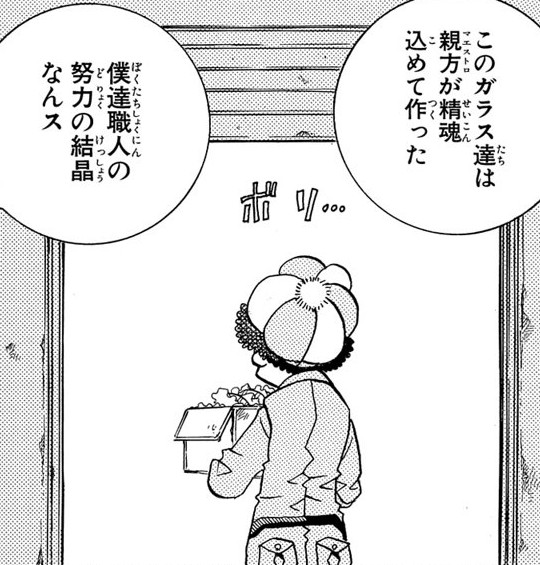
Akari picks up a box containing glassware items for her to transport. One of the employees from the shop making the glassware takes the box from her to place in her gondola. After he does this a second time, Akari says she can help carry the boxes, but he refuses.
- 職人:
- 「このガラス達は親方が精魂込めて作った」
- “These pieces of glass were made with the maestro's heart and soul poured into them.”
- 「僕達職人の努力の結晶なんス」
- “They're the crystallization of our craftsmen's efforts.”
A glassworker won’t let Akari carry the boxes, since the maestro made every piece with all his heart. 精魂込めて is “putting heart and soul into it”.
When the Spellings Overlap
Crowding is where they meet. The guide explains that crowding was traditionally written 込む, from many people or things piling into one spot, and that 混む is now more common because of the link to 混雑. It still accepts 込 there, as its parentheses show, and デジタル大辞泉 lists both spellings under one headword.
So 人込み and 電車が込む aren’t mistakes, just less common. In this site’s manga corpus, 人込み turns up about 20 times, most often in 名探偵コナン. For anything that isn’t crowding, there’s no choice to make: write 込.
2 sources
「混雑する」意では,元々,多くの人や物が重なるように1か所に集まる様子から「込む」と書かれてきたが,現在は,「混雑」という語との関連から「混む」と書く方が一般的である。
In the sense "be crowded", it was originally written 込む, from the image of many people or things gathering in one place as if piled on top of one another. Today, 混む is the more common spelling, because of its link to the word 混雑.
こ・む【込む/混む/▽籠む】
「込」は国字。①は、混雑する意では「混む」と書くことが多い。こむ, written 込む, 混む, or 籠む, the last with a reading off the official list. 込 is a kanji made in Japan. Within sense 1, the crowding meaning is often written 混む.
When こむ Stays in Kana
Kana works for every こむ, and the 2014 guide says its spelling examples don’t rule out writing a word in kana where it suits. Manga use kanji for most of these, but 人ごみ and 人ゴミ, “crowd”, are common. In this site’s manga corpus, they turn up more than half as often as 人混み. The こむ of a compound often stays in kana too, as in 落ちこむ, which turns up about a third as often as 落ち込む.
Check Yourself
Guess the Meaning from the Kanji
Each spelling's kanji points at one sense of こむ. Say what each one means, then open it.
混む
be crowded込む
pile up; be intricate
Pick the Spelling
Each phrase has こむ in kana. Decide which kanji fits, then open it.
電車がこむ
電車が混む. 混む: be crowded.
負けがこむ
負けが込む. 込む: pile up; be intricate.
こみ合う店内
混み合う店内. 混む: be crowded.
手のこんだ料理
手の込んだ料理. 込む: pile up; be intricate.
Spell a Manga Line
Hayato is on a packed train to the amusement park. Which kanji fits こむ?
「連休だからこむよねー」
Show the answer
混む. A train full of holiday crowds is 混雑, so it takes 混. 込む is allowed here too, but 混む is now the usual spelling. “It’s a long holiday, so it’ll be crowded.”
On his first day at a rough new school, Zen can’t believe his eyes. Which kanji fits まよいこんだ?
「異世界にまよいこんだに違いない」
Show the answer
迷い込んだ. After a verb stem, 〜込む takes 込, not 混, and here 迷い込む is “wander into”. “I must have wandered into another world.”
Sanae has just eaten the dumpling meant for Yukari. Which kanji fits おちこんじゃった?
「ミナ、おちこんじゃったじゃない。」
Show the answer
落ち込んじゃった. Sinking into low spirits is 〜込む after 落ちる, with no crowd in sight. “Mina’s gotten all depressed.”
A glassworker explains why the boxes matter so much. Which kanji fits こめて?
「このガラス達は親方が精魂こめて作った」
Show the answer
込めて. 込める, “put into”, has no 混 spelling, and 込 is its standard kanji. “These pieces of glass were made with the maestro’s heart and soul poured into them.”