Early and fast with はやい
はやい has two official spellings. 早い is about time: early in the day, sooner than expected, or not taking long. 速い is about speed: a fast runner, a fast pitch, a fast current. The verbs follow the same split, as in 出発を早める, “move up the departure”, and 足を速める, “quicken your pace”.
A rough test: if the opposite is “late”, write 早, and if it’s “slow”, write 速. A few set words, such as 素早い and 早口, break the rule, and the sections below cover them. Both are official, so they show up in formal writing as well as in manga. Same reading, different kanji explains where the official list comes from.
The Spellings at a Glance
| Spelling | Used for | Standing |
|---|---|---|
| 早い | early, or soon; taking little time | Official |
| 速い | fast, with speed | Official |
Early and Soon with 早い
早い is when something happens. 朝早い is “early in the morning”, 早起き is “getting up early”, and まだ早い is “it’s too soon”. 気が早い, “jumping the gun”, is getting ahead of yourself. It also covers taking only a short time, as in 早変わり, “a quick change”. 早口, “talking fast”, is filed there too, even though its opposite is “slow”. The kanji is the 早 of 早朝, “early morning”.
早い is the more common of the two by far. In this site’s manga corpus, the adverb 早く turns up more than 20 times as often as 速く.
1 source
【早い・早まる・早める】時期や時刻が前である。時間が短い。予定よりも前になる。
時期が早い。早く起きる。気が早い。早変わり。早口。矢継ぎ早。早まった行動。
順番が早まる。出発時間が早まる。開会の時刻を早める。早い, 早まる, 早める: earlier in time. Taking a short time. Ahead of schedule. "The timing is early." "Get up early." "Be hasty." "A quick change." "Talking fast." "In rapid succession." "A rash act." "Your turn comes sooner." "The departure time is moved up." "Move up the opening time."
Example 1 of 2: Megure wants his apple peeled with 皮をむく
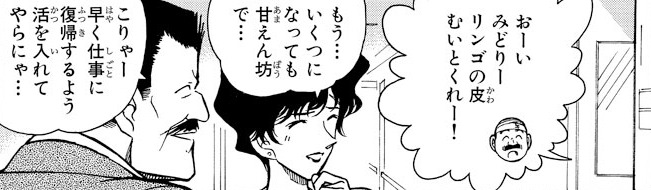
Inspector Megure is in the hospital after an old head wound reopened during a case. Superintendent Matsumoto has just told Kogoro and the others how Megure got the scar twenty years ago. Now Megure’s wife, Midori, has stepped out of his room to greet the visitors.
- 目暮:
- 「おーい みどりー リンゴの皮むいとくれー!」
- “Heeey, Midori! Peel an apple for me!”
- みどり:
- 「もう… いくつになっても甘えん坊で…」
- “Honestly... He's such a baby, no matter how old he gets...”
- 松本:
- 「こりゃー早く仕事に復帰するよう活を入れてやらにゃ…」
- “Looks like I'll have to light a fire under him so he gets back to work soon...”
Megure is in the hospital after an old wound reopened, and Superintendent Matsumoto jokes that he’ll have to light a fire under him so he gets back to work soon. 早く here is “soon”, a point in time.
Example 2 of 2: Leaving the zoo quickly after entering with 〜てから
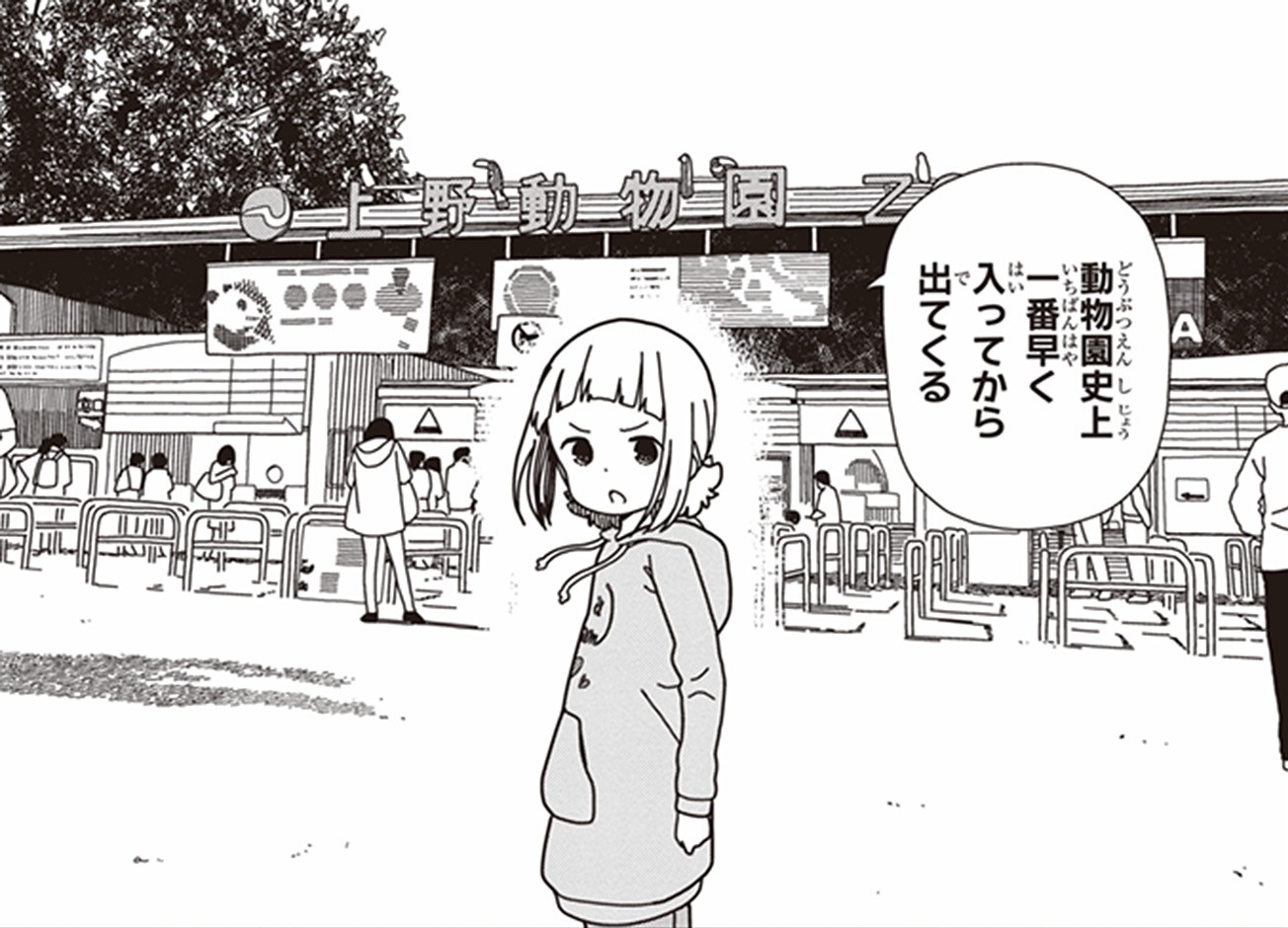
While trying to find something to do, Sacchan and her friends pass by the zoo, which is free for children to enter. Yui asks if Sacchan plans to enter the zoo.
- さっちゃん:
- 「動物園史上一番早く入ってから出てくる」
- “The fastest in zoo history to enter and then leave.”
Sacchan’s plan for the zoo, which is free for kids, is to set the record for the quickest trip in and out. The record is the shortest time spent inside, so it’s 早く, the guide’s “taking a short time”.
Telling Someone to Hurry with 早く
Telling someone to hurry takes 早, since you want it done soon, not at a particular speed. 早く来い is “come here, quick”, 早くしろ is “hurry up”, and いいから早く is “never mind, just hurry”. Kansai speakers say 早う.
Manga almost never use 速 here. In this site’s manga corpus, 早くしろ turns up over 400 times and 早く来い about 170, against a single 速くしろ, which is about the pace of a horse race, and no 速く来い at all.
Example 1 of 4: Making it so you can walk on water with 〜ようにする
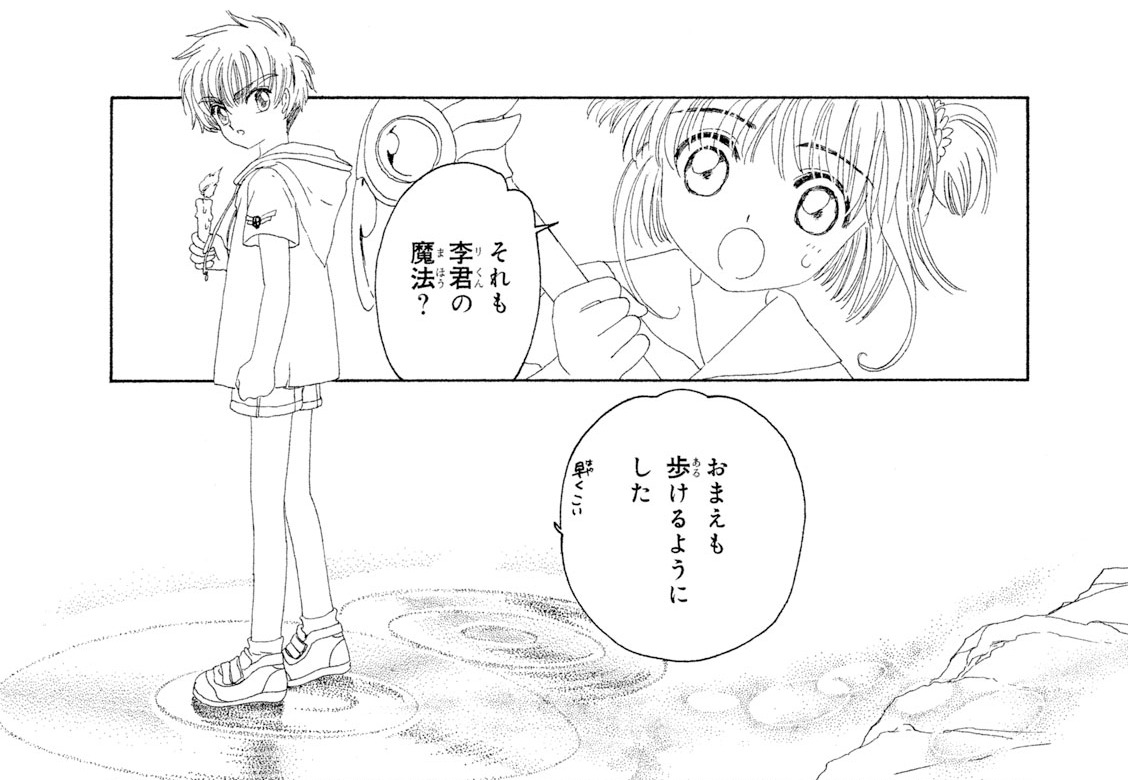
During a test of courage in a cave, Sakura’s classmates vanish one by one. Li senses a Clow Card near the shrine by the spring at the end of the cave, and he lights a candle with fire magic so they can see. The bridge across the water to the shrine has burned. Sakura suggests flying over with the Fly card, but Li says they should approach quietly so the card won’t notice them. He chants a spell, and sparkles swirl around both their feet. Then Li steps out onto the water, and Sakura cries out his name.
- 桜:
- 「それも李君の魔法?」
- “Is that your magic too, Li?”
- 小狼:
- 「おまえも歩けるようにした」
- “I made it so you can walk on it too.”
- 「早くこい」
- “Hurry up and come on.”
Li has used his magic so Sakura can walk across the water to the shrine, and he tells her to hurry and follow. 早くこい is “come on, quick”.
Example 2 of 4: Don't worry, just hurry with いいから
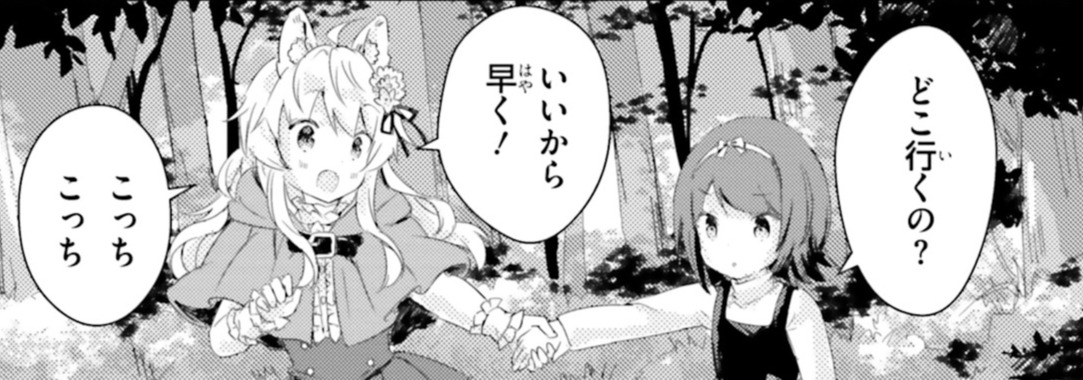
Wolf spends some time with Mia, a young girl who’s run away into the forest. After hearing about the troubles Mia is facing at home, Wolf hears something in the distance. She tells Mia to go with her.
- みあ:
- 「どこ行くの?」
- “Where is it that we're going?”
- オオカミちゃん:
- 「いいから早く!」
- “Don't worry about that, hurry!”
- 「こっちこっち」
- “This way!”
Wolf hears something in the distance and tells Mia to come with her right away. いいから早く is “never mind, just hurry”.
Example 3 of 4: Is something there with いんの
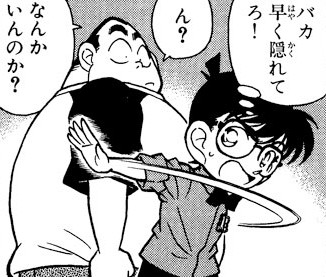
In a game of hide-and-seek, Conan and Ayumi find they’re hiding on the same bench. Their conversation attracts the seeker, Genta, leading him to find Conan. As Ayumi sneaks away unseen, she signals an apology to Conan.
- コナン:
- 「バカ 早く隠れてろ!」
- “Stupid, hurry and hide!”
- 元太:
- 「ん? なんかいんのか?」
- “Mm? Is something there?”
Conan and Ayumi end up hiding on the same bench in a game of hide-and-seek, and Conan tells her to get hidden, fast. 早く隠れてろ is “hurry up and hide”.
Example 4 of 4: Hurry up with 早う
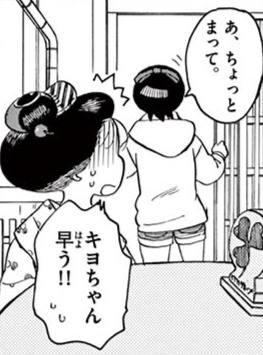
Kenta’s class visits Kyoto, and he takes the opportunity to stop by the place where Sumire and Kiyo are staying. He meets with Sumire, but Kiyo is out. When Sumire hears Kiyo in the kitchen later, she calls a cab for the two to rendezvous with Kenta.
- キヨ:
- 「あ、ちょっとまって。」
- “Ah, wait a moment.”
- すみれ:
- 「キヨちゃん早う!!」
- “Kiyo-chan, hurry up!!”
Sumire has called a cab so she and Kiyo can meet Kenta, and she tells Kiyo to hurry. 早う is the Kansai form of 早く.
Fast with 速い
速い is how fast something moves or progresses. 流れが速い is “the current is fast”, 投手の球が速い is “the pitcher throws hard”, and テンポが速い is “the tempo is fast”. 足を速める is “quicken your pace”. The kanji is the 速 of 速度, “speed”, 時速, “speed in distance per hour”, and 高速, “high-speed”.
Manga lean toward 速 when speed is the point. In this site’s manga corpus, 球が速い never turns up with 早, and 速く走る, counting all its forms, is about five times as common as 早く走る.
1 source
【速い・速まる・速める】スピードがある。速度が上がる。
流れが速い。投手の球が速い。テンポが速い。改革のスピードが速まる。
回転を速める。脈拍が速まる。足を速める。速い, 速まる, 速める: have speed. Speed up. "The current is fast." "The pitcher throws hard." "The tempo is fast." "Reform picks up speed." "Spin faster." "Your pulse quickens." "Quicken your pace."
Example 1 of 2: Riding the current away fast with 速い
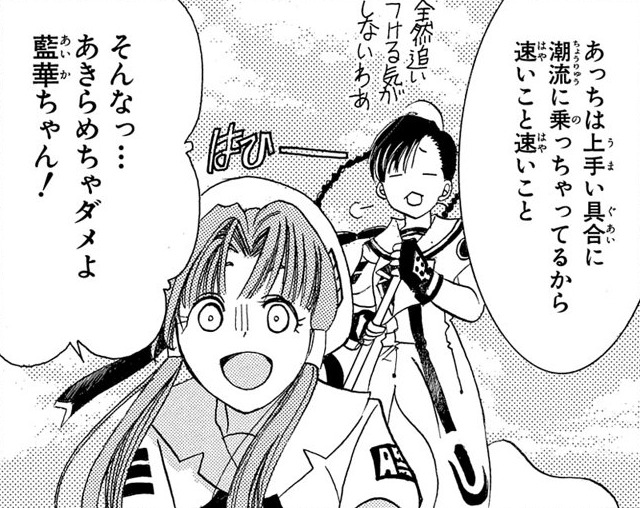
Aika, an apprentice gondolier from the rival company Himeya, has dropped by ARIA Company, where Akari works. President Aria, the company’s cat, starts drifting away alone in a gondola, and Akari jumps into Aika’s gondola and urges her to chase him. Aika rows after him, but at this time of day the tidal currents are tricky.
- 藍華:
- 「あっちは上手い具合に潮流に乗っちゃってるから速いこと速いこと」
- “That one's caught the current just right, so it's fast, really fast.”
- 「全然追いつける気がしないわぁ」
- “I don't feel like we'll ever catch up.”
- 灯里:
- 「そんなっ… あきらめちゃダメよ 藍華ちゃん!」
- “No way... You can't give up, Aika!”
President Aria is drifting off in a gondola, and Aika is rowing after him. The gondola has caught the tidal current, and 速いこと速いこと is how fast it’s pulling away, so it’s 速, like the guide’s 流れが速い.
Example 2 of 2: A fast runner should join a club with 速い
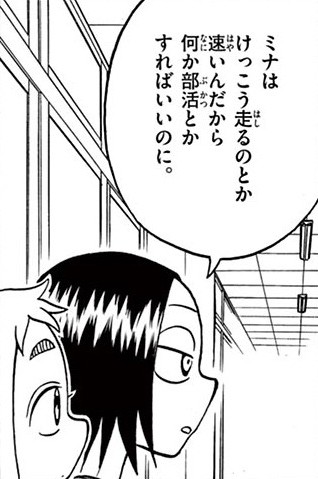
Sanae, who is on the track team, asks Mina and Yukari why they haven’t joined any clubs, and both say they’re fine without one. Sanae asks Mina whether she doesn’t get out of shape. Mina says walking her dog and stopping off places on the way home give her enough exercise.
- サナエ:
- 「ミナはけっこう走るのとか速いんだから 何か部活とかすればいいのに。」
- “Mina, you're pretty fast at running and stuff, so you should join some club or something.”
Sanae, who runs track, thinks Mina should join a club. 走るのとか速い is “fast at running”, how quickly a runner covers ground, so it’s 速. In this site’s manga corpus, 足が速い outnumbers 足が早い about seven to one.
When the Spellings Overlap
The two spellings write one word. デジタル大辞泉 lists them under a single headword, and it files quick action and progress under 速, as in 足が速い, “a fast runner”, and 返事が速い, “quick to reply”.
Manga lean toward 早 for that kind of quickness. In this site’s manga corpus, 足が速い is the usual spelling for a runner, but 仕事が早い, “a fast worker”, 話が早い, “that makes it easy”, and 反応が早い, “quick to react”, all take 早 more often than 速, the first two almost always. The dictionary agrees for some of these. Its sense 4 files “quicker because it’s simpler” under 早, as in 聞くほうが早い, “it’s quicker to ask”, and 手っ取り早い, “quick and easy”, so 話が早い fits that split. 素早い, “nimble”, is about speed and still takes 早 as its standard spelling, and the 常用漢字表 itself lists it under 早.
So 速 holds up best when the speed itself is measured or compared, like a runner or a pitch. Even a current is sometimes written 早. For “quick” in the sense of “without delay” or “without fuss”, 早 is the usual choice.
1 source
はや・い【早い/速い】
1 (速い)物事の進む度合いが大きい。動作・進行などがすみやかである。「足が―・い」「返事が―・い」「流れの―・い川」「のみこみの―・い人」⇔遅い。
2 (早い)ある基準より時間があまり過ぎていない。また、ある基準より時期が前である。「朝―・い電車に乗る」「―・いうちに手を打つ」「卒業が一年―・い」「梅雨入りが―・い」⇔遅い。
4 (早い)簡単である。てっとり早い。「調べるより聞くほうが―・い」「自分でするのがいちばん―・い」はやい, written 早い or 速い. 1. Written 速い: things progress rapidly; an action or a process is quick. "A fast runner." "Quick to reply." "A fast-flowing river." "A quick learner." The opposite is 遅い. 2. Written 早い: not much time has passed since some reference point, or earlier than some reference point. "Take an early-morning train." "Act while there's still time." "Graduate a year early." "The rainy season starts early." The opposite is 遅い. 4. Written 早い: simple; quick and easy. "It's quicker to ask than to look it up." "Doing it yourself is quickest."
When はやい Stays in Kana
Kana works for every はやい, and the 2014 guide says its spelling examples don’t rule out writing a word in kana where it suits. Manga mostly use kanji, though はやく in kana turns up often, and the rough はえー, “so fast” or “already?”, turns up in kana about as often as 早え or 速え.
Check Yourself
Guess the Meaning from the Kanji
Each spelling's kanji points at one sense of はやい. Say what each one means, then open it.
早い
early, or soon; taking little time速い
fast, with speed
Pick the Spelling
Each phrase has はやい in kana. Decide which kanji fits, then open it.
時期がはやい
時期が早い. 早い: early, or soon; taking little time.
流れがはやい
流れが速い. 速い: fast, with speed.
はやく起きる
早く起きる. 早い: early, or soon; taking little time.
投手の球がはやい
投手の球が速い. 速い: fast, with speed.
Spell a Manga Line
Superintendent Matsumoto is visiting Megure in the hospital. Which kanji fits はやく?
「こりゃーはやく仕事に復帰するよう活を入れてやらにゃ…」
Show the answer
早く. Getting back to work soon is about time, not speed, so it’s 早. “Looks like I’ll have to light a fire under him so he gets back to work soon…”
Sacchan has a plan for the zoo, which is free for kids. Which kanji fits はやく?
「動物園史上一番はやく入ってから出てくる」
Show the answer
早く. She’s after the shortest time inside, and taking little time is 早, like the guide’s 早変わり, “a quick change”. “The fastest in zoo history to enter and then leave.”
Li has made the water walkable for Sakura. Which kanji fits はやく?
「はやくこい」
Show the answer
早く. Telling someone to hurry is asking for it soon, so it’s 早. In this site’s manga corpus, 早く来い turns up about 170 times and 速く来い never. “Hurry up and come on.”
Conan and Ayumi are hiding on the same bench. Which kanji fits はやく?
「バカ はやく隠れてろ!」
Show the answer
早く. “Hurry up” takes 早, since Conan wants her hidden right away. “Stupid, hurry and hide!”