Getting off and coming down with おりる
おりる and its partner おろす have three official spellings. 降りる is getting off a vehicle such as a train, or getting down from a high place such as a roof or a tree. 下りる is something moving downward, such as a stage curtain, a lock, or permission from above. 卸す is a wholesaler selling goods to a shop. おりる is intransitive and おろす is transitive: 車を降りる is “get out of the car”, and 車から降ろす is “drop someone off”.
A quick test: 降 is the standard choice for getting off a vehicle, stepping down from a role, or frost settling. In the official guide, a curtain or a lock coming down, or permission coming through, takes 下. For going down stairs or a slope, manga use both 降 and 下. In the official guide, 卸す is only for selling wholesale. All three are official, so they show up in formal writing as well as in manga. Same reading, different kanji explains where the official list comes from.
The Spellings at a Glance
| Spelling | Used for | Standing |
|---|---|---|
| 降りる・降ろす | get off a vehicle; come down from a high place; step down from a role | Official |
| 下りる・下ろす | move from above to below; take down; withdraw money | Official |
| 卸す | sell wholesale to a shop | Official |
Vehicles and High Places with 降りる and 降ろす
降りる is leaving a vehicle, or going from a high place to a low one. 電車を降りる is “get off the train”, 次の駅で降りる is “get off at the next station”, and 飛び降りる is “jump down”. It also covers stepping down from a role, as in 主役を降りる, “drop out of the lead role”, and frost or dew settling, as in 霜が降りる. The kanji is the 降 of 降る, “fall”, as rain and snow do.
Manga strongly favor 降 for vehicles. In this site’s manga corpus, getting out of a car, a bus, or a train takes 降 dozens of times, and 下 only a handful of times. 飛び降りる and 舞い降りる, “flutter down”, lean the same way.
1 source
【降りる・降ろす】乗り物から出る。高い所から低い所へ移る。辞めさせる。
電車を降りる。病院の前で車から降ろす。高所から飛び降りる。月面に降り立つ。
霜が降りる。主役から降ろされる。降りる, 降ろす: leave a vehicle. Move from a high place to a low one. Remove someone from a role. "Get off the train." "Let someone out of the car in front of the hospital." "Jump down from a height." "Land on the moon's surface." "Frost forms." "Be dropped from the lead role."
Example 1 of 2: Stuck up a tree with 〜ていたところを
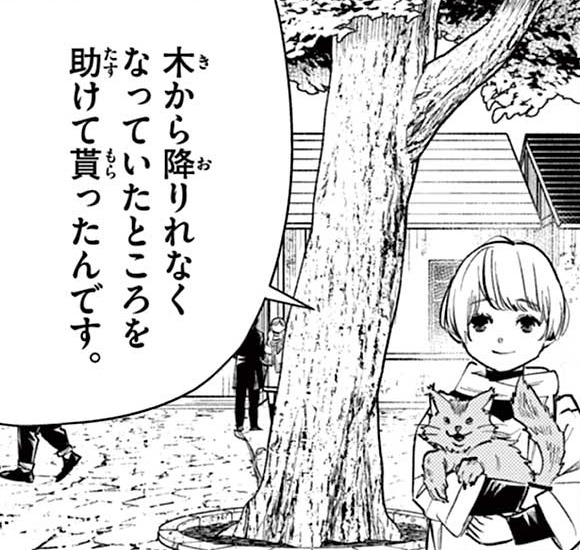
Frieren tells Fern that today is Stark’s eighteenth birthday, and Fern has no idea what he wants for a present. She decides to sound him out directly, but he isn’t in his room. Fern asks around town. A woman says the warrior with the axe helped push her cart, then headed toward the plaza.
- 女の子:
- 「木から降りれなくなっていたところを助けて貰ったんです。」
- “He helped us when we couldn't get down from the tree.”
Fern is asking around town for Stark, and a girl holding a cat says he helped with a rescue from a tree. A tree is a high place to come down from, which fits 降, and the manga writes it that way. 降りれない is a casual potential form of 降りる, with the ら dropped.
Example 2 of 2: According to Nostradamus with 〜によれば
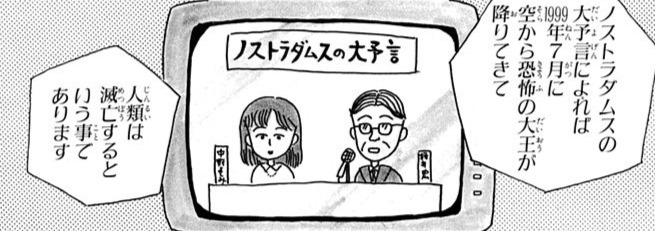
Maruko learns about Nostradamus and his predictions from a classmate. She tells her family about it, leading to them watching a TV show about it that night.
- アナウンサー:
- 「ノストラダムスの大予言によれば1999年7月に空から恐怖の大王が降りてきて」
- “According to Nostradamus's great prophecy, in July 1999 a great king of terror will descend from the sky...”
- 「人類は滅亡するという事であります」
- “...and humanity will perish.”
Maruko’s family watches a TV special on Nostradamus. The announcer says a great king of terror will come down from the sky in July 1999. Coming down from the sky is the guide’s “from a high place to a low one”, so it’s 降りる.
Curtains, Permits, and Lowering with 下りる and 下ろす
下りる is something moving from above to below. 幕が下りる is “the curtain comes down”, and 錠が下りる is “the lock drops into place”. It also covers something handed down from above, as in 許可が下りる, “permission comes through”. 下ろす is lowering or taking down, as in 腰を下ろす, “sit down”, and 荷を下ろす, “unload”.
The guide gives 下ろす three more jobs. One is cutting off, as in 枝を下ろす, “prune a branch”. Another is taking money out, as in 貯金を下ろす, “withdraw savings”. The third is something new, whether just put into use, as in 下ろし立て, or newly written, as in 書き下ろし. Manga volumes print 描き下ろし, “newly drawn”, for pages drawn specially for the volume, and in this site’s manga corpus it turns up hundreds of times.
1 source
【下りる・下ろす】上から下へ動く。切り落とす。引き出す。新しくする。
幕が下りる。肩の荷を下ろす。腰を下ろす。錠が下りる。許可が下りる。枝を下ろす。
貯金を下ろす。下ろし立ての背広。書き下ろしの短編小説。下りる, 下ろす: move from above to below. Cut off. Draw out. Make new. "The curtain falls." "Take a weight off your shoulders." "Sit down." "The lock drops into place." "Permission is granted." "Prune a branch." "Withdraw savings." "A suit you've only just started wearing." "A newly written short story."
Example 1 of 2: Leaving the mountain at the shortest route with 最短
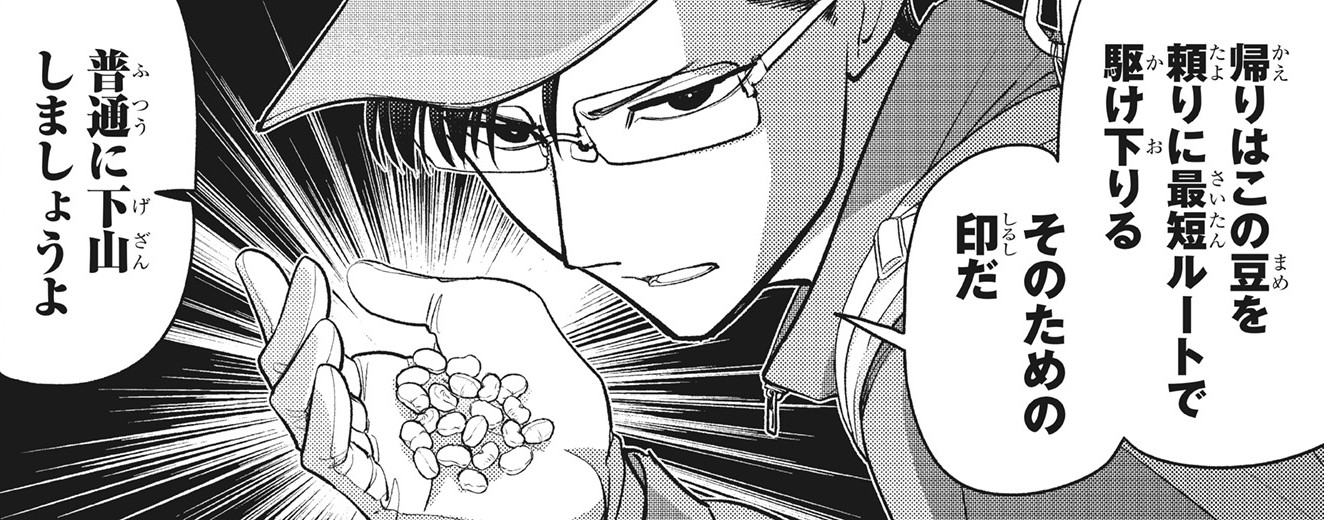
Kumada takes a trip to the mountain, in hope that the bear living in his apartment will follow him there, then he can run away and leave the bear stranded behind. He has with him his employee Sanami, an expert on mountains, to act as a guide. During their hike, Sanami asks Kumada why he’s placing beans on the ground as they go.
- 熊田:
- 「帰りはこの豆を頼りに最短ルートで駆け下りる」
- “On the way back, I'll use these beans as a guide and run down by the shortest route.”
- 「そのための印だ」
- “That's what the markers are for.”
- 砂波:
- 「普通に下山しましょうよ」
- “Let's just go down the mountain normally.”
Kumada hopes to leave the bear that lives in his apartment stranded on the mountain, so he’s dropping beans along the trail to find the shortest way back down. Going down a slope is movement from above to below, which fits 下, and the manga writes 駆け下りる.
Example 2 of 2: A grater on the shelf with すり下ろす
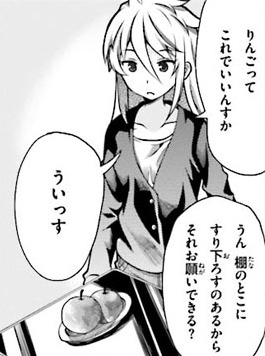
Renge is home in bed with a cold, and Kaede from the candy shop has dropped by with snacks, though she claims she only came to deliver a pillow. Renge’s older sister Kazuho heads off to make dinner and promises Renge some grated apple. Kaede offers to help, and the two go to the kitchen.
- 楓:
- 「りんごってこれでいいんすか」
- “Are these the apples you want?”
- 一穂:
- 「うん 棚のとこにすり下ろすのあるから それお願いできる?」
- “Yeah. There's a grater over by the shelf, so could you do that for me?”
- 楓:
- 「ういっす」
- “You got it.”
Renge is in bed with a cold, and Kazuho has promised her grated apple. Kazuho asks Kaede to do the grating with the grater over by the shelf. すり下ろす is “grate”, rubbing food down against a grater.
Selling Wholesale with 卸す
卸す is a producer or a wholesaler selling goods to a shop. 小売りに卸す is “sell to retailers”, 卸値 is “the wholesale price”, and 棚卸し is “taking stock”. It’s the narrowest of the three. Manga use it when a character supplies goods to a shop, and in market words like 卸売市場, “wholesale market”.
1 source
【卸す】問屋が小売店に売り渡す。
小売りに卸す。定価の6掛けで卸す。卸売物価指数。卸問屋を営む。卸値。卸す: a wholesaler sells to a retail shop. "Sell to retailers." "Sell wholesale at 60 percent of list price." "The wholesale price index." "Run a wholesale business." "The wholesale price."
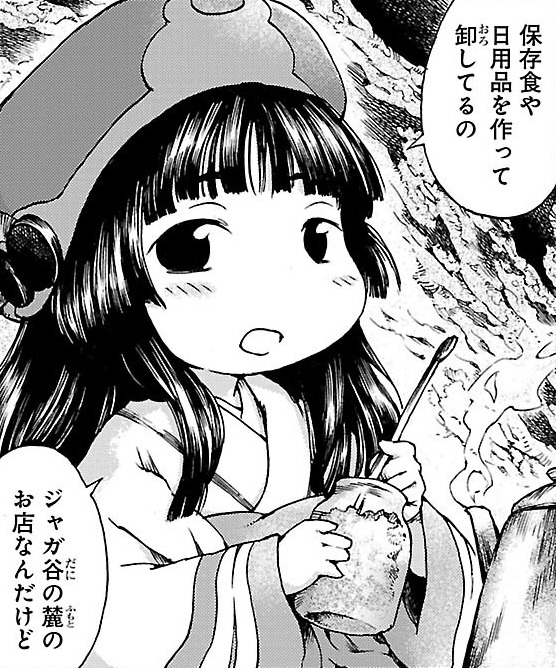
Konju visits Hakumei and Mikochi’s new house with a housewarming gift of herbal tea. She finds Mikochi in a basement packed with jars and bundles, and asks why she’s gone out of her way to clutter the place up. Mikochi tells her it’s for work.
- ミコチ:
- 「保存食や日用品を作って卸してるの」
- “I make preserved food and household goods and sell them to a shop.”
- 「ジャガ谷の麓のお店なんだけど」
- “It's a shop at the foot of Jaga Valley.”
Konju has come to see Hakumei and Mikochi’s new house and asks why Mikochi’s basement is so cluttered. Mikochi makes preserved food and household goods and sells them to a shop at the foot of Jaga Valley. A maker supplying a shop is selling wholesale, so it’s 卸す.
When the Spellings Overlap
降りる and 下りる write one word. デジタル大辞泉 lists them under a single headword and marks only a few senses, such as permission for 下りる and frost and dew for 降りる. Its first sense, going from a high place to a lower one, gives 山をおりる and 木からおりる with no spelling at all.
Stairs and slopes are where manga split. The guide’s 降 is going from a high place to a low one and its 下 is moving from above to below. A staircase fits both. In this site’s manga corpus, 階段を下りる and 階段を降りる come up in similar numbers, with 下 slightly ahead, and so do 山を下りる and 山を降りる. Getting down from a tree leans toward 降: forms of 木から降りる, “get down from a tree”, turn up 12 times and 木から下りる once.
A vehicle usually takes 降. For permission, 下 is the usual kanji. Curtains are looser: the guide writes 幕が下りる, but manga use 幕が降りる too, and 幕を下ろす turns up about three times as often as 幕を降ろす.
1 source
お・りる【下りる/降りる】
1 高い所から低い方へと移って、ある位置・場所に着く。上から下へ移動する。「山を―・りる」「木から―・りる」⇔あがる。
6 (下りる)官公庁などから、支給・下付される。「認可が―・りる」「年金が―・りる」
8 (降りる)霧や霜などが地上・空中などに生じる。「露が―・りる」
[用法]おりる・くだる――高い所から低い所へ位置を移す、位置をかえるの意で共通性があるが、「おりる」は「階段を(から)おりてください」「一階におりる」など、下への場所の移動を表すほか、「電車をおりる」「役員をおりる」など、ある物事から離れる意味でも使われる。おりる, written 下りる or 降りる. 1. Move from a high place to a lower one and arrive somewhere. Move from above to below. "Go down a mountain." "Get down from a tree." The opposite is あがる. 6. Written 下りる: be granted or issued by a government office and so on. "Approval comes through." "A pension is paid out." 8. Written 降りる: mist, frost, and so on form on the ground or in the air. "Dew forms." Usage, おりる and くだる: both share the sense of moving from a high place to a low one, but おりる expresses moving to a lower place, as in "please go down the stairs" and "go down to the first floor", and it's also used for leaving something, as in "get off the train" and "step down as a director."
When おりる Stays in Kana
Kana works for every おりる and おろす, and the 2014 guide says its spelling examples don’t rule out writing a word in kana where it suits. Food words usually stay in kana, and so does 腰をおろす, “sit down”, more often than not. In this site’s manga corpus, 大根おろし, “grated daikon”, is in kana nearly every time, and 三枚におろす, “fillet a fish”, usually is too.
Check Yourself
Guess the Meaning from the Kanji
Each spelling's kanji points at one sense of おりる・おろす. Say what each one means, then open it.
降りる・降ろす
get off a vehicle; come down from a high place; step down from a role下りる・下ろす
move from above to below; take down; withdraw moneyMore about 下卸す
sell wholesale to a shop
Pick the Spelling
Each phrase has おりる・おろす in kana. Decide which kanji fits, then open it.
電車をおりる
電車を降りる. 降りる・降ろす: get off a vehicle; come down from a high place; step down from a role.
幕がおりる
幕が下りる. 下りる・下ろす: move from above to below; take down; withdraw money. More about 下
小売りにおろす
小売りに卸す. 卸す: sell wholesale to a shop.
車からおろす
車から降ろす. 降りる・降ろす: get off a vehicle; come down from a high place; step down from a role.
肩の荷をおろす
肩の荷を下ろす. 下りる・下ろす: move from above to below; take down; withdraw money. More about 下
Spell a Manga Line
A girl holding a cat tells Fern how Stark helped. Which kanji does the manga use for おりれなくなっていた?
「木からおりれなくなっていたところを助けて貰ったんです。」
Show the answer
降りれなくなっていた. A tree is a high place to get down from, which fits 降, and manga agree: in this site’s manga corpus, forms of 木から降りる turn up 12 times and 木から下りる once. “He helped us when we couldn’t get down from the tree.”
The TV announcer is describing Nostradamus’s prophecy. Which kanji fits おりてきて?
「1999年7月に空から恐怖の大王がおりてきて」
Show the answer
降りてきて. Coming down from the sky is going from a high place to a low one, so it’s 降, the same kanji as 降る for rain and snow. “In July 1999, a great king of terror will descend from the sky…”
Kumada has a plan for getting off the mountain. Which kanji does the manga use for かけおりる?
「帰りはこの豆を頼りに最短ルートでかけおりる」
Show the answer
駆け下りる. Running down a slope is movement from above to below, so 下 fits, though manga write 山を降りる almost as often as 山を下りる. “On the way back, I’ll use these beans as a guide and run down by the shortest route.”
Kazuho asks Kaede to grate an apple for Renge. Which kanji does the manga use for すりおろす?
「うん 棚のとこにすりおろすのあるから それお願いできる?」
Show the answer
すり下ろす, rubbing food down against a grater. Some dictionaries allow 卸 for grating too, but the official guide keeps 卸 for wholesale. Food words like this usually stay in kana, as in 大根おろし. “Yeah. There’s a grater over by the shelf, so could you do that for me?”