Honorifics
Honorifics follow a person’s name and signal familiarity and status. Speakers choose them based on their relationship with the addressee.
This page focuses on manga usage. Real-life usage can differ.
さん: The Polite Default
さん addresses adults, strangers, and acquaintances. Add it to surnames in formal or distant relationships and to given names among friends.
名探偵コナン »
Volume 18 » Page 96
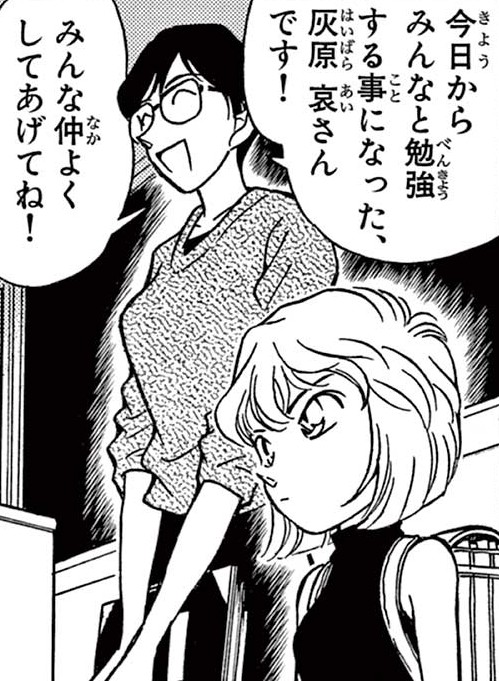
A new student joins Conan’s elementary school classroom. The teacher introduces her.
先生( せんせい ) :「今日( きょう ) からみんなと勉強( べんきょう ) する事( こと ) になった、灰原( はいばら ) 哀( あい ) さん です!」
“This is Ai Haibara. It came to be that she'll be studying with us starting today.”
「みんな仲良( なかよ ) くしてあげてね!」
“Everyone be friendly with her!”
Challenge Yourself
Show translation
Challenge
What new arrangement does the teacher announce?
Clues
今日( きょう ) からstarting today
みんなと勉強( べんきょう ) する事( こと ) になった
it has been arranged that she will study with everyone
What does the speaker mean?
Haibara will join the class starting today.
The teacher introduces Haibara as someone who will study with everyone from today.
Haibara will teach the class for one day.
She will 勉強( べんきょう ) する with everyone, not teach them.
The whole class will transfer to another school.
The new arrangement concerns Haibara joining this group.
Everyone must study alone starting today.
みんなと means together with everyone.
Haibara has finished studying with the class.
今日( きょう ) から marks the beginning, not the end, of the arrangement.
The students may decide whether Haibara can enter.
〜ことになった presents the placement as already decided.
The teacher announces that Ai Haibara will begin studying with the class that day. 〜ことになった presents this as an established arrangement.
View Full Example
さん also attaches to occupations and businesses, as in 店員( てんいん ) さん for a shop clerk, 運転手( うんてんしゅ ) さん for a driver, or 本屋( ほんや ) さん for a bookstore.
ふらいんぐうぃっち »
Volume 1 » Page 21
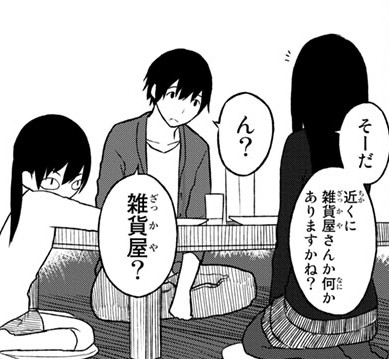
Having just settled in at her relative’s house where she will be living, Makoto has a meal with her cousins.
真琴( まこと ) :「そーだ。近( ちか ) くに雑貨屋( ざっかや ) さん か何( なに ) かありますかね?」
“Oh yeah, is there a general store or something nearby?”
圭( けい ) :「ん? 雑貨屋( ざっかや )
“Hm? A general store?”
Challenge Yourself
Show translation
Challenge
What kind of place is Makoto asking about?
Clues
近( ちか ) くにsomewhere nearby
雑貨屋( ざっかや ) さんか何( なに ) かa general store or another similar kind of shop
What does the speaker mean?
A nearby general store or something similar.
雑貨屋( ざっかや ) さん names the type of shop, and か何( なに ) か leaves room for a similar place.
The exact location of the nearest supermarket.
Makoto gives a broad category with か何( なに ) か rather than asking for one exact supermarket.
A place where she can get a job nearby.
The question asks whether a type of shop exists nearby. It does not mention employment.
A relative's house close to the station.
雑貨屋( ざっかや ) is a general store, not a home, and no station appears in the question.
A particular store that Kei recommended earlier.
Makoto introduces the question herself and uses か何( なに ) か because the exact type does not matter.
Any restaurant that serves dinner.
The example category is a general store. Makoto does not ask about food or restaurants.
Makoto wants to know whether there is a general store, or some similar shop, nearby. か何( なに ) か keeps the request flexible instead of requiring that exact type of store.
View Full Example
In Kansai speech, はん can take the place of さん. A name followed by はん marks the character’s dialect as well as the relationship.
ちゃん: Affectionate and Cute
ちゃん shows affection and familiarity. It’s used for children, friends, family members such as お母( かあ ) ちゃん, and pets. It can follow the name of an adult or a male character when the speaker feels close to him. It’s never used for strangers, so ちゃん between characters signals an established closeness.
カードキャプターさくら »
Volume 1 » Page 131
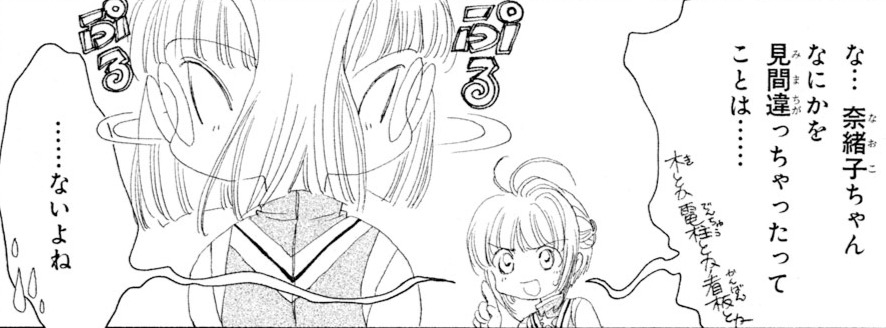
After piano class, Naoko hurries home only to see a ghostly figure appear from within a lake at the park. She recalls the events to her friends at school.
桜( さくら ) :「な…奈緒子( なおこ ) ちゃん なにかを見( み ) 間( ま ) 違( ちが ) っちゃったってことは…… (木( き ) とか電柱( でんちゅう ) とか看板( かんばん ) とか)」
“Na... Naoko, could it be that you ended up seeing something wrong...... (like a tree or a utility pole sign or something)?”
「……ないよね」
“......I guess not.”
Challenge Yourself
Show translation
Challenge
What possibility does Sakura hesitantly suggest?
Clues
なにかを見( み ) 間( ま ) 違( ちが ) っちゃった
Naoko accidentally mistook something she saw
木( き ) とか電柱( でんちゅう ) とか看板( かんばん ) とかexamples of ordinary objects such as a tree, utility pole, or sign
ってことは……ないよね
could it be that, followed by Sakura backing away from the suggestion
What does the speaker mean?
Naoko may have mistaken an ordinary object for the ghostly figure.
見( み ) 間( ま ) 違( ちが ) っちゃった suggests an accidental misidentification, and Sakura lists ordinary objects Naoko might have seen.
Naoko may have seen the ghost turn into a tree.
The tree is one possible object Naoko mistook for the figure. Sakura does not say the figure transformed.
Naoko may have invented the story to frighten her friends.
Sakura wonders whether Naoko misidentified what she saw, not whether she deliberately lied.
Naoko may have gone to the wrong park after class.
見( み ) 間( ま ) 違( ちが ) う concerns seeing something incorrectly. It does not mean choosing the wrong location.
Naoko may have read a warning on a sign incorrectly.
看板( かんばん ) is listed as an object she might have mistaken for the figure, not as text she misread.
Naoko may have confused Sakura with someone near the lake.
Sakura proposes a tree, utility pole, or sign as the mistaken object. She does not place herself at the lake.
Sakura wonders whether Naoko accidentally mistook an ordinary object for the ghostly figure. Her examples make the suggestion concrete, but ……ないよね shows that she doubts her own explanation.
View Full Example
A young character, typically a girl, may refer to herself in the third person with ちゃん attached to her own name. This comes across as childlike.
君: Familiar, Toward Males
君( くん )
名探偵コナン »
Volume 1 » Page 65
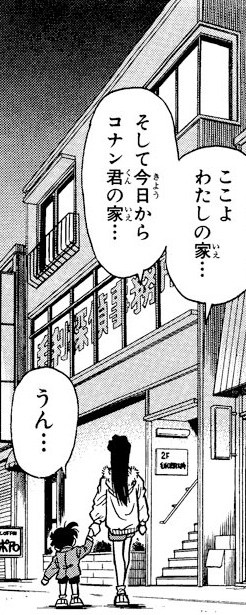
Professor Agasa convinces Ran to take Conan in to stay with her and her father.
蘭( らん ) :「ここよ わたしの家( いえ ) … そして今日( きょう ) からコナン 君( くん ) 家( いえ ) …」
“It's here. My home... And starting today, your home...”
Challenge Yourself
Show translation
Challenge
What does Ran tell Conan about the house?
Clues
わたしの家( いえ )
my home
今日( きょう ) からコナン君( くん ) の家( いえ ) starting today, Conan's home
What does the speaker mean?
Her home will also be Conan's home starting today.
そして今日( きょう ) から links Ran's home to Conan's new living arrangement.
Conan must leave her home today.
今日( きょう ) から marks the start of his living there, not his departure.
She is taking Conan to Agasa's house.
Ran identifies the place as わたしの家( いえ ) , her own home.
The house belongs only to Conan now.
She first calls it her home, then includes Conan in it.
Conan has mistaken the building for his school.
The line introduces a home, not a school.
Ran will visit Conan's home tomorrow.
She is telling him that the home in front of them becomes his from today.
Ran points out her home and tells Conan that it will be his home too starting that day. わたしの marks her relationship to the house before she extends it to him.
View Full Example
君( くん ) isn’t limited to males. A male teacher may address female students with 君( くん ) , and a character may use it for a close friend of any gender. When used toward a girl or woman, it reads as more respectful than ちゃん. A female character may also use 君( くん ) for a male character she has known a long time or feels attached to.
名探偵コナン »
Volume 18 » Page 150
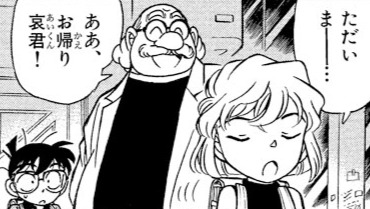
The Detective Boys get caught up in a counterfeit money case, taking their new classmate, Ai Haibara, along. After the case is resolved, Conan walks Haibara home, only to discover she’s staying with his neighbor.
灰原( はいばら ) :「ただいまーーー…」
“I'm home...”
阿笠( あがさ ) :「ああ、お帰( かえ ) り哀( あい ) 君( くん )
“Oh, welcome back, Ai.”
Challenge Yourself
Show translation
Challenge
How does Agasa address Ai when welcoming her home?
Clues
お帰( かえ ) り
welcome home
哀( あい ) 君( くん ) Ai-kun
What does the speaker mean?
He calls her Ai-kun.
Agasa places 君( くん ) directly after Ai's given name.
He calls her Haibara-sensei.
The form used is her given name followed by 君( くん ) , not a professional title.
He avoids using any name or honorific.
The greeting explicitly includes 哀( あい ) 君( くん ) .
He calls her his older sister.
君( くん ) is an honorific here, not a family relationship.
He addresses her as Ai-sama.
The suffix in the line is 君( くん ) , not 様( さま ) .
He calls her Conan-kun by mistake.
Agasa correctly addresses the person returning as Ai.
Agasa welcomes Ai home with お帰( かえ ) り and addresses her as 哀( あい ) 君( くん ) . This shows that 君( くん ) can follow a girl’s name as well.
View Full Example
The hiragana spelling くん is more common than 君. You’ll also see クン.
アオハライド »
Volume 1 » Page 88
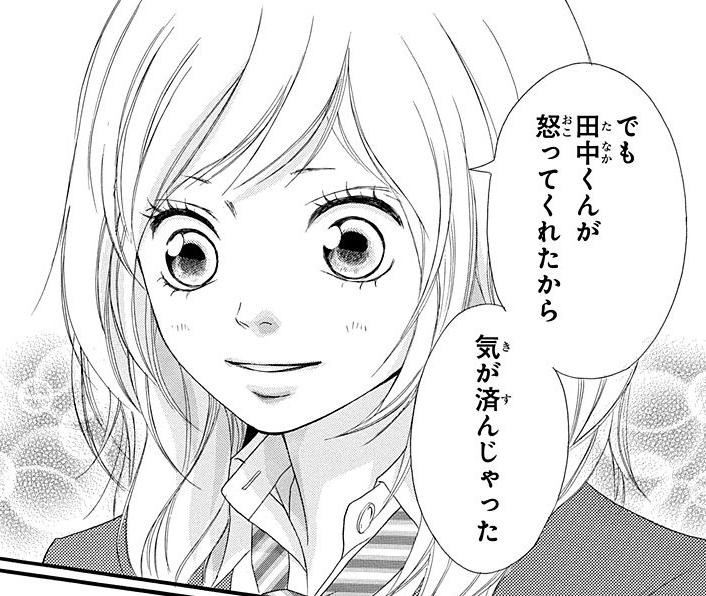
Futaba is falsely accused of stealing by a lunch lady, but Tanaka steps in and vindicates her. Soon after, Futaba thanks Tanaka, saying that when she was accused, she was so angry she didn’t know what to do.
双葉( ふたば ) :「でも田中( たなか ) くん が怒( おこ ) ってくれたから気( き ) が済( す ) んじゃった」
“But since you scolded her for me, I felt better.”
Challenge Yourself
Show translation
Challenge
Why does Futaba say that she feels better?
Clues
田中( たなか ) くんが怒( おこ ) ってくれたからbecause Tanaka got angry on her behalf
気( き ) が済( す ) んじゃったher frustrated feelings ended up settling down
What does the speaker mean?
Tanaka stood up for her by scolding the person who accused her.
怒( おこ ) ってくれた says Tanaka got angry as a kindness to Futaba, and から gives that as the reason her feelings settled.
Tanaka apologized to her for making the accusation.
Tanaka defended Futaba. The line does not say that he accused her or apologized.
She was able to scold Tanaka herself.
Tanaka is the subject marked by が, and くれた shows that his action benefited Futaba.
The lunch lady admitted the mistake before Tanaka spoke.
Futaba credits Tanaka getting angry for her relief. She does not mention an earlier admission.
She decided that being accused no longer mattered.
Her anger settles because Tanaka takes her side, not because she dismisses the accusation.
Tanaka explained why the lunch lady was angry with him.
怒( おこ ) ってくれた describes Tanaka becoming angry on Futaba's behalf. It does not describe someone being angry with him.
Tanaka speaks up for Futaba when she cannot settle her own anger. His intervention gives her the sense that the wrong has been answered, so her frustration subsides.
View Full Example
様: Elevated Respect
In speech, 様( さま ) (or さま) shows strong deference or reverence. Speakers who use it sarcastically or for themselves, as in 俺様( おれさま ) , project arrogance.
ポケットモンスタースペシャル »
Volume 3 » Page 68
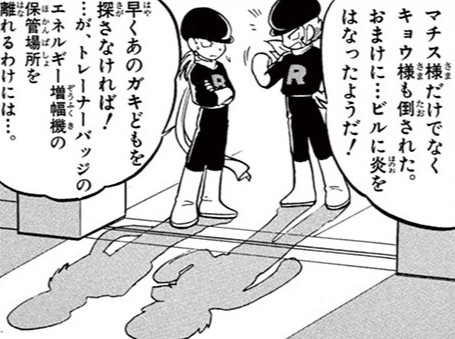
After infiltrating a Team Rocket hideout, Red, Green, and Blue take on the various Gym Leaders inside, including Machisu, Natsume, and Kyou. A couple of Team Rocket grunts discuss the fallout.
したっぱ 1:
「マチス 様( さま ) 様( さま ) 倒( たお ) された。 おまけに…ビルに炎( ほのお ) をはなったようだ!」
“Not only Master Machisu, but Master Kyou was defeated too. On top of that... it looks like they set fire to the building!”
したっぱ 2:
「早( はや ) くあのガキどもを探( さが ) さなければ! …が、トレーナーバッジのエネルギー増幅器( ぞうふくき ) の保管( ほかん ) 場所( ばしょ ) を離( はな ) れるわけには…。」
“We have to find those brats quickly! ...But we cannot leave the place where the Trainer Badge energy amplifier is being stored...”
Challenge Yourself
Show translation
Challenge
What bad news does the first Team Rocket grunt report?
Clues
マチス様( さま ) だけでなくキョウ様( さま ) も倒( たお ) された
not only Machisu but Kyou too was defeated
おまけに
on top of that, adding further bad news
ビルに炎( ほのお ) をはなったようだ
it appears the intruders set fire to the building
What does the speaker mean?
Machisu and Kyou were defeated, and the building was apparently set on fire.
だけでなく〜も includes both leaders among those defeated, and おまけに adds the apparent fire as another problem.
Machisu escaped, but Kyou was defeated in the fire.
Both Machisu and Kyou are linked to 倒( たお ) された. The fire is additional news about the building.
Only Machisu was defeated before the intruders left.
キョウ様( さま ) も explicitly adds Kyou to the defeated leaders.
The intruders stole the energy amplifier and burned its storage room.
The second grunt says they are still guarding the amplifier's storage place. The report only says that fire was set in the building.
Kyou defeated the intruders after Machisu was injured.
倒( たお ) された is receptive, so Machisu and Kyou are the ones who were defeated.
Both leaders ordered the grunts to set fire to the building.
The grunt attributes the fire to the intruders discussed in the scene, not to the defeated leaders.
The grunt reports that the intruders defeated both Machisu and Kyou and apparently started a fire in the building. だけでなく〜も joins the two defeated leaders, while おまけに piles on the fire as further bad news.
View Full Example
Businesses use 様( さま ) 客様( きゃくさま ) .
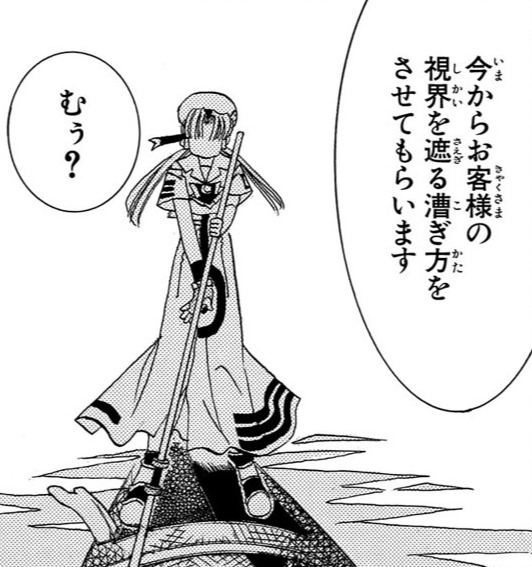
ARIA The MASTERPIECE »
Volume 1 » Page 213
Akatsuki asks Akari for a gondola ride to his destination. Along the way, he asks whether he’ll make his deadline. Akari suggests Alicia should take over, but Akatsuki says he’s Akari’s customer (and paying the cheaper fare). Realizing her responsibility, Akari turns the gondola around so she can use her high-speed backward rowing. Alicia apologizes to Akatsuki for the turnaround.
アリシア:
「今( いま ) からお客様( きゃくさま ) 視界( しかい ) を遮( さえぎ ) る漕( こ ) ぎ方( かた ) をさせてもらいます」
“From now on, she'll be using a rowing technique that blocks your view.”
暁( あかつき ) :「むぅ?」
“Mm?”
Challenge Yourself
Show translation
Challenge
What is Alicia announcing?
Clues
今から
starting now, from here on
遮( さえぎ ) る漕( こ ) ぎ方( かた ) a rowing method that blocks something
させてもらいます
politely receive permission to do it
What does the speaker mean?
Akari is about to row in a way that blocks his view.
今( いま ) から sets the start, and 遮( さえぎ ) る漕( こ ) ぎ方( かた ) is the technique that blocks the customer's view. させてもらいます frames it as permission received.
She is giving Akatsuki permission to row the gondola.
させてもらう is permission received, not granted. Alicia's side is the one doing the rowing, and the customer is the one whose allowance is implied.
She is complaining that something is blocking her own view.
The 視界( しかい ) in the line belongs to お客様( きゃくさま ) , the customer. It is his view that the technique blocks.
She is ending the ride because he will miss his deadline.
The deadline came up earlier in the conversation. This line only announces the rowing technique, and 今から points to a change in how Akari rows, not a stop.
She wants him to close his eyes and rest.
Nothing in the line mentions closing his eyes. The 視界( しかい ) gets blocked by the rowing position itself, not by a request to him.
Alicia politely announces that, starting now, Akari will row in a way that blocks the customer’s view, framed as receiving permission to use that technique.
View Full Example
It’s also used for deities, as in 神様( かみさま ) .
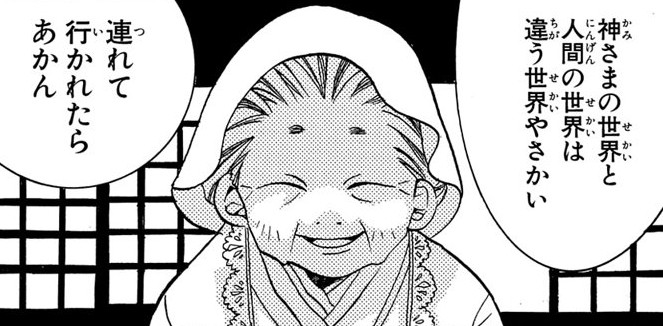
ARIA The MASTERPIECE »
Volume 2 » Page 129
Alicia and Akari visit an island that’s modeled after part of Japan back on Earth. There, an elderly local woman tells the two of the fox spirits that visit the human world there. Akari is excited at the prospect of meeting one, but the old woman gives her a warning: on rare occasion, a fox will take a person back home with them.
おばあさん:
「神( かみ ) さま の世界( せかい ) と人間( にんげん ) の世界( せかい ) は違( ちが ) うやさかい」
“Since the god world and the human world are different...”
「連( つ ) れて行( い ) かれたらあかん」
“...it is bad to follow along.”
View Full Example
先生: Honorific Title for Experts
先生( せんせい )
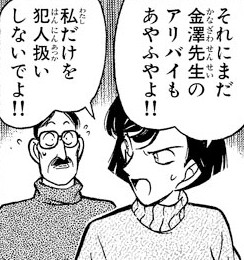
名探偵コナン »
Volume 11 » Page 10
In a snow-covered mountain villa, a room full of suspects listen as Detective Mouri explains how their host was murdered. The accused notes she has a receipt showing she was at the convenience store at the bottom of the mountain when the murder took place.
中原( なかはら ) :「それにまだ金澤( かなざわ ) 先生( せんせい )
“Moreover, Mr. Kanazawa's alibi is also vague!”
「私( わたし ) だけを犯人( はんにん ) 扱( あつか ) いしないでよ!!」
“Don't treat only me as the suspect!”
Challenge Yourself
Show translation
Challenge
What is Nakahara protesting?
Clues
私( わたし ) だけをonly me
犯人( はんにん ) 扱( あつか ) いしないでよdo not treat me as the culprit
What does the speaker mean?
She is being singled out as the culprit.
私( わたし ) だけ and 犯人( はんにん ) 扱( あつか ) い identify her complaint directly.
Nobody has checked her alibi yet.
She presents her own evidence and complains about being singled out, not ignored.
Kanazawa has already been cleared.
She says Kanazawa's alibi is still vague, so he has not been cleared.
Everyone is being treated as equally suspicious.
だけ shows that she feels the suspicion is falling only on her.
She wants to confess without the others present.
しないで is a request to stop treating her as guilty, not an attempt to confess.
She objects to being called a witness.
The role named in the line is 犯人( はんにん ) , the culprit.
Nakahara objects to being treated as the only culprit. She points to another uncertain alibi to argue that the suspicion should not fall solely on her.
View Full Example
先生 can replace a name.
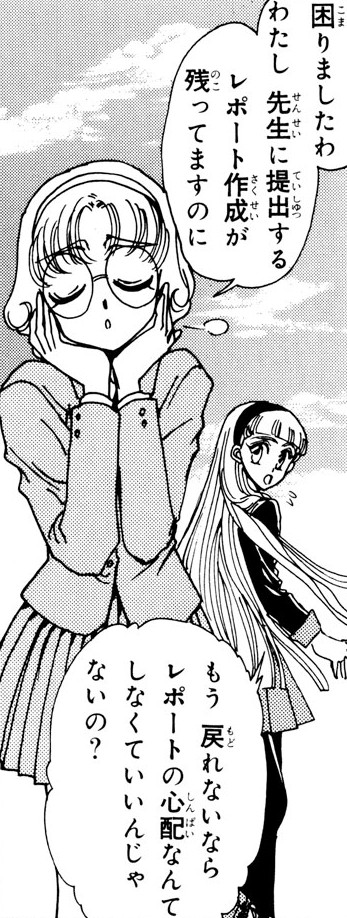
魔法騎士レイアース »
Volume 1 » Page 47
Fuu finds herself spirited away to another world, along with two other girls. A wizard appears before them, saying they cannot return home until they accomplish a specific goal.
風( ふう ) :「困( こま ) りましたわ。 わたし 先生( せんせい ) 提出( ていしゅつ ) するレポート作成( さくせい ) が残( のこ ) ってますのに」
“Oh dear. I've still got to write that report to hand in to the teacher...”
海( うみ ) :「もう 戻( もど ) れないならレポートの心配( しんぱい ) なんてしなくていいんじゃないの?」
“If we can't go back anyway, isn't there no point worrying about the report?”
Challenge Yourself
Show translation
Challenge
Why does Umi say Fuu does not need to worry about her unfinished report?
Clues
先生( せんせい ) に提出( ていしゅつ ) するレポート作成( さくせい ) が残( のこ ) ってますのにFuu still has a report to finish and submit to her teacher
もう戻( もど ) れないなら
Umi treats being unable to return home as the condition
What does the speaker mean?
If they cannot return home, Fuu cannot submit it to her teacher.
戻れないなら sets up the possibility that they cannot go home. The report is meant for Fuu's teacher, so she would have no way to submit it.
The wizard has agreed to finish the report for Fuu.
Umi does not mention the wizard doing the work. Her point depends on whether they can return home.
Fuu's teacher has canceled the assignment.
Fuu says the report remains unfinished. Nothing in either line says the teacher canceled it.
作成 shows that Fuu has already completed the report.
作成が残ってます means the work of preparing the report still remains. It is not complete.
Umi plans to return alone and submit the report for Fuu.
戻れない refers to their inability to go back. Umi does not offer to deliver the report herself.
The report matters only if Fuu becomes a mage.
Umi links the report to returning home, not to whether Fuu becomes a mage.
Fuu is worried because she still has to finish a report for her teacher. Umi reasons that if they cannot return home, Fuu cannot submit it anyway, so worrying about it serves no purpose.
View Full Example
先輩: Honorific Title for Seniors
先輩( せんぱい )
ああっ女神さまっ »
Volume 2 » Page 75
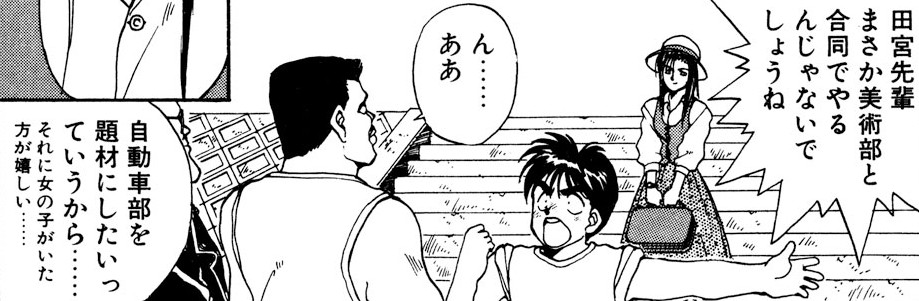
Kei’ichi is excited to spend four days at the beach with his university automobile club and Belldandy. His mood changes when he hears Sayoko call out to him.
螢一( けいいち ) :「田宮( たみや ) 先輩( せんぱい ) 美術部( びじゅつぶ ) と合同( ごうどう ) でやるんじゃないでしょうね」
“Tamiya, don't tell me we're doing this with the art club!”
田宮( たみや ) :「ん……ああ。自動車部( じどうしゃぶ ) を題材( だいざい ) にしたいっていうから…… それに女( おんな ) の子( こ ) がいた方( ほう ) が嬉( うれ ) しい…」
“It's because they said they wanted to use the automobile club as a subject... Additionally, I'm happier having girls here.”
Challenge Yourself
Show translation
Challenge
What reason does Tamiya add for welcoming the joint trip?
Clues
それに
besides that, in addition
女( おんな ) の子( こ ) がいたgirls were there
〜方( ほう ) が
the option that is preferable
嬉( うれ ) しいhappy or pleased
What does the speaker mean?
He would be happier if girls were there too.
それに adds Tamiya's personal reason, and 女( おんな ) の子( こ ) がいた方( ほう ) が嬉( うれ ) しい says he would prefer having girls there.
He thinks the art club would be happier without the automobile club.
The line does not say the art club wants to be separate. Tamiya says that he would welcome having girls present.
He wants the girls to use the automobile club as their art subject.
That belongs to the earlier reason given by the art club. それに introduces Tamiya's separate reason for liking the plan.
He is relieved that the two clubs canceled their joint trip.
合同( ごうどう ) でやる describes doing the trip jointly. Nothing in the exchange says it has been canceled.
He tells Kei'ichi to be happy that Sayoko called out.
嬉( うれ ) しい describes Tamiya's reaction to having girls along, not an instruction to Kei'ichi.
He would rather replace the automobile club members with girls.
女( おんな ) の子( こ ) がいた方( ほう ) が compares having girls present with not having them present. It does not say anyone will be replaced.
Tamiya first states the art club’s reason for joining the trip. With それに, he adds his own reason. He would be happier with girls there.
View Full Example
It may also be written as せんぱい or センパイ, without kanji.
くノ一ツバキの胸の内 »
Volume 1 » Page 151
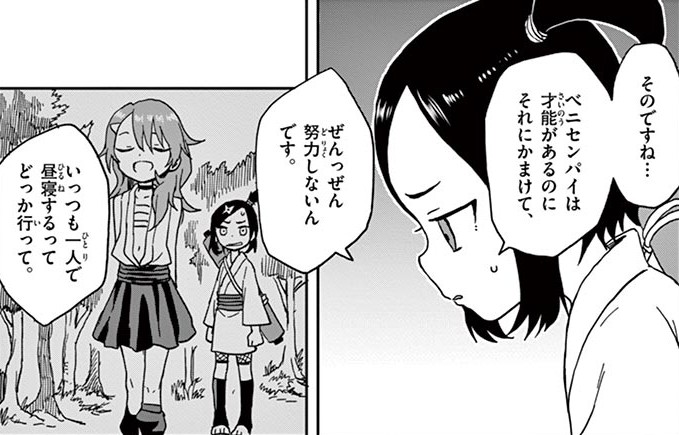
During a free day from training, Touwata and Mizubashou approach Tsubaki to request a favor. She would like Tsubaki to challenge Benisumomo to a one-on-one fight.
トウワタ:
「そのですね… ベニセンパイ は才能( さいのう ) があるのにそれにかまけて、ぜんっぜん努力( どりょく ) しないんです。」
“Well, you see... Beni-senpai has talent, but she takes it for granted and doesn't put in any effort at all.”
「いっつも一人( ひとり ) で昼寝( ひるね ) するってどっか行( い ) って。」
“She always go off somewhere to take a nap alone.”
Challenge Yourself
Show translation
Challenge
What is Touwata's complaint about Beni-senpai?
Clues
才能( さいのう ) があるのに"even though she has talent," setting up a frustrated contrast
それにかまけて
"resting on that" and neglecting what she should do
ぜんっぜん努力( どりょく ) しない
"does not make any effort at all"
What does the speaker mean?
She relies on her talent and makes no effort.
それ refers to Beni-senpai's 才能( さいのう ) , and それにかまけて…努力( どりょく ) しない states Touwata's complaint.
She works hard but lacks natural talent.
Touwata says Beni-senpai has talent and does not put in effort, the reverse of this reading.
She trains alone because nobody can keep up with her.
The second line says she goes away alone to nap, not to train.
She spends all her effort helping the younger students.
ぜんっぜん努力( どりょく ) しない says she makes no effort at all.
She is talented but too nervous to fight anyone.
Touwata criticizes complacency and napping. She does not mention nervousness.
She wants Tsubaki to teach her the fundamentals.
Touwata wants Tsubaki to challenge Beni-senpai. The line does not present a request from Beni herself.
Touwata concedes that Beni-senpai has 才能( さいのう ) , then complains that she rests on it and makes no effort. Her habit of going off alone to nap supports that accusation.
View Full Example
先輩( せんぱい ) can stand alone and replace a name.
それでも歩は寄せてくる »
Volume 5 » Page 101
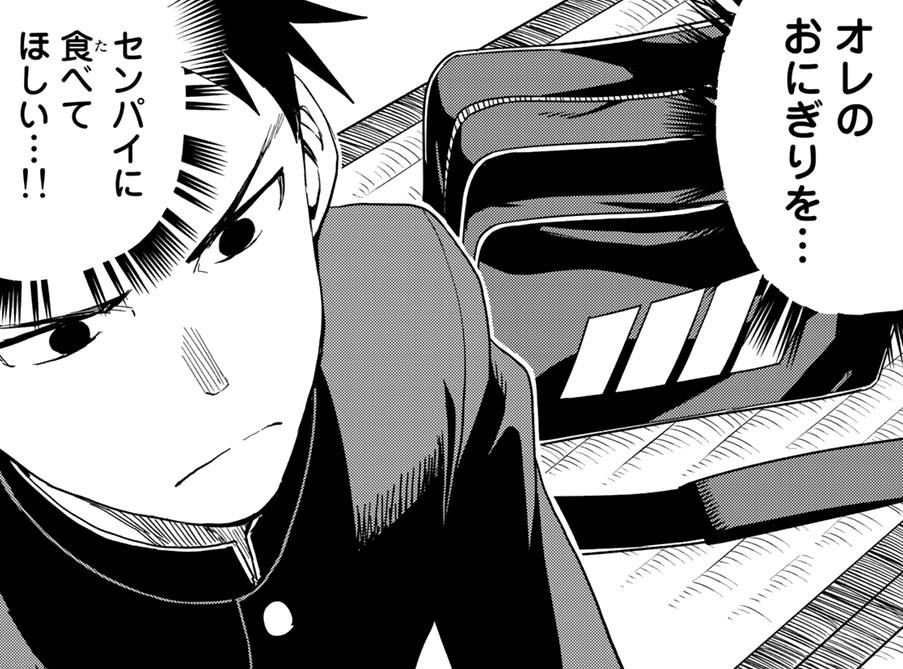
As they start a shogi game after school, Ayumu hears Urushi’s stomach growl. She pretends there wasn’t a sound, but Ayumu realizes she’s hiding that she’s hungry. If he can avoid embarrassing her, Ayumu has the solution in his school bag.
歩( あゆむ ) :「オレのおにぎりを… センパイ に食( た ) べてほしい…!!」
“I want her to eat my rice ball.”
Challenge Yourself
Show translation
Challenge
What does Ayumu want Urushi to do?
Clues
オレのおにぎりを
"my rice ball," marking the food as the object of the action
センパイに
marks Urushi as the person Ayumu wants to act
食( た ) べてほしい"I want someone to eat it."
What does the speaker mean?
He wants Urushi to eat his rice ball.
センパイに marks Urushi as the eater, while オレのおにぎりを marks Ayumu's rice ball as what she should eat.
He wants to eat Urushi's rice ball himself.
The possessive オレの identifies the rice ball as Ayumu's, and センパイに identifies Urushi as the person he wants to eat it.
He wants Urushi to make him a rice ball.
The verb is 食( た ) べる, to eat, not a verb meaning to make.
He wants Urushi to admit that she is hungry.
Ayumu avoids embarrassing her. He silently focuses on giving her food rather than demanding an admission.
He wants to save the rice ball until after shogi.
食( た ) べてほしい expresses a wish for Urushi to eat it, not to save it.
He wants Urushi to share the rice ball with the club.
The line names Urushi alone with センパイに. It does not mention sharing.
Ayumu thinks センパイに食( た ) べてほしい, that he wants Urushi to eat. The thing he wants her to eat is オレのおにぎり, his rice ball.
View Full Example
後輩( こうはい ) 先輩( せんぱい ) , it functions as a relationship noun rather than an honorific attached to a person’s name.
呼び捨て: Dropping Honorifics
呼( よ ) び捨( す ) て君( くん ) to 呼( よ ) び捨( す ) て, the change can mark a new stage in their relationship.
からかい上手の(元)高木さん »
Volume 13 » Page 44
Yukari stops by the preschool where Mina works, just as Takagi is there picking up her daughter. Yukari compares her life with theirs.
ユカリ:
「高木( たかぎ ) ちゃんは成績( せいせき ) よくて しっかりしてたし、」
“Takagi-chan got good grades and had it together.”
「ミナ は料理( りょうり ) が得意( とくい ) だったりするじゃない。」
“And Mina's good at cooking and such, right?”
Challenge Yourself
Show translation
Challenge
Which strengths does Yukari assign to Takagi and Mina?
Clues
高木( たかぎ ) ちゃんは成績( せいせき ) よくてTakagi got good grades
しっかりしてた
was dependable or had it together
ミナは料理( りょうり ) が得意( とくい )
Mina is good at cooking
What does the speaker mean?
Takagi had good grades and was dependable; Mina is good at cooking.
Yukari links 成績( せいせき ) よくて and しっかりしてた to Takagi, then gives 料理( りょうり ) が得意( とくい ) as Mina's strength.
Takagi was good at cooking; Mina had good grades.
This swaps the qualities assigned to the two women.
Both Takagi and Mina were known mainly for good grades.
Only Takagi is described with 成績( せいせき ) . Mina's example is cooking.
Both women were good cooks but unreliable students.
Yukari calls Takagi dependable and gives cooking as Mina's skill.
Takagi struggled in school while Mina helped her study.
成績( せいせき ) よくて is positive, and no help with studying is mentioned.
Yukari says neither woman had a useful strength.
The lines list positive qualities as Yukari compares herself with them.
Yukari remembers Takagi as academically strong and dependable. She then points to cooking as one of Mina’s strengths.
View Full Example
Without that closeness, a bare name can sound rude.
名探偵コナン »
Volume 4 » Page 94
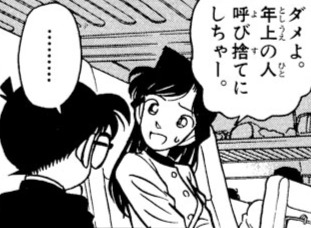
Conan needs to investigate a bomb set to go off on the train, but being a child restricts his ability to move around and gather information. He decides he needs to reveal his true self to Ran, but when he addresses her as simply “Ran”, she corrects him to add “ねえちゃん” to her name.
蘭( らん ) :「ダメよ。年上( としうえ ) の人( ひと ) 呼( よ ) び捨( す ) てにしちゃー。」
“That's no good. You shouldn't call older people by their given name alone.”
Challenge Yourself
Show translation
Challenge
What does Ran say Conan did wrong when addressing her?
Clues
年上( としうえ ) の人( ひと ) an older person
呼( よ ) び捨( す ) てにしちゃーyou must not address them without a title or honorific
What does the speaker mean?
He called an older person by name without an honorific.
呼( よ ) び捨( す ) て means using the name alone when Ran expects ねえちゃん to be added.
He used an honorific that was too formal.
Ran objects because he left the expected form of address off entirely.
He called Ran by another person's name.
The problem is the missing title after Ran's correct name.
He claimed to be older than Ran.
Ran refers to herself as the older person and corrects how child-aged Conan addresses her.
He refused to say Ran's name at all.
He says Ran, but without the familiar ねえちゃん she expects.
He spoke politely to someone younger than him.
The line concerns casual address toward someone older.
Ran scolds Conan for calling an older person by name alone. She expects child-aged Conan to address her as 蘭( らん ) ねえちゃん instead.
View Full Example
高木さん/からかい上手の(元)高木さん-volume-13-page-44-panel-3.jpg)