Hot things and hot weather with あつい
あつい has two official spellings for heat. 熱い is something hot to the touch, such as tea, bath water, or a stove, and it also covers strong feelings. 暑い is hot weather, the air all around you being hot enough to make you uncomfortable.
The opposites make a quick test. If the opposite is 冷たい, write 熱い. If the opposite is 寒い, write 暑い. A third あつい, 厚い, “thick”, is a different word. Both heat spellings are official, so they show up in formal writing as well as in manga. Same reading, different kanji explains where the official list comes from.
The Spellings at a Glance
| Spelling | Used for | Standing |
|---|---|---|
| 熱い | hot to the touch; heated feelings | Official |
| 暑い | hot weather, hot enough to be uncomfortable | Official |
Hot to the Touch with 熱い
熱い is a thing that feels hotter than your body: a drink, food, water, metal, or anything else you could touch. Its opposite is 冷たい. 熱いうちに, “while it’s hot”, is what you say when urging someone to eat, and 熱々, “piping hot”, takes 熱 too.
Manga keep to 熱 for these. In this site’s manga corpus, 熱いお茶 turns up 25 times, and 暑いお茶 never does.
1 source
【熱い】温度がとても高く感じられる。感情が高ぶる。
お茶が熱くて飲めない。熱い湯。熱くなって論じ合う。熱い声援を送る。熱い思い。熱い: a temperature that feels very high. Feelings running high. "The tea is too hot to drink." "Hot water." "Get heated and argue it out." "Cheer someone on passionately." "Strong feelings."
Example 1 of 2: Hot tea after a rainy grocery run with お茶を淹れる
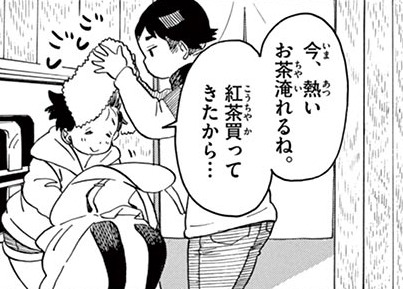
Kiyo and Riko come home from a grocery run in the cold rain. Kiyo is relieved that the groceries in her backpack stayed dry, but she is soaked through herself, so Riko dries her hair with a towel.
- 理子:
- 「今、熱いお茶淹れるね。紅茶買ってきたから…」
- “I'll make you some hot tea right now. I picked up some black tea, so...”
Kiyo is soaked from the cold rain, so Riko dries her hair and offers to make hot tea. Tea is hot to the touch, so it’s 熱いお茶.
Example 2 of 2: Oden fixings fresh from the fryer with 揚げたて
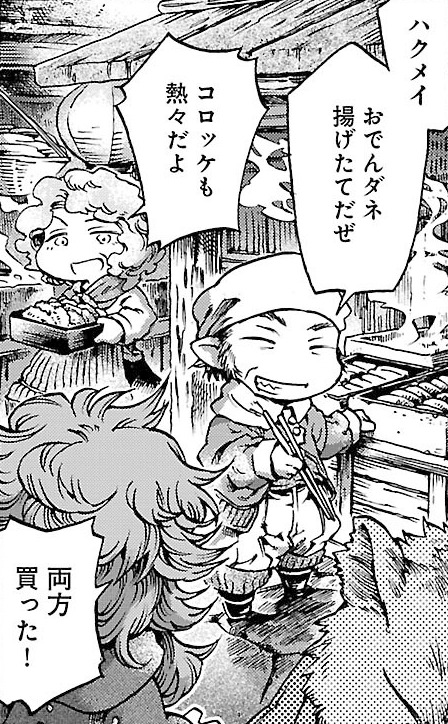
Hakumei and Mikochi are showing Iwashi around the city and want to find a restaurant he’d like for dinner. Nothing works out. One place is too cramped for him, another is closed, and he wants nothing sweet for dinner. They give up and head into a busy street of food stalls.
- 店主Ⓐ:
- 「ハクメイ おでんダネ揚げたてだぜ」
- “Hakumei! The oden fixings are fresh out of the fryer!”
- 店主Ⓑ:
- 「コロッケも熱々だよ」
- “The croquettes are piping hot, too!”
- ハクメイ:
- 「両方買った!」
- “I'll take both!”
A second stall vendor adds that the croquettes are piping hot, too. 熱々 doubles 熱 for food fresh off the heat.
Heated Feelings with 熱い
熱い also covers feelings that run hot. 熱い思い is a strong feeling or passion, 熱い声援 is cheering someone on with all you’ve got, and 熱くなる can mean getting worked up. 胸が熱くなる is being moved, and 目頭が熱くなる is being moved to tears. お熱いね teases a couple who can’t keep their eyes off each other.
Manga don’t use 暑 for these. In this site’s manga corpus, 胸が熱い or 胸が熱くなる turns up 25 times and 目頭が熱くなる 5 times, and neither one is ever written with 暑.
1 source
感情が高まった状態である。
㋐恋する相手に夢中になるさま。また、深く愛し合うさま。「憧れの人に―・い眼差しをそそぐ」「お―・い仲」
㋑感情が激しく燃え上がるさま。「―・くなって論じ合う」「―・いものがこみあげる」「目頭が―・くなる」
㋒熱心である。熱意がある。「届け、―・い声援」「仕事への―・い思い」Feelings running high. Being crazy about someone you love, or two people deeply in love. "Cast a passionate gaze at the person you admire." "A couple deeply in love." Feelings flaring up. "Get heated and argue it out." "Feel a surge of emotion." "Be moved to tears." Being eager and earnest. "Reach them, our passionate cheers!" "A passion for one's work."
Hot Weather with 暑い
暑い is the air around you being hot: a summer day, a stuffy room, a heat wave. It’s about how the weather feels on your whole body, and its opposite is 寒い. The noun is 暑さ, “the heat”, and words built on 暑い take 暑 too, such as 蒸し暑い, “muggy”, and 暑がり, “someone who feels the heat easily”.
Indoor air counts too. A stuffy room is 暑い because its air is hot, and the guide’s own examples include 暑い部屋. In this site’s manga corpus, 暑い日, “a hot day”, turns up 65 times, and 熱い日 is used that way only once.
2 sources
【暑い】不快になるくらい気温が高い。
今年の夏は暑い。暑さ寒さも彼岸まで。日中はまだまだ暑い。暑い部屋。暑がり屋。暑い: the air temperature is high enough to be unpleasant. "This summer is hot." "Summer heat eases by the autumn equinox, and winter cold by the spring one." "It's still hot during the day." "A hot room." "Someone who feels the heat easily."
あつ・い【暑い】
[形][文]あつ・し[ク]《「熱い」と同語源》気温が著しく高い。「今年の夏は異常に―・い」「―・い盛り」「―・い部屋」⇔寒い。あつい, written 暑い. An adjective, from the same root as 熱い. The air temperature is very high. "This summer is unusually hot." "The hottest part of the season." "A hot room." The opposite is 寒い.
Example 1 of 4: Furthermore, this room is too warm with さらに〜
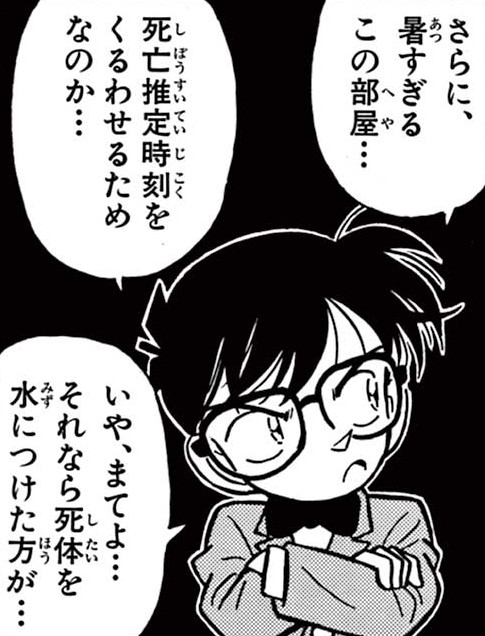
Upon walking in on a murder scene, Conan goes right to work making observations about the blood-covered body and its surroundings. He notes how the room is torn apart save for one upright chair beside the deceased.
- コナン:
- 「さらに、暑すぎるこの部屋…」
- “Furthermore, this room is too warm...”
- 「死亡推定時刻をくるわせるためなのか…」
- “Is it to confuse the estimated time of death...?”
- 「いや、まてよ… それなら死体を水につけた方が…」
- “No, wait... If that's the case, it would be better to put the corpse in water...”
Conan takes in a murder scene and adds one more clue: the room is far too warm. 暑すぎるこの部屋 is “this room, which is too hot”.
Example 2 of 4: Not hot enough for the AC with 〜ほど〜ない
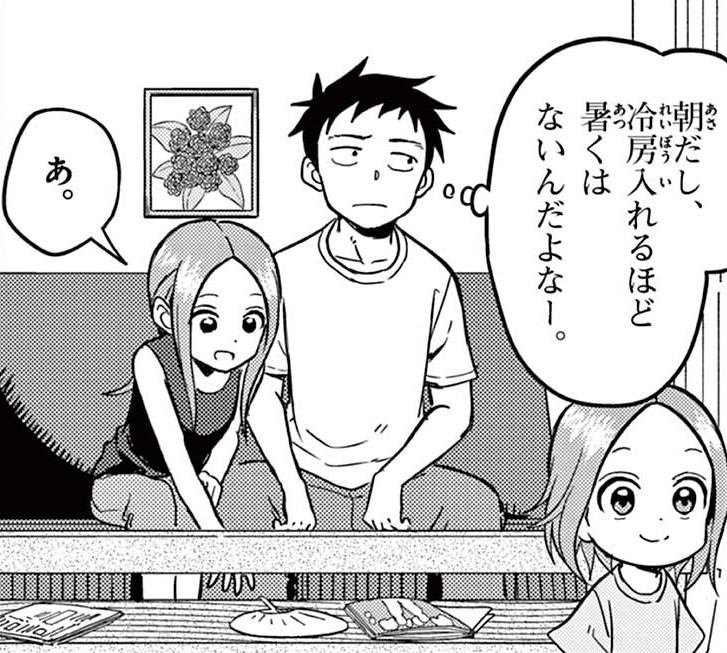
On a warm morning, Chii has taken over the electric fan, chasing it as it swings so the breeze only reaches her. Nishikata complains that none of the air is getting to him, and Takagi laughs.
- 西片:
- 「朝だし、冷房入れるほど暑くはないんだよなー。」
- “It's still morning, and it's not really hot enough to turn on the AC.”
- 高木:
- 「あ。」
- “Oh.”
Chii has taken over the fan, and Nishikata thinks to himself that it’s still morning, so it isn’t hot enough to turn on the AC. 暑くはない is “isn’t hot”, with は for contrast.
Example 3 of 4: Not even an air conditioner with 〜さえ
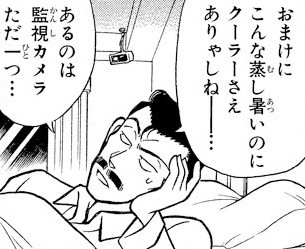
Kogoro, Ran, and Conan are guests on a Sherlock Holmes fan tour at a pension. At four in the morning, Kogoro lies awake grumbling that the room has no TV, no phone, and no newspaper.
- 小五郎:
- 「おまけにこんな蒸し暑いのにクーラーさえありゃしねー…」
- “And on top of that, it's this muggy and there isn't even an air conditioner…”
- 「あるのは監視カメラただ一つ…」
- “All we've got is one security camera…”
Kogoro lies awake at four in the morning in a pension room with no TV, no phone, and no air conditioner. 蒸し暑い is “hot and muggy”.
Example 4 of 4: I'd totally die in the heat with 〜じゃう
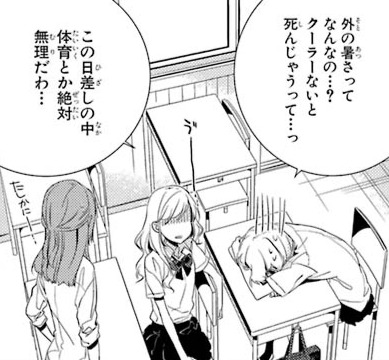
On a summer day, Hori and her friends in class can’t ignore the heat.
- 由紀:
- 「外の暑さってなんなの…? クーラーないと死んじゃうって…っ」
- “What's with this heat outside...? I'd totally die without the AC...”
- 「この日差しのなか体育とか絶対無理だわ…」
- “There's no way I can do PE in this blazing sun...”
On a summer day, Yuki can’t stand the heat outside. 外の暑さ is “the heat outside”, the noun form of 暑い.
When the Two Overlap
The usual line between them is what’s hot. 熱 is for a thing hotter than you, felt with part of your body, and 暑 for the air around you, felt with your whole body. Heat from inside the body falls on the 熱 side. 体が熱い and 顔が熱い, a body or face burning up from fever, embarrassment, or excitement, take 熱. In this site’s manga corpus, 体が熱い and 体が熱くなる turn up dozens of times, and 体が暑い never does.
Manga sometimes pick the other kanji on purpose. 熱い夏 is a summer full of passion, such as a high school baseball season, while 暑い夏 is just a hot one. 暑苦しい is “stifling”, and it can describe a person who’s too intense to be around. A few manga write it 熱苦しい to point at the passion, but 暑苦しい is far more common, about 24:1 in this site’s manga corpus.
1 source
①(熱)物体や液体、また気体など、体の一部で感じるときの物の温度が、自分の体温よりも著しく高く感じられる。…
②(暑)気温など、体全体で感じる外気の温度が、人間の肉体に苦痛を覚えさせるほどに高い。…① Written 熱: when you feel an object, a liquid, or a gas with part of your body, its temperature feels much higher than your own body temperature. ② Written 暑: the temperature of the outside air, such as the weather, felt with the whole body, is high enough to cause physical discomfort.
A Different Word with 厚い
厚い is “thick”, the opposite of 薄い. It’s for a thick book, a thick wall, or thick clouds, and 分厚い is “really thick”. It also describes warm, generous care. 手厚い is “kind and attentive”, and 人望が厚い is “widely trusted and respected”. 厚かましい, “brazen”, is written with the same 厚.
厚い is a separate word with its own meaning, not another spelling of the heat あつい. The 1972 list that the 2014 guide replaced put it in the same group as 暑い and 熱い, but the 2014 guide’s main table leaves it out.
1 source
あつい
暑い-今年の夏は暑い。暑い部屋。暑がり屋。
熱い-熱い湯。
厚い-厚い壁で隔てる。支持者の層が厚い。手厚いもてなし。From the 1972 list, reprinted in the reference material at the back of the 2014 report. あつい. 暑い: "This summer is hot." "A hot room." "Someone who feels the heat easily." 熱い: "Hot water." 厚い: "Separate with a thick wall." "A broad base of supporters." "Generous hospitality."
Example 1 of 2: Kei the hotcake machine with ホットケーキを焼く
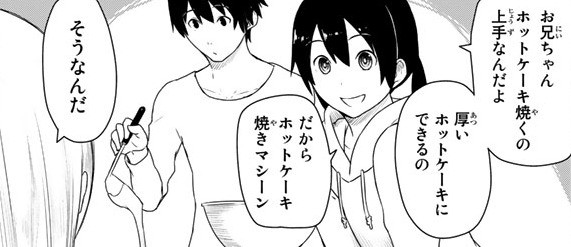
After seeing the sky whale together, Makoto and her family invite Anzu home for a late breakfast of hotcakes, cooked on a hot plate in the middle of the table. Kei stands over the batter and does all the cooking. Chinatsu asks if her brother has turned into a hotcake-making machine, and Kei says that grilling hotcakes is all he can do now. Anzu asks what that’s about.
- 千夏:
- 「お兄ちゃん ホットケーキ焼くの上手なんだよ 厚いホットケーキにできるの」
- “My brother's good at making hotcakes. He can make them really thick.”
- 「だから ホットケーキ焼きマシーン」
- “So he's the hotcake machine.”
- 杏子:
- 「そうなんだ」
- “Oh, I see.”
Chinatsu brags that her brother is good at cooking hotcakes and can make them nice and thick. 厚いホットケーキ is “a thick hotcake”.
Example 2 of 2: Respected by the fishing folk with 漁民
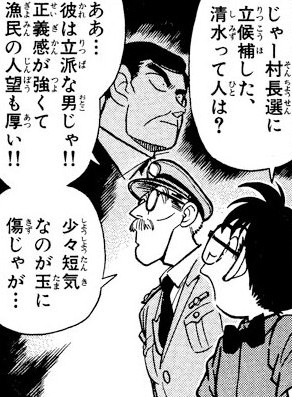
Conan is walking with the island’s elderly police officer to fetch a key from the police box. On the way, he asks about each person connected to the murders. The officer has just described Murasawa, who recently got engaged to the village head’s daughter, and Hirata, the village head’s secretary.
- コナン:
- 「じゃー村長選に立候補した、清水って人は?」
- “Then what about Shimizu, the guy who ran for village head?”
- おまわりさん:
- 「ああ…彼は立派な男じゃ!! 正義感が強くて漁民の人望も厚い!!」
- “Ah... He's a fine man!! He has a strong sense of justice, and the fishermen hold him in high regard!!”
- おまわりさん:
- 「少々短気なのが玉に傷じゃが…」
- “His one flaw is that he's a bit short-tempered, though...”
The island’s old police officer tells Conan that Shimizu is a fine man with a strong sense of justice. 人望が厚い is “widely respected”, here with も, “also”.
When あつい Stays in Kana
Kana works for every あつい, and the 2014 guide says its spelling examples don’t rule out writing a word in kana where it suits. Manga write the plain form in kanji far more often, but the rough, stretched forms people blurt out in the heat, such as あっつい and あちい, often stay in kana.
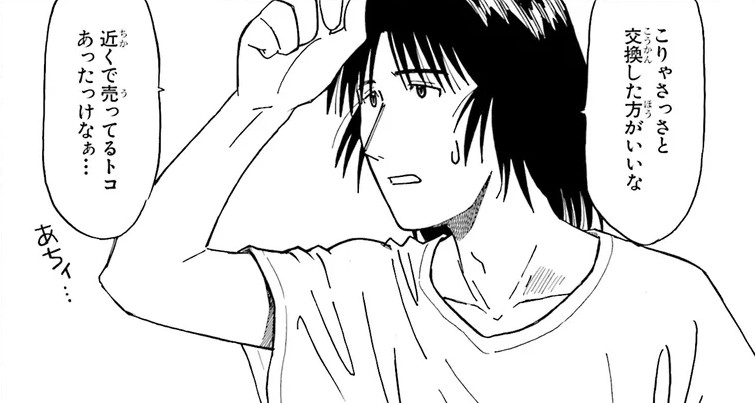
The bathroom door lock broke, leaving the door unable to open. With a bit of effort, Yousuke is finally able to unlock it.
- 葉介:
- 「こりゃさっさと交換した方がいいな」
- “Looks like I'd better replace it right away.”
- 「近くで売ってるトコあったっけなぁ…(あちィ…)」
- “Was there somewhere nearby that sells them...? (Man, it's hot...)”
Yousuke has wrestled the broken bathroom lock open and wipes the sweat from his forehead. あちィ is a rough, casual あつい, muttered to himself about the heat.
Check Yourself
Guess the Meaning from the Kanji
Each spelling's kanji points at one sense of あつい. Say what each one means, then open it.
熱い
hot to the touch; heated feelings暑い
hot weather, hot enough to be uncomfortable
Pick the Spelling
Each phrase has あつい in kana. Decide which kanji fits, then open it.
お茶があつい
お茶が熱い. 熱い: hot to the touch; heated feelings.
今年の夏はあつい
今年の夏は暑い. 暑い: hot weather, hot enough to be uncomfortable.
あつい湯
熱い湯. 熱い: hot to the touch; heated feelings.
あつい部屋
暑い部屋. 暑い: hot weather, hot enough to be uncomfortable.
あつい思い
熱い思い. 熱い: hot to the touch; heated feelings.
Spell a Manga Line
Kiyo is soaked from the rain, and Riko offers to make tea. Which kanji fits あつい?
「今、あついお茶淹れるね。」
Show the answer
熱い. Tea is hot to the touch, and its opposite is 冷たい. In this site’s manga corpus, 熱いお茶 turns up 25 times and 暑いお茶 never does. “I’ll make you some hot tea right now.”
Conan is taking in a murder scene. Which kanji fits あつすぎる?
「さらに、あつすぎるこの部屋…」
Show the answer
暑すぎる. A room is hot because its air is hot, felt with your whole body, and the official guide’s own examples include 暑い部屋. “Furthermore, this room is too warm…”
Chinatsu is bragging about her brother’s hotcakes. Which kanji fits あつい? It isn’t either of the heat spellings.
「お兄ちゃん ホットケーキ焼くの上手なんだよ あついホットケーキにできるの」
Show the answer
厚い, “thick”, a different word with the opposite 薄い. A fresh hotcake is hot too, but Chinatsu is praising how thick her brother makes them. “My brother’s good at making hotcakes. He can make them really thick.”
Kogoro is lying awake at four in the morning in a pension with no air conditioner. Which kanji fits むしあつい?
「おまけにこんなむしあついのにクーラーさえありゃしねー…」
Show the answer
蒸し暑い, “muggy”. It’s built on 暑い, since it’s the air that’s hot and damp, and words built on 暑い keep 暑. “And on top of that, it’s this muggy and there isn’t even an air conditioner…”