Personal Pronouns
Japanese personal pronouns can mark politeness, gender, region, age, and the relationship between speakers. One person may choose different pronouns for different audiences, and omit them when context already identifies the subject.
This page focuses on usage in manga. Usage in everyday conversation may differ.
私 : Neutral and Polite私( わたし ) is a standard polite pronoun. Men often use it in professional or respectful contexts but choose a less formal pronoun among peers. Women commonly use it in both formal and casual settings.
からかい上手の高木さん »
Volume 5 » Page 63
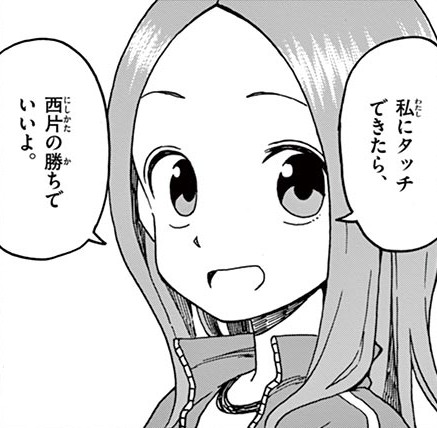
During a class marathon, Takagi challenges Nishikata to a competition.
高木( たかぎ ) :「私( わたし ) 西片( にしかた ) の勝( か ) ちでいいよ。」
“If you can tag me, you win.”
Challenge Yourself
Show translation
Challenge
What must Nishikata do to win Takagi's challenge?
Clues
私( わたし ) にタッチできたら"if you can tag me," setting the condition
西片( にしかた ) の勝( か ) ちでいいよ"we can call it Nishikata's win"
What does the speaker mean?
Tag Takagi while they run.
私( わたし ) にタッチできたら makes tagging Takagi the condition for Nishikata's win.
Finish the entire marathon ahead of Takagi.
Takagi's stated condition is tagging her, not finishing first.
Keep Takagi from tagging him.
私( わたし ) に marks Takagi as the person Nishikata must tag, not the other way around.
Run beside Takagi until the finish.
The line requires a tag. It does not say that running beside her is enough.
Ask Takagi to let him win.
できたら sets an ability-based condition. Nishikata must manage the tag himself.
Beat his previous marathon time.
No previous time appears in the rule. The challenge centers on タッチ.
Takagi makes 私( わたし ) にタッチできたら the condition. If Nishikata can tag her, she will count that as his win.
View Full Example
名探偵コナン »
Volume 1 » Page 65
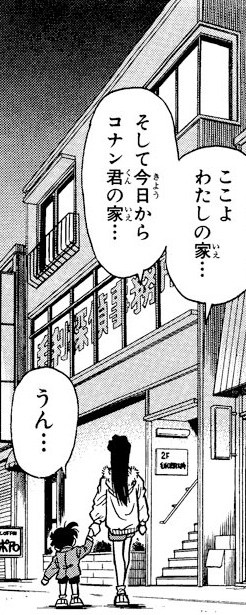
Professor Agasa convinces Ran to take Conan in to stay with her and her father.
蘭( らん ) :「ここよ わたし の家( いえ ) … そして今日( きょう ) からコナン君( くん ) の家( いえ ) …」
“It's here. My home... And starting today, your home...”
Challenge Yourself
Show translation
Challenge
What does Ran tell Conan about the house?
Clues
わたしの家( いえ )
my home
今日( きょう ) からコナン君( くん ) の家( いえ ) starting today, Conan's home
What does the speaker mean?
Her home will also be Conan's home starting today.
そして今日( きょう ) から links Ran's home to Conan's new living arrangement.
Conan must leave her home today.
今日( きょう ) から marks the start of his living there, not his departure.
She is taking Conan to Agasa's house.
Ran identifies the place as わたしの家( いえ ) , her own home.
The house belongs only to Conan now.
She first calls it her home, then includes Conan in it.
Conan has mistaken the building for his school.
The line introduces a home, not a school.
Ran will visit Conan's home tomorrow.
She is telling him that the home in front of them becomes his from today.
Ran points out her home and tells Conan that it will be his home too starting that day. わたしの marks her relationship to the house before she extends it to him.
View Full Example
僕 : Casual and Masculine僕( ぼく ) is an informal pronoun used primarily by boys and men. It is common among boys and young men and in relaxed social settings. In some serious contexts, it can sound youthful. Its less common use by a girl or woman may characterize her as tomboyish or nonconforming.
名探偵コナン »
Volume 21 » Page 119
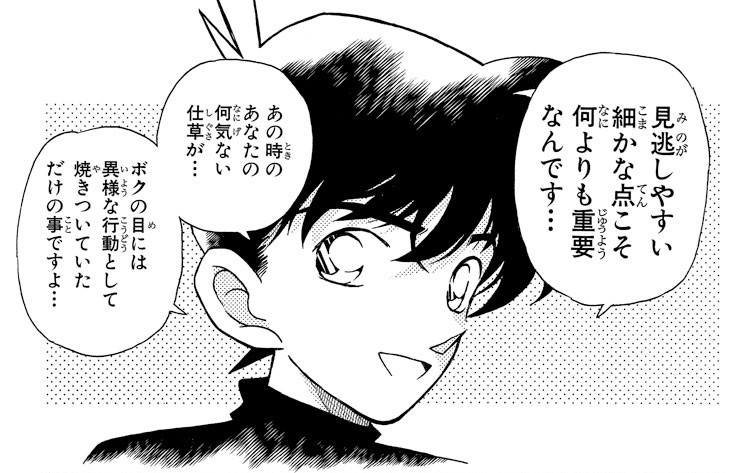
Shin’ichi reveals the details of a murder. The culprit asks how Shin’ichi discovered the hidden weapon, and he explains it was due to a specific movement the culprit made.
新一( しんいち ) :「見逃( みのが ) しやすい細( こま ) かな点( てん ) こそ何( なに ) よりも重要( じゅうよう ) なんです…」
“It's precisely those subtle details that are easy to overlook that matter most of all...”
「あの時( とき ) のあなたの何気( なにげ ) ない仕草( しぐさ ) が…」
“That casual gesture of yours back then...”
「僕( ぼく ) 目( め ) には異様( いよう ) な行動( こうどう ) として焼( や ) きついてただけの事( こと ) ですよ…」
“It's just that it was etched in my mind as strange behavior...”
Challenge Yourself
Show translation
Challenge
Why did the culprit's casual gesture stay in Shin'ichi's memory?
Clues
僕( ぼく ) の目( め ) には異様( いよう ) な行動( こうどう ) としてin my eyes, as strange behavior
焼( や ) きついてたit was etched into my memory
What does the speaker mean?
It struck him as unnaturally strange behavior.
異様( いよう ) な行動( こうどう ) explains why the otherwise casual gesture stood out.
It was the most ordinary action at the scene.
Shin'ichi says it appeared 異様( いよう ) , abnormal or out of place.
The culprit repeated it after confessing.
The line refers to the gesture at the earlier moment, not a later confession.
Someone photographed the movement for him.
焼( や ) きつく is figurative here, meaning the sight remained vividly in his mind.
It caused him to overlook all the smaller details.
He says small, easily missed details are especially important.
The gesture directly revealed the culprit's name.
It served as suspicious behavioral evidence, not a spoken identification.
The gesture looked casual, but Shin’ichi saw it as strangely out of place. That abnormal impression caused it to remain vividly etched in his memory.
View Full Example
俺 : Rough and Intimate Masculine俺( おれ ) is more informal and forceful than 僕( ぼく ) . It is associated with confidence, toughness, and closeness, and is used chiefly by men, especially among close friends.
よつばと! »
Volume 1 » Page 8
Yotsuba and her father are driving to their new home. As they pass a school letting out, Yotsuba waves to a student. When the student waves back, Yotsuba tells her father to wave too.
よつば:
「おねーちゃんが手( て ) ぇふった! とーちゃんもふれ!」
“The girl waved! Daddy, you wave too!”
父( とう ) さん:「とーちゃん手( て ) がはなせないからな俺( おれ ) 分( ぶん ) もよつばがふってくれ」
“Dad's hands are full, so Yotsuba, please wave for me too.”
Challenge Yourself
Show translation
Challenge
Why does Yotsuba's father ask her to wave for him?
Clues
とーちゃん手( て ) がはなせないからな
he cannot take his hands away from what he is doing
俺( おれ ) の分( ぶん ) もよつばがふってくれhe asks Yotsuba to give his share of the wave too
What does the speaker mean?
He cannot take his hands off the steering wheel.
手( て ) がはなせない gives the reason, and 俺( おれ ) の分( ぶん ) も asks Yotsuba to wave on his behalf.
He does not know how to wave politely.
The problem is that his hands are occupied, not that he lacks the skill or manners to wave.
The student waved only to Yotsuba.
Dad still wants to return the greeting. He asks Yotsuba to include a wave for him because he cannot do it himself.
He wants Yotsuba to stop waving and hold the wheel.
Dad keeps control of the vehicle and asks Yotsuba to handle the wave, not the steering.
His hands are cold and trembling.
手( て ) がはなせない means he cannot let go or take his hands away. It does not describe temperature or shaking.
He wants two students to wave back at once.
俺( おれ ) の分( ぶん ) means Dad's share of the greeting, not a request aimed at another student.
Yotsuba’s father is driving and cannot take his hands off the steering wheel. He therefore asks Yotsuba to wave once for herself and also give the wave he would have given.
View Full Example
それでも歩は寄せてくる »
Volume 6 » Page 4
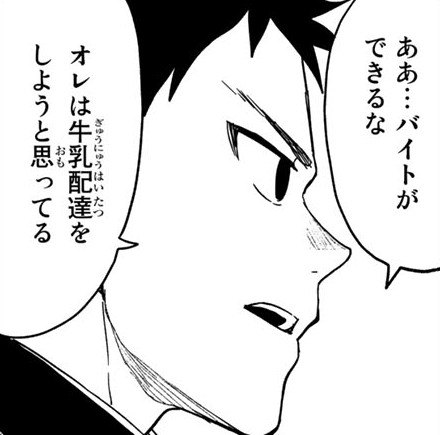
Takeru and Ayumu talk about now being in high school.
歩( あゆむ ) :「ああ…バイトができるな」
“Yeah, I can get a part-time job.”
「オレ は牛乳( ぎゅうにゅう ) 配達( はいたつ ) をしようと思ってる」
“I'm thinking of doing milk delivery.”
Challenge Yourself
Show translation
Challenge
What part-time job is Ayumu considering?
Clues
バイトができるな
"Now I can get a part-time job."
オレは牛乳( ぎゅうにゅう ) 配達( はいたつ ) をしようと思( おも ) ってる
"I am thinking of doing milk delivery."
What does the speaker mean?
Delivering milk.
牛乳( ぎゅうにゅう ) 配達( はいたつ ) names milk delivery, and しようと思( おも ) ってる marks it as Ayumu's current plan.
Working at a shogi shop.
Ayumu discusses part-time work, but the job he names is milk delivery.
Studying instead of taking a job.
バイトができるな shows that he is pleased he can now work part time.
Delivering newspapers with Takeru.
The item being delivered is 牛乳( ぎゅうにゅう ) , milk, and Ayumu frames it as his own plan.
Helping at the school cafeteria.
No cafeteria appears in the line. The stated work is 牛乳( ぎゅうにゅう ) 配達( はいたつ ) .
Starting the job immediately that day.
しようと思( おも ) ってる describes an intention under consideration, not an immediate start.
Ayumu says he can now take a part-time job and follows with 牛乳( ぎゅうにゅう ) 配達( はいたつ ) をしようと思( おも ) ってる. He is thinking of delivering milk.
View Full Example
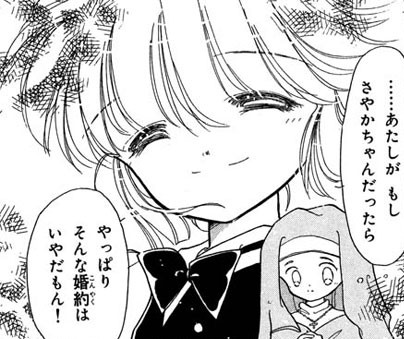
あたし : Cutesy and Feminineあたし is an informal, feminine form of 私( わたし ) . It is common among friends or family and can give a youthful or cute impression.
怪盗セイント・テール »
Volume 1 » Page 85
Seira learns that Sayaka’s parents have forced her into an arranged marriage engagement, even though she likes Asuka Jr. Seira relays this to Meimi, saying if Saint Tail steals the gifted wedding veil from Sayaka’s home, the engagement will be called off. Before Meimi sets out, Seira confirms her intention to go through with the theft.
セイント・テール:
「あたし が もし さやかちゃんだったら やっぱり そんな婚約( こんやく ) はいやだもん!」
“If I were Sayaka-chan, sure enough, I'd hate such an engagement!”
Challenge Yourself
Show translation
Challenge
Whose situation is Meimi imagining herself in?
Clues
あたしがもしさやかちゃんだったら
Meimi imagines the hypothetical case where she were Sayaka
そんな婚約( こんやく ) はいやだもん
she says she would hate an engagement like that
What does the speaker mean?
Sayaka's situation, being forced into an unwanted engagement.
もしさやかちゃんだったら places Meimi in Sayaka's position, and そんな婚約はいやだ gives the feeling she would have there.
Seira's situation, deciding whether Saint Tail should help.
The hypothetical person named after だったら is Sayaka, not Seira.
Asuka Jr.'s situation, learning that Sayaka likes him.
Meimi imagines being Sayaka and facing the engagement, rather than imagining Asuka Jr.'s perspective.
Sayaka's parents' situation, arranging a suitable marriage.
あたしがもしさやかちゃんだったら centers Sayaka's feelings, not her parents' reasons.
Her own situation, choosing whether to become engaged.
Meimi uses a hypothetical to put herself in Sayaka's place. She is not discussing an engagement arranged for herself.
Saint Tail's situation, planning to keep the wedding veil.
The theft is meant to help Sayaka. The line concerns how Meimi would feel about Sayaka's engagement, not keeping the veil.
Meimi uses あたし for herself and follows it with もしさやかちゃんだったら, if I were Sayaka-chan. She is imagining Sayaka’s position and concludes that she too would hate being forced into that engagement.
View Full Example
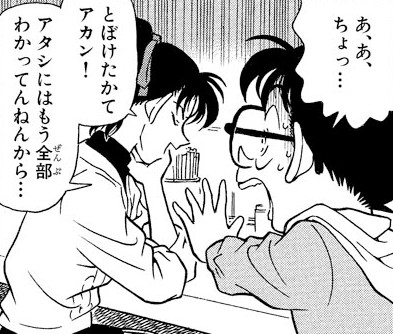
名探偵コナン »
Volume 19 » Page 88
Heiji invites Conan, Ran, and Mouri on a tour of Osaka. While Heiji steps away, his childhood friend who’s been following the group confronts them. She opens by saying “You’re Kudo, right?” and that she heard it from Heiji. Conan, realizing his true identity is about to be revealed to Ran, tries to stop her.
コナン:
「あ、あ、ちょっ…」
“Ah, ah, wai--!”
和葉( かずは ) :「とぼけたかてアカン! アタシ にはもう全部( ぜんぶ ) わかってんねんから…」
“It's no use playing dumb. Since I already know everything...”
Challenge Yourself
Show translation
Challenge
What does Kazuha claim despite Conan's attempt to stop her?
Clues
とぼけたかてアカン
it is no use playing dumb
アタシにはもう全部( ぜんぶ ) わかってんねん
I already know everything
What does the speaker mean?
She already knows everything, so pretending is useless.
もう全部( ぜんぶ ) わかってんねん states that Kazuha believes she has the full truth already.
She has forgotten everything Heiji told her.
She claims the opposite with 全部( ぜんぶ ) わかってる.
She wants Conan to explain the situation later.
Kazuha says playing dumb now will not work because she already understands.
She thinks Heiji has been pretending not to know her.
Her accusation is directed at the person she believes is Kudo.
She knows only one small part of the story.
全部( ぜんぶ ) means everything, not a limited piece.
She agrees to keep silent before saying anything.
Conan tries to stop her, but Kazuha continues with confidence.
Kazuha says that playing dumb will not work because she already knows everything. アタシ is her casual feminine first-person pronoun, colored by the Kansai speech around it.
View Full Example
わたくし : Highly Formalわたくし is more formal than 私( わたし ) . Speakers of any gender may use it in highly formal settings; in casual conversation, it can sound stiff or affected.
うち : Cozy and Feminineうち can sound intimate and homey. It is used mainly by women, especially in the Kansai region, and may be used playfully elsewhere.
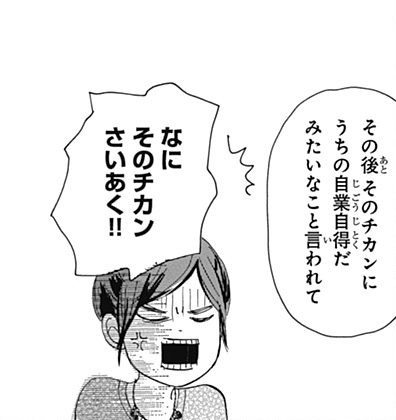
俺物語!! »
Volume 5 » Page 21
Rinko tells Saijou how she first met Takeo through her encounter with a groper on the train. It was Takeo who came to her rescue.
凛子( りんこ ) :「その後( あと ) そのチカンにうち の自業自得( じごうじとく ) だみたいなこと言( い ) われて」
“After that, the groper essentially told me it was my own fault.”
西城( さいじょう ) :「なに そのチカン さいあく!!」
“What?! That groper is the worst!”
Challenge Yourself
Show translation
Challenge
What cruel claim did the groper make to Rinko?
Clues
うちの自業自得( じごうじとく ) だ
it was my own fault or something I brought on myself
みたいなこと言( い ) われて
I was told something like that
What does the speaker mean?
She had brought the harassment on herself.
自業自得( じごうじとく ) blames the victim for receiving the consequence, and 言( い ) われて marks Rinko as the person told this.
Takeo was responsible for the incident.
The groper directs the blame at Rinko with うちの自業自得( じごうじとく ) .
The groper admitted that the incident was his own fault.
うち refers to Rinko in her retelling, so the blame is not self-directed by the groper.
Rinko had mistaken an accident for harassment.
The line reports victim-blaming, not a denial that the harassment occurred.
Rinko deserved an apology from him.
自業自得( じごうじとく ) says she supposedly deserved the bad result, not an apology.
The train company was at fault for the encounter.
No company or train policy appears in the groper's claim.
The groper blamed Rinko for the harassment, telling her it was something she had brought on herself. She paraphrases the remark with みたいなこと rather than quoting his exact words.
View Full Example
Examples
Vocabulary Explanation:
Personal Pronouns
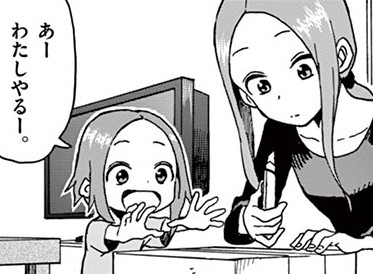
からかい上手の高木さん »
Volume 5 » Page 6
In a bonus story, Takagi is shown as an adult with a child. A package arrives, and Takagi prepares to open it with a box cutter.
ちー:
「あー わたし やるー」
“Ah, I 'll do it!”
Challenge Yourself
Show translation
Challenge
What does Chii volunteer to do?
Clues
わたし
"I" or "me," identifying Chii as the person volunteering
やるー
an eager, stretched "will do it"
What does the speaker mean?
Do the task herself.
わたし identifies Chii, and やる says that she will do the understood task.
Ask her mother to do it.
Chii uses わたし and やる, so she volunteers herself rather than asking her mother.
Watch while someone else does it.
やる means to do the task, not merely watch it.
Say that she already finished it.
やる is nonpast. Chii is declaring what she wants to do now.
Refuse because the task looks dangerous.
Her stretched やるー sounds eager, not reluctant.
Tell her mother that the package is hers.
わたし marks who will act. It does not mark ownership of the package here.
Chii eagerly says わたしやるー. The object is understood from the scene, so the line means that she wants to do the task herself.
Vocabulary Explanation:
Personal Pronouns
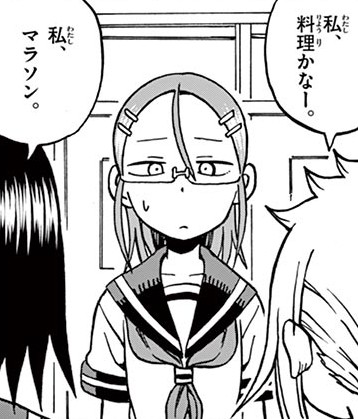
あしたは土曜日 »
Volume 春・夏 » Page 28
Yukari asks Mina and Sanae if they have any special skills.
ミナ:
「私( わたし ) 料理( りょうり ) かなー。」
“For me , perhaps it's cooking.”
サナエ:
「私( わたし )
“Me , it's marathon running.”
Challenge Yourself
Show translation
Challenge
Which special skill does each girl name?
Clues
私( わたし ) 、as for me, with the topic particle left unstated
料理( りょうり ) かなperhaps cooking
マラソン
marathon running
What does the speaker mean?
Mina says cooking, and Sanae says marathon running.
Mina follows 私( わたし ) with 料理( りょうり ) かな, while Sanae gives the clipped answer 私( わたし ) 、マラソン.
Mina says marathon running, and Sanae says cooking.
This reverses the two replies. Mina names 料理( りょうり ) , and Sanae names マラソン.
Both girls say cooking.
Only Mina says 料理( りょうり ) . Sanae's answer is マラソン.
Both girls say marathon running.
Only Sanae says マラソン. Mina tentatively offers 料理( りょうり ) .
Mina asks whether Sanae can cook.
かな softens Mina's answer about herself. It does not turn 料理( りょうり ) into a question about Sanae.
The girls are deciding whether cooking is harder than running.
Each 私( わたし ) introduces a personal answer. The lines do not compare the two skills.
Both girls omit the topic particle after 私( わたし ) . Mina tentatively names cooking, while Sanae answers more bluntly with marathon running.