Raising, frying, and holding with あげる
あがる and its partner あげる have three official spellings. 上がる is moving up or rising, such as climbing the stairs, prices going up, or a voice being raised. 揚がる is floating up into the air, or frying in oil, as with a kite or tempura. 挙げる is putting something forward clearly or holding a ceremony, such as giving an example or having a wedding. あがる is intransitive and あげる is transitive: 値段が上がる is “the price goes up”, and 値段を上げる is “raise the price”.
A quick test covers most cases: if it’s frying, or something floating in the sky, write 揚. If it’s naming, showing, scoring a win, or holding a ceremony, write 挙. For everything else, write 上. A few words take two spellings, and the overlap section below sorts those out. All three are official, so they show up in formal writing as well as in manga. Same reading, different kanji explains where the official list comes from.
The Spellings at a Glance
| Spelling | Used for | Standing |
|---|---|---|
| 上がる・上げる | move up or rise; give; let out a voice or sound; finish | Official |
| 揚がる・揚げる | float up into the air; fly a flag; deep-fry | Official |
| 挙がる・挙げる | show clearly, as an example or a raised hand; hold a ceremony; arrest | Official |
Rising and Raising with 上がる and 上げる
上がる is the general “go up”. 二階に上がる is “go upstairs”, 成績が上がる is “your grades improve”, and 声が上がる is “voices are raised”. It also covers finishing, as in 雨が上がる, “the rain stops”, and coming ashore, as in 陸に上がる.
It’s by far the most common of the three, and it builds a long list of everyday compounds: 盛り上がる, “liven up”, 立ち上がる, “stand up”, 仕上げる, “finish off”, and 売り上げ, “sales”. The humble verbs 申し上げる and 差し上げる take it too.
1 source
【上がる・上げる】位置・程度などが高い方に動く。与える。声や音を出す。終わる。
二階に上がる。地位が上がる。料金を引き上げる。成果が上がる。腕前を上げる。
お祝いの品物を上げる。歓声が上がる。雨が上がる。上がる, 上げる: a position, a degree, and so on moves higher. Give. Let out a voice or a sound. Finish. "Go upstairs." "Rise in status." "Raise the fee." "Get results." "Improve your skill." "Give a congratulatory gift." "A cheer goes up." "The rain stops."
Example 1 of 4: Deep-sea fishing with 遠洋漁業
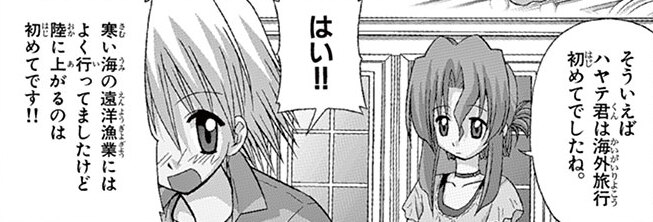
Over Golden Week, Hayate, Nagi, and Maria have come to the Aegean Sea on vacation. Hayate leans over the balcony railing, thrilled at the view. He has worked jobs among adults since he was a small child.
- マリア:
- 「そういえばハヤテ君は海外旅行初めてでしたね。」
- “Come to think of it, Hayate, this is your first trip abroad, isn't it?”
- ハヤテ:
- 「はい!!」
- “Yes!!”
- 「寒い海の遠洋漁業にはよく行ってましたけど陸に上がるのは初めてです!!」
- “I used to go out on deep-sea fishing trips in cold waters all the time, but this is my first time going ashore!!”
Hayate often went out on deep-sea fishing boats, but this trip to the Aegean is his first time going ashore abroad. 陸に上がる is “come up onto land”.
Example 2 of 4: Keeping a museum from shutting down with 事件
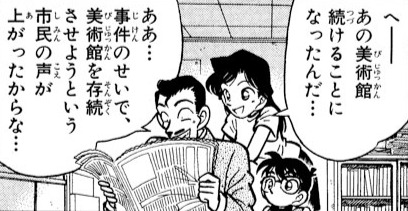
Following the solving of a murder case, Detective Mouri reads an article about the museum where the murder took place.
- 蘭:
- 「へーーー あの美術館続けることになったんだ…」
- “Wow... So they decided to keep the art museum open after all...”
- 毛利:
- 「ああ… 事件のせいで、美術館を存続させようという市民の声が上がったからな…」
- “Yeah... Because of the incident, there was a public outcry to keep the art museum open...”
Kogoro explains that the murder case set off public calls to keep the art museum open. 声が上がる is “voices are raised”, the guide’s “let out a voice or a sound”.
Example 3 of 4: Reeling it in before it escapes with 釣り上げる
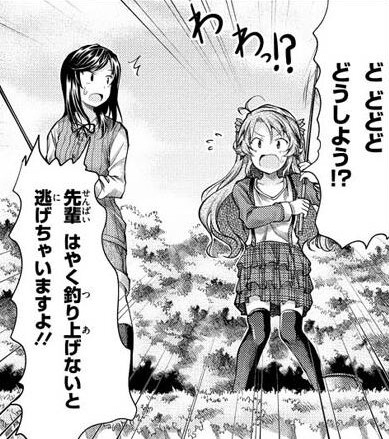
Natsumi’s mother has offered her pocket money to catch some creatures for a pond, so Natsumi has dragged everyone out to go fishing. As Komari waits with her line in the water, her rod suddenly jerks, and she cries that she might have hooked a fish.
- 小鞠:
- 「わ わっ!?」
- “Wh-whoa!?”
- 「ど どどど どうしよう!?」
- “Wh-wh-what do I do!?”
- 蛍:
- 「先輩 はやく釣り上げないと逃げちゃいますよ!!」
- “Senpai, reel it in fast or it'll get away!”
Komari panics when her line jerks, and Hotaru tells her to reel it in before it gets away. 釣り上げる is “pull a catch up out of the water”.
Example 4 of 4: The result of your sales with 成果
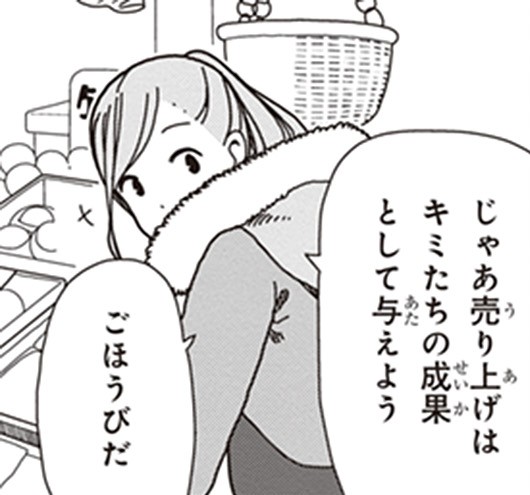
Sacchan’s mother has an overstock of bananas at her fruit shop, so she gives them to Sacchan and her friends to sell around the neighborhood. Later, Sacchan returns having sold all the bananas.
- お母さん:
- 「じゃあ売り上げはキミたちの成果として与えよう」
- “Then I'll give you the sales as your reward.”
- 「ごほうびだ」
- “Consider it a bonus.”
Sacchan and her friends have sold every banana, and her mother gives them the takings as their reward. 売り上げ is “sales”, what selling brings in.
Frying and Flying with 揚がる and 揚げる
揚げる is deep-frying, as in 天ぷらを揚げる, “fry tempura”, 唐揚げ, “fried chicken”, and 揚げたて, “fresh from the fryer”. It’s also raising something up into the air, as in 国旗を揚げる, “raise the flag”, and 凧揚げ, “kite flying”. A third use is unloading cargo or coming back from somewhere, as in 水揚げ, “landing a catch”, and 引き揚げる, “pull out” or “come home from abroad”.
1 source
【揚がる・揚げる】空中に浮かぶ。場所を移す。油で調理する。
国旗が揚がる。花火が揚(上)がる*。たこ揚げをして遊ぶ。船荷を揚げる。
海外から引き揚げる。天ぷらを揚げる。揚がる, 揚げる: float in the air. Move to another place. Cook in oil. "The national flag goes up." "Fireworks go up," with 上 allowed. "Play at flying kites." "Unload a ship's cargo." "Come home from abroad." "Fry tempura."
Example 1 of 2: Just out of the fryer with 〜たとこだ
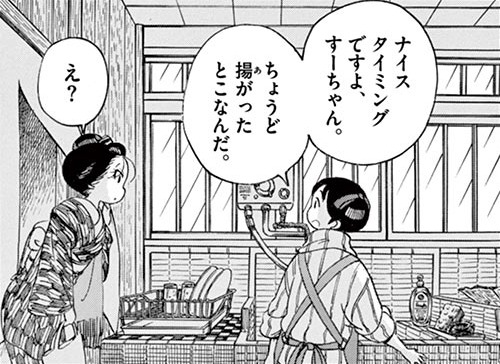
Kenta, a friend from back home, has told Sumire that he’s taking a job in Kyoto and staying. Sumire is thrilled, then scolds herself for it, since he must have made some hard choices. She comes home worn out from holding back a grin, and Kiyo leans out to welcome her back.
- キヨ:
- 「ナイスタイミングですよ、すーちゃん。」
- “Nice timing, Su-chan.”
- 「ちょうど揚がったとこなんだ。」
- “It's just come out of the fryer.”
- すみれ:
- 「え?」
- “Huh?”
Sumire comes home just as Kiyo finishes frying something, and Kiyo calls it perfect timing. 揚がる is food coming out of the oil done.
Example 2 of 2: Oden fixings fresh from the fryer with 揚げたて
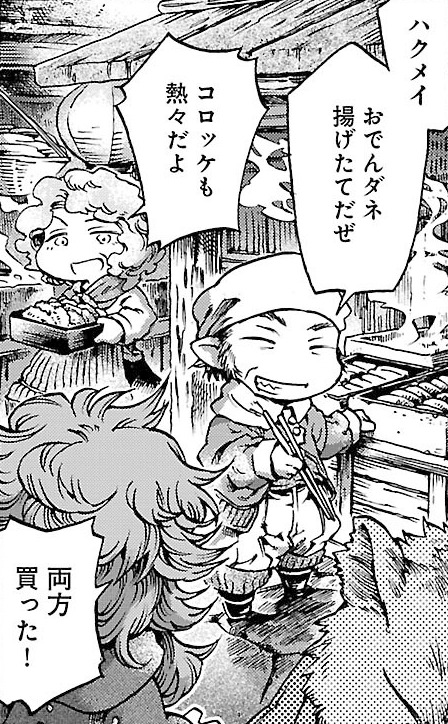
Hakumei and Mikochi are showing Iwashi around the city and want to find a restaurant he’d like for dinner. Nothing works out. One place is too cramped for him, another is closed, and he wants nothing sweet for dinner. They give up and head into a busy street of food stalls.
- 店主Ⓐ:
- 「ハクメイ おでんダネ揚げたてだぜ」
- “Hakumei! The oden fixings are fresh out of the fryer!”
- 店主Ⓑ:
- 「コロッケも熱々だよ」
- “The croquettes are piping hot, too!”
- ハクメイ:
- 「両方買った!」
- “I'll take both!”
A stall vendor calls out to Hakumei that the oden fixings are fresh from the fryer. 揚げたて is the stem 揚げ plus 〜たて, “just done”.
Naming and Holding Events with 挙がる and 挙げる
挙げる is putting something forward where everyone can see it. 例を挙げる is “give an example”, 手を挙げる is “raise your hand” to volunteer or answer, and 名前が挙がる is “a name comes up”. It’s also holding a ceremony, as in 結婚式を挙げる, “hold a wedding”, and chalking up a result, as in 勝ち星を挙げる, “score a win”. Acting all together takes it too, as in 国を挙げて, “as a whole nation”, and 犯人を挙げる is “arrest the culprit”. The kanji is the 挙 of 選挙, “an election”, and 検挙, “an arrest”.
Manga write a wedding with 挙 or in kana, and almost never with 上. In this site’s manga corpus, 結婚式を挙げる in its various forms turns up more than a dozen times and never with 上. Kana, 結婚式をあげる, is nearly as common as 挙.
1 source
【挙がる・挙げる】はっきりと示す。結果を残す。執り行う。こぞってする。捕らえる。
例を挙げる。手が挙がる。勝ち星を挙げる。式を挙げる。国を挙げて取り組む。
全力を挙げる。犯人を挙げる。挙がる, 挙げる: show clearly. Achieve a result. Conduct a ceremony. Do as one. Arrest. "Give an example." "Hands go up." "Chalk up a win." "Hold a ceremony." "Tackle something as a whole nation." "Do your utmost." "Arrest the culprit."
Example 1 of 3: Naming a reason for going to cafés with 理由を挙げる
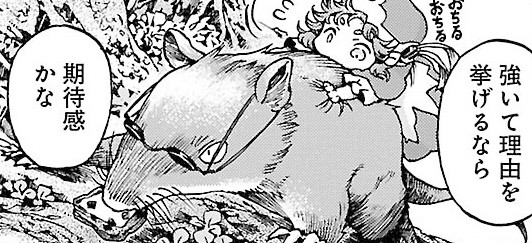
Two rats offered Hakumei and Mikochi a ride to a café, but they lost the way and got too hungry to keep climbing, so Mikochi shares the sandwiches she packed. One rat asks why Mikochi goes to cafés when she can make food herself. Mikochi first answers that coffee isn’t her specialty.
- ミコチ:
- 「強いて理由を挙げるなら」
- “If I had to give a reason...”
- 「期待感かな」
- “I guess it's the anticipation.”
A rat asks Mikochi why she goes to cafés when she can make food herself. 強いて理由を挙げるなら is “if I had to give a reason”. Putting a reason forward is the guide’s “show clearly”.
Example 2 of 3: Raising a hand under hypnosis with 挙げる
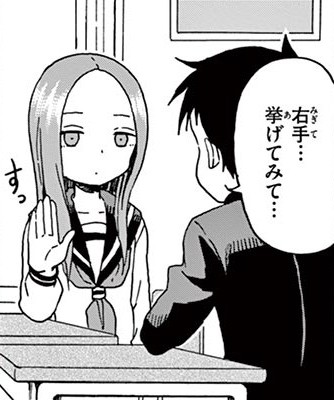
Nishikata saw a hypnotist on TV the day before, though he insists the act is staged. Takagi asks him to try it on her. After his routine, she stares blankly and doesn’t answer, even when he calls her name.
- 西片:
- 「右手…挙げてみて…」
- “Try... raising your right hand...”
Nishikata has tried a hypnotism routine on Takagi, and now she won’t answer him. To test it, he says 右手…挙げてみて…, “try raising your right hand”. The guide lists a raised hand, 手が挙がる, under 挙.
Example 3 of 3: Holding a friend's wedding with 結婚式を挙げる
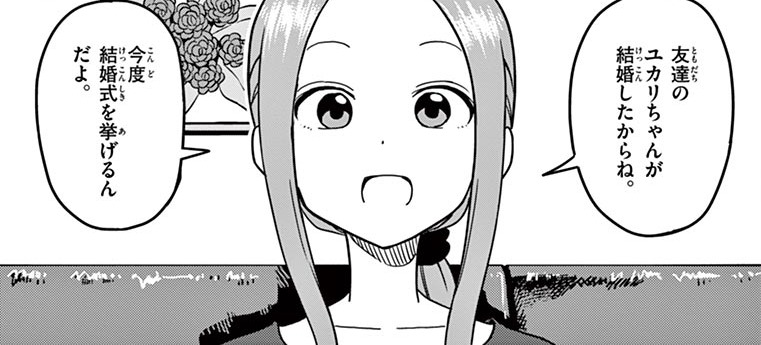
Chi has heard the word けっこんしき, “wedding”, and asks whether she’s the one getting married. Nishikata quickly tells her no.
- お母さん:
- 「友達のユカリちゃんが結婚したからね。」
- “It's because my friend Yukari got married.”
- 「今度結婚式を挙げるんだよ。」
- “She's having her wedding ceremony soon.”
Chi has heard the word “wedding” and asks if she’s the one getting married. Her mother explains that her friend Yukari will 結婚式を挙げる, “hold her wedding”, soon. That’s the guide’s “conduct a ceremony”.
When the Spellings Overlap
The three spellings write one word. デジタル大辞泉 lists them under a single headword and gives both 上 and 揚 for raising a flag.
Fireworks are the guide’s own overlap. It gives 揚, since fireworks float in the sky, but notes that 上 is common for fireworks shooting up high. Manga go with 上: in this site’s manga corpus, 花火が上がる in its various forms turns up more than a dozen times and 花火が揚がる never does.
Raised hands lean the same way. The guide’s example is 手が挙がる, but in manga 手を上げる is more common than 手を挙げる. Part of that gap is other meanings: 手を上げろ is “hands up”, and 手を上げる can be “raise a hand against someone”, and both lean to 上. For a hand raised in class, 挙 is the guide’s choice.
The guide’s examples split 引きあげる by meaning: 料金を引き上げる, “raise the fee”, takes 上, and 海外から引き揚げる, “come home from abroad”, takes 揚. Manga often write the everyday “head back” or “pack it in” sense as 引き上げる, as in 引き上げるぞ.
2 sources
「花火があがる」は,「空中に浮かぶ」花火の様子に視点を置いて「揚」を当てるが,「空高く上がっていく(高い方に動く)」花火の様子に視点を置いた場合には「上」を当てることが多い。
For "fireworks go up", 揚 is used when focusing on the fireworks floating in the air, but 上 is often used when focusing on them shooting up high into the sky, moving upward.
あ・げる【上げる/揚げる/挙げる】
7 ㋐(上げる・揚げる)掲げる。「国旗を―・げる」
㋓(挙げる)執り行う。「結婚式を―・げる」
㋔(挙げる)表し示す。「例を―・げる」「証拠を―・げる」
8 (揚げる)揚げ物を作る。「てんぷらを―・げる」あげる, written 上げる, 揚げる, or 挙げる. 7. Written 上げる or 揚げる: hoist. "Raise the national flag." Written 挙げる: hold a ceremony. "Hold a wedding." Written 挙げる: show or present. "Give an example." "Present evidence." 8. Written 揚げる: make fried food. "Fry tempura."
Giving with あげる
あげる also means “give”, and after a て form it means “do something for someone”, as in 手伝ってあげる, “I’ll help you”. The guide lists giving under 上げる, as in お祝いの品物を上げる, but manga usually write both uses in kana. Doing for someone with 〜てあげる covers the helper verb.
デジタル大辞泉 adds a note on politeness. Giving was first a humble word for presenting something to someone above you, so phrases like 犬にえさをあげる, “feed the dog”, weren’t said. Today more and more people use it as a gentler word for やる.
1 source
9 ㋑「与える」「やる」を、その相手を敬っていう語。「洋服を―・げる」
[補説]9㋑は本来、敬うべき対象に物をさし上げるの意で、「犬にえさをあげる」のような言い方はしなかった。現在では「与える・やる」の美化語として使う人が増えている。9. A word for "give" that shows respect to the receiver. "Give someone clothes." Note: sense 9 originally meant presenting something to someone deserving respect, so phrases like "feed the dog" weren't used. Today more people use it as a refined word for "give."
When あげる Stays in Kana
Kana works for every あがる and あげる, and the 2014 guide says its spelling examples don’t rule out writing a word in kana where it suits. Besides the helper verb, a few common words lean to kana in manga. In this site’s manga corpus, からあげ in kana is more common than 唐揚げ, and 挙句, “in the end”, is written あげく more often than all its kanji spellings combined. In manga, the most common kanji form is 挙句, without okurigana.
1 source
したがって,ここに示した使い分けとは異なる使い分けを否定する趣旨で示すものではない。また,この使い分け例は,必要に応じて,仮名で表記することを妨げるものでもない。
Accordingly, these examples are not meant to rule out other ways of choosing among these spellings. Nor do they stop anyone from writing a word in kana where needed.
Check Yourself
Guess the Meaning from the Kanji
Each spelling's kanji points at one sense of あがる・あげる. Say what each one means, then open it.
上がる・上げる
move up or rise; give; let out a voice or sound; finish揚がる・揚げる
float up into the air; fly a flag; deep-fry挙がる・挙げる
show clearly, as an example or a raised hand; hold a ceremony; arrest
Pick the Spelling
Each phrase has あがる・あげる in kana. Decide which kanji fits, then open it.
二階にあがる
二階に上がる. 上がる・上げる: move up or rise; give; let out a voice or sound; finish.
国旗があがる
国旗が揚がる. 揚がる・揚げる: float up into the air; fly a flag; deep-fry.
例をあげる
例を挙げる. 挙がる・挙げる: show clearly, as an example or a raised hand; hold a ceremony; arrest.
地位があがる
地位が上がる. 上がる・上げる: move up or rise; give; let out a voice or sound; finish.
天ぷらをあげる
天ぷらを揚げる. 揚がる・揚げる: float up into the air; fly a flag; deep-fry.
手があがる
手が挙がる. 挙がる・挙げる: show clearly, as an example or a raised hand; hold a ceremony; arrest.
式をあげる
式を挙げる. 挙がる・挙げる: show clearly, as an example or a raised hand; hold a ceremony; arrest.
Spell a Manga Line
Hayate is on vacation in the Aegean. Which kanji fits あがる?
「寒い海の遠洋漁業にはよく行ってましたけど陸にあがるのは初めてです!!」
Show the answer
上がる. Going ashore is the plain “go up”, with no frying or showing involved, so it’s the general 上. “I used to go out on deep-sea fishing trips in cold waters all the time, but this is my first time going ashore!!”
Sumire walks in just as the food finishes frying. Which kanji fits あがった?
「ちょうどあがったとこなんだ。」
Show the answer
揚がった. Food coming out of the fryer is 揚, the kanji for cooking in oil. “It’s just come out of the fryer.”
Kogoro is reading about the art museum after the case. Which kanji fits あがった?
「ああ… 事件のせいで、美術館を存続させようという市民の声があがったからな…」
Show the answer
上がった. Voices being raised is the guide’s 歓声が上がる, so it’s 上. “Yeah… Because of the incident, there was a public outcry to keep the art museum open…”
Komari’s line has just jerked. Which kanji fits あげない?
「先輩 はやく釣りあげないと逃げちゃいますよ!!」
Show the answer
釣り上げない. Pulling a fish up out of the water is moving it higher, so it’s 上. “Senpai, reel it in fast or it’ll get away!”