Taking, catching, and photographing with とる
とる has five official spellings, and one of them does most of the work. 取る is the default: holding, getting, taking off, or writing down. The other four each take one job. 撮る is taking a photo or a video. 捕る is catching something that moves, such as a mouse or a ball. 採る is gathering or choosing, such as picking mushrooms or hiring staff. 執る is carrying out a duty or taking command, such as office work or an orchestra. Manga also write 獲る for winning a prize or catching prey, and 盗る for stealing, both unofficial.
A quick test: start with 取, and switch only when one of the others fits. A camera means 撮, a catch means 捕, a harvest or a pick means 採, and being in charge means 執. All five are official, so they show up in formal writing as well as in manga. Same reading, different kanji explains where the official list comes from.
The Spellings at a Glance
| Spelling | Used for | Standing |
|---|---|---|
| 取る | hold in the hand; get; write down; remove | Official |
| 採る | gather; take on, as staff; adopt | Official |
| 執る | take up and use; carry out duties | Official |
| 捕る | catch | Official |
| 撮る | take a photo or film | Official |
| 獲る | catch game; win a prize or a title | Off-list |
| 盗る | steal | Off-list |
An official spelling has its reading in the 常用漢字表, the government's list of kanji for general use. An off-list spelling uses a reading the list doesn't give that kanji, or a kanji that isn't on it. Newspapers avoid those spellings, but manga use them freely.
Taking and Holding with 取る
取る covers most とる. 本を手に取る is “pick up a book”, メモを取る is “take notes”, 年を取る is “get older”, and 連絡を取る is “get in touch”. It’s also getting something, as in 資格を取る, “get a qualification”, and taking something away, as in 汚れを取る, “get a stain out”. 責任を取る is “take responsibility”.
In this site’s manga corpus, forms of 手に取る alone turn up hundreds of times, and forms of 取り戻す, “get back”, more than 1,000.
1 source
【取る】手で持つ。手に入れる。書き記す。つながる。除く。
本を手に取る。魚を取(捕)る*。資格を取る。新聞を取る。政権を取る。年を取る。
メモを取る。連絡を取る。着物の汚れを取る。疲れを取る。痛みを取る。取る: hold in your hand. Get. Write down. Connect. Remove. "Pick up a book." "Catch fish," with 捕 allowed. "Get a qualification." "Subscribe to a newspaper." "Take power." "Get older." "Take notes." "Get in touch." "Get a stain out of a kimono." "Shake off fatigue." "Relieve pain."
Example 1 of 3: No time to return to headquarters with 本部
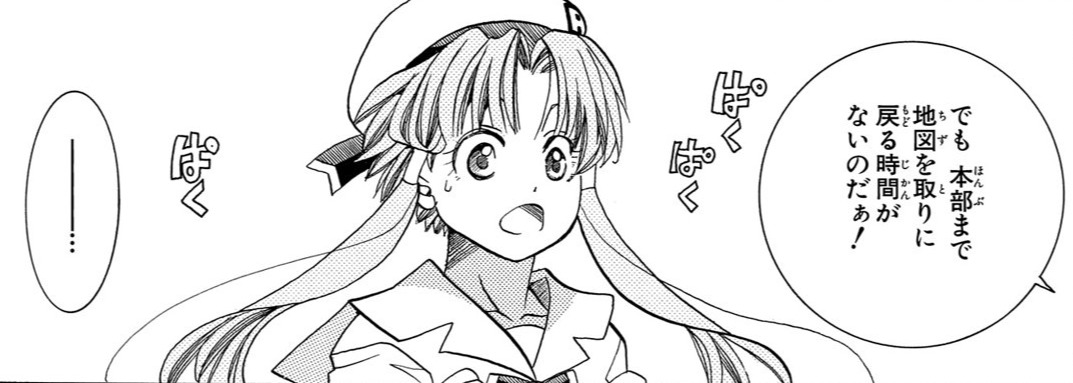
Akari encounters Woody while he’s out on a delivery run. He stopped to show off for some kids, but in the process, he seems to have lost his city map, and he has a terrible sense of direction. Akari asks if he has the delivery addresses, which he says he does.
- ウッディー:
- 「でも 本部まで地図を取りに戻る時間がないのだぁ!」
- “But I don't have time to go back to headquarters to get a map!!”
Woody has lost his city map in the middle of a delivery run, and there’s no time to go back to headquarters for another. 取りに戻る is “go back to get”.
Example 2 of 3: Not moving while staring with 〜ながら
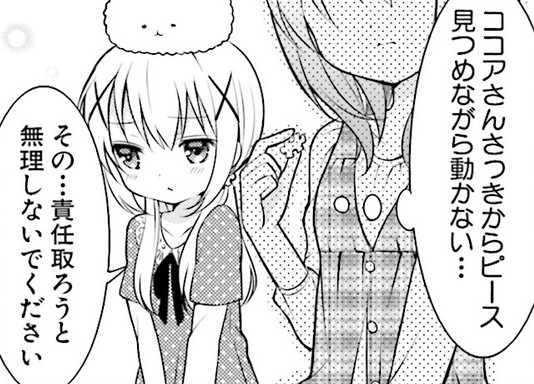
Cocoa buys Chino a puzzle to make up for finishing the one Chino had been working on. The two and their friends work at putting the new puzzle together.
- チノ:
- 「ココアさんさっきからピース見つめながら動かない…」
- “Cocoa-san has been staring at the puzzle piece while not moving for a while now...”
- 「その…責任取ろうと無理しないでください」
- “Um... Please don't push yourself trying to take responsibility.”
Cocoa has been staring at a puzzle piece without moving, and Chino tells her not to push herself trying to make up for finishing Chino’s last puzzle. 責任を取る is “take responsibility”, here with the を dropped.
Example 3 of 3: Receiving a taking-away with 〜れる
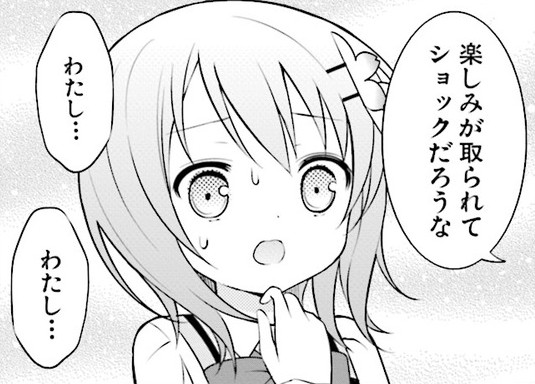
Cocoa isn’t certain why Chino is upset, until Rize explains what it meant when Cocoa completed the puzzle Chino had been working on a little each day.
- リゼ:
- 「楽しみが取られてショックだろうな」
- “She must be shocked that she had her fun taken away.”
- ココア:
- 「わたし… わたし…」
- “I... I...”
Rize explains why Chino is upset: Cocoa finished the puzzle Chino had been building a little each day. 楽しみが取られる is “have your fun taken away”.
Taking Photos with 撮る
撮る is taking a photo or filming a video. 写真を撮る is “take a photo”, 映画を撮る is “shoot a film”, and 自撮り is “a selfie”. The kanji is the 撮 of 撮影, “photography”.
When manga write it in kanji, it’s almost always 撮. In this site’s manga corpus, forms of 写真を撮る and 写真撮る together turn up more than 1,000 times, and 取 for a photo is rare. デジタル大辞泉 also gives 録る for recording sound or video, as in 録音 and 録画, but the 常用漢字表 lists only ロク for 録, with no kun reading.
1 source
【撮る】撮影する。
写真を撮る。映画を撮る。ビデオカメラで撮る。撮る: photograph or film. "Take a photo." "Shoot a film." "Film something with a video camera."
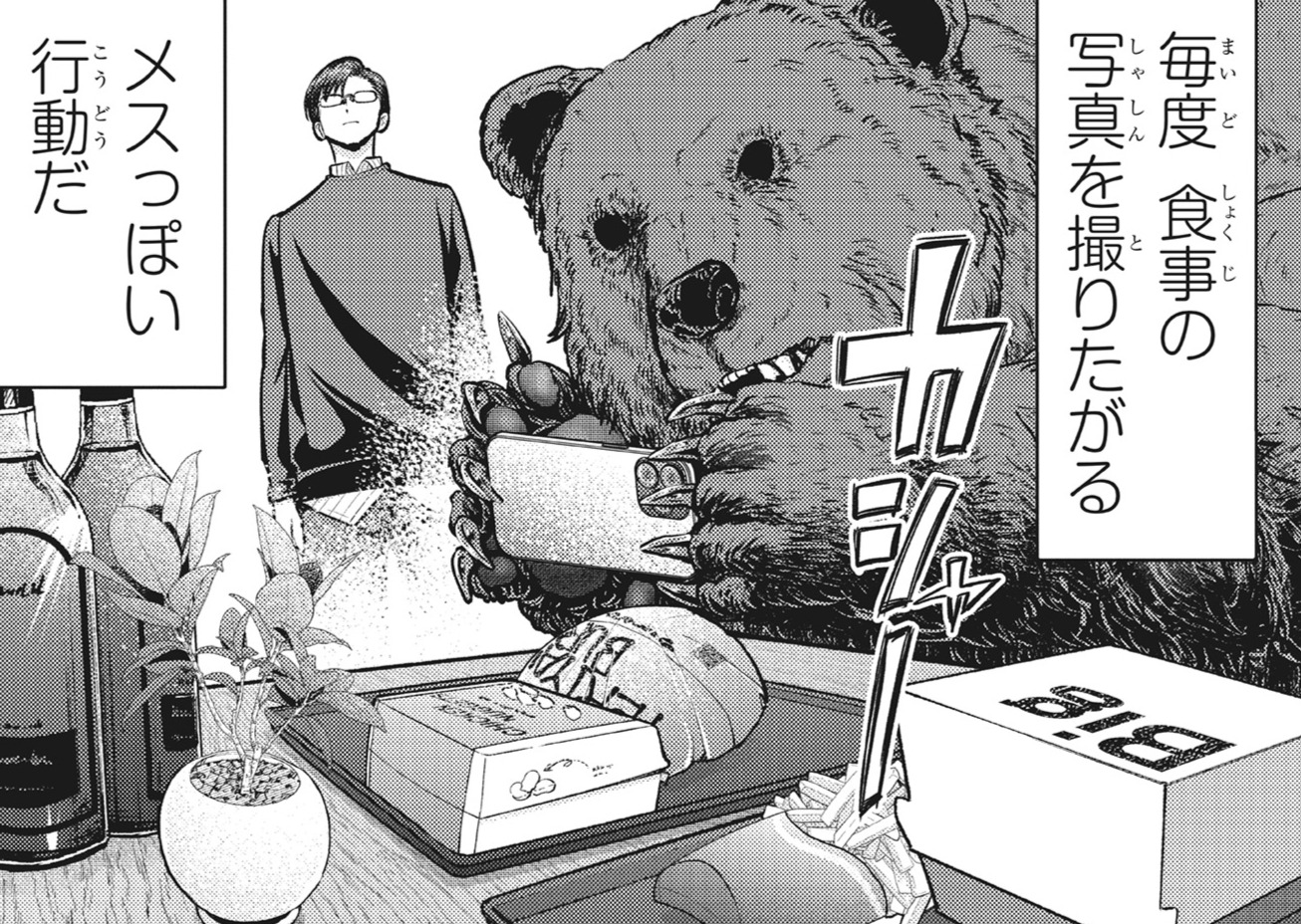
Kumada observes the bear that’s been living in his apartment for a while now, trying to determine from its personality traits whether it’s male or female.
- (熊田):
- 「毎度 食事の写真を撮りたがる」
- “It always wants to take photos of its meals.”
- 「メスっぽい行動だ」
- “That's female-like behavior.”
Kumada is trying to work out whether the bear living in his apartment is male or female. It always wants to photograph its meals, which strikes him as a feminine trait. 写真を撮る is “take a photo”.
Catching with 捕る
捕る is catching something that moves. ねずみを捕る is “catch a mouse”, 外野フライを捕る is “catch a fly ball”, and 虫捕り is “bug catching”. The kanji is the 捕 of 逮捕, “arrest”. Watch out for 捕らえる, “capture”, a separate verb with the same kanji.
1 source
【捕る】つかまえる。
ねずみを捕る。鯨を捕る。外野フライを捕る。生け捕る。捕り物。捕る: catch. "Catch a mouse." "Catch a whale." "Catch a fly ball in the outfield." "Catch alive." "Catching a criminal."
Gathering and Choosing with 採る
採る is gathering something that grows or can be collected, and picking one option from many. 山菜を採る is “gather wild vegetables”, 血を採る is “draw blood”, and 新入社員を採る is “hire new staff”. 決を採る is “put it to a vote”. The kanji is the 採 of 採用, “hiring”, and 採集, “collecting”.
1 source
【採る】採取する。採用する。採決する。
血を採る。きのこを採る。指紋を採る。新入社員を採る。こちらの案を採る。
会議で決を採る。採る: collect. Adopt or hire. Put to a vote. "Draw blood." "Pick mushrooms." "Take fingerprints." "Hire new staff." "Go with this plan." "Put it to a vote at the meeting."
Example 1 of 5: Picking the taranome clean with 採り尽くす
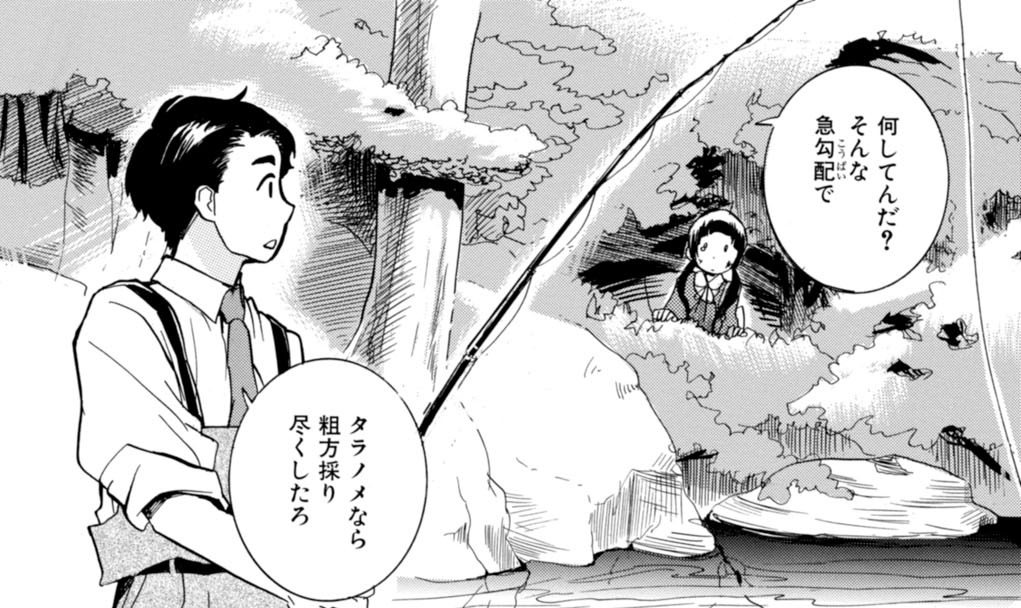
Machi sets out for the Uniqlo in town, but the heavy bicycle she borrowed breaks down on the mountain road. She decides to cut straight across the mountain on foot and pushes through the undergrowth until she comes out above a stream. Yoshio is standing in it with a fishing rod, and he’s surprised to see her up on the slope.
- 良夫:
- 「何してんだ? そんな急勾配で」
- “What are you doing up on a slope that steep?”
- 「タラノメなら粗方採り尽くしたろ」
- “If you're after taranome, we've pretty much picked them all already, haven't we?”
Yoshio is fishing in a mountain stream when Machi comes out of the brush on the steep slope above him, and he guesses she’s out foraging for wild spring vegetables. 採り尽くす is “pick until none are left”.
Example 2 of 5: Gathered a bunch yesterday with 採る
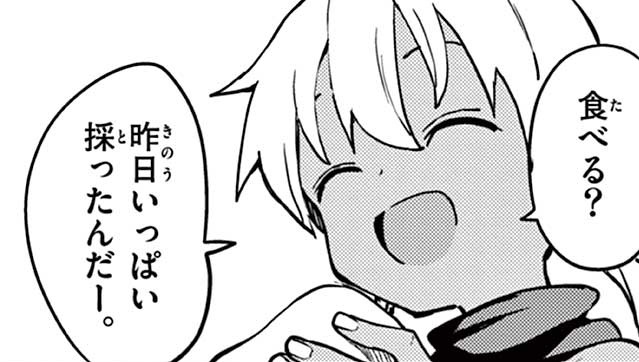
Sazanka, a member of Tsubaki’s squad, is upset with Tsubaki. She won’t accept Tsubaki’s apology and has moved out to sleep in a tree in the woods. Now Asagao, another member of the squad, has climbed up to join her on the branch, holding something to eat.
- アサガオ:
- 「食べる?」
- “Want some?”
- 「昨日いっぱい採ったんだー。」
- “I picked a whole bunch yesterday.”
Sazanka has moved out to sleep in a tree after a falling-out with Tsubaki, and Asagao climbs up beside her with something to eat. 採る is “pick” or “gather”, here for food she found in the woods.
Example 3 of 5: Gathering wedge stones for the wall with 採る
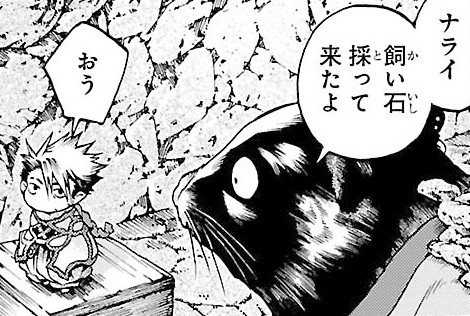
Narai’s guild is repairing the big stone wall along the main street. Narai directs the work from a wooden box, yelling at anyone who slacks off. Katen, a badger who works with the crew, stops by the cooking for a snack, and Hakuyo tells Katen to get going before Narai loses his temper.
- カテン:
- 「ナライ 飼い石採って来たよ」
- “Narai, I gathered the wedge stones and brought them back.”
- ナライ:
- 「おう」
- “Good.”
Narai’s crew is repairing a big stone wall, and Katen the badger comes back from an errand to report to him. 飼い石採って来た is “I gathered the wedge stones and brought them back”.
Example 4 of 5: A tomato from the greenhouse with 採れる
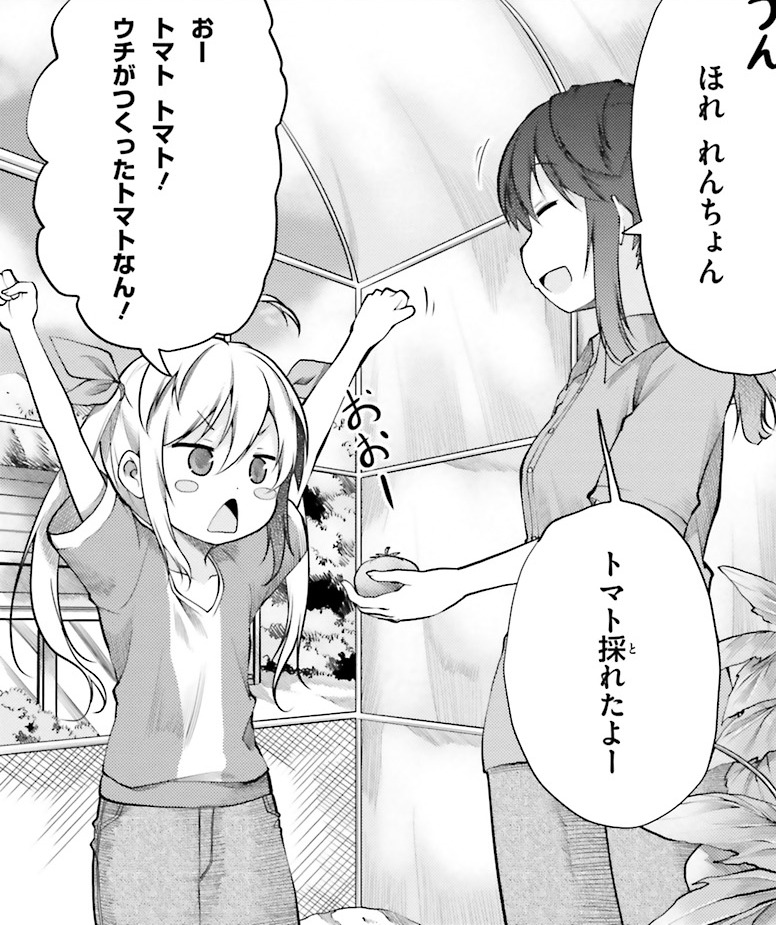
It’s summer, and Kazuho is in the school greenhouse with Renge. She snips a ripe tomato off the vine with a pair of scissors, looks it over, and smiles.
- 一穂:
- 「ほれ れんちょん」
- “Here, Ren-chon.”
- 「トマト採れたよー」
- “The tomatoes are in!”
- れんげ:
- 「おー トマト トマト! ウチがつくったトマトなん!」
- “Ooh! Tomato, tomato! It's the tomato I grew!”
Kazuho has just cut a ripe tomato off the vine in the school greenhouse, and she holds it out to Renge, who grew it. トマト採れた is “the tomatoes are in”.
Example 5 of 5: Sharing the harvest with 採れる
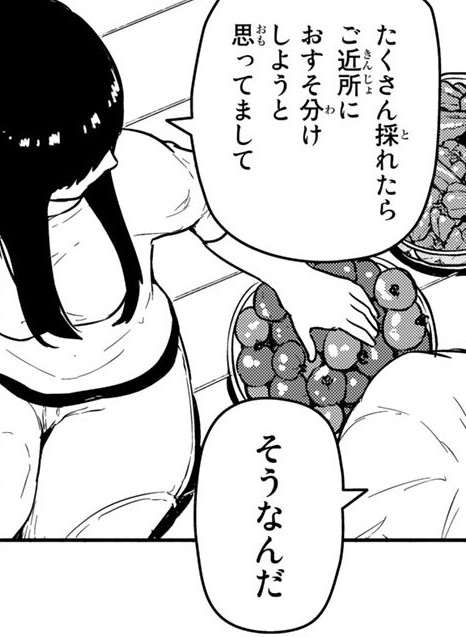
Makoto grew tomatoes, peppers, and corn from seed in the family’s garden, and the harvest has come in. After everyone tastes the vegetables fresh off the plants, the rest sits in baskets on the porch. Everyone is amazed at how much they picked, and it’s only part of the crop.
- 真琴:
- 「たくさん採れたらご近所におすそ分けしようと思ってまして」
- “I was thinking that if we got a big harvest, I'd share some with the neighbors.”
- 茜:
- 「そうなんだ」
- “Oh, I see.”
Makoto grew tomatoes, peppers, and corn from seed in the family garden, and the harvest has come in. She’d planned to share it if there was plenty. 採れる is “be harvested”, with the crop as the subject, and 採れたら is “if we get a big harvest”.
Running Things with 執る
執る is taking charge of something and carrying it out. 指揮を執る is “be in command” or “conduct”, 筆を執る is “take up the pen”, and 事務を執る is “handle office work”. It’s the rarest of the five, and manga mostly use it in 指揮を執る and 執り行う, “formally hold”, as in 式を執り行う, “hold a ceremony”.
1 source
【執る】手に持って使う。役目として事に当たる。
筆を執る。事務を執る。指揮を執る。政務を執る。式を執り行う。執る: hold something and use it. Take on a task as your role. "Take up the pen." "Handle office work." "Be in command." "Handle government affairs." "Hold a ceremony."
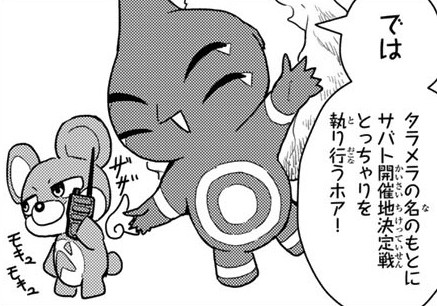
Taramera, ruler of the fire world, couldn’t choose which of five candidate sites should host the first fire Sabbath in 180 years. So Taramera has gathered a young witch from each site to settle it the fire world’s way, with a contest. The game is とっちゃり, a kind of sumo with magic, and the first witch to beat Taramera’s friend Akatsuki in the ring wins the Sabbath for her home. Everyone has changed into the happi coats handed out for the match.
- タラメラ:
- 「では」
- “And now...”
- 「タラメラの名のもとに サバト開催地決定戦 とっちゃりを執り行うホア!」
- “In the name of Taramera, I hereby open the match to decide the Sabbath's host, Tocchari!”
Taramera, ruler of the fire world, couldn’t pick a host for the next Sabbath, so the young witches will settle it with とっちゃり, a game of magic sumo. With everyone ready, Taramera opens the match. 執り行う is “formally hold”.
Winning and Hunting with 獲る
Manga often reach for an unofficial spelling for winning a prize or catching game. 獲る is タイトルを獲る, “win a title”, or 魚を獲る, “catch fish”. The kanji is the 獲 of 獲物, “prey”, and 獲得, “winning”. The 常用漢字表 lists no とる reading for 獲, and its only kun reading is える, so writing that keeps to the list uses 取る for a prize and 取る or 捕る for an animal.
デジタル大辞泉 notes 獲る for taking game under its 取る entry, as another way to write that sense. It doesn’t mark 獲る for prizes, but manga write it that way often. In this site’s manga corpus, forms of タイトルを獲る are far more common than forms of タイトルを取る, and forms of 賞を獲る come up nearly as often as forms of 賞を取る.
1 source
と・る【取る/執る/採る/捕る/撮る】
…
1 … ㋔(「(作物を)穫る」「(動物を)獲る」とも書く)生きていくための、えものや作物を手に入れる。収穫したり、捕獲したりする。「山菜を―・って暮らしを立てる」とる, written 取る, 執る, 採る, 捕る, or 撮る. ... 1. Also written 穫る for crops and 獲る for animals: get the game or crops you need to live, by harvesting or catching. "Make a living by gathering wild vegetables."
Example 1 of 4: Catching our food by the sea with 獲る
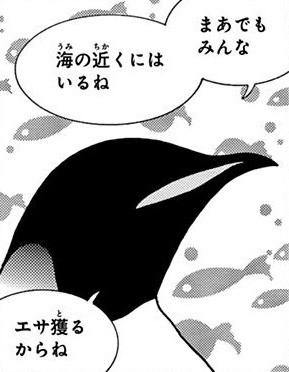
At the café, Panda is looking over picture cards of different penguin species with Penguin. He has just learned that Fiordland penguins live in forests, Humboldt penguins on sandy ground, and yellow-eyed penguins in grassland, and says his picture of penguins is starting to change.
- ペンギンさん:
- 「まあでも みんな海の近くにはいるね」
- “Well, we all live near the sea, though.”
- 「エサ獲るからね」
- “That's where we catch our food.”
Panda has just learned that some penguins live in forests, on sand, or in grassland, and says his picture of penguins is changing. Penguin explains why they all still live near the sea: エサ獲るからね. エサ(を)獲る is “catch food”.
Example 2 of 4: Catching char with 獲れる
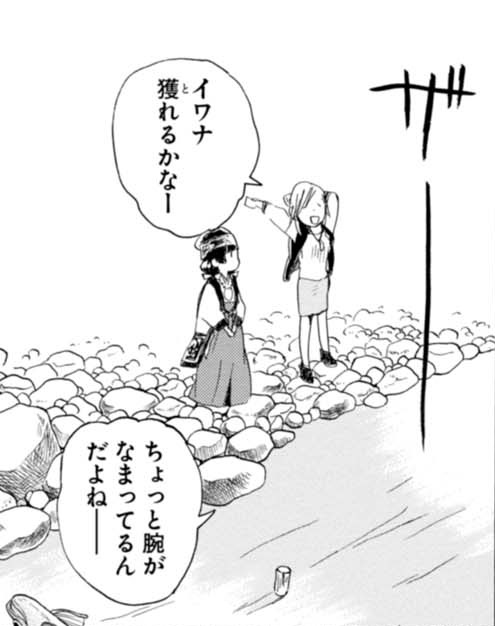
Machi wants to learn to chat with Hibiki, so she practices on Natsu, calling him ひびきちゃん. The talk keeps stalling. When Natsu comes back from the bathroom, Machi sees him as Hibiki, and the conversation suddenly flows. “Hibiki” suggests they get something to eat and leads Machi off to the river.
- ナツ:
- 「イワナ獲れるかなー」
- “Wonder if I can catch some char!”
- 「ちょっと腕がなまってるんだよねー」
- “I'm a little out of practice, though.”
Machi has been practicing small talk on Natsu, picturing him as Hibiki, and “Hibiki” leads her to the river for something to eat. 獲れる, the potential of 獲る, is “can catch”, and イワナ獲れるかな is “Wonder if I can catch some char”.
Example 3 of 4: Catching a big boar with 獲れる
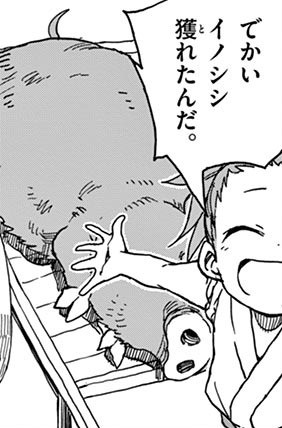
Sazanka has slipped out of class to go see Tsubaki, and Asagao has been told she gets no dinner unless she brings Sazanka back. Asagao chases her across the rooftops. Sazanka tries to buy her off with more dried sweet potatoes than dinner would give her, and Asagao asks for time to think it over. Below them, Higuruma cups a hand to her mouth and calls up to them, telling them to listen and rejoice. Then she builds up to her news.
- ヒグルマ:
- 「でかいイノシシ獲れたんだ。」
- “A huge wild boar got caught!”
Sazanka and Asagao are squabbling on a rooftop when Higuruma calls up to them with news, a huge wild boar lying beside her. 獲れた, from 獲れる, is “got caught”, with the boar as the subject: でかいイノシシ獲れたんだ is “a huge wild boar got caught!”
Example 4 of 4: The superb fish caught here with 獲れる
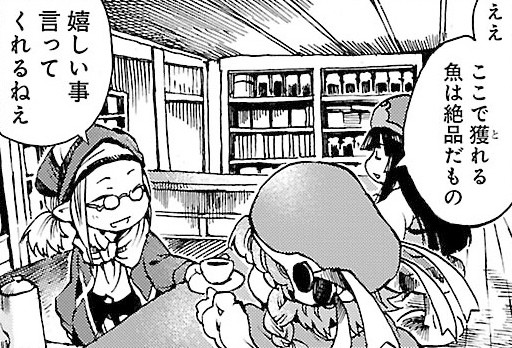
Hakumei and Mikochi are shopping in the port town of Arabi, known for its stacked market, and Mikochi has filled both their baskets with fish. She takes Hakumei to her regular café to leave the shopping there. The master, who hasn’t opened yet, teases her about how much she bought and asks whether she’s stocking up for her cooking again.
- ミコチ:
- 「ええ ここで獲れる魚は絶品だもの」
- “Yes. The fish they catch here are superb, after all.”
- マスター:
- 「嬉しい事言ってくれるねえ」
- “Now that's nice to hear.”
Mikochi has filled two baskets at the port town’s market, and the café master asks if she’s stocking up again. She says the local fish is superb. ここで獲れる魚 is “the fish caught here”.
Stealing with 盗る
盗る is stealing, as in 財布を盗られる, “have your wallet stolen”. The kanji is the 盗 of 盗む, “steal”, and 強盗, “robbery”. The 常用漢字表 gives no とる for 盗, and its only kun reading is ぬすむ, so writing that keeps to the list uses 取る or 盗む. デジタル大辞泉 notes 盗る under its 取る entry, as another way to write the stealing sense.
Manga write 盗る when the point is theft. 取る covers that too, as 大辞泉’s own example 現金だけ取られた shows. In this site’s manga corpus, forms of 盗られる turn up more than 100 times, and forms of 取られる far more often, since 取 covers every kind of taking.
1 source
と・る【取る/執る/採る/捕る/撮る】
…
3 … ㋓(「盗る」とも書く)人のものを無理に自分のものとする。盗む。奪う。「力ずくで財布を―・る」「現金だけ―・られた」とる, written 取る, 執る, 採る, 捕る, or 撮る. ... 3. Also written 盗る: take someone's things by force; steal; rob. "Take someone's wallet by force." "Only the cash was taken."
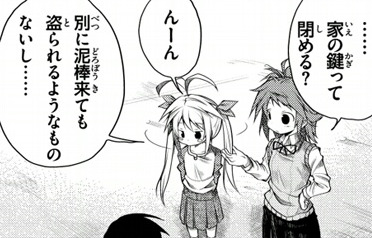
Hotaru moved from a school in Tokyo to the village’s tiny school this year. In the middle of a game of dodgeball, Renge finds a key on the ground, and Hotaru says it’s hers. Nobody will be home until night, so she brought her house key with her. Natsumi stares at her, puzzled, and then turns to Renge.
- 夏海:
- 「……家の鍵って閉める?」
- “...Do you lock your house?”
- れんげ:
- 「んーん」
- “Nuh-uh.”
- 「別に泥棒来ても盗られるようなものないし……」
- “Even if a burglar came, there's nothing worth stealing...”
Hotaru, new from Tokyo, carries her house key, and Natsumi asks Renge if she locks her house. Renge shakes her head: even if a burglar came, there’s nothing to steal. 盗られるようなもの is “anything that would get stolen”.
When the Spellings Overlap
The five spellings write one word. デジタル大辞泉 lists them under a single headword and marks the senses that take 執, 採, 捕, or 撮, much as the guide does.
Catching fish is the guide’s own overlap. It gives 魚を取る, as getting something, and allows 捕, as catching. Manga lean away from 取 here: in this site’s manga corpus, 魚を獲る and 魚を捕る both outnumber 魚を取る. With a ball, 捕 stresses the catch and 取 stresses getting hold of it, and manga use both. 虫とり comes as 虫取り, 虫捕り, 虫採り, and kana.
If you’re unsure, 取 is the broad spelling: the guide itself allows 取 for catching fish, and デジタル大辞泉 lists gathering nuts under plain 取る. Learn set phrases with their own kanji as they come up: 写真を撮る, 決を採る, 指揮を執る. Kana is always an option.
1 source
「魚をとる」の「とる」は「手に入れる」という意で「取」を当てるが,「つかまえる」という視点から捉えて,「捕」を当てることもできる。
For the とる in "catch fish", 取 is used in the sense of "get", but 捕 can also be used, seeing it as "catch".
When とる Stays in Kana
Kana works for every とる, and the 2014 guide says its spelling examples don’t rule out writing a word in kana where it suits. Manga leave many everyday とる in kana. In this site’s manga corpus, 食事をとる, “have a meal”, is in kana more often than with any kanji.
1 source
また,この使い分け例は,必要に応じて,仮名で表記することを妨げるものでもない。
These examples of usage also do not stand in the way of writing a word in kana where needed.
Check Yourself
Guess the Meaning from the Kanji
Each spelling's kanji points at one sense of とる. Say what each one means, then open it.
取る
hold in the hand; get; write down; remove採る
gather; take on, as staff; adopt執る
take up and use; carry out duties捕る
catch撮る
take a photo or film獲る
catch game; win a prize or a titleoff-list盗る
stealoff-list
Pick the Spelling
Each phrase has とる in kana. Decide which kanji fits, then open it.
本を手にとる
本を手に取る. 取る: hold in the hand; get; write down; remove.
きのこをとる
きのこを採る. 採る: gather; take on, as staff; adopt.
筆をとる
筆を執る. 執る: take up and use; carry out duties.
ねずみをとる
ねずみを捕る. 捕る: catch.
写真をとる
写真を撮る. 撮る: take a photo or film.
金メダルをとる
金メダルを獲る. 獲る: catch game; win a prize or a title. An off-list spelling.
財布をとられる
財布を盗られる. 盗る: steal. An off-list spelling.
メモをとる
メモを取る. 取る: hold in the hand; get; write down; remove.
新卒をとる
新卒を採る. 採る: gather; take on, as staff; adopt.
指揮をとる
指揮を執る. 執る: take up and use; carry out duties.
ボールをとる
ボールを捕る. 捕る: catch.
映画をとる
映画を撮る. 撮る: take a photo or film.
天下をとる
天下を獲る. 獲る: catch game; win a prize or a title. An off-list spelling.
決をとる
決を採る. 採る: gather; take on, as staff; adopt.
Spell a Manga Line
Woody has lost his map partway through his deliveries. Which kanji fits とりに?
「でも 本部まで地図をとりに戻る時間がないのだぁ!」
Show the answer
取りに. Going back to get a map is getting something in hand, so it’s the default 取. “But I don’t have time to go back to headquarters to get a map!!”
Kumada is listing the bear’s habits. Which kanji fits とりたがる?
「毎度 食事の写真をとりたがる」
Show the answer
撮りたがる. A photo is the clearest case of all: 撮, the 撮 of 撮影. “It always wants to take photos of its meals.”
Chino doesn’t want Cocoa to overdo it. Which kanji fits とろう?
「その…責任とろうと無理しないでください」
Show the answer
取ろう. Taking responsibility on yourself is one of 取’s own senses, with no camera, catch, harvest, or command in sight, so it’s the default 取. “Um… Please don’t push yourself trying to take responsibility.”
Rize explains why Chino is upset about the finished puzzle. Which kanji fits とられて?
「楽しみがとられてショックだろうな」
Show the answer
取られて. Nothing was stolen, just a pleasure taken away, so it’s 取, not 盗. “She must be shocked that she had her fun taken away.”