Turning and surroundings with まわり
まわり has two official spellings. 回り comes from the verb 回る, “turn” or “go around”: turning, making the rounds, or going the long way. 周り is the area around something, such as the people around you or the edge of a pond.
A quick test: if you could say 周囲, “surroundings”, write 周. If it’s about turning or going around, write 回. The guide also gives 回 to your personal things, 身の回り, and to body measurements such as 胴回り. Both are official, so they show up in formal writing as well as in manga. Same reading, different kanji explains where the official list comes from.
The Spellings at a Glance
| Spelling | Used for | Standing |
|---|---|---|
| 回り | turning; what's around you; the girth of something round | Official |
| 周り | the surroundings | Official |
Turning and Making the Rounds with 回り
回り is the noun of 回る, so it’s about turning and going around. 時計回り is “clockwise”, 遠回り is “a roundabout way”, and 見回り is “a patrol”. After the name of a place or the purpose of a visit, 〜回り can mean making the rounds, as in 挨拶回り, “a round of courtesy calls”. The guide also puts the things close at hand here, as in 身の回り, “your personal things”, and the distance around something cylindrical, as in 胴回り, “waist size”.
一回り, “one step in size”, is another 回り, as in 一回り大きい, “a size bigger”. Manga usually use 回 for movement. In this site’s manga corpus, 遠回り turns up more than 150 times and 時計回り dozens, and neither is ever written with 周.
1 source
【回り】回転。身辺。円筒形の周囲。
モーターの回りが悪い。回り舞台。時計回り。身の回り。胴回り。首回り。回り: turning. Your personal surroundings. The distance around something cylindrical. "The motor turns poorly." "A revolving stage." "Clockwise." "Your personal things." "Waist size." "Neck size."
Example 1 of 2: Feeling you've gained weight with 〜気がする
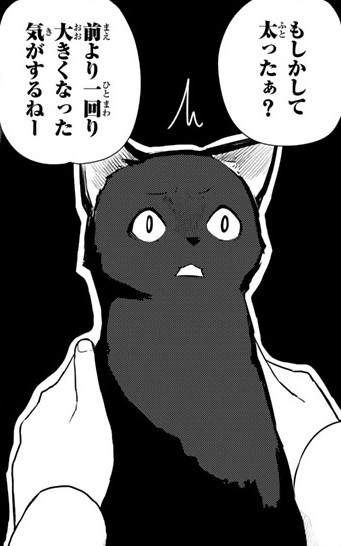
Nao sees Makoto’s cat, Chito. She stops to pet the cat when she notices something.
- なお:
- 「もしかして太ったぁ?前より一回り大きくなった気がするねー」
- “Could it be you've gotten fatter? I feel you've grown a size bigger than before.”
Nao stops to pet Chito and wonders whether the cat has put on weight. 一回り大きく is “a size bigger”, the 〜回り that compares sizes.
Example 2 of 2: Visiting teahouses with お茶屋さん
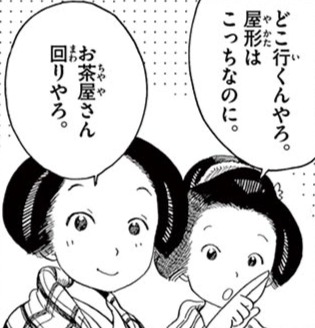
A couple of maiko see Momohana leave a shop and head in the other direction.
- まいこ1:
- 「どこ行くんやろ。屋形はこっちなのに。」
- “I wonder where she's going. The lodge is this way, though.”
- まいこ2:
- 「お茶屋さん回りやろ。」
- “She's probably doing the teahouse rounds.”
Two maiko watch Momohana head away from their lodge, and one guesses she’s making the rounds of the teahouses. お茶屋さん回り is “a round of teahouse visits”, 〜回り after the places visited.
What Surrounds You with 周り
周り is what lies around something. 池の周り is “around the pond”, 家の周り is “around the house”, and 目の周り is “around the eyes”. On its own, 周り often means the people around you: 周りの人, “the people around you”, and 周りの目, “what others think”. The kanji is the 周 of 周囲, “surroundings”.
Manga usually use 周 for this. In this site’s manga corpus, 周りの人 turns up more than 200 times against a single 回りの人間, and 周りの目 is never written with 回.
1 source
【周り】周囲。周辺。
池の周り。周りの人。周りの目が気になる。学校の周りには自然が残っている。周り: the surroundings. The vicinity. "Around the pond." "The people around you." "Worry about what others think." "There's still nature around the school."
Example 1 of 2: Not letting anyone find out with 〜ないようにしろ
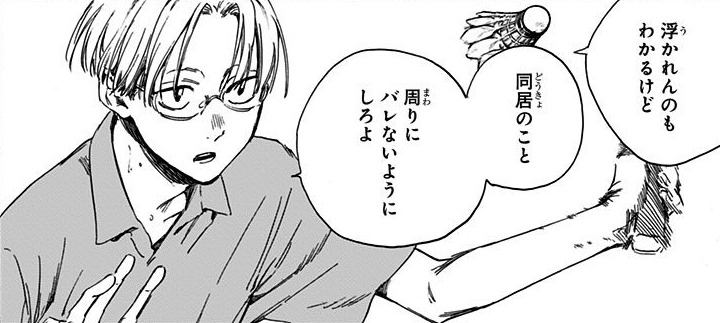
Chinatsu has moved into Taiki’s family’s house. At badminton practice the next day, he’s in high spirits. His friend Kyou is aware of the living arrangement.
- 匡:
- 「浮かれんのもわかるけど」
- “I get why you're walking on air, but...”
- 「同居のこと周りにバレないようにしろよ」
- “...make sure nobody around here finds out you two live together.”
Kyou knows Chinatsu has moved in with Taiki’s family, and he warns Taiki not to let anyone else find out. 周り here is the people around them at school.
Example 2 of 2: Hesitant to wear contacts with 抵抗
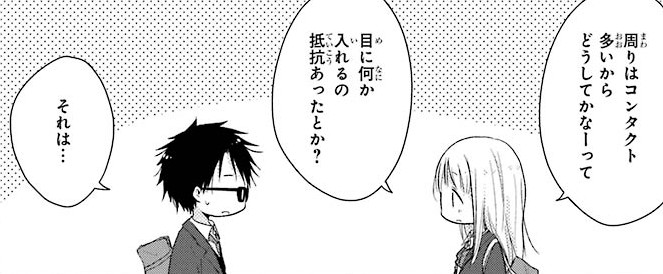
Seeing Shun again for the first time in seven years, Sana notices he’s now wearing glasses. She asks him why he doesn’t wear contacts.
- 紗奈:
- 「周りはコンタクト多いからどうしてかなーって」
- “Most people wear contacts, so I was kind of wondering why.”
- 「目に何か入れるの抵抗あったとか?」
- “Is it because you're hesitant with putting something in your eye?”
- 駿:
- 「それは…」
- “Well...”
Seeing Shun again after seven years, Sana notices his glasses and asks why he doesn’t wear contacts, since so many people around her do. 周りは is “the people around her”.
When the Spellings Overlap
The two spellings write one word. デジタル大辞泉 lists them under a single headword, labels the surroundings sense “usually written 周り”, and writes turning, the rounds, routes, and the size suffix with 回り.
Two of the guide’s 回り senses sit close to surroundings, so manga sometimes write 周 for them. 身の回り, “your personal things”, keeps 回 about five times as often as 周 in this site’s manga corpus. Body measurements are the guide’s “distance around something cylindrical”. 首回り and 胴回り mostly keep 回, but 腰回り, “hip size”, is also the area around the hips, and manga split on it. 大辞泉 puts the length around an edge under 周り, which helps explain spellings like 腰周り.
For everything else, ask where the word comes from. If it grows out of turning or going around, it’s 回. If it’s the area around something, it’s 周.
1 source
まわり〔まはり〕【回り/×廻り/周り】
1 (回り・廻り)まわること。まわり方。転じて、ものの働きぐあい。「モーターの―が悪い」「頭の―が早い」
2 (ふつう「周り」と書く)
㋐そのものの外側の縁の部分。また、その長さ。周囲。ぐるり。「湖の―に沿った道」
㋑そのものを囲んでいる近くの部分。近辺。周辺。あたり。「口の―をふく」「―に迷惑をかける」まわり, written 回り, 廻り, or 周り. 1. Written 回り or 廻り: turning, or how something turns, and from that, how well something works. "The motor turns poorly." "Be quick-witted." 2. Usually written 周り: the outer edge of something, or its length; the circumference. "A road along the edge of the lake." The area close around something; the vicinity. "Wipe around your mouth." "Bother the people around you."
When まわり Stays in Kana
Kana works for every まわり, and the 2014 guide says its spelling examples don’t rule out writing a word in kana where it suits. Manga use kana for まわり a lot. In this site’s manga corpus, まわり in kana before a particle such as の or に turns up about a third as often as 周り, and 口のまわり, “around the mouth”, is more common in kana than in kanji.
Check Yourself
Guess the Meaning from the Kanji
Each spelling's kanji points at one sense of まわり. Say what each one means, then open it.
回り
turning; what's around you; the girth of something round周り
the surroundings
Pick the Spelling
Each phrase has まわり in kana. Decide which kanji fits, then open it.
身のまわり
身の回り. 回り: turning; what's around you; the girth of something round.
池のまわり
池の周り. 周り: the surroundings.
首まわり
首回り. 回り: turning; what's around you; the girth of something round.
まわりの人
周りの人. 周り: the surroundings.
Spell a Manga Line
Nao is petting Chito and notices something. Which kanji fits ひとまわり?
「もしかして太ったぁ?前よりひとまわり大きくなった気がするねー」
Show the answer
一回り. 〜回り is the usual spelling for size comparisons, and it’s the spelling in Nao’s line. “Could it be you’ve gotten fatter? I feel you’ve grown a size bigger than before.”
Two maiko watch Momohana walk off in the opposite direction from their lodge. Which kanji fits まわり?
「お茶屋さんまわりやろ。」
Show the answer
回り. Making the rounds of several places is going around, so it’s 回, like 挨拶回り. “She’s probably doing the teahouse rounds.”
Kyou gets why Taiki is excited, but he has a warning. Which kanji fits まわり?
「同居のことまわりにバレないようにしろよ」
Show the answer
周り. The people around them are their surroundings, so it’s 周, like the guide’s 周りの人. “Make sure nobody around here finds out you two live together.”
Sana wonders why Shun wears glasses instead of contacts. Which kanji fits まわり?
「まわりはコンタクト多いからどうしてかなーって」
Show the answer
周り. Sana means the people around her, so it’s 周. “Most people wear contacts, so I was kind of wondering why.”