Ways of opening with あく and あける
あく and its partner あける have three official spellings. 開く is something closed coming open, such as a door, a box, or your eyes. 空く is a space becoming empty or free, such as a seat, a room, or your hands. 明ける is a night or a season coming to an end. For 開 and 空, あく is intransitive and あける is transitive: ドアが開く is “the door opens”, and ドアを開ける is “open the door”. 明ける breaks the pattern: when a period ends, as in 夜が明ける, it has no object.
All three are official, so they show up in formal writing as well as in manga. Same reading, different kanji explains where the official list comes from.
The Spellings at a Glance
| Spelling | Used for | Standing |
|---|---|---|
| 明く・明ける | open so you can see; come to an end, as a night or a period | Official |
| 空く・空ける | become empty or free | Official |
| 開く・開ける | open | Official |
Opening Doors with 開く and 開ける
開く is something that was shut coming open: a door, a window, a lid, a shop, a theater curtain, your eyes or your mouth. The official guide explains it with a single word, ひらく. It’s by far the most common of the three in manga. In this site’s manga corpus, the spelling 開ける turns up about six times as often as 明ける and ten times as often as 空ける.
開く can also be read ひらく, and furigana or context usually tells you which. デジタル大辞泉 says 窓を開ける and 窓を開く mean the same thing. 開ける is moving a lid or other barrier out of the way, as in ふたを開ける, while 開く is spreading out something folded or closed, as in 本を開く.
1 source
「窓を開ける(開く)」は相通じて用いられる。◇「開ける」は空間をふさいでいる仕切りや覆いなどを取り除く意で、「ふたを開ける」「かばんを開ける」のように用いる。◇「開く」は「包みを開く」「本を開く」のように、重ねて結び合わせたり、折り畳んだりしてあるものを広げて、中が見えるようにすること。
"Open the window" works with either 開ける or 開く. 開ける means removing a partition or a cover that closes off a space, as in "open a lid" or "open a bag". 開く means spreading out something folded, or stacked and tied together, so that you can see inside, as in "unwrap a package" or "open a book".
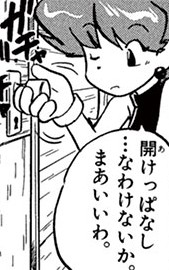
Blue tries to sneak into Masaki’s cottage, but the door is locked.
- ブルー:
- 「開けっぱなし…なわけないか。まあいいわ。」
- “There's no way it'd be left unlocked. Well, that's fine.”
Blue tries the door of Masaki’s cottage and finds it locked. 開けっぱなし is “left open”, and she knew it was too much to hope for.
Making Room with 空く and 空ける
空く is a space becoming empty or free to use: a seat, a room, a house, or your hands. It’s the 空 of 空き缶, “empty can”, and 空き家, “empty house”. 家を空ける is being away from home, and 手が空く is having your hands free, or being done with work.
Manga keep to 空 for these. In this site’s manga corpus, 手が空く and 席が空く never turn up written with 開.
空く has a second reading to watch for. 空く is a place getting less crowded, or your stomach getting empty, as in お腹が空いた. So 空いてる can be あいてる, “free”, or すいてる, “not crowded”, and furigana or context usually tells you which. 手が空く can also be read 手が空く, with the same meaning.
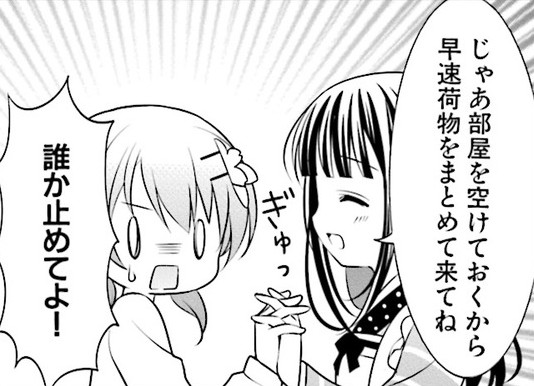
After Cocoa suggests if she were staying at Chiya’s place rather than Chino’s, that she’d be working for Chiya’s family’s tea house, Chiya takes to the idea.
- 千夜:
- 「じゃあ部屋を空けておくから早速荷物をまとめて来てね」
- “Then I'll clear out a room in advance, so go gather your things and come right away.”
- ココア:
- 「誰か止めてよ!」
- “Somebody stop her!”
Chiya likes the idea of Cocoa working at her family’s tea house. She says she’ll clear out a room in advance and tells Cocoa to gather her things and come right away. 部屋を空ける is emptying a room so someone else can use it.
When a Hole Takes Either Kanji
デジタル大辞泉 files 穴があく, “a hole forms”, under 空く, in the sense of something that filled a place being gone. Manga don’t agree on it. In this site’s manga corpus, 穴が開く and 穴が空く come up about equally, and for making a hole, 穴を開ける leads 穴を空ける about 2:1.
With ピアス as the object, the corpus never uses 空. When manga use a kanji for it, they write ピアスを開ける. The pierced hole itself can still go either way, as in 耳に穴空いてない, “no holes in my ears”.
1 source
(空く)今までそこを占めていたもの、ふさいでいたものが、除かれたり、なくなったりする。㋐穴ができる。「胃壁に穴が―・く」
Written 空く: something that filled or blocked a place is removed or gone. A hole forms. "A hole opens in the stomach wall."
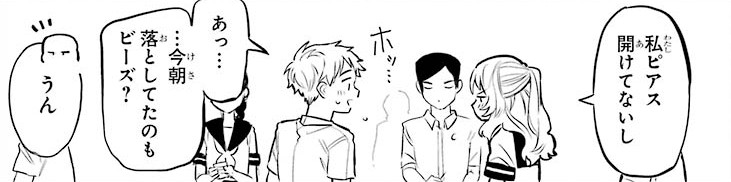
Komura sees Mie pick up an item she dropped and he wonders if it’s an earring. During class later, Mie shows Komura the item held up to her ear calling it a 「ピアス」. She then reveals it’s just a bead.
- 三重:
- 「私ピアス開けてないし」
- “Since I don't have my ears pierced.”
- 小村:
- 「あっ… …今朝落としてたのもビーズ?」
- “Ah... the thing you dropped this morning was a bead too?”
- 三重:
- 「うん」
- “Mmhm.”
Mie shows Komura what looks like an earring, then admits it’s only a bead. Her ears aren’t pierced. ピアス開けてない is “I don’t have pierced ears”, with the を dropped.
Dawn and Endings with 明く and 明ける
明ける is a stretch of time coming to an end. 夜が明ける is the night ending as dawn breaks, 年が明ける is the new year coming in, and 梅雨が明ける is the rainy season ending. The New Year greeting あけましておめでとう comes from this sense.
The guide gives 明く two more jobs. One is eyes that open and begin to see, as in 子犬の目が明く, “the puppy’s eyes open”. The other is something that was blocking the way going away, as in らちが明かない, “getting nowhere”. 打ち明ける, “confide”, takes 明 as well. For opening your own eyes, the guide itself writes そっと目を開ける, and manga agree: 目を開ける outnumbers 目を明ける about 150:1.
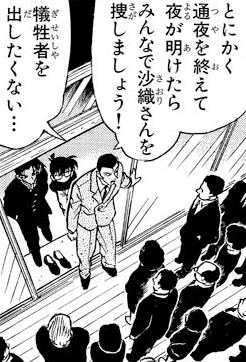
Another woman has been strangled during a wake, and the killer took her Dugong Arrow, a sacred arrow from the island’s festival. Saori is still missing, and she had also lost her arrow. Her father sneers that she may have turned into a mermaid. Kazuha shudders as she recalls the island’s old woman warning that a girl who lets go of her arrow will return to the water as a mermaid.
- 小五郎:
- 「とにかく通夜を終えて夜が明けたらみんなで沙織さんを捜しましょう!」
- “Anyway, let's get through the wake, and once the sun comes up, we'll all search for Saori!”
- 「犠牲者を出したくない…」
- “I don't want any more victims...”
Another woman has died during a wake, and Saori is still missing. Kogoro says they’ll all search for her once the sun is up. 夜が明けたら is “once night is over”.
When あく Stays in Kana
Kana works for every あく and あける, and the 2014 guide says its spelling examples don’t rule out writing a word in kana where it suits. Two set phrases show how often manga do. あけましておめでとう is in kana about 7:2, and in らちがあかない the あく is in kana about twice as often as it’s written with 明.
Check Yourself
Guess the Meaning from the Kanji
Each spelling's kanji points at one sense of あく・あける. Say what each one means, then open it.
明く・明ける
open so you can see; come to an end, as a night or a period空く・空ける
become empty or free開く・開ける
open
Pick the Spelling
Each phrase has あく・あける in kana. Decide which kanji fits, then open it.
子犬の目があく
子犬の目が明く. 明く・明ける: open so you can see; come to an end, as a night or a period.
席があく
席が空く. 空く・空ける: become empty or free.
幕があく
幕が開く. 開く・開ける: open.
夜があける
夜が明ける. 明く・明ける: open so you can see; come to an end, as a night or a period.
時間をあける
時間を空ける. 空く・空ける: become empty or free.
ドアがあかない
ドアが開かない. 開く・開ける: open.
年があける
年が明ける. 明く・明ける: open so you can see; come to an end, as a night or a period.
窓をあける
窓を開ける. 開く・開ける: open.
Spell a Manga Line
Chiya has decided Cocoa will work at her family’s tea house. Which kanji fits あけて?
「じゃあ部屋をあけておくから早速荷物をまとめて来てね」
Show the answer
空けて. Chiya isn’t opening a door. She’s emptying a room so Cocoa can use it, which is 空ける, making a space free. “Then I’ll clear out a room in advance, so go gather your things and come right away.”
Another woman has died during the wake, and Kogoro is planning the search. Which kanji fits あけたら?
「とにかく通夜を終えて夜があけたらみんなで沙織さんを捜しましょう!」
Show the answer
明けたら. The night is a stretch of time coming to an end, which is 明ける. It’s the same 明 as in あけましておめでとう. “Anyway, let’s get through the wake, and once the sun comes up, we’ll all search for Saori!”
Blue has just tried the door of Masaki’s cottage and found it locked. Which kanji fits あけ?
「あけっぱなし…なわけないか。まあいいわ。」
Show the answer
開け. A door that was shut coming open is 開ける, and 開けっぱなし is “left open”. “There’s no way it’d be left unlocked. Well, that’s fine.”
Mie’s earring turns out to be a bead. A pierced hole is a hole, so manga could pick either kanji for あけて. Which one do they use?
「私ピアスあけてないし」
Show the answer
開けて. In this site’s manga corpus, ピアスを開ける never takes 空, though a hole elsewhere can go either way. The を is dropped here. “Since I don’t have my ears pierced.”