Ways to say no in Japanese
Japanese expressions translated as “no” include an array of more specific responses. The word a character uses reveals what kind of refusal they mean and how they feel about it.
いいえ: A Clear Contradiction
いいえ rejects the content of a question or statement.
ご注文はうさぎですか? »
Volume 1 » Page 11
Cocoa tries to show off her ability to recognize the three types of coffee Chino made for her.
ココア:
「この上品( じょうひん ) な香( かお ) り! これがブルーマウンテンかー」
“What a refined aroma! So this is Blue Mountain, huh?”
チノ:
「いいえ コロンビアです」
“No, that's Columbian.”
Challenge Yourself
Show translation
Challenge
What does ココア mean in the highlighted line?
Clues
これ
これ points to the coffee Cocoa is holding
What does the speaker mean?
What a refined aroma! So this is Blue Mountain, huh?
これ means "this" because the cup of coffee is on Cocoa's side of the conversation, close to her as the speaker.
Cocoa correctly identifies the coffee as Blue Mountain.
The highlighted form is これ. Here これ points to the coffee Cocoa is holding, so this choice does not match the Japanese.
Cocoa uses これ for a cup that is beside Chino rather than herself.
The highlighted form is これ. Here これ points to the coffee Cocoa is holding, so this choice does not match the Japanese.
Cocoa says the refined aroma proves the coffee is Colombian.
The highlighted form is これ. Here これ points to the coffee Cocoa is holding, so this choice does not match the Japanese.
これ points to the coffee Cocoa is holding. これ means “this” because the cup of coffee is on Cocoa’s side of the conversation, close to her as the speaker.
View Full Example
いえ is a shortened form.
それでも歩は寄せてくる »
Volume 1 » Page 33
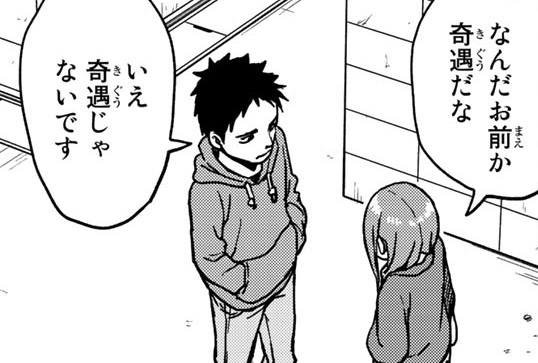
On her way home from grocery shopping, Urushi sees Ayumu from shogi club at school.
うるし:
「なんだお前( まえ ) か 奇遇( きぐう ) だな」
“Oh, it's you. What a coincidence.”
歩( あゆむ ) :「いえ 奇遇( きぐう ) じゃないです」
“No, it's not a coincidence.”
Challenge Yourself
Show translation
Challenge
How do Urushi and Ayumu interpret their meeting differently?
Clues
奇遇( きぐう ) だなUrushi comments that their meeting is a coincidence
奇遇( きぐう ) じゃないですAyumu politely but directly says it is not a coincidence
What does the speaker mean?
Urushi calls it a chance encounter, but Ayumu says it was not chance.
Ayumu repeats Urushi's word 奇遇( きぐう ) and negates it with じゃないです.
They both agree that meeting there was a coincidence.
Ayumu explicitly denies Urushi's description with 奇遇( きぐう ) じゃないです.
Ayumu calls it a coincidence, while Urushi says she planned it.
This reverses the speakers. Urushi says 奇遇( きぐう ) だな, and Ayumu denies it.
Urushi does not recognize Ayumu at first, and he introduces himself.
なんだお前( まえ ) か shows that she recognizes him as she reacts.
Ayumu says they have never met outside school before.
He comments only that this meeting is not a coincidence. He does not discuss their past meetings.
Urushi thinks the encounter is strange, while Ayumu says it is ordinary.
奇遇( きぐう ) specifically means a coincidental encounter here, not merely something strange.
Urushi treats seeing Ayumu as 奇遇( きぐう ) , a chance meeting. Ayumu immediately answers 奇遇( きぐう ) じゃないです, revealing that he does not see the encounter as accidental.
View Full Example
The repeated いえいえ often dismisses praise or thanks and can mean “not at all”. In that use, the speaker rejects the need for gratitude or denies the compliment.
よつばと! »
Volume 1 » Page 45
Yousuke’s daughter Yotsuba wanders off while he’s moving things into their new home. One of his new neighbors offers to keep an eye out for her. Later, he finds Yotsuba outside with the neighbors.
葉介( ようすけ ) :「あぁ連( つ ) れて帰( かえ ) ってくれたんだね」
“Ah, so you brought her back home.”
「どうもありがとう 」
“Thank you so much.”
あさぎ:
「いえいえ 私( わたし ) はたいした事( こと ) はなにも」
“No, no, it was nothing at all.”
恵那( えな ) :「ただいま…」
“I'm home...”
Challenge Yourself
Show translation
Challenge
What is Yousuke thanking the neighbors for?
Clues
連( つ ) れて帰( かえ ) ってくれたんだねhe realizes that they kindly brought Yotsuba back home
どうもありがとう
a warm expression of thanks for that help
What does the speaker mean?
Bringing Yotsuba back home.
連( つ ) れて帰( かえ ) ってくれた names the helpful action, and くれた presents it as a favor Yousuke received.
Helping him move furniture into the house.
The thanks follows Yousuke's realization that the neighbors brought his daughter back, not help with the move.
Inviting Yotsuba to stay for dinner.
帰( かえ ) ってくれた concerns returning her home. No dinner invitation is mentioned.
Finding a missing box from the move.
The person brought back is Yotsuba. The line does not refer to an object or box.
Introducing themselves to Yotsuba.
Yousuke thanks them for taking care of Yotsuba and returning her, not simply meeting her.
Watching his house while he went outside.
The kindness marked by くれた is bringing Yotsuba home, not guarding the house.
Yousuke realizes that his new neighbors found Yotsuba and brought her back. He recognizes that favor with くれた and then thanks them warmly with どうもありがとう.
View Full Example
ううん: Casual No
ううん is a casual negative response used among friends, family, and other familiar characters. It corresponds to “no”, “nope”, or “uh-uh”. Its affirmative counterpart is うん.
カードキャプターさくら »
Volume 2 » Page 19
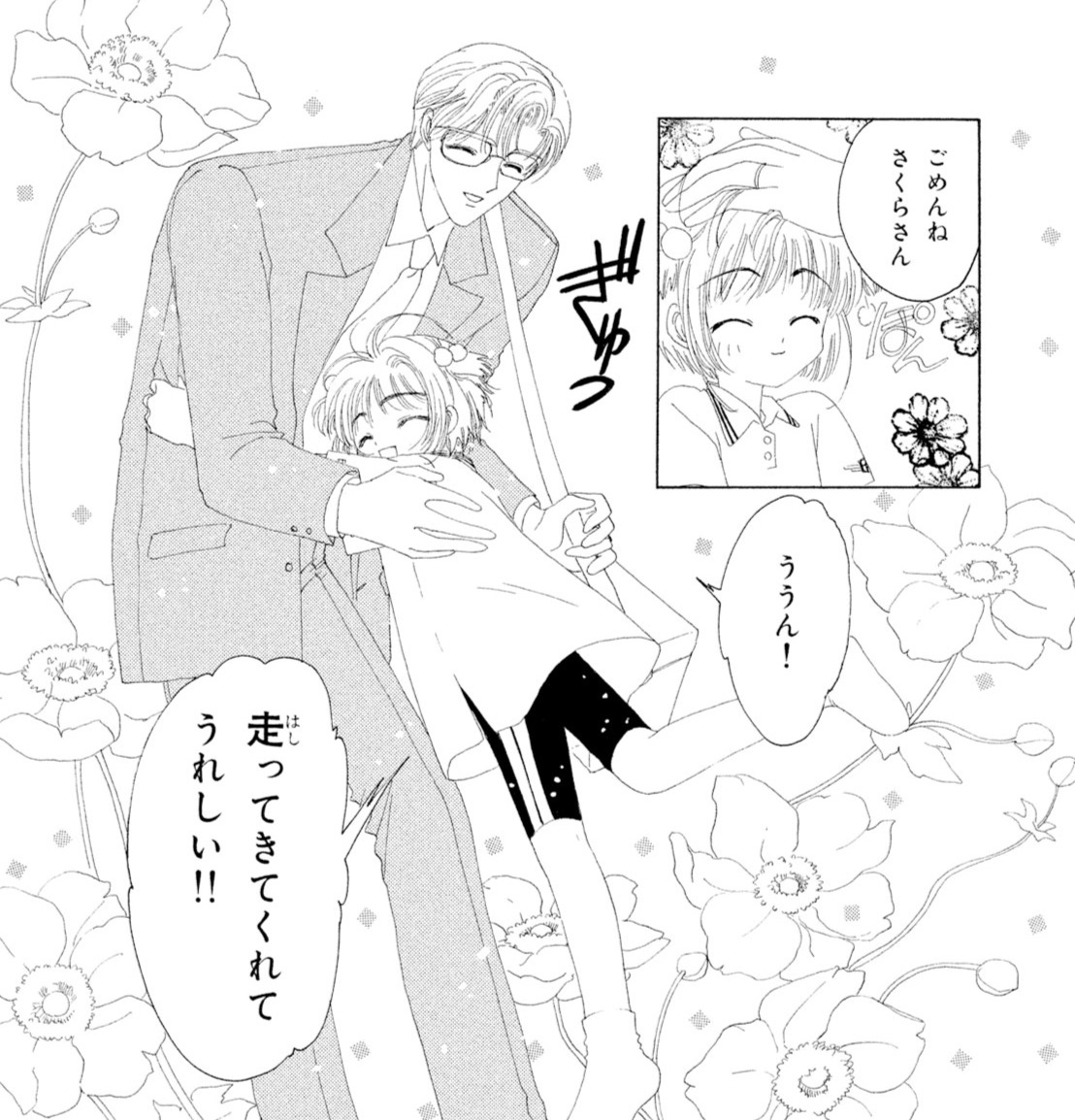
Sakura’s older brother and his friend show up for her school’s sports day event. During their picnic lunch, Sakura’s father runs up to the group and apologizes for missing the cheerleading event Sakura participated in. Tomoyo assures him she recorded it on video, and Yukito says he took photographs.
藤隆( ふじたか ) :「ごめんね さくらさん」
“I'm sorry, Sakura.”
桜( さくら ) :「ううん !」
“No, no!”
「走( はし ) ってきてくれてうれしい!!」
“I'm so glad you came running over!!”
Challenge Yourself
Show translation
Challenge
Why does Sakura say she is happy?
Clues
走( はし ) ってきてくれてher father came running over, an action Sakura received as a kindness
うれしい
happy or glad
What does the speaker mean?
Her father hurried over to join her at the sports day.
走( はし ) ってきて says he came running toward Sakura, and くれて presents his effort as something that made her happy.
Her father arrived in time to watch her cheerleading performance.
He apologizes because he missed the performance. Sakura is happy that he hurried over afterward.
Her father asked her to run in another event.
Her father is the person who came running. The line does not ask Sakura to run.
She was able to leave the sports day early with her father.
走( はし ) ってくる describes her father coming to her location. It says nothing about Sakura leaving.
Her father brought her something she had forgotten.
The kindness named in the line is his coming over quickly, not bringing an object.
She learned that her father had recorded the performance.
Sakura reacts to her father coming over. The line does not say that he made a recording.
Sakura is not upset that her father missed the performance. She is glad that he still rushed over to be with her, and 〜てくれて frames that effort as a kindness she received.
View Full Example
Do not confuse ううん with うーん , which represents thought or uncertainty. Spellings such as うーうん, んーん, and ううんっ can stretch or sharpen the delivery without changing the negative answer.
いや: Rejection or Correction
いや can reject another character’s claim, interrupt a line of thought, or introduce a correction. Depending on the delivery, translations include “no”, “wait”, “well”, and “I mean”.
ふだつきのキョーコちゃん »
Volume 1 » Page 11
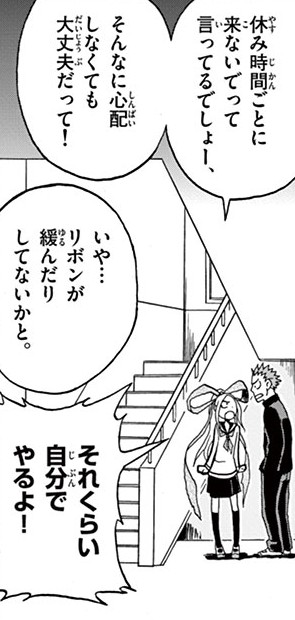
Due to concern about his sister’s ribbon, which seals away her need to attack people for their blood, Kenji takes every opportunity he can to check up on her in at school.
キョーコ:
「休( やす ) み時間( じかん ) ごとに来( こ ) ないでって言( い ) ってるでしょー、そんなに心配( しんぱい ) しなくても大丈夫( だいじょうぶ ) だって!」
“I'm telling you, you don't need to check up on me every break period. I'll be fine even without you worrying about me!”
ケンジ:
「いや … リボンが緩( ゆる ) んだりしてないかと。」
“No, I'm just checking whether your ribbon's come loose.”
キョーコ:
「それくらい自分( じぶん ) でやるよ!」
“I can handle that much on my own!”
Challenge Yourself
Show translation
Challenge
What does Kyouko want Kenji to stop doing?
Clues
休( やす ) み時間( じかん ) ごとに来( こ ) ないでdo not come to see her at every break
そんなに心配( しんぱい ) しなくても大丈夫( だいじょうぶ )
she will be fine without him worrying so much
What does the speaker mean?
Visiting her at every break to check the ribbon.
休( やす ) み時間( じかん ) ごとに means at every break, and 来( こ ) ないで tells Kenji not to keep coming.
Coming to school whenever the ribbon is loose.
Kenji worries that the ribbon might loosen, but Kyouko objects to his visits at every break, not emergency help.
Telling other students why she wears the ribbon.
The complaint concerns how often Kenji checks on her. She does not mention him revealing her secret.
Asking her to tighten the ribbon by herself.
Kyouko says she can handle that herself. Kenji is the one repeatedly coming to check it.
Worrying about her only after the school day ends.
Kyouko wants less constant worry. She does not ask him to move the same checks to after school.
Waiting until each break before returning to class.
ごとに marks repeated visits during every break, not a request to wait before going back to class.
Kyouko wants Kenji to stop checking on her during every break. He is worried that her ribbon might come loose, but she insists that she can manage it herself and will be fine without so much attention.
View Full Example
Lengthened いやあ may work as an emotional interjection rather than a negative answer.
名探偵コナン »
Volume 1 » Page 71
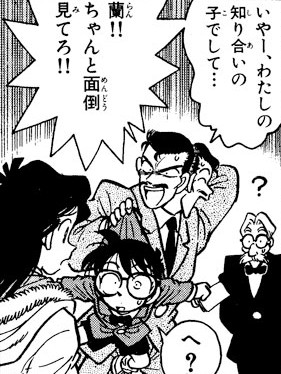
Conan and Ran end up with Kogoro investigating a kidnapping case. As Kogoro questions the butler, Conan steps in with his own questions. The butler asks who the child is.
小五郎( こごろ ) :「いやー 、わたしの知( し ) り合( あ ) いの子( こ ) でして…」
“Well, it's the child of an acquaintance, and...”
「蘭( らん ) !! ちゃんと面倒( めんどう ) 見( み ) てろ!!」
“Ran! Properly look after him!”
Challenge Yourself
Show translation
Challenge
What does Kogoro order Ran to do?
Clues
ちゃんと
properly
面倒( めんどう ) 見( み ) てろkeep looking after him
What does the speaker mean?
Watch Conan properly.
ちゃんと modifies the rough command 面倒( めんどう ) 見( み ) てろ, with Conan as the understood object.
Introduce Conan as her own child.
Kogoro has just described Conan as an acquaintance's child.
Let Conan question the butler alone.
He wants Ran to supervise Conan and keep him out of the questioning.
Ask the butler to look after Conan.
Kogoro addresses Ran directly and assigns the supervision to her.
Take Conan home immediately.
The command is to keep an eye on him, not necessarily to leave.
Explain the kidnapping case to Conan.
面倒( めんどう ) 見( み ) る means to look after someone, not explain a case.
Kogoro orders Ran to supervise Conan properly. The object is omitted because everyone knows that Conan is the child he means.
View Full Example
Repeated いやいや can reject an idea with emphasis.
それでも歩は寄せてくる »
Volume 11 » Page 122
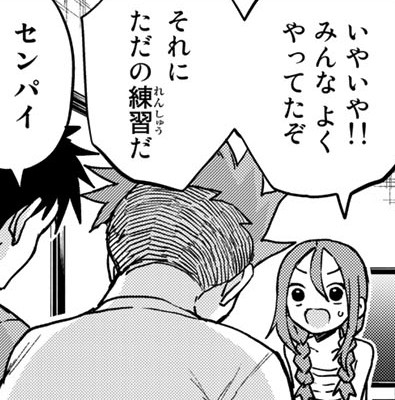
Urushi plays three shogi games at once against the other members of the shogi club. After she wins all three, she worries she has hurt their confidence right before the upcoming tournament.
うるし:
「いやいや !!みんなよくやってたぞ」
“No, no! You guys did great!”
「それにただの練習( れんしゅう ) だ」
“Besides, it's just practice.”
Challenge Yourself
Show translation
Challenge
How does Urushi try to reassure the club members after beating them?
Clues
みんなよくやってたぞ
"Everyone played well," praising their performance.
それに
"besides" or "in addition," adding another reassuring reason
ただの練習( れんしゅう ) だ
"It is only practice," downplaying the importance of the losses.
What does the speaker mean?
She praises their play and reminds them that it was only practice.
Urushi first says みんなよくやってたぞ, then uses それに to add ただの練習( れんしゅう ) だ as a second reassurance.
She says they played badly but will improve before the tournament.
Urushi says they played well. She does not criticize their performance or promise future improvement.
She claims the games did not count because she broke the rules.
ただの練習( れんしゅう ) だ downplays the matches as practice, not as invalid games.
She asks them to practice without her next time.
The line reassures them about the games they just played. It does not propose a new practice arrangement.
She warns that the tournament will be much harder.
There is no warning about the tournament's difficulty in these lines.
She says winning three games at once was easy for her.
Urushi focuses on protecting their confidence, not boasting about her own win.
Urushi reassures the group in two steps. She tells them they played well, then adds それにただの練習( れんしゅう ) だ, besides, it was only practice.
View Full Example
嫌だ and やだ: I Don’t Want That
嫌( いや ) だ
The shorter やだ is a casual spoken contraction of いやだ.
怪盗セイント・テール »
Volume 2 » Page 89
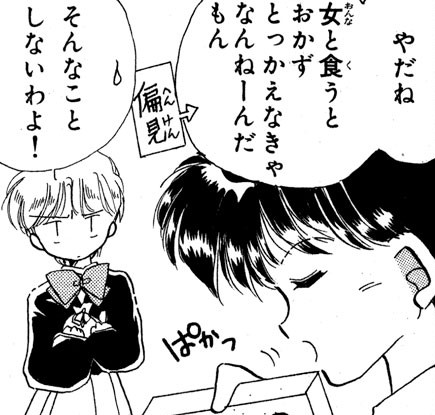
Rina asks Asuka Jr. if she can eat lunch with him.
アスカ Jr.:
「やだ ね」
“No way.”
「女( おんな ) と食( く ) うとおかずとっかえなきゃなんねーんだもん」
“If I eat with a girl, I'd have to swap side dishes.”
リナ:
「そんなことしないわよ!」
“I wouldn't do that!”
Challenge Yourself
Show translation
Challenge
Why does Asuka Jr. refuse to eat lunch with Rina?
Clues
女( おんな ) と食( く ) うとhe is talking about what happens if he eats with a girl
おかずとっかえなきゃなんねー
he believes he would have to swap side dishes
What does the speaker mean?
He thinks eating with a girl means he would have to swap side dishes.
女と食うと sets the condition, and おかずとっかえなきゃなんねー gives the obligation he objects to.
He thinks Rina has already taken one of his side dishes.
The line describes what he believes would happen if they ate together, not something Rina has already done.
He has to finish lunch before Rina is allowed to eat.
〜なきゃなんねー applies to swapping side dishes, not finishing lunch first.
He refuses to eat any food prepared by a girl.
His excuse concerns exchanging side dishes while eating together, not who prepared the food.
He wants Rina to trade seats with someone else.
とっかえ refers to the おかず, side dishes, rather than their seats.
He thinks girls are not allowed to eat lunch with him.
He presents a supposed custom about swapping food, not a rule forbidding girls from joining him.
Asuka Jr. claims that if he eats with a girl, he will have to exchange side dishes with her. The rough contraction とっかえなきゃなんねー presents that imagined obligation as his reason for saying no.
View Full Example
ダメ: No Good
ダメ , also written だめ or 駄目( だめ ) , judges something as unacceptable.
名探偵コナン »
Volume 4 » Page 94
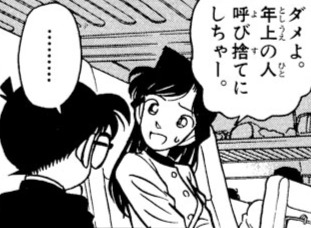
Conan needs to investigate a bomb set to go off on the train, but being a child restricts his ability to move around and gather information. He decides he needs to reveal his true self to Ran, but when he addresses her as simply “Ran”, she corrects him to add “ねえちゃん” to her name.
蘭( らん ) :「ダメ よ。年上( としうえ ) の人( ひと ) 呼( よ ) び捨( す ) てにしちゃー。」
“That's no good. You shouldn't call older people by their given name alone.”
Challenge Yourself
Show translation
Challenge
What does Ran say Conan did wrong when addressing her?
Clues
年上( としうえ ) の人( ひと ) an older person
呼( よ ) び捨( す ) てにしちゃーyou must not address them without a title or honorific
What does the speaker mean?
He called an older person by name without an honorific.
呼( よ ) び捨( す ) て means using the name alone when Ran expects ねえちゃん to be added.
He used an honorific that was too formal.
Ran objects because he left the expected form of address off entirely.
He called Ran by another person's name.
The problem is the missing title after Ran's correct name.
He claimed to be older than Ran.
Ran refers to herself as the older person and corrects how child-aged Conan addresses her.
He refused to say Ran's name at all.
He says Ran, but without the familiar ねえちゃん she expects.
He spoke politely to someone younger than him.
The line concerns casual address toward someone older.
Ran scolds Conan for calling an older person by name alone. She expects child-aged Conan to address her as 蘭( らん ) ねえちゃん instead.
View Full Example
The prohibition pattern 〜てはダメ marks an action as unacceptable. In casual speech, 〜ては contracts to 〜ちゃ , while 〜では contracts to 〜じゃ .
三ツ星カラーズ »
Volume 2 » Page 5
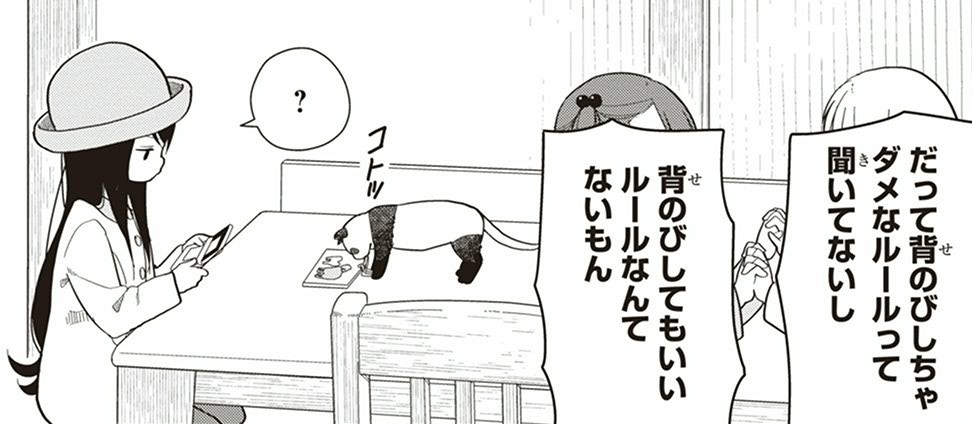
Standing back to back, Sacchan is slightly taller than Yui. Yui questions whether Sacchan is standing tip-toed, which Sacchan denies, but Yui looks and sees that Sacchan is.
さっちゃん:
「だって背( せ ) のびしちゃ ダメ なルールって聞( き ) いてないし」
“You say that, but I didn't hear a rule against tiptoes.”
結衣( ゆい ) :「背( せ ) のびしてもいいルールなんてないもん」
“There's no way there'd be a rule allowing tiptoes!”
Challenge Yourself
Show translation
Challenge
How does Sacchan defend standing on tiptoe?
Clues
だって
but or because, introducing a defensive excuse
背( せ ) のびしちゃダメなルールって聞( き ) いてないしI have not heard of a rule saying tiptoeing is forbidden
What does the speaker mean?
She says she never heard of a rule forbidding it.
聞( き ) いてない denies hearing about such a rule, and だって frames that denial as her defense.
She insists that Yui gave her permission to do it.
Sacchan refers to the absence of a rule she has heard, not permission from Yui.
She claims that she was not standing on tiptoe.
Her excuse accepts the action and argues that no rule bans it.
She says tiptoeing is required when comparing heights.
The line mentions no rule requiring tiptoes. It denies hearing a rule against them.
She promises not to stand on tiptoe again.
聞( き ) いてないし pushes back against the complaint rather than making a promise.
She says the height comparison has already ended.
The line is about whether tiptoeing is prohibited, not whether the comparison is over.
Sacchan does not deny standing on tiptoe. She argues that she never heard of any rule forbidding it, using だって to launch the excuse.
View Full Example
Other prohibitions include 〜てはいけない , 禁止( きんし ) , and a dictionary-form verb followed by な . The last form gives a strong negative command. This な differs from sentence-ending な used for reflection or emphasis.
大丈夫: I’m Fine
大丈夫( だいじょうぶ )
ストロボ・エッジ »
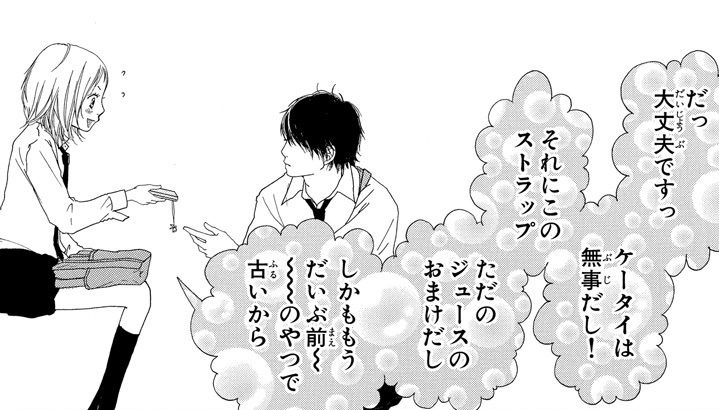
Volume 1 » Page 23
After school, Ninako notices Ren sleeping a few seats away on the train. When Ren wakes and rushes for his stop, he knocks Ninako’s phone from her hand. The phone hits the floor, and the strap charm breaks. Ren misses his exit while apologizing and offers to replace the charm.
仁奈子( になこ ) :「だっ 大丈夫( だいじょうぶ )
“I—it's all right.”
「ケータイは無事( ぶじ ) だし!」
“Since my cell phone is safe!”
「それにこのストラップただのジュースのおまけだし」
“Furthermore, this strap is just a juice prize.”
「しかももうだいぶ前( まえ ) 〜〜〜〜のやつで古( ふる ) いから」
“Plus, it's from way back when, so it's old.”
Challenge Yourself
Show translation
Challenge
Why does Ninako say Ren does not need to replace the broken charm?
Clues
ケータイは無事( ぶじ ) だし
her phone itself is unharmed, offered as one reason
それにこのストラップただのジュースのおまけだし
besides that, the strap was only a free extra from a juice purchase
しかももうだいぶ前( まえ ) のやつで古( ふる ) いから
what is more, it is old and from a long time ago
What does the speaker mean?
The phone is safe, and the charm was only an old promotional extra.
Ninako stacks three reasons: the phone is unharmed, the strap was a mere おまけ, and it was already old.
The charm did not break when the phone hit the floor.
Ninako is minimizing the loss after the charm breaks. She does not deny that it was damaged.
She has another identical charm waiting at home.
She says the broken one was cheap and old. No replacement charm appears in her explanation.
Ren already paid her for the damage.
Ren offers to replace the charm, but Ninako argues that replacement is unnecessary.
The charm belongs to the juice company rather than to her.
おまけ explains how she obtained the charm. It does not mean the company still owns it.
She wanted an excuse to throw the charm away.
Ninako reassures Ren by downplaying the charm's value and age. She does not say she wanted it broken.
Ninako piles up reasons to ease Ren’s guilt. Her phone is fine, the broken strap was only a free juice bonus, and it was already old. それに adds the second reason to the first.
View Full Example
結構: That’s Enough
結構( けっこう ) 結構( けっこう ) です from a dismissive もう結構( けっこう ) だ. 結構( けっこう ) can also mean “quite”, so it does not signal refusal in every appearance.
いい: I’m Good
いい can decline something in the sense of “I’m good” or “things are fine as they are”. It can also grant permission or accept a suggestion. もういい means that the speaker has had enough and may be translated as “that’s enough”, “never mind”, or “forget it”.
それでも歩は寄せてくる »
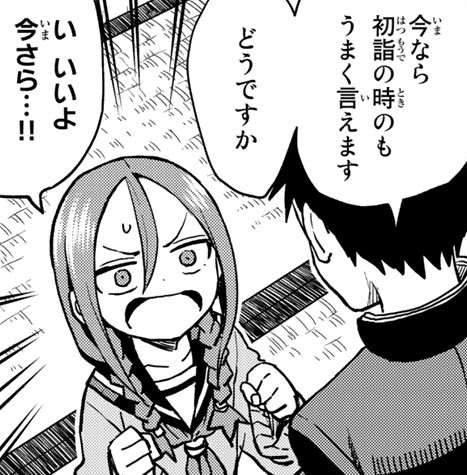
Volume 4 » Page 46
Ayumu heavily compliments Urushi on her looks wearing a sweater that’s a little too big. He quietly congratulates himself, and when Urushi questions him on it, Ayumu explains that he’s regretted his inability to find the words to compliment her outfit during their New Year’s shrine visit.
歩( あゆむ ) :「今( いま ) なら初詣( はつもうで ) の時( とき ) のもうまく言( い ) えます。どうですか」
“I can properly say it now for the New Year's shrine visit. How about it?”
うるし:
「い いい よ。 今( いま ) さら…!!」
“It's okay. It's too late!”
Challenge Yourself
Show translation
Challenge
Why does Urushi reject Ayumu's compliment with 今( いま ) さら?
Clues
今( いま ) なら初詣( はつもうで ) の時( とき ) のもうまく言( い ) えますAyumu says he can now properly express the compliment from the shrine visit
いいよ。今( いま ) さら…!!
"It is fine. It is too late now," refusing because the proper moment has passed.
What does the speaker mean?
The shrine-visit moment for that compliment has already passed.
Ayumu contrasts 今( いま ) with 初詣( はつもうで ) の時( とき ) , and Urushi's 今( いま ) さら says the delayed compliment comes too late.
She thinks the compliment is false because her current outfit is different.
Her objection is the late timing, not a claim that Ayumu is lying.
She wants him to repeat the compliment at the next shrine visit.
いいよ and 今( いま ) さら stop the delayed compliment rather than reschedule it.
She has forgotten what she wore at the shrine.
Urushi recognizes exactly which missed moment Ayumu means.
She is upset that he complimented the sweater too early.
今( いま ) さら means the opposite. The relevant timing is already too far in the past.
She believes compliments should never be said directly.
Her response is tied to this compliment's delay, not a general rule against compliments.
Ayumu says he can finally express what he failed to say during the New Year’s shrine visit. Urushi answers 今( いま ) さら because that was the moment when the compliment belonged, and it has long since passed.
View Full Example
違う: That’s Wrong
違( ちが ) う
そうじゃない: That’s Not It
そうじゃない rejects the conclusion another character has reached.
無理: Impossible or Too Much
無理( むり )
ホリミヤ »
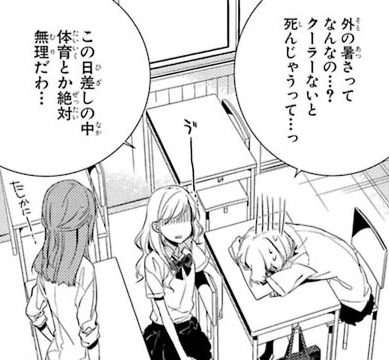
Volume 1 » Page 45
On a summer day, Hori and her friends in class can’t ignore the heat.
由紀( ゆき ) :「外( そと ) の暑( あつ ) さってなんなの…? クーラーないと死( し ) んじゃうって…っ」
“What's with this heat outside...? I'd totally die without the AC...”
「この日差( ひざ ) しのなか体育( たいいく ) とか絶対( ぜったい ) 無理( むり )
“There's no way I can do PE in this blazing sun...”
Challenge Yourself
Show translation
Challenge
What does Yuki say would happen without air conditioning?
Clues
クーラーないと
if there is no air conditioning, with が omitted
死( し ) んじゃうwould end up dying, said as an exaggerated reaction
What does the speaker mean?
She would end up dying from the heat.
クーラーないと sets the lack of AC as the condition, and 死( し ) んじゃう gives the exaggerated result.
The air conditioner would stop working because of the heat.
ない describes the absence of AC. The subject of 死( し ) んじゃう is Yuki, not the machine.
She would have to leave class and exercise outside.
Yuki says outdoor PE is impossible in the sunlight. She does not present it as the result of having no AC.
She would become accustomed to the heat eventually.
死( し ) んじゃう gives a disastrous result, even if exaggerated. It does not suggest adaptation.
She would refuse to turn on the air conditioner.
Yuki treats AC as necessary relief. She does not reject using it.
She would already have died before reaching school.
The condition is hypothetical and present. She says what would happen without AC, not that it has already happened.
Yuki exaggerates that she would die without air conditioning. 死( し ) んじゃう contracts 死( し ) んでしまう and presents death as the extreme unwanted result.
View Full Example
いらない: I Don’t Need It
いらない , the negative form of 要( い ) る, rejects an item or offer as unnecessary.
できない: I Can’t
できない says that a character cannot do something.
断る: Explicit Refusal
断( ことわ ) る