Words for safety and security
Japanese uses different words for physical safety, peace of mind, security, and stability.
大丈夫 (All right)大丈夫( だいじょうぶ ) is a broad word for saying that something is fine or not a problem. Context determines the meaning, so 大丈夫 covers more ground than the other words in this group.
俺物語!! »
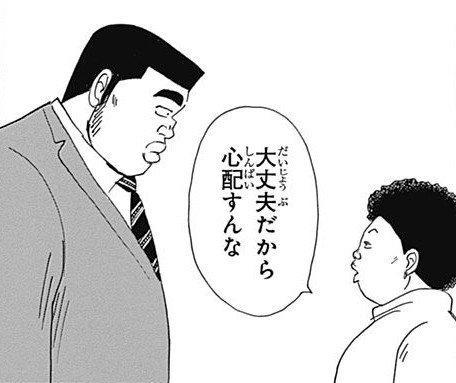
Volume 6 » Page 56
Takeo takes his pregnant mother to the hospital, as she’s getting close to delivery. Once there, she gives Takeo and his friend Suna a list of things to take care of during her stay.
母( かあ ) さん:「大丈夫( だいじょうぶ ) 心配( しんぱい ) すんな」
“I'll be fine, so don't worry.”
Challenge Yourself
Show translation
Challenge
Why does Takeo's mother tell him not to worry?
Clues
大丈夫( だいじょうぶ ) だからbecause she will be all right
心配( しんぱい ) すんなdo not worry, a blunt casual contraction of (心配:しんぱい)するな
What does the speaker mean?
She says she will be fine.
大丈夫( だいじょうぶ ) gives her reason, and から links it to the command not to worry.
She says the hospital visit has been canceled.
She reassures him that she is all right. She does not say the visit is canceled.
She wants Takeo to leave before the delivery.
The command concerns worrying, not leaving the hospital.
She says Suna will handle every task for him.
Neither Suna nor the task list appears in this line. Her own condition is the reason.
She orders Takeo to hide his concern from her.
心配( しんぱい ) すんな tells him not to worry, not merely to conceal it.
She thinks Takeo is the one who needs medical care.
大丈夫( だいじょうぶ ) refers to her reassurance about herself in this context.
Takeo’s mother reassures him that she will be all right, so he should not worry. すんな contracts するな and makes the command sound direct and familiar.
View Full Example
安心 (Peace of mind)安心( あんしん ) describes freedom from anxiety. It names the calm one feels when they believe things are secure. Since that feeling depends on the individual’s experience and circumstances, one person can feel 安心( あんしん ) in a situation that still worries someone else.
からかい上手の(元)高木さん »
Volume 20 » Page 24
After returning home from work, Nishikata is ready to sit back and relax for a bit. Takagi leans over and asks Nishikata if he knows what day it is.
西片( にしかた ) :「あれ?何( なん ) の日( ひ ) だっけ?」
“Huh? What day is it again?”
高木( たかぎ ) :「2人( ふたり ) の記念日( きねんび ) とかではないから安心( あんしん )
“Relax, it's not an anniversary or anything like that.”
Challenge Yourself
Show translation
Challenge
Why does Takagi tell Nishikata to relax?
Clues
2人( ふたり ) の記念日( きねんび ) an anniversary for the two of them
〜とかではないから
because it is not that or anything like it
安心( あんしん ) してrelax or be at ease
What does the speaker mean?
The day is not an anniversary or another occasion he forgot.
記念日( きねんび ) とかではない removes the kind of forgotten special date Nishikata fears, giving the reason for 安心( あんしん ) して.
She has remembered their anniversary for him.
Takagi says the day is not their anniversary or anything like that.
Their anniversary has been canceled.
The line identifies what kind of day this is not. It does not cancel an anniversary.
She wants him to forget every special date.
Takagi reassures him about this question. She does not give a general instruction to forget dates.
She says there is no reason to know what day it is.
She only rules out a shared anniversary as the source of danger. The original day still matters to her question.
She promises never to ask him about anniversaries again.
安心( あんしん ) して is immediate reassurance, not a promise about future conversations.
Nishikata worries he has forgotten an important date. Takagi reassures him that it is not their anniversary or a similar shared occasion.
View Full Example
平気 (Composed)平気( へいき ) describes someone who stays unaffected or unbothered by something that might cause worry. It focuses on the person’s reaction, so someone can be 平気( へいき ) even in an uncomfortable situation.
無事 (Safety)無事( ぶじ ) describes coming through something without injury or trouble. It is used after danger or uncertainty has passed to confirm that nothing bad happened.
ストロボ・エッジ »
Volume 1 » Page 23
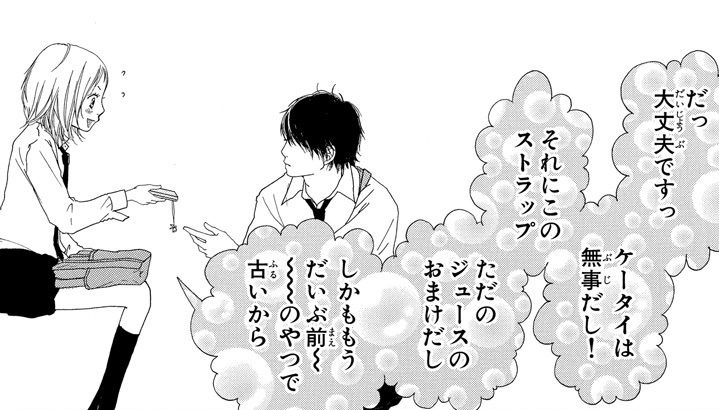
After school, Ninako notices Ren sleeping a few seats away on the train. When Ren wakes and rushes for his stop, he knocks Ninako’s phone from her hand. The phone hits the floor, and the strap charm breaks. Ren misses his exit while apologizing and offers to replace the charm.
仁奈子( になこ ) :「だっ 大丈夫( だいじょうぶ ) ですっ」
“I—it's all right.”
「ケータイは無事( ぶじ )
“Since my cell phone is safe!”
「それにこのストラップただのジュースのおまけだし」
“Furthermore, this strap is just a juice prize.”
「しかももうだいぶ前( まえ ) 〜〜〜〜のやつで古( ふる ) いから」
“Plus, it's from way back when, so it's old.”
Challenge Yourself
Show translation
Challenge
Why does Ninako say Ren does not need to replace the broken charm?
Clues
ケータイは無事( ぶじ ) だし
her phone itself is unharmed, offered as one reason
それにこのストラップただのジュースのおまけだし
besides that, the strap was only a free extra from a juice purchase
しかももうだいぶ前( まえ ) のやつで古( ふる ) いから
what is more, it is old and from a long time ago
What does the speaker mean?
The phone is safe, and the charm was only an old promotional extra.
Ninako stacks three reasons: the phone is unharmed, the strap was a mere おまけ, and it was already old.
The charm did not break when the phone hit the floor.
Ninako is minimizing the loss after the charm breaks. She does not deny that it was damaged.
She has another identical charm waiting at home.
She says the broken one was cheap and old. No replacement charm appears in her explanation.
Ren already paid her for the damage.
Ren offers to replace the charm, but Ninako argues that replacement is unnecessary.
The charm belongs to the juice company rather than to her.
おまけ explains how she obtained the charm. It does not mean the company still owns it.
She wanted an excuse to throw the charm away.
Ninako reassures Ren by downplaying the charm's value and age. She does not say she wanted it broken.
Ninako piles up reasons to ease Ren’s guilt. Her phone is fine, the broken strap was only a free juice bonus, and it was already old. それに adds the second reason to the first.
View Full Example
安全 (Safety)安全( あんぜん ) describes a situation with no danger, independent of how anyone feels about it. It points to external conditions, such as a safe method or a safe place.
三ツ星カラーズ »
Volume 3 » Page 142
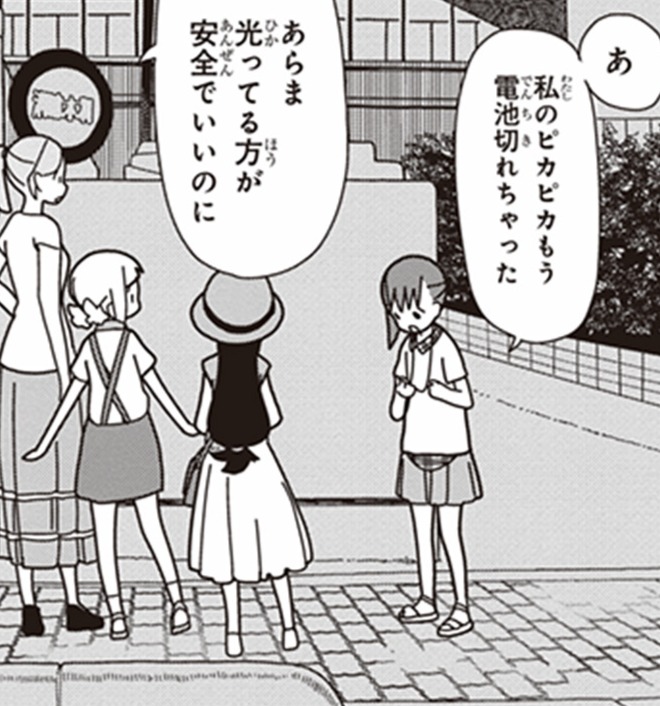
At a nighttime festival, Sacchan, Yui, and Kotoha receive glowing star necklaces to wear. After some time, Sacchan’s mother arrives to pick them up.
結衣( ゆい ) :「あ 私( わたし ) のピカピカもう電池( でんち ) 切( き ) れちゃった」
“Ah, my sparkler's battery has already run out.”
母( かあ ) さん:「あらま 光( ひか ) ってる方( ほう ) が安全( あんぜん )
“Oh dear, it's safer and better when it's lit up.”
Challenge Yourself
Show translation
Challenge
Why does Sacchan's mother wish Yui's necklace were still glowing?
Clues
光( ひか ) ってる方( ほう ) がthe glowing state is the preferable option
安全( あんぜん ) でいいのにit would be safe and good, with regret that it is not
What does the speaker mean?
The light would make Yui safer and easier to see at night.
光( ひか ) ってる方( ほう ) selects the lit state, and 安全( あんぜん ) gives the practical reason for preferring it.
The necklace would keep Yui warm.
The mother mentions safety, not warmth.
The light would show that the festival is still open.
Her comparison concerns Yui's glowing necklace and safety, not the festival's hours.
The battery would be cheaper while the necklace glowed.
Yui says the battery has run out, but her mother does not discuss its cost.
The necklace is unsafe whenever its light is on.
光( ひか ) ってる方( ほう ) が安全( あんぜん ) says the glowing option is safer, not more dangerous.
The light would help them find Sacchan's mother.
The mother has already arrived. Her comment is about the girl's nighttime visibility.
Sacchan’s mother prefers the necklace to keep glowing because it makes Yui more visible and therefore safer at night. Sentence-final のに adds regret that the battery has already died.
View Full Example
In this scene, the light at the end of the necklace provides visibility as the night gets darker.
安定 (Stability)安定( あんてい ) describes a calm, stable state without drastic change.
とんがり帽子のアトリエ »
Volume 2 » Page 50
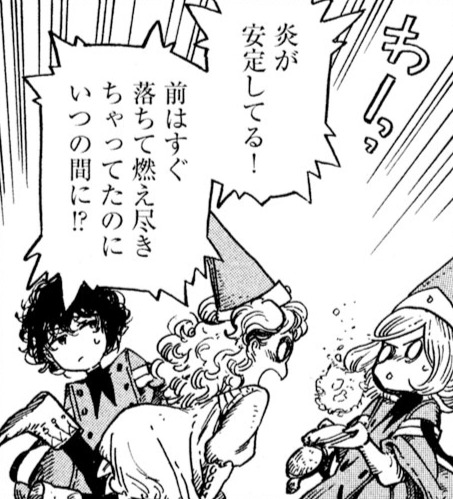
Coco and her friends are trapped in a maze and trying to find a way past a dragon. Seeing the others working out magic to use, Coco tries her hand at a spell, creating a flame. Agott isn’t impressed, but Tetia feels otherwise.
テティア:
「炎( ほのお ) が安定( あんてい )
“The flame is stable!”
「前( まえ ) はすぐ落( お ) ちて燃( も ) え尽( つ ) きちゃってたのにいつの間( ま ) に!?」
“It used to go out and burn out right away, so when did this happen!?”
Challenge Yourself
Show translation
Challenge
Why is Tetia surprised by Coco's flame?
Clues
炎( ほのお ) が安定( あんてい ) してる!the flame is burning steadily now
前( まえ ) はすぐ落( お ) ちて燃( も ) え尽( つ ) きちゃってたのにcontrasts the current flame with earlier attempts that quickly fell and burned out
What does the speaker mean?
The flame is stable now, although Coco's earlier flames quickly burned out.
安定( あんてい ) してる describes the flame now, while 前( まえ ) は and のに contrast it with Coco's failed attempts before.
The flame used to be stable, but it has suddenly started burning out.
This reverses the timeline. 前( まえ ) は introduces the flames that burned out, and the current flame is stable.
The flame fell before Coco could make it burn steadily.
Falling and burning out describe Coco's earlier attempts. Tetia says the flame she sees now is stable.
Coco made the flame disappear as soon as Tetia noticed it.
すぐ belongs to the description of earlier flames. The current flame remains steady.
Tetia realizes that Agott created the stable flame instead of Coco.
The lines compare the current flame with Coco's previous results. They do not identify Agott as its creator.
Tetia wonders when the group moved away from the dragon.
いつの間( ま ) に asks when Coco's improvement happened, not when the group changed location.
Tetia sees that Coco’s flame is stable. That is a clear improvement because Coco’s earlier flames would fall and burn themselves out right away, so Tetia blurts out いつの間( ま ) に to ask when Coco became able to do this.
View Full Example
安泰 (Peace)安泰( あんたい ) describes a secure, stable state that gives one no reason to worry about the future.
キラキラとギラギラ »
Volume 4 » Page 85
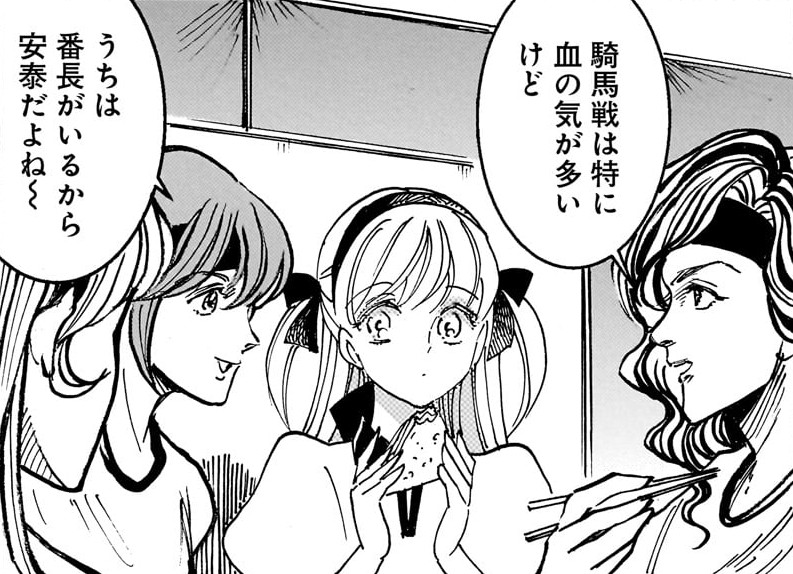
During sports day, the events break for lunch. Lulu joins her friends, and they discuss the upcoming afternoon activities.
響子( きょうこ ) :「騎馬戦( きばせん ) は特( とく ) に血( ち ) の気( き ) が多( おお ) いけど」
“The cavalry battles are especially full of hot-blooded guys, though.”
清美( きよみ ) :「うちは番長( ばんちょう ) がいるから安泰( あんたい )
“As long as the big boss is here, we're safe and sound, right~”
Challenge Yourself
Show translation
Challenge
Why does Kiyomi think her group will be safe?
Clues
騎馬戦( きばせん ) は特( とく ) に血( ち ) の気( き ) が多( おお ) いけどthe cavalry battle is especially full of hot-blooded competitors, though
うちは番長( ばんちょう ) がいるから
because their side has its big boss
安泰( あんたい ) だよねthey are safe and secure, seeking agreement
What does the speaker mean?
Their group's big boss will be with them.
番長( ばんちょう ) がいるから gives the presence of their big boss as the reason Kiyomi says their side is 安泰( あんたい ) .
The cavalry battle has been canceled for being too violent.
Kyoko says the event is hot-blooded, but nobody says it has been canceled. Kiyomi expects their leader to keep them safe.
Their group has no aggressive competitors.
血( ち ) の気( き ) が多( おお ) い describes the cavalry battle as especially aggressive. Kiyomi's confidence comes from their leader.
They plan to leave before the afternoon events begin.
The group discusses how they will fare in the event. The line does not propose leaving.
The other groups have agreed not to challenge them.
No agreement from the other groups appears. Kiyomi relies on the 番長( ばんちょう ) being present.
Kiyomi believes the cavalry battle is harmless.
The first line acknowledges that the event is full of people ready to clash. Her sense of safety comes despite that danger.
Kyoko warns that the cavalry battle draws especially aggressive competitors. Kiyomi is unconcerned because their group’s big boss is there, which she treats as enough to keep their side safe.
View Full Example
高木さん/からかい上手の(元)高木さん-volume-20-page-24-panel-3.jpg)