Writing and drawing with かく
かく has two official spellings for writing and drawing. 書く is writing letters or words, such as a name, a letter, or a novel. 描く is drawing or painting, such as a picture, a diagram, or a manga.
A quick test: if what you make is letters or words, write 書. If it’s a picture or a diagram, even one you read like a map, write 描. 描く can also be read えがく, and furigana or context usually tells you which. Both are official, so they show up in formal writing as well as in manga. Same reading, different kanji explains where the official list comes from.
The Spellings at a Glance
| Spelling | Used for | Standing |
|---|---|---|
| 書く | write letters or words | Official |
| 描く | draw or paint a picture | Official |
Writing Words with 書く
書く is putting down letters, numbers, or other symbols, and putting words together into something to read. 名前を書く is “write your name”, 手紙を書く is “write a letter”, and 小説を書く is “write a novel”. デジタル大辞泉 also lists composing music or a computer program under the same verb without marking a spelling. In practice that’s 書, as in 曲を書く, “write a song”, which is how this site’s manga corpus writes it whenever it uses kanji.
Brush calligraphy takes 書 too, however artful it looks, since it’s still letters. In this site’s manga corpus, 名前, 手紙, and 小説 go with 書く more than 300 times between them, and with 描く only once.
1 source
【書く】文字や文章を記す。
漢字を書く。楷書で氏名を書く。手紙を書く。小説を書く。日記を書く。書く: write letters or text. "Write kanji." "Write your full name in block style." "Write a letter." "Write a novel." "Keep a diary."
Example 1 of 3: Compatability fortune with 相性
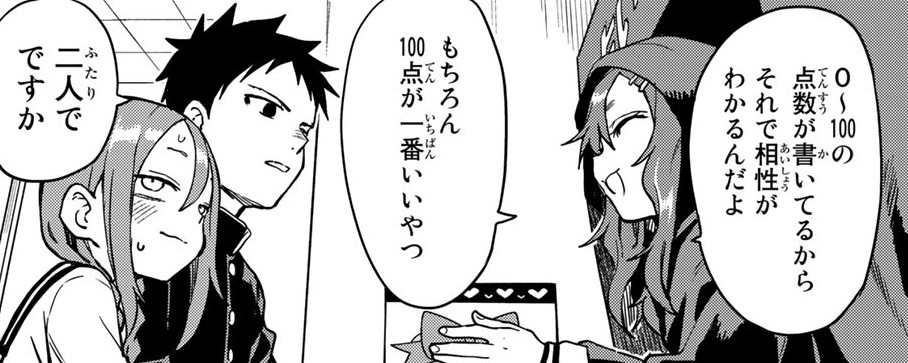
At the school festival, Ayumu and Urushi stop by the affinity fortune telling booth while Maki is on duty. Maki holds out a box with an opening on top, and says they need to pull out a single card together.
- マキ:
- 「0〜100の点数が書いてるからそれで相性がわかるんだよ」
- “Your compatibility is determined by the score written from 0 to 100.”
- 「もちろん100点が一番いいやつ」
- “Of course, 100 points is the best score.”
- 歩:
- 「二人でですか?」
- “Together?”
Maki explains the fortune booth: each card has a score from 0 to 100 written on it. A number is a symbol to be read, so it takes 書. 書いてる here means “is written”, the sense usually carried by 書いてある.
Example 2 of 3: Corresponding letters of the alphabet with 相当
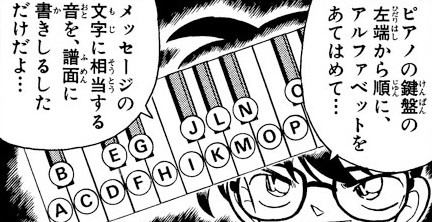
Following a series of murders, Conan discovers a message hidden in sheet music. He explains it to Ran.
- コナン:
- 「ピアノの鍵盤の左端から順に、アルファベットをあてはめて…」
- “Starting from the leftmost key on the piano keyboard, I assigned each key a letter...”
- 「メッセージの文字に相当する音を、譜面に書きしるしただけだよ…」
- “I simply wrote down the notes corresponding to the letters of the message on the sheet music...”
Conan shows Ran how the killer hid a message in sheet music by writing down the notes that matched each letter. 書きしるす is “write down”.
Example 3 of 3: A hard kanji championship with 選手権
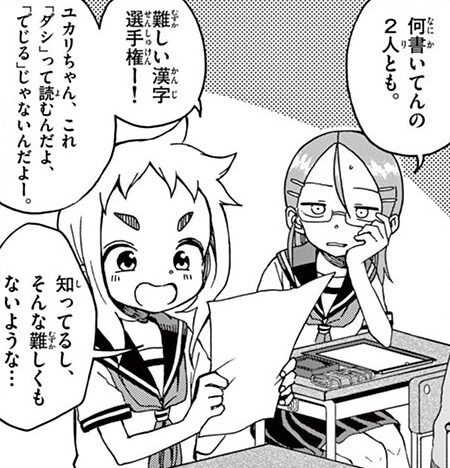
In calligraphy class, the teacher tells everyone to write a word they like and hand it in by the end of class. Yukari settles on something plain. Then Mina shouts that she’s done, and she and Sanae hold up their sheets. Mina’s reads 出汁 and Sanae’s reads 韋駄天.
- ユカリ:
- 「何書いてんの2人とも。」
- “What are you two writing?”
- ミナ:
- 「難しい漢字選手権ー!」
- “The hard kanji championship!”
- 「ユカリちゃん、これ「ダシ」って読むんだよ、「でじる」じゃないんだよー。」
- “Yukari, this is read "dashi", not "dejiru"!”
- ユカリ:
- 「知ってるし、そんな難しくもないような…」
- “I know that, and it's not even that hard...”
In calligraphy class, Mina and Sanae hold up the hard kanji they’ve written for a contest of their own, and Yukari asks what they’re writing. Brushwork on a sheet of paper is still writing letters, so it’s 書く.
Drawing Pictures with 描く
描く is making a picture: a drawing, a painting, a map, a diagram, or a manga. 絵を描く is “draw a picture”, 似顔絵を描く is “draw a portrait”, and 漫画を描く is “draw manga”. Someone who draws is an 絵描き. The guide’s examples include 眉を描く, “pencil in your eyebrows”, since that’s drawing a line, not writing a word.
Manga mostly keep to 描 for pictures. In this site’s manga corpus, 絵を描く turns up more than 500 times and 絵を書く only a handful. 漫画を描く and マンガを描く, together, turn up hundreds of times, and most of the few 書 hits are one publisher’s notice repeated across volumes.
The same kanji also reads えがく. That’s the reading for portraying something in words or picturing it in your mind, as in 夢を描く, “picture your dream”, and the usual one for a shape made by a movement, as in 弧を描く, “make an arc”. For a picture, either reading works, and かく is the everyday one.
1 source
【描く】絵や図に表す。
油絵を描く。ノートに地図を描く。漫画を描く。設計図を描く。眉を描く。描く: show something as a picture or a diagram. "Paint in oils." "Draw a map in a notebook." "Draw manga." "Draw up a blueprint." "Pencil in your eyebrows."
Example 1 of 2: Trying to draw latte art with 〜てみる
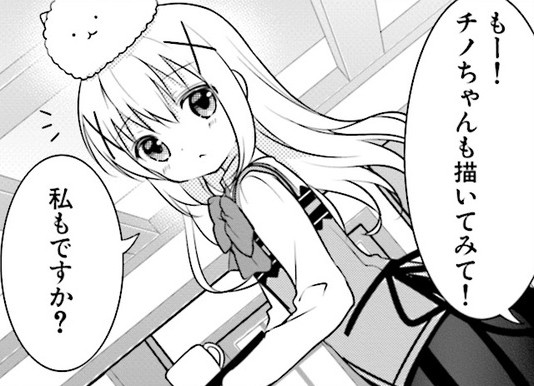
After learning about latte art, Cocoa wants to see what Chino can do.
- ココア:
- 「チノちゃんも描いてみて!」
- “Chino-chan, try drawing one too!”
- チノ:
- 「私もですか?」
- “Me too?”
Cocoa has just learned about latte art and wants to see Chino make some. A design in milk foam is a picture, so it’s 描く.
Example 2 of 2: Cute latte art like yours with 〜みたい
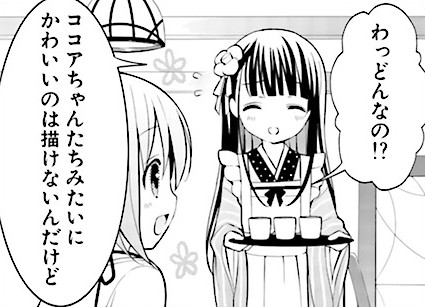
Recalling the latte art Cocoa made in coffee for her, Chiya tries making the same in the tea she brings to her friends.
- ココア:
- 「わっ どんなの!?」
- “Oh! What kind!?”
- 千夜:
- 「ココアちゃんたちみたいにかわいいのは描けないんだけど」
- “I can't draw cute (latte art) like you all, though.”
Chiya brings tea with a design in it, though she says she can’t draw anything as cute as Cocoa and the others can. 描けない is the potential form, “can’t draw”.
When the Spellings Overlap
The two spellings write one word. デジタル大辞泉 lists them under a single entry and gives drawing as one of its senses. Dictionaries also list 画く for drawing, but it’s rare, and the 2014 guide leaves it out.
A few things that are part picture and part words vary. The guide puts 地図 and 設計図 under 描, but manga split on 地図, and in the few hits in this site’s manga corpus, 地図を書く turns up about as often as 地図を描く. 下書き is any rough draft, writing or drawing, and manga artists use it for their pencils too. 下描き is only for pictures: a preliminary sketch, which in manga usually means the one before inking. Overall, manga use the two spellings about equally. 落書き, “graffiti” or “a doodle”, usually takes 書 even when it’s a drawing.
A shape made by a movement can take 描 even when the shape is a letter. In the corpus, 「の」の字を描くように, “as if making the letter の”, describes a circular motion.
1 source
か・く【書く/描く/▽画く】
[動カ五(四)]《「掻く」と同語源》
4 (描く・画く)絵・模様や図をえがく。「眉を―・く」「グラフを―・く」かく, written 書く, 描く, or 画く. A godan verb, from the same root as 掻く, "scratch". 4. Written 描く or 画く: draw a picture, a pattern, or a diagram. "Pencil in your eyebrows." "Draw a graph."
Other Words Read かく
Several common phrases use a different かく, 掻く, “scratch”. 頭をかく is scratching your head, and the same verb covers bringing something unwanted to the surface: 汗をかく, “sweat”, 恥をかく, “embarrass yourself”, and いびきをかく, “snore”. あぐらをかく, “sit cross-legged”, is another. 掻 isn’t on the 常用漢字表, so these usually stay in kana. In this site’s manga corpus, 汗をかく and 恥をかく turn up hundreds of times in kana and almost never with 掻.
None of these take 書 or 描, so 汗を書く would be a mistake. There’s also 欠く, “lack”, and its relative 欠かす, seen in 欠かせない, “essential”.
1 source
か・く【×掻く】
7 あまり好ましくないものを表面にだす。
㋐恥などを身に受ける。「赤っ恥を―・く」
㋑涙や汗などをからだの外に出す。「寝汗を―・く」「べそを―・く」
㋒いびきを立てる。「高いびきを―・く」かく, written 掻く, with 掻 outside the 常用漢字表. 7. Bring something unwelcome to the surface. Suffer something such as shame. "Be utterly humiliated." Let tears, sweat, and so on out of the body. "Sweat in your sleep." "Be on the verge of tears." Make the sound of snoring. "Snore loudly."
When かく Stays in Kana
Kana works for every かく, and the 2014 guide says its spelling examples don’t rule out writing a word in kana where it suits. For writing and drawing, manga mostly use kanji, though 絵をかく in kana does turn up now and then.
Check Yourself
Guess the Meaning from the Kanji
Each spelling's kanji points at one sense of かく. Say what each one means, then open it.
書く
write letters or words描く
draw or paint a picture
Pick the Spelling
Each phrase has かく in kana. Decide which kanji fits, then open it.
漢字をかく
漢字を書く. 書く: write letters or words.
油絵をかく
油絵を描く. 描く: draw or paint a picture.
手紙をかく
手紙を書く. 書く: write letters or words.
ノートに地図をかく
ノートに地図を描く. 描く: draw or paint a picture.
Spell a Manga Line
Cocoa has just learned about latte art. Which kanji fits かいて?
「チノちゃんもかいてみて!」
Show the answer
描いて. A design in milk foam is a picture, made to be looked at, so it takes 描. “Chino-chan, try drawing one too!”
Maki is explaining the fortune booth at the school festival. Which kanji fits かいてる?
「0〜100の点数がかいてるからそれで相性がわかるんだよ」
Show the answer
書いてる. A score is a number, meant to be read, so it takes 書. “Your compatibility is determined by the score written from 0 to 100.”
Chiya has brought tea with a design floating in it. Which kanji fits かけない?
「ココアちゃんたちみたいにかわいいのはかけないんだけど」
Show the answer
描けない. She’s talking about latte art, a picture, so it’s 描, here in the potential form. “I can’t draw cute ones like you all, though.”
It’s calligraphy class, and Mina and Sanae are holding up their brushwork. Which kanji fits かいてん?
「何かいてんの2人とも。」
Show the answer
書いてん. Calligraphy can look like art, but it’s still letters, and the guide’s own examples include 楷書で氏名を書く. “What are you two writing?”