A discreet investigation with 極秘
Kanji Explanation: Secrecy and hiddenness with 秘 (Future entry)
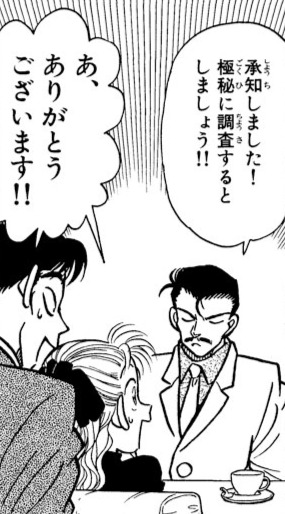
Detective Mouri’s favorite idol, Yoko, comes to his agency after receiving threatening calls and candid photos. Her manager hopes to keep the matter quiet to protect her image.
- 毛利:
- 「承知しました!極秘に調査するとしましょう!!」
- “Got it! Let's investigate this discreetly!!”
- Literal: “Understood! Let us investigate in strict secrecy!!”
- ヨーコ:
- 「あ、ありがとうございます!!」
- “Thank you very much!!”
Key Points
1極秘 = “strictly confidential”
- In this scene, 極秘に means Mouri will handle the investigation very discreetly and keep it out of public view.
- The 極- part adds intensity, so this is stronger than just saying something is merely hidden or private.
2Adverb use: 極秘に 調査する
- Here 極秘 works adverbially with に, modifying 調査する.
- The full idea is “to investigate in a highly confidential way”.
3〜するとしましょう softens the declaration a little
- Rather than a blunt 調査します, 調査するとしましょう has a slightly performative “all right, let’s proceed that way” feel.
4承知しました is formal and businesslike
- 承知しました is a polite “understood” often used when accepting a request or instruction.
- That formality matches the client-facing situation, even though Mouri’s double exclamation marks show his excitement.
Vocabulary
承知 (Consent)
承知 means knowledge, understanding, or consent. In conversation, it often means “understood” or “certainly”.
極秘 (Top secret)
極秘 means top secret or strictly confidential.
調査 (Investigation)
調査 means an investigation, survey, or detailed examination of the facts.
See Also
- Future entry: Past tense with 〜た・〜だ
- Kanji: Investigation and inspection with 査
名探偵コナン © its respective creators. It is used here for educational commentary.