A freeloading child with 居候
Kanji Explanation: Living and being somewhere with 居 (Future entry)
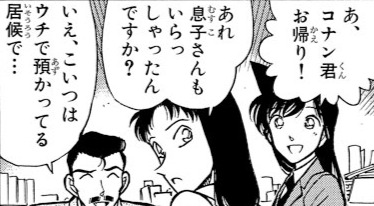
Conan returns home from school to the sound of a music box. When he opens the door, he finds Kogoro and Ran with a client.
- 欄:
- 「あ、コナン君 お帰り!」
- “Ah, Conan, welcome back!”
- 春菜:
- 「あれ 息子さんもいらっしゃったんですか?」
- “Oh? You have a son, too?”
- 小五郎:
- 「いえ、こいつはウチで預かってる居候で…」
- “No, this kid's just a freeloader we're looking after...”
- Literal: “No, this one is a freeloader we're keeping at our place...”
Key Points
1居候 = someone living in another household
- Here 居候 describes Conan as a child staying in Kogoro’s home rather than as Kogoro’s son.
- The word often carries a dependent or freeloading nuance, which fits Kogoro’s dismissive tone.
2預かってる = “we’re looking after” or “have in our care”
- 預かってる is casual speech for 預かっている, the progressive/result state of 預かる.
- In this scene it means Conan has been entrusted to the household, so Kogoro is responsible for him but not his parent.
3ウチで marks the household, not just the building
- ウチで means “in our household” here, setting where Conan is being kept or looked after.
- This supports the contrast with 息子さん: Conan belongs in the home for now, but not as family in the way Haruna guesses.
4Casual correction after いえ
- Kogoro’s いえ rejects Haruna’s assumption that Conan is his son.
- こいつ is a rough, familiar way to refer to Conan, so the line sounds casual and blunt rather than politely explanatory.
- 君 is an honorific suffix used after names, typically for boys or men. It’s commonly used by teachers addressing male students, by friends among young people, or by superiors addressing junior colleagues, and can also be used for girls in childhood or casual contexts.
Vocabulary
居候 (Live-in dependent)
居候 means a nonpaying lodger or freeloader who depends on someone else’s hospitality.
See Also
- Future entry: Past tense with 〜た・〜だ
- Grammar: Marking the topic with は and も
- Grammar: Ongoing actions and resulting states with 〜ている
名探偵コナン © its respective creators. It is used here for educational commentary.