Depressed over a snatched dumpling with 落ち込む
Vocabulary Explanation: Words ending in 込む
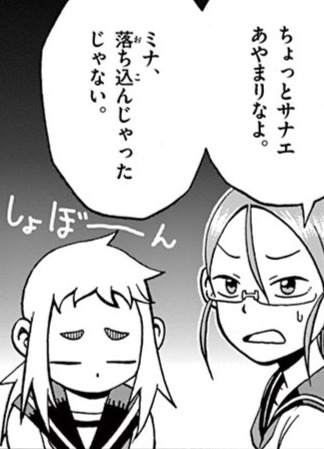
Yukari doesn’t like carrots, so she offers the ones from her lunch to Mina, who gladly accepts. Mina offers one of her dumplings in return, but Yukari is hesitant to accept because Mina did her a favor by taking the carrots. Sanae takes the opportunity to snatch the dumpling and eat it herself, claiming that neither of the other two seemed to want it. Mina mutters that she never said that.
- ユカリ:
- 「ちょっとサナエ あやまりなよ。」
- “Hey, Sanae, apologize.”
- 「ミナ、落ち込んじゃったじゃない。」
- “Mina's gotten all depressed.”
Key Points
1落ち込む = “to feel down”
- 落ちる means “to fall”, while 込む adds the image of going deeply into a state.
- Here, it refers to Mina’s having sunk into an unhappy mood; nothing has literally fallen.
2落ち込んじゃった = casual 落ち込んでしまった
- 落ち込む has the て-form 落ち込んで; 〜でしまった contracts to 〜じゃった.
- Besides marking a completed change, 〜てしまう can add an unwanted or regrettable nuance.
3The final じゃない is an accusation, not ordinary negation
- In 〜じゃったじゃない, the two occurrences do different jobs: じゃった is part of the contraction above, while sentence-final じゃない asks Sanae to recognize the obvious result.
- It implies that Mina is depressed because of what Sanae did, not a negation saying Mina didn’t get depressed.’
4謝りなよ is a positive command
- 謝る becomes the stem 謝り, followed by command-like な (short for なさい) and emphatic よ: “Apologize.”
- This differs from prohibitive dictionary-form + な: 謝るな would mean “Do not apologize.”
See Also
- Vocabulary: Words ending in 込む
- Future entry: Past tense with 〜た・〜だ
- Grammar: Doing completely or ending up doing with 〜てしまう and 〜ちゃう
- Grammar: The plain imperative
あしたは土曜日 © its respective creators. It is used here for educational commentary.