Leaving off ねえちゃん
Vocabulary Explanation: Honorifics
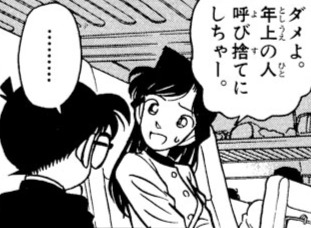
Conan needs to investigate a bomb set to go off on the train, but being a child restricts his ability to move around and gather information. He decides he needs to reveal his true self to Ran, but when he addresses her as simply “Ran”, she corrects him to add “ねえちゃん” to her name.
- 蘭:
- 「ダメよ。年上の人呼び捨てにしちゃー。」
- “That's no good. You shouldn't call older people by their given name alone.”
- Literal: “That's no good. You shouldn't address an older person without a title or honorific.”
Key Points
1呼び捨て = addressing someone without a title or honorific
- In this scene, Conan has called her simply 蘭 instead of 蘭ねえちゃん. That is the 呼び捨て she objects to.
- The English translation renders the idea as “by their given name alone”; the key issue is leaving off the expected form of address, not the use of a given name by itself in every context.
2The object marker を is omitted
- The fuller phrase is 年上の人を 呼び捨てにする, “to address an older person without a title”.
- Dropping を is common in casual speech, so 年上の人 runs directly into 呼び捨て here.
3しちゃー is a casual form of しては
- 呼び捨てにしては contracts to 呼び捨てにしちゃ, with ー showing that the final vowel is drawn out.
- The warning can be understood in regular order as 年上の人を 呼び捨てにしちゃダメよ. 蘭 puts ダメよ first, then states what Conan must not do.
4ねえちゃん is a familiar way to address an older girl
- It literally relates to “older sister”, but a child can also use it for a familiar older girl who is not his sister. 蘭 expects child-aged Conan to address her this way.
Vocabulary
年上 (Older)
年上 describes someone older than another person. As a noun, it means an older person or senior.
See Also
- Vocabulary: Honorifics
名探偵コナン © its respective creators. It is used here for educational commentary.