Picked up in my place with 〜の代わりに
Grammar Explanation: Instead of with 〜の代わりに
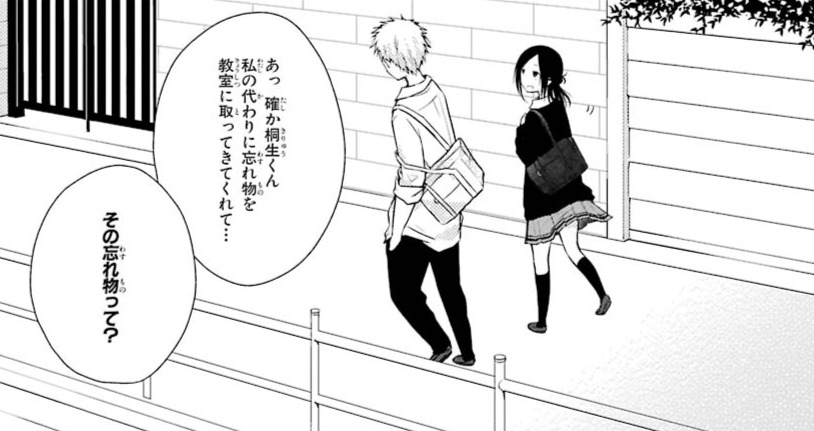
Fujimiya was able to work around forgetting her friends every Monday by using a journal to record her time spent with Hase. After Fujimiya discovers she can remember Hase’s friend Kiryuu, Hase gets jealous and reacts poorly. The following Monday, Fujimiya arrives at school with no memory of Hase or her journal, and Hase isn’t able to regain her trust. After school, Kiryuu walks with Fujimiya. Without mentioning Fujimiya eating lunch with Hase each day, he asks about how she spent her lunches last week. She isn’t certain. Without mentioning that Fujimiya previously had forgotten her journal at her desk and classmates found it, Kiryuu questions her about the after-school event.
- 藤宮:
- 「あっ 確か桐生くん私の代わりに忘れ物を教室に取ってきてくれて…」
- “Ah, right… Kiryuu, you went to the classroom and picked up my forgotten item in place of me, didn't you…?”
- Literal: “Ah, right... Kiryuu, you went and got the forgotten item from the classroom in place of me, and...”
- 桐生:
- 「その忘れ物って?」
- “That forgotten item was...?”
- Literal: “As for that forgotten item?”
Key Points
- Here 私の代わりに says Kiryuu acted as Fujimiya’s substitute by going to get the item she had forgotten.
- The の links the person being replaced to 代わり, so 私の代わりに means “in place of me”.
- 取ってくる means to go get something and bring it back; 〜てくれて shows that Kiryuu did it for Fujimiya’s benefit.
- 忘れ物を is the object, the forgotten item.
- 教室に marks the destination Kiryuu went to, the classroom.
- その points back to the forgotten item Fujimiya just mentioned.
- The casual って? asks for clarification: “What forgotten item?” This lets Kiryuu probe what she remembers without directly naming the journal.
- 君 is an honorific suffix used after names, typically for boys or men. It’s commonly used by teachers addressing male students, by friends among young people, or by superiors addressing junior colleagues, and can also be used for girls in childhood or casual contexts.
Vocabulary
私 (I)
私 means “I” or “me”. It is the standard first-person pronoun in polite speech and is also common in casual speech among women.
教室 (Classroom)
教室 means a classroom or a class held there.
取る (To take)
取る means to take or obtain something. Its exact sense depends on what is being taken.
See Also
- Grammar: Instead of with 〜の代わりに
- Grammar: Receiving kindness with 〜てくれる
- Kanji: Privacy and self with 私