Poor vision without glasses with 裸眼
Kanji Explanation: Seeing and insight with 眼
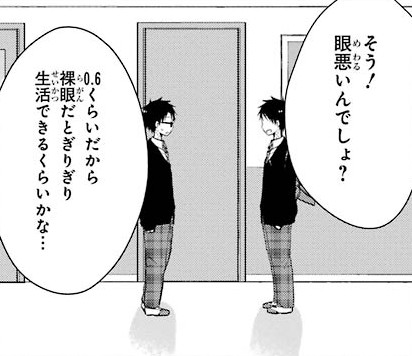
Shun asks Ayumu to continue switching places with him, since pretending to be Ayumu helps him be more open. Ayumu is game, but this requires Shun to go without his glasses, so Ayumu suggests he get contact lenses. Shun asks, “Contacts?”
- 歩:
- 「そう!眼悪いんでしょ?」
- “That's right! You have bad eyesight, don't you?”
- Literal: “That's right! Your eyes are bad, aren't they?”
- 駿:
- 「0.6くらいだから裸眼だときりぎり生活できるくらいかな…」
- “My vision's about 0.6, so without glasses, I can just barely get by in daily life...”
- Literal: “Since it's about 0.6, if it's with the naked eye, I guess it's to the extent that I can just barely live...”
Key Points
1裸眼 = “with the naked eye”
- In this scene, 裸眼だと means “if I’m using just my natural vision” or more simply “without glasses”.
- The kanji 裸 means “bare”, so 裸眼 literally suggests “bare eyes”, with no visual aid.
2Condition pattern: 裸眼だと
- The と here marks a condition: “if it’s with bare eyes”.
- A fuller English unpacking is: “Since my vision is about 0.6, if I’m not wearing glasses, I can just barely manage daily life.”
30.6くらいだから gives the reason
- くらい means “approximately”, so 0.6くらい is “about 0.6”.
- だから connects that fact to what follows: “since my vision is about 0.6…”
- 0.6 refers to visual acuity. In Japan, 1.0 is normal/good vision; 0.6 is moderately poor, roughly equivalent to about 20/33 in US terms.
4ぎりぎり生活できるくらい
- ぎりぎり means “just barely”.
- 生活できるくらい means “to the extent that I can live/manage”, so together it means he can only barely function in ordinary daily life.
5Soft uncertainty with かな
- The ending かな makes the statement sound reflective and slightly tentative, like “I guess” or “I’d say”.
- That keeps Shun’s line casual and non-assertive rather than sounding like a hard measurement report.
Vocabulary
悪い (Bad)
悪い means bad, wrong, or at fault. In conversation, it can also express an apology.
裸眼 (Unaided vision)
裸眼 means the unaided eye, without glasses or contact lenses.
生活 (Daily life)
生活 means daily life or livelihood. It can refer to everyday routines and circumstances or to the means by which someone supports themselves.
See Also
- Kanji: Seeing and insight with 眼
- Kanji: Living and lively movement with 活
僕が僕であるために。 © its respective creators. It is used here for educational commentary.