Safer when lit up with 安全
Kanji Explanation: Peace and ease with 安
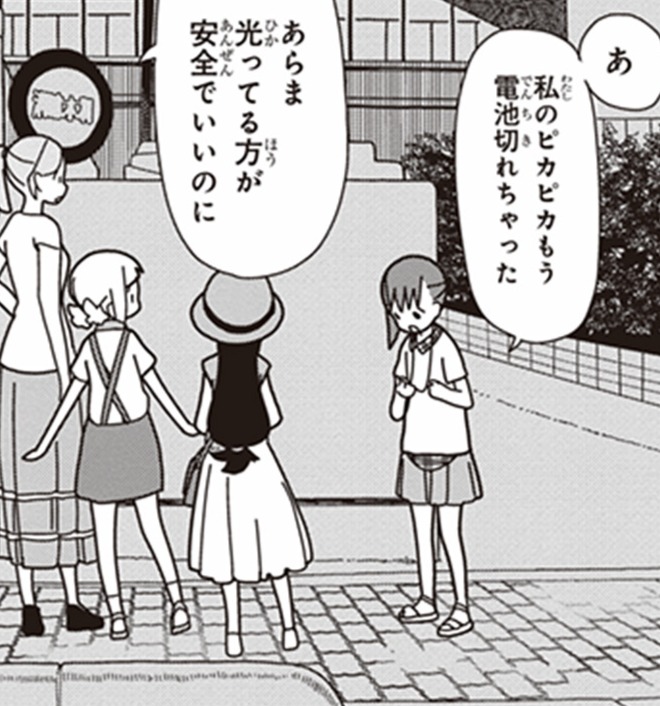
At a nighttime festival, Sacchan, Yui, and Kotoha receive glowing star necklaces to wear. After some time, Sacchan’s mother arrives to pick them up.
- 結衣:
- 「あ 私のピカピカもう電池切れちゃった」
- “Ah, my sparkler's battery has already run out.”
- Literal: “Ah, my shiny thing's battery has already run out.”
- 母さん:
- 「あらま 光ってる方が安全でいいのに」
- “Oh dear, it's safer and better when it's lit up.”
- Literal: “Oh dear, the glowing one would be safe and good, though.”
Key Points
1安全 = “safe” in a practical nighttime sense
- Here, 安全 means being safer because the girls are easier to see in the dark.
2光ってる = casual spoken form of 光っている
- 光ってる is a common contraction of 光っている, meaning “is glowing”.
- Recognizing this contraction helps you parse the line quickly in natural dialogue.
3光ってる方が = “the glowing state is the better option”
- 方 is used when comparing alternatives, so 光ってる方が means “the lit-up one” or “when it’s lit up”.
- The unstated comparison is with not glowing anymore, since Yui just said the battery ran out.
4安全でいい = “safer and better”
- The sentence links 安全 and いい to say that the glowing state is both safer and preferable.
5Sentence-ending のに adds a mild “that’s a shame” feeling
- Here, のに does not start a full contradiction; it works like a soft lament that it would have been better if it were still glowing.
Vocabulary
私 (I)
私 means “I” or “me”. It is the standard first-person pronoun in polite speech and is also common in casual speech among women.
安全 (Safety)
安全 means safety or freedom from danger, harm, or loss.
See Also
- Kanji: Peace and ease with 安
- Grammar: Ongoing actions and resulting states with 〜ている
- Future entry: Even though with 〜のに
- Grammar: Doing completely or ending up doing with 〜てしまう and 〜ちゃう
- Future entry: Past tense with 〜た・〜だ
- Grammar: Marking the topic with は and も
- Kanji: Privacy and self with 私
- Kanji: Wholeness and completion with 全
三ツ星カラーズ © its respective creators. It is used here for educational commentary.