Corresponding letters of the alphabet with 相当
Kanji Explanation: Mutuality and appearance with 相
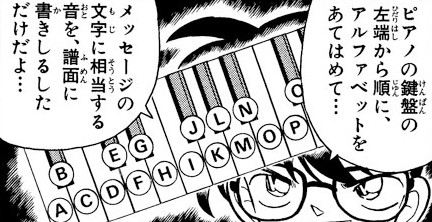
Following a series of murders, Conan discovers a message hidden in sheet music. He explains it to Ran.
- コナン:
- 「ピアノの鍵盤の左端から順に、アルファベットをあてはめて…」
- “Starting from the leftmost key on the piano keyboard, I assigned each key a letter...”
- Literal: “Starting in order from the left edge of the piano keyboard, I applied the alphabet...”
- 「メッセージの文字に相当する音を、譜面に書きしるしただけだよ…」
- “I simply wrote down the notes corresponding to the letters of the message on the sheet music...”
- Literal: “I only wrote down on the score the sounds that correspond to the letters of the message...”
Key Points
1相当する = to correspond to
- Here 相当する means “to match up with” or “to correspond to”.
- Conan is pairing each letter with its matching piano note.
2に相当する links one item to its counterpart
- 「メッセージの文字に 相当する 音」 means “the notes corresponding to the letters of the message”.
- The に marks what those notes correspond to.
3だけだよ downplays the cleverness
- Conan frames the method as simple with 〜だけだよ.
- It gives the sense of “that’s all I did”, even though the decoding was actually quite smart.
Vocabulary
鍵盤 (Keyboard)
鍵盤 means the keyboard of a piano or similar instrument.
左端 (Left edge)
左端 means the left edge or end. For visible objects such as a page or keyboard, the everyday reading is often 左端.
文字 (Letters)
文字 means a letter, character, or piece of written text.
相当 (Corresponding)
相当 means suitable or equivalent to a standard. As an adverb, it means considerably or quite.
譜面 (Score)
譜面 means sheet music or a score written in musical notation.
See Also
- Kanji: Mutuality and appearance with 相
- Future entry: Past tense with 〜た・〜だ
- Kanji: Faces and surfaces with 面
名探偵コナン © its respective creators. It is used here for educational commentary.