To end up cleaning for you with 〜ことになる
Grammar Explanation: To end up being with 〜ことになる
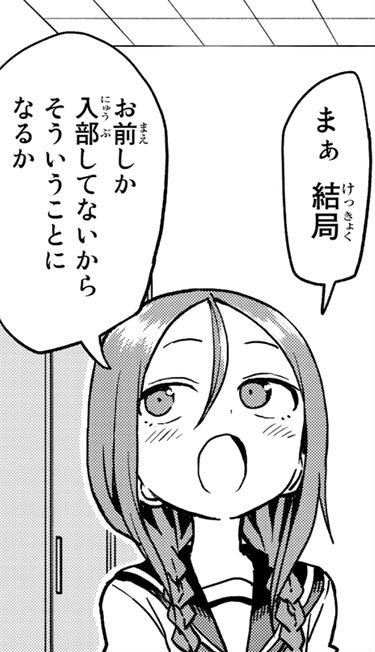
Urushi and Ayumu give their makeshift clubroom a cleaning to welcome potential new members. Considering that Urushi was the only club member before he joined, Ayumu remarks how she alone had cleaned the room for his sake last year.
- うるし:
- 「まぁ 結局」
- “Well, in the end...”
- 「お前しか入部してないからそういうことになるか」
- “You were the only new member, so it ended up as you say, huh?”
- Literal: “Since only you joined, it becomes that kind of thing, huh?”
Key Points
1そういうことになる means it ends up that way
- 〜ことになる describes a result or arrangement that follows from the situation.
- Here Urushi realizes Ayumu’s description is effectively true because he was the only new member.
2そういう points back to Ayumu’s interpretation
- そういう means “that kind of” or “like that”, referring to what was just said.
- The phrase avoids repeating the whole idea that Urushi cleaned the room for Ayumu.
3お前しか入部してないから gives the cause
- しか with a negative verb means “only”.
- Because only Ayumu joined, Urushi accepts that the cleaning can be framed as having been for him.
4か marks reluctant realization
- The ending か is not asking someone else for information here.
- It sounds like Urushi arriving at the conclusion herself.
Vocabulary
結局 (In the end)
結局 means “in the end”, “after all”, or “ultimately”, once everything has played out.
入部 (Joining a club)
入部 means joining a school club or sports team.
See Also
- Grammar: To end up being with 〜ことになる
- Kanji: Binding and results with 結
- Kanji: Entering and putting in with 入
- Kanji: Sections and departments with 部
それでも歩は寄せてくる © its respective creators. It is used here for educational commentary.