Worth the effort to build a garden with 〜甲斐がある
Grammar Explanation: Worth it with 〜甲斐がある
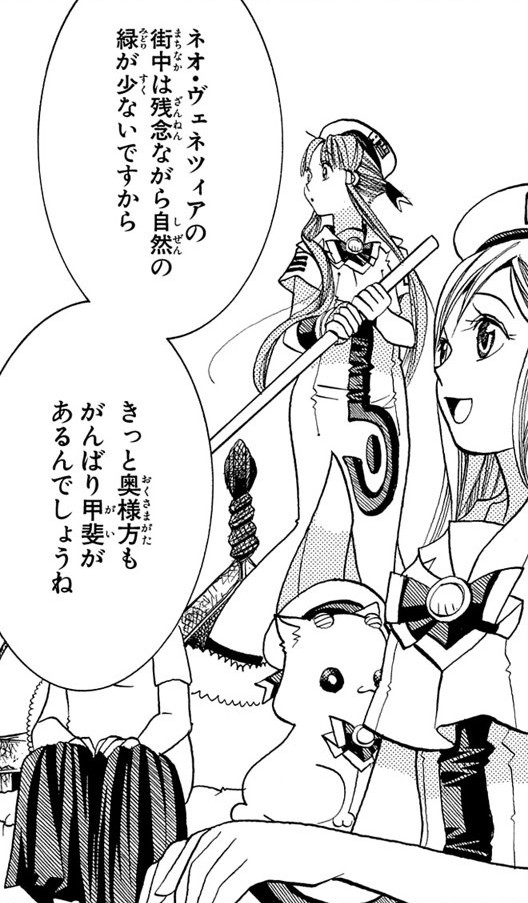
A customer asks Akari to stop the gondola as she sees a house with a fantastic flower garden. The customer asks if it’s a special place, to which Alicia explains it’s an ordinary house. She says the flower bed and gardening are a barometer to measure the caliber of the woman of the household.
- アリシア:
- 「ネオ・ヴェネツィアの街中は残念ながら自然の緑が少ないですから」
- “Since there's regrettably little natural greenery in the city of Neo-Venezia...”
- 「きっと奥様方もがんばり甲斐があるんでしょうね」
- “...surely the housewives also find it worth the effort.”
- Literal: “Surely the ladies also have worth in working hard.”
Key Points
- Here, がんばり甲斐がある means the housewives can feel their hard work is rewarded by the beautiful result.
- Alicia is not saying effort is good in the abstract; she means gardening here has a visible payoff because the flowers stand out in a city with little greenery.
- んでしょう shows Alicia is making a gentle inference, not stating a hard fact.
- ね invites shared agreement with the listener: “I imagine that must be true, don’t you think?”
- Together, があるんでしょうね gives the line a warm, reflective tone that fits Alicia’s polite speech.
Vocabulary
街中 (In town)
街中 means in town, downtown, or the built-up part of a city. The reading まちじゅう means throughout the whole town.
自然 (Nature)
自然 means nature, naturalness, or something that happens without human intervention.
奥様 (Madam)
奥様 is a respectful term for another person’s wife, a female head of household, or a proprietress. The more casual form is 奥さん; neither form normally refers to one’s own wife.
See Also
- Grammar: Worth it with 〜甲斐がある
- Grammar: Marking the subject with が
- Grammar: Marking the topic with は and も
- Kanji: Forms and appearances with 様