The kanji 後 locates something after a reference point in time or behind it in space. It also expresses falling behind.
Etymology
Etymology Research
Kanjipedia’s account, credited to Kadokawa’s Shinjigen, classifies 後 as a semantic compound. It analyzes 彳 with a foot component written 夂 and 幺 understood as binding. Bound feet cannot advance, giving “fall behind”, then “after” and “behind”. The existing explanation accurately reflects this source’s main account, though “binding” explains 幺’s proposed role more precisely than the bare label “thread”. Kanjipedia, 後
CUHK identifies an early oracle-bone form with 幺 and a foot-shaped 夂, followed by the addition of 彳 to mark walking. It attributes the tied-foot interpretation to Lin Yiguang, while noting that Liu Zhao and He Linyi instead treat 幺 as phonetic. Bronze and Warring States forms sometimes use 辵 in place of 彳. These alternatives prevent a firm claim that every component was purely semantic. CUHK, Multi-function Chinese Character Database, 後
CUHK separates several attested uses. Oracle-bone text 屯南 2358 uses 後 for temporal order. The bronze 杕氏壺 uses it for lagging behind; 小臣單觶 uses it for temporal succession. Bronze inscriptions also use 後人 and 後嗣 for descendants, with 後 alone sometimes carrying that sense. These attestations establish early meanings, without proving one uninterrupted path of development. CUHK, 後
Heibonsha’s Jitsu offers another interpretation. It writes the foot component as 夊 and cites Shuowen’s gloss “slow”. It reports Duan Yucai’s explanation through small feet and childhood, then proposes that bronze variants concern a ritual, possibly a prayer for an enemy to retreat. Jitsu presents that ritual account tentatively. It should remain attributed rather than merged into the tied-foot explanation. Heibonsha, Jitsu, 後
The unresolved issue is the original role of 幺 and the precise scene, if any, represented by the earliest graph. The sources consulted do not settle it. A proposed phonetic role for 幺 does not supply a rule for choosing modern Japanese ゴ or コウ. The character’s Chinese formation also does not establish the origins of the native Japanese words あと, のち, うしろ, or おくれる.
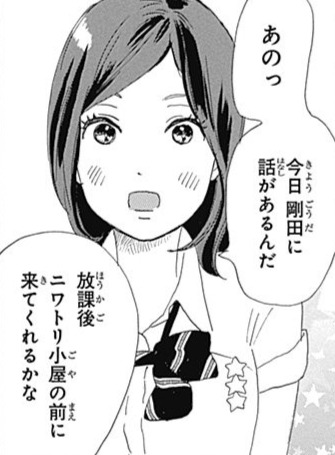
After Takeo (Gouda) has helped her out multiple times, Saijou considers confessing her feelings to him. She waits for him near the shoe lockers before class.
西城:
「あのっ 今日剛田に話があるんだ」
“Um... I need to talk to you today.”
「放課後ニワトリ小屋の前に来てくれるかな」
“Could you come to the chicken coop after school?”
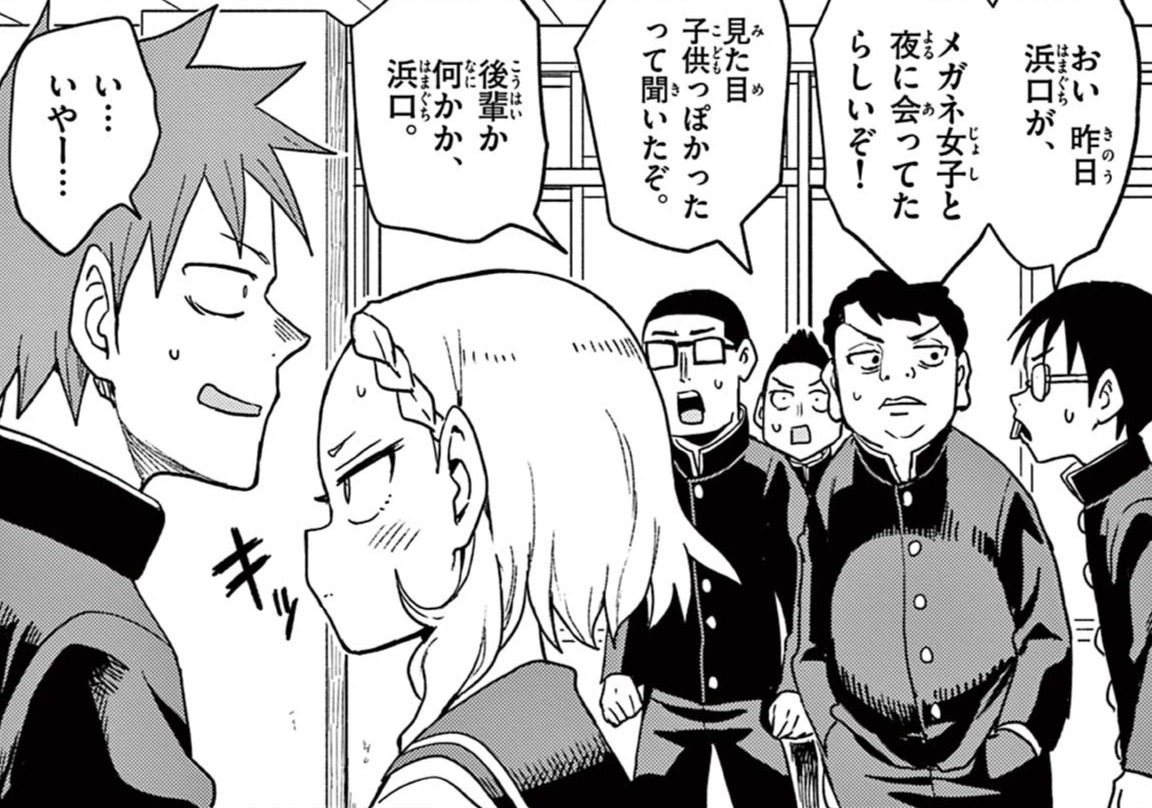
On a nighttime walk, Hamaguchi sees Hokujou casually dressed and wearing glasses. She’s fine with Hamaguchi seeing her like this, as they’ve known each other for a long time, but she tells him not to tell their classmates. At school the next morning…
高尾:
「おい 昨日浜口が、メガネ女子と夜に会ってたらしいぞ!」
“Hey, I heard Hamaguchi was hanging out with a girl in glasses last night!”