Patterns and writing with

The kanji 文 has several connected senses: decorative patterning, characters and words, composed text, books and records, learning and the arts, and historical units of money or footwear size.

Etymology

Etymology Research

Oracle-bone and bronze forms show an upright human figure with a chest motif. CUHK records heart-shaped, crossed, and dotted markings. Some early forms omit the internal mark; Warring States bamboo forms and small-seal forms continue that simpler outline. These variants give better evidence for the older shape than a breakdown of the modern strokes. CUHK, 文

Kanjipedia classifies 文 as a pictogram. Under this account, the figure and marking belong to one image; the character has no separately identified phonetic component. Kanjipedia, 文

CUHK treats tattooing as the original meaning. Its cited oracle-bone inscriptions use 文 in personal names, place names, and the royal designation 文武丁. Bronze inscriptions also use it to praise ancestors and in the name of King Wen of Zhou. These attested uses already extend beyond literal body marking. CUHK, 文

Xu Shen’s Shuowen describes intersecting markings. CUHK proposes an extension through signs to writing and cites a Warring States bamboo text using 文 for composed text. This account connects the senses without dating every step. CUHK, 文

Japanese ふみ denotes written works or letters. The character’s Chinese formation explains the written symbol; it does not establish the origin of that Japanese word. Shogakukan’s Seisenban Nihon Kokugo Daijiten, 文

Characters

(Letters)

文字(もじ) means a letter, character, or piece of written text.

It combines 文 (writing / pattern) with 字 (character) to show written characters.

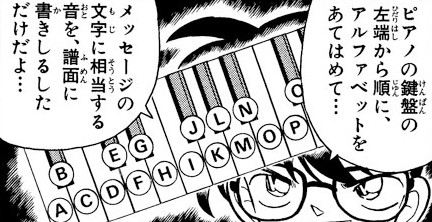
Manga panel from 名探偵コナン showing example of Corresponding letters of the alphabet with 相当.
名探偵コナン » Volume 7 » Page 80

Following a series of murders, Conan discovers a message hidden in sheet music. He explains it to Ran.

コナン:
「ピアノの鍵盤(けんばん)の左端(ひだりはし)から順(じゅん)に、アルファベットをあてはめて…」
“Starting from the leftmost key on the piano keyboard, I assigned each key a letter...”
「メッセージの文字(もじ)に相当(そうとう)する音(おと)を、譜面(ふめん)に書(か)きしるしただけだよ…」
“I simply wrote down the notes corresponding to the letters of the message on the sheet music...”
View Full Example

Texts and Letters

(Classical Japanese)

古文(こぶん) means classical Japanese writing or literature, especially works from the Edo period or earlier. In school, it also names the study of such texts.

It combines 古 (old) with 文 (writing) to show old writing or a classical text.

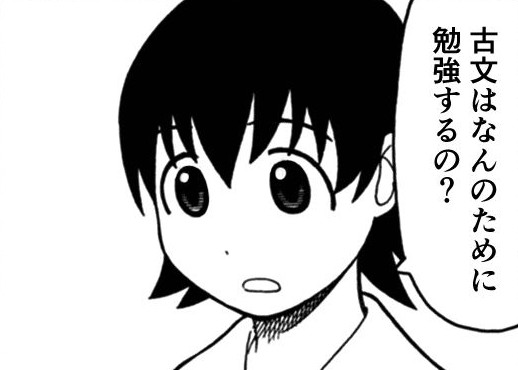
Manga panel from あずまんが大王 showing example of Studying classical Japanese with 古文.
あずまんが大王 » Volume 1年生 » Page 34

Following the a midterm exam, Yomi asks Tomo how it went.

とも:
「古文(こぶん)はなんのために勉強(べんきょう)するの?」
“What's the point of studying classical Japanese?”
View Full Example

Culture and Learning

(Observatory)

天文台(てんもんだい) is a facility where celestial bodies (such as stars, the moon, and galaxies) and cosmic phenomena are observed and studied using instruments such as telescopes.

It combines 天文 (astronomy) with 台 (platform, stand) to show a platform for observing the heavens.
Manga panel from 怪盗セイント・テール showing example of Seeing a comet with the naked eye with 肉眼.
怪盗セイント・テール » Volume 4 » Page 6

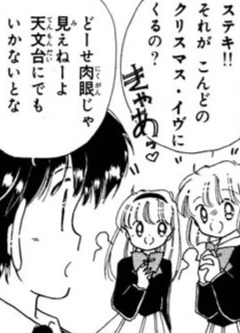
Before class, Asuka Jr. mentions a Graham Comet, which passes near the Earth once every fifty years.

涼子(りょうこ):
「ステキ!! それが こんどのクリスマス・イヴにくるの?」
“Awesome!! Is it coming this Christmas Eve?”
アスカ Jr.:
「どーせ肉眼(にくがん)じゃ見(み)えねーよ。天文台(てんもんだい)にでもいかないとな」
“You won't be able to see it with the naked eye anyway. You'd have to go to an observatory or something.”
View Full Example