Women and femininity with 女
女 represents women, girls, and, more broadly, the “female” aspect of the male-female dichotomy.
Etymology
This kanji is a pictogram of a kneeling woman. The curved form preserves the image of the body in a seated or bent posture.
Women and Femininity
女子 (Girl)女子( じょし ) labels girls or women as a group or category.
It combines 女 (female ) with 子 (child ) to show a female child .
からかい上手の高木さん »
Volume 17 » Page 84
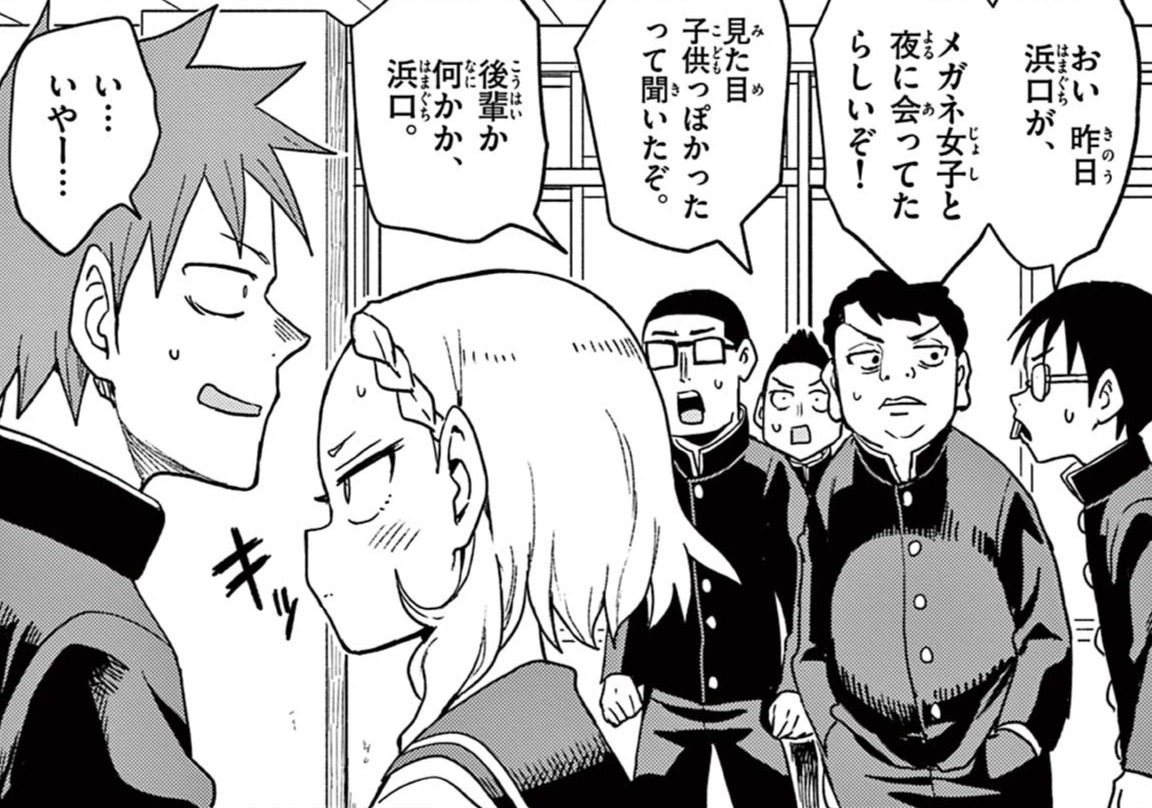
On a nighttime walk, Hamaguchi sees Hokujou casually dressed and wearing glasses. She’s fine with Hamaguchi seeing her like this, as they’ve known each other for a long time, but she tells him not to tell their classmates. At school the next morning…
高尾( たかお ) :「おい 昨日( きのう ) 浜口( はまぐち ) が、メガネ女子( じょし ) 夜( よる ) に会( あ ) ってたらしいぞ!」
“Hey, I heard Hamaguchi was hanging out with a girl in glasses last night!”
生徒( せいと ) A:「見( み ) た目( め ) 子供( こども ) っぽかったって聞( き ) いたぞ。」
“I heard she looked kind of childish.”
生徒( せいと ) B:「後輩( こうはい ) か何( なに ) かか、浜口( はまぐち ) 。」
“Is she a junior or something, Hamaguchi?”
浜口( はまぐち ) :「い… いやー…」
“Uh... well...”
Challenge Yourself
Show translation
Challenge
What does the classmate guess about the girl Hamaguchi met?
Clues
メガネ女子( じょし )
the girl in glasses
後輩( こうはい ) か何( なに ) かa junior or something
〜か、浜口( はまぐち )
asks Hamaguchi to confirm the guess
What does the speaker mean?
She might be Hamaguchi's junior or someone like that.
後輩( こうはい ) か何( なに ) か offers junior as a tentative category for the girl in glasses.
She is definitely Hamaguchi's younger sister.
The guess is 後輩( こうはい ) , not younger sister, and か何( なに ) か keeps it uncertain.
She is a teacher Hamaguchi met at school.
No teacher is mentioned. The proposed category is a junior.
Hamaguchi met several girls wearing glasses.
The rumor concerns one メガネ女子( じょし ) . か何( なに ) か lists possible identity, not additional people.
The girl asked Hamaguchi to become her junior.
The classmate is guessing what relationship she already has to Hamaguchi, not reporting a request.
Hamaguchi says he does not know the girl.
Hamaguchi only hesitates in response. The identity claim comes from his classmate.
The classmate tentatively guesses that the girl in glasses might be Hamaguchi’s junior or someone in a similar relationship.
View Full Example
女性 (Woman)女性( じょせい ) means a woman or adult female.
It combines 女 (woman ) with 性 (sex ) to show the female sex .
名探偵コナン »
Volume 9 » Page 28
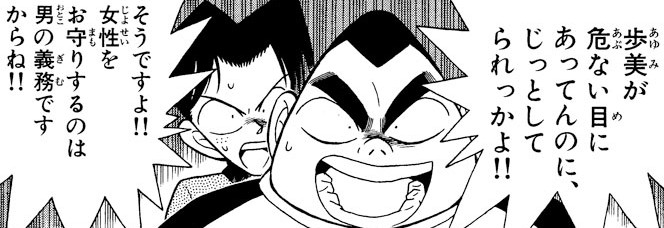
During a hide-and-seek game at the park, Ayumi hides in a car trunk and falls asleep. She wakes to find the car moving and discovers a bag of money, a slimy saw, and what seems like a severed head. Conan, tracking her via their Detective Boys badges, prepares to pursue on his electric skateboard. Genta and Mitsuhiko join him on it, but Conan urges them to stay behind due to the danger.
元太( げんた ) :「歩美( あゆみ ) が危( あぶ ) ない目( め ) にあってんのに、じっとしてられっかよ!!」
“Ayumi is in danger, so how can I just stand by and do nothing?”
光彦( みつひこ ) :「そうですよ!! 女性( じょせい ) 守( まも ) りするのは男( おとこ ) の義務( ぎむ ) ですからね!!」
“That's right! It's a man's duty to protect women!”
Challenge Yourself
Show translation
Challenge
Why does Genta refuse to stay behind?
Clues
歩美( あゆみ ) が危( あぶ ) ない目( め ) にあってんのにeven though Ayumi is going through something dangerous
じっとしてられっかよ
how could I stay still?
What does the speaker mean?
Ayumi is in danger, so he cannot sit still.
The rhetorical じっとしてられっか rejects doing nothing while Ayumi is endangered.
He thinks Ayumi has already returned safely.
危( あぶ ) ない目( め ) にあってんのに presents her danger as ongoing.
He wants to continue the hide-and-seek game.
His concern has shifted from the game to rescuing Ayumi.
He believes Conan's skateboard is too slow.
He does not criticize the skateboard. He insists on joining the pursuit.
He has a duty to guard the park.
Genta's reason is Ayumi's danger, not responsibility for the location.
He wants Conan to wait while he calls the police.
He rejects waiting and wants to take action immediately.
Genta says he cannot remain idle while Ayumi is in danger. 危( あぶ ) ない目( め ) にあう describes undergoing a dangerous experience.
View Full Example
魔女 (Witch)魔女( まじょ ) means a witch, a woman believed to use magic or sorcery.
It combines 魔 (magic ) with 女 (woman ) to show a magical woman .
骨ドラゴンのマナ娘 »
Volume 1 » Page 74
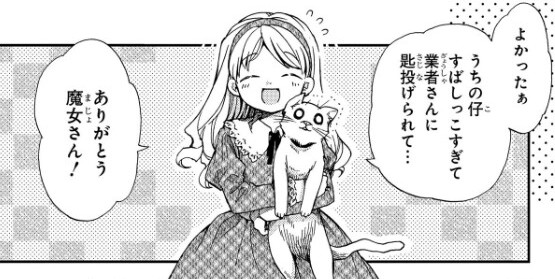
Eve takes the job of catching a cat that ran away from its owner. Following a successful mid-air catch off the roof and into a tree, Eve returns the cat to its owner.
お城( じょう ) ちゃん:
「よかったぁ うちの仔( こ ) すばしっこすぎて業者( ぎょうしゃ ) さんに匙( さじ ) 投( な ) げられて…」
“Thank goodness! Our little one was so quick that the hired help gave up on us...”
「ありがとう 魔女( まじょ )
“Thank you, Miss Mage.”
Challenge Yourself
Show translation
Challenge
Why had the hired cat-catchers given up on the job?
Clues
うちの仔( こ ) すばしっこすぎて
the owner's cat was excessively quick and nimble
業者( ぎょうしゃ ) さんに匙( さじ ) 投( な ) げられてthe hired professionals abandoned the job as hopeless
What does the speaker mean?
The cat was too quick for them to catch.
すばしっこすぎて gives the cat's excessive quickness as the reason the professionals gave up.
The owner refused to tell them where the cat went.
The line blames the cat's speed, not missing information from the owner.
They caught the cat but would not return it.
匙を投げられて means they abandoned the attempt, not that they kept the cat.
They thought the cat had already returned home.
The professionals gave up because it was too nimble to catch, not because they believed the job was finished.
The owner canceled the job before they began.
The owner was left without help after the professionals gave up; she did not cancel their work.
They were frightened because Eve used magick nearby.
The account concerns their failed attempt before Eve returned the cat. Magick is not given as the cause.
The owner says her cat was so nimble that the hired professionals gave up trying to catch it. 匙を投げられて presents the owner as the person left without help when they abandoned the job.
View Full Example
王女 (Princess)王女( おうじょ ) means a princess, especially the daughter of a king.
It combines 王 (king ) with 女 (woman ) to show a female child of a king .
怪盗セイント・テール »
Volume 3 » Page 148
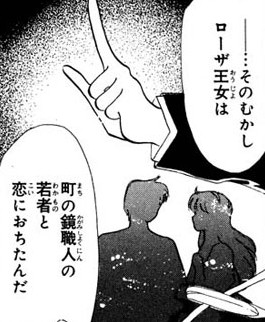
Following the theft of the Mirror of Queen Rosa, Sawatari writes an article for the school paper accusing Saint Tail. As Asuka Jr. demands proof from Sawatari, a notification appears from Saint Tail, announcing her intent to steal the stolen mirror. Later, Asuka Jr. goes to Sawatari to learn about the mirror’s backstory.
佐渡( さわたり ) :「そのむかしローザ王女( おうじょ ) 街( まち ) の鏡( かがみ ) 職人( しょくにん ) の若者( わかもの ) と恋( こい ) におちたんだ」
“Long ago, Princess Rosa fell in love with a young mirror maker from the town.”
Challenge Yourself
Show translation
Challenge
Who does Sawatari say Princess Rosa fell in love with?
Clues
街( まち ) の鏡( かがみ ) 職人( しょくにん ) の若者( わかもの ) a young person from town whose trade was making mirrors
若者( わかもの ) と恋( こい ) におちたshe fell in love with that young man
What does the speaker mean?
A young mirror artisan from the town.
街の鏡職人の若者 describes one person: a young townsman who worked as a skilled mirror maker.
A young prince who gave her the Mirror of Queen Rosa.
The man is identified as a 職人, an artisan, rather than a prince.
A merchant who sold mirrors throughout the kingdom.
鏡職人 describes someone who makes mirrors as a craft, not a merchant who sells them.
An older artisan employed inside the royal palace.
若者 identifies him as young, and 街の places him in the town rather than the palace.
A reporter who later wrote about the stolen mirror.
Sawatari is telling the mirror's old legend. The person Rosa loved was the young artisan in that story.
A thief who stole a mirror to prove his love.
The line says only that he was a mirror artisan from town. It does not call him a thief.
The long noun phrase 街の鏡職人の若者 describes a single young man: a townsman skilled in making mirrors. The particle と connects him to 恋におちた as the person Princess Rosa fell in love with.
View Full Example
女神 (Goddess)女神( めがみ ) means a goddess. Figuratively, it can describe an admired or exceptionally beautiful woman.
It combines 女 (woman ) with 神 (god ) to show a female deity .
Example 1 of 2: Going to school together so as to not get lost with 〜ように Example 1 of 2
ご注文はうさぎですか? »
Volume 1 » Page 32
After Cocoa gets lost looking for her new school, she meets Chiya, who will be going to the same school as her.
千夜( ちや ) :「ココアちゃんが迷( まよ ) わないように今( いま ) から学校( がっこう ) まで行( い ) きましょう」
“Let's go from here to the school now so you won't get lost.”
ココア:
「め 女神様( めがみさま ) !」
“A-a goddess!”
Challenge Yourself
Show translation
Challenge
What does (千夜:ちや) mean in the highlighted line?
Clues
迷( まよ ) わないように(迷:まよ)わないように gives the purpose
What does the speaker mean?
Let's go from here to the school now so you won't get lost.
Chiya proposes walking to the school now so Cocoa will not get lost later.
Chiya proposes the walk because she is the one who gets lost.
The highlighted form is 迷( まよ ) わないように. Here 迷( まよ ) わないように gives the purpose, so this choice does not match the Japanese.
Chiya says they are transferring to the school immediately.
The highlighted form is 迷( まよ ) わないように. Here 迷( まよ ) わないように gives the purpose, so this choice does not match the Japanese.
Chiya asks Cocoa to guide her to the school.
The highlighted form is 迷( まよ ) わないように. Here 迷( まよ ) わないように gives the purpose, so this choice does not match the Japanese.
迷( まよ ) わないように gives the purpose. Chiya proposes walking to the school now so Cocoa will not get lost later.
View Full Example
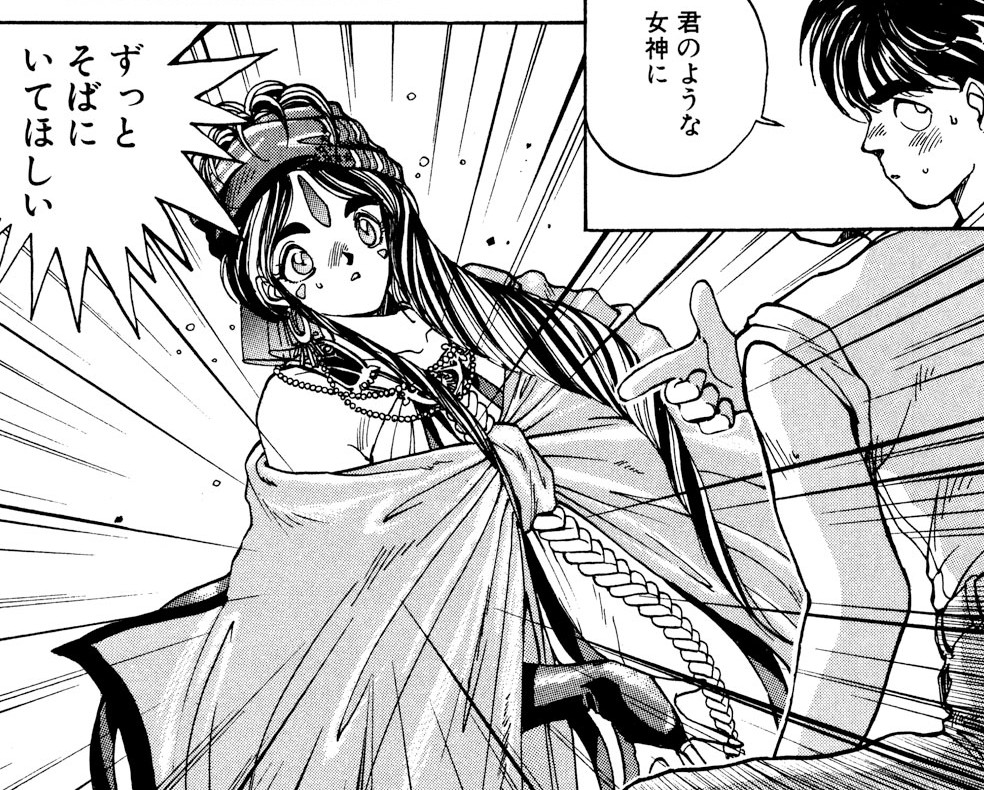
Example 2 of 2: Want you always by my side with 〜てほしい Example 2 of 2
ああっ女神さまっ »
Volume 1 » Page 11
After accidentally dialing the Goddess Technical Help Line, Kei’ichi finds himself face-to-face with a Goddess offering him a wish. After a brief conversation, Kei-ichi flippantly makes a wish.
螢一( けいいち ) :「君( きみ ) のような女神( めがみ )
“I want a Goddess like you to always be by my side.”
Challenge Yourself
Show translation
Challenge
What does Kei'ichi impulsively wish for?
Clues
君( きみ ) のような女神( めがみ ) a goddess like you
〜に
marks the person he wants to act or remain
ずっとそばに
always by his side
いてほしい
want someone to be or stay
What does the speaker mean?
He wants a goddess like her to stay by his side forever.
君( きみ ) のような女神( めがみ ) is the person targeted by いてほしい, and ずっとそばに says where and for how long he wants her to stay.
He asks to remain by the goddess's side until she grants a wish.
The person marked by に is the one Kei'ichi wants to remain. He is asking for the goddess to be by his side, not the reverse.
He wants the goddess to find another woman who resembles her.
君( きみ ) のような modifies 女神( めがみ ) . There is no verb for finding or bringing another person.
He says that the goddess has always been beside him.
いてほしい expresses a wish about what he wants, not a statement about what has already been true.
He asks the goddess to leave him alone after a while.
ずっと means continuously or forever, and そば means nearby. Both point toward her staying, not leaving.
He wishes that he could become a goddess like her.
The line asks a goddess like her to いる, to be present. It does not use なる or any other expression for becoming a goddess.
Kei’ichi makes the goddess the target of いてほしい. He wants a goddess like Belldandy to remain beside him, and ずっと extends that wish indefinitely.
View Full Example