According to Nostradamus with 〜によれば
Grammar Explanation: According to with 〜によると and 〜によれば
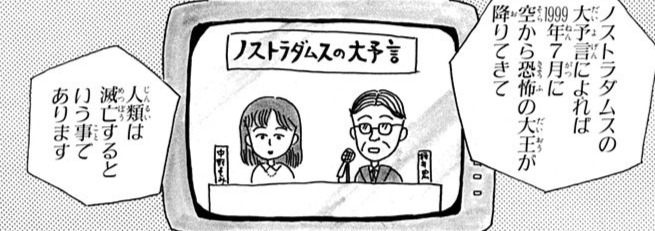
Maruko learns about Nostradamus and his predictions from a classmate. She tells her family about it, leading to them watching a TV show about it that night.
- アナウンサー:
- 「ノストラダムスの大予言によれば1999年7月に空から恐怖の大王が降りてきて」
- “According to Nostradamus's great prophecy, in July 1999 a great king of terror will descend from the sky,”
- 「人類は滅亡するという事であります」
- “and humanity will perish.”
Key Points
- ノストラダムスの大予言 means “Nostradamus’s great prophecy”. によれば introduces what that prophecy says.
- Here によれば means “according to”. The announcer is reporting a prediction from that source.
- 〜という事だ can report information with the sense of “it is said that…”. Here it covers both the king’s descent and humanity’s extinction.
- であります is the polite form of である, a formal equivalent of だ. It gives the line the stiff tone of a broadcast announcement.
- 降りる means “descend”. 降りてくる adds movement toward the speaker’s viewpoint, here down from the sky toward Earth.
- The final て connects this to the next clause, “and humanity will perish”. The sentence continues across the two dialogue balloons.
- 恐怖の大王が identifies who comes down. 人類は then makes humanity the topic of the next clause.
- 滅亡する means “perish” or “become extinct”. Humanity is what perishes.
- に marks the time, “in July 1999”. It tells when the predicted events occur, rather than when Nostradamus made the prophecy.
- 滅亡する is nonpast. Within the prediction, it refers to what will happen.
Vocabulary
予言 (Prophecy)
予言 is the act of predicting events that will occur in the future, or the words used to describe such predictions.
大王 (Great king)
大王 is a title of respect for a great king or monarch, or a term used to refer to the monarch (later known as the Emperor) of the Yamato royal court in ancient Japan.
人類 (Humanity)
人類 refers to the collective group of all humans on Earth, or, biologically speaking, the genus Homo (Homo sapiens) within the order Primates. It represents the entire human species as a single entity, transcending differences in nationality, race, culture, and other factors.
See Also
- Grammar: According to with 〜によると and 〜によれば
- Grammar: Quoting and reporting with と and って
- Grammar: Connecting actions with 〜て・〜で
- Grammar: Marking the topic with は and も
- Kanji: Fear and intimidation with 恐
- Kanji: People and persons with 人